Crochet poncho free pattern: cozy ripple poncho
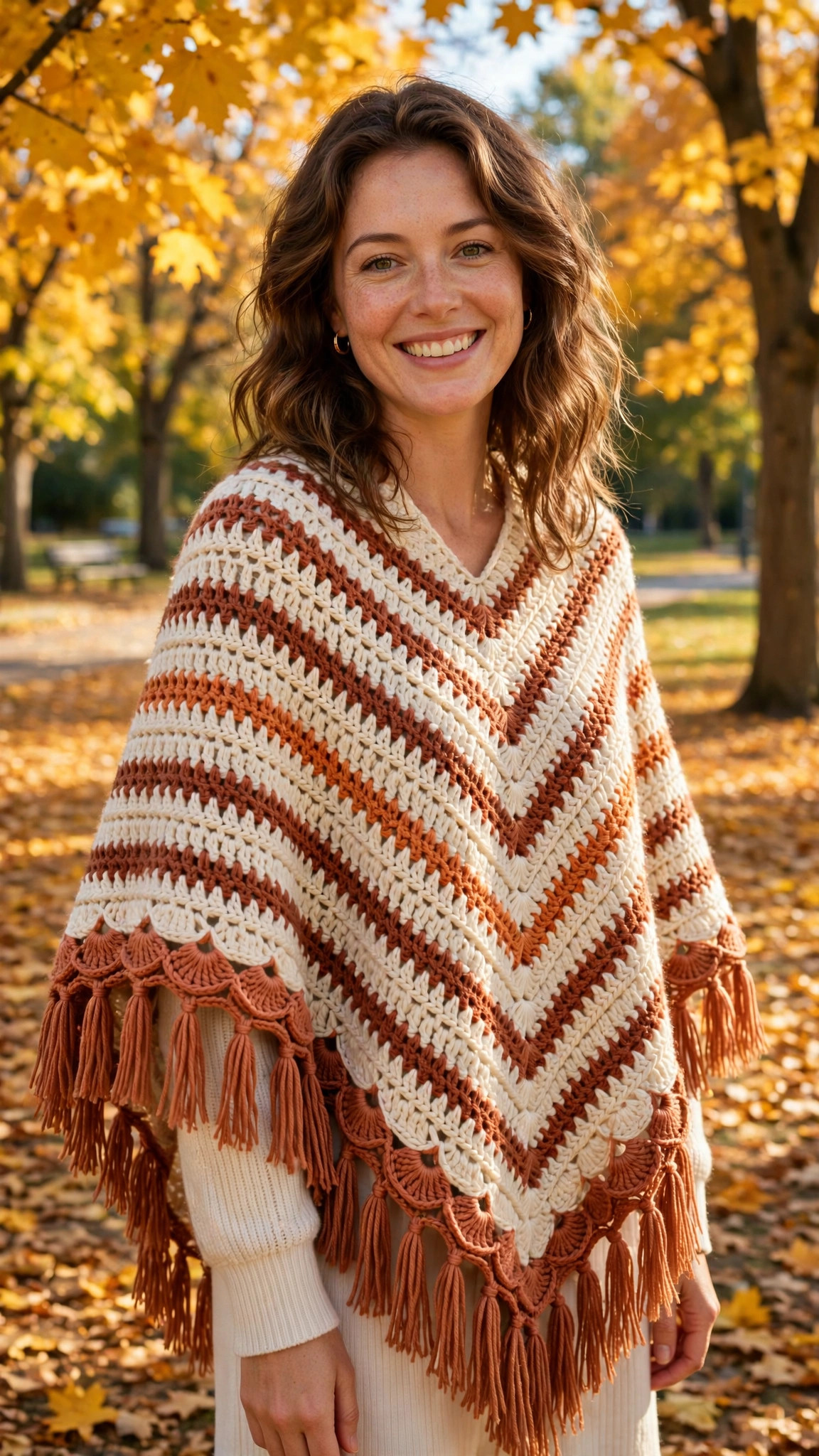
A cozy two-rectangle poncho with V-stitch stripes, a scalloped shell hem and swingy fringe — no shaping, no increases, just two plain rectangles seamed at the shoulders in a relaxing weekend project.

Wearables · Crochet
- Finished size
- 44 in around, 26 in long (S/M)
- Making time
- About 6–8 hours
- Hook
- 5.5 mm, worsted-weight yarn
- Panels
- 2 rectangles, no shaping
- Skill
- Beginner
In this post
If you've been searching for a crochet poncho free pattern that is actually free, actually wearable, and simple enough to finish in a weekend, this cozy ripple poncho is the one. It's made from two plain rectangles, so there is no shaping, no increasing, and no scary math. Just crochet two panels, add a few lacy V-stitch stripes, seam the shoulders, and finish with a shell hem and fringe. Throw it over jeans and a tee and you look like you spent a fortune at a boutique.
Why you'll love this free crochet poncho pattern
Most poncho patterns fall into two traps: the endless triangle, whose point hangs past your knees, and the fitted poncho that quietly turns into a sweater pattern. This pattern dodges both: two rectangles drape straight, sit evenly, and never need a single increase or decrease.
The stitch pattern does the decorating for you. The body is plain half-double crochet: fast, warm, and forgiving. Every few rows, a V-stitch stripe in a contrast color breaks up the fabric with a lacy ripple effect, so the finished poncho looks far more impressive than the effort. And because the panels are rectangles, the same instructions cover a child's poncho and an adult L/XL.
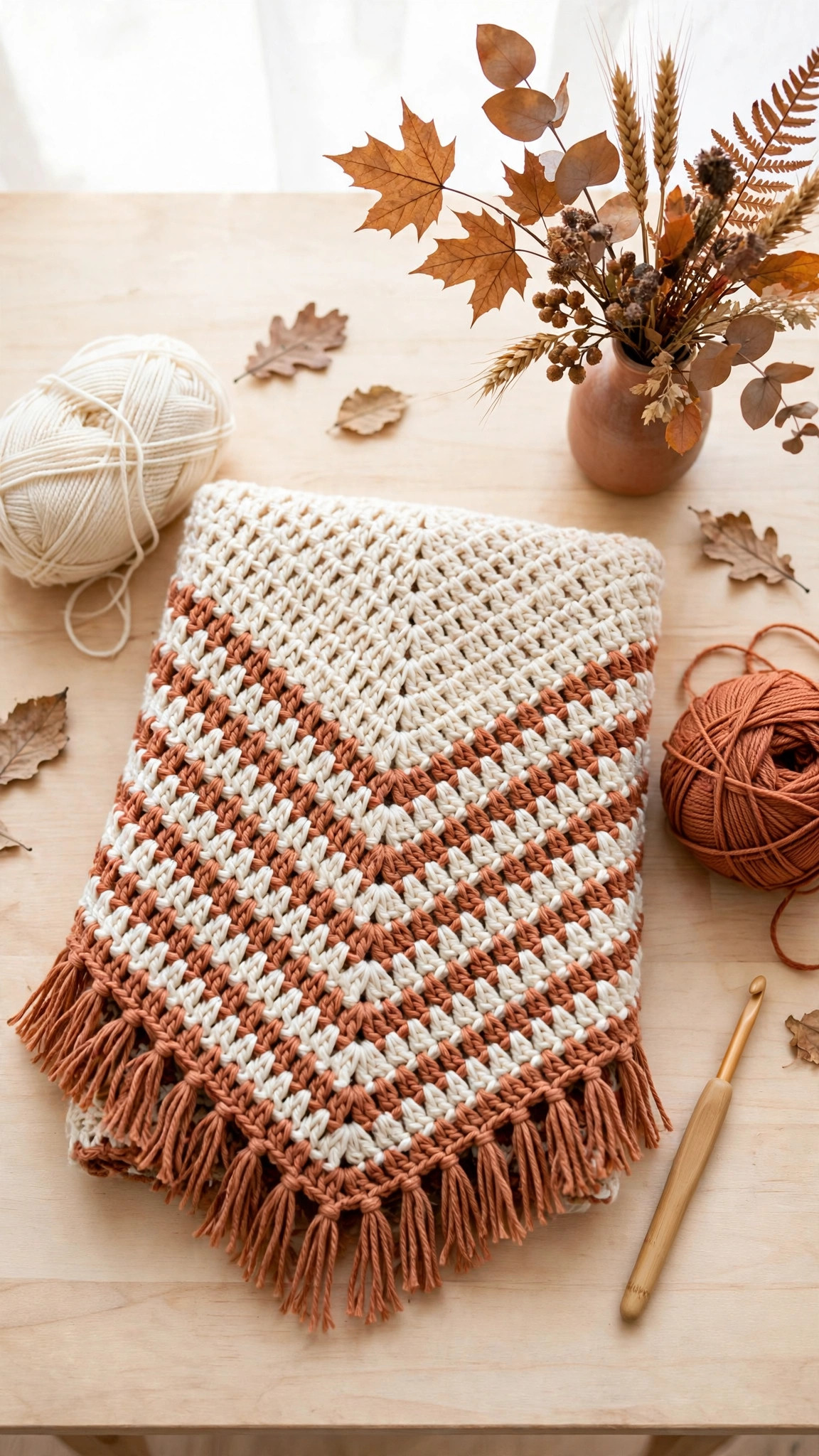
Materials you'll need
| Supply | What to get |
|---|---|
| Main color (A) | Worsted-weight (#4) yarn in cream, about 600 yds / 550 m (3 balls of 200 yds) for S/M |
| Contrast color (B) | Worsted-weight (#4) yarn in terracotta, about 300 yds / 275 m (2 balls of 200 yds) for S/M |
| Crochet hook | 5.5 mm (I-9) |
| Tapestry needle | For seaming and weaving in ends |
| Notions | Stitch markers, scissors, tape measure |
| Optional | A hardcover book for wrapping fringe |
A soft acrylic or acrylic-blend worsted is the best pick here: it drapes well, survives the washing machine, and keeps the fringe from going limp. Cotton makes a beautiful spring poncho, but it is heavier, so the finished piece stretches longer over time.
Yarn amounts by size (approximate): Kids — A: 350 yds (2 balls), B: 200 yds (1 ball). S/M — A: 600 yds (3 balls), B: 300 yds (2 balls). L/XL — A: 700 yds (4 balls), B: 350 yds (2 balls).
Size, gauge and skill level
You make two identical panels, then seam them together. Measurements below are per panel, before seaming.
| Size | Panel width | Panel length | Foundation chain | Rows |
|---|---|---|---|---|
| Kids (4–6 years) | 16 in / 41 cm | 20 in / 51 cm | Ch 50 | 45 |
| Adult S/M | 22 in / 56 cm | 26 in / 66 cm | Ch 68 | 58 |
| Adult L/XL | 26 in / 66 cm | 28 in / 71 cm | Ch 80 | 63 |
- Finished size (S/M): about 44 in (112 cm) around, 26 in (66 cm) shoulder to hem, 10 in (25 cm) neck opening. It fits loose, with 6–8 in of positive ease.
- Gauge: 12 hdc and 9 rows = 4 in (10 cm) with a 5.5 mm hook, unblocked. Crochet a 5 in swatch first: if your panel comes out wider than the table, drop to a 5.0 mm hook; if narrower, go up to a 6.0 mm hook.
- Skill level: confident beginner. You should know how to chain, half-double crochet, double crochet, and slip stitch. The V-stitch is just two double crochets and a chain in one stitch.
If you have never made a garment before, this is the perfect first one: there is no shaping anywhere. If you can crochet a rectangle, you can make this poncho. And if you fall in love with easy layering pieces, our free crochet ruana pattern is the natural next project: a ruana is the poncho's open-front cousin, made the same way.
Abbreviations — US terms
| Abbreviation | Meaning |
|---|---|
| ch | chain |
| hdc | half-double crochet |
| dc | double crochet |
| sc | single crochet |
| sl st | slip stitch |
| st(s) | stitch(es) |
| sp | space |
| V-st | V-stitch: (dc, ch 1, dc) all in the same stitch |
| RS | right side |
| FO | fasten off |
A note on turning chains: the ch 2 at the start of a half-double crochet row does not count as a stitch: work the first hdc into the very first stitch. The ch 3 at the start of a V-stitch row does count as a double crochet.
The pattern (US terms)
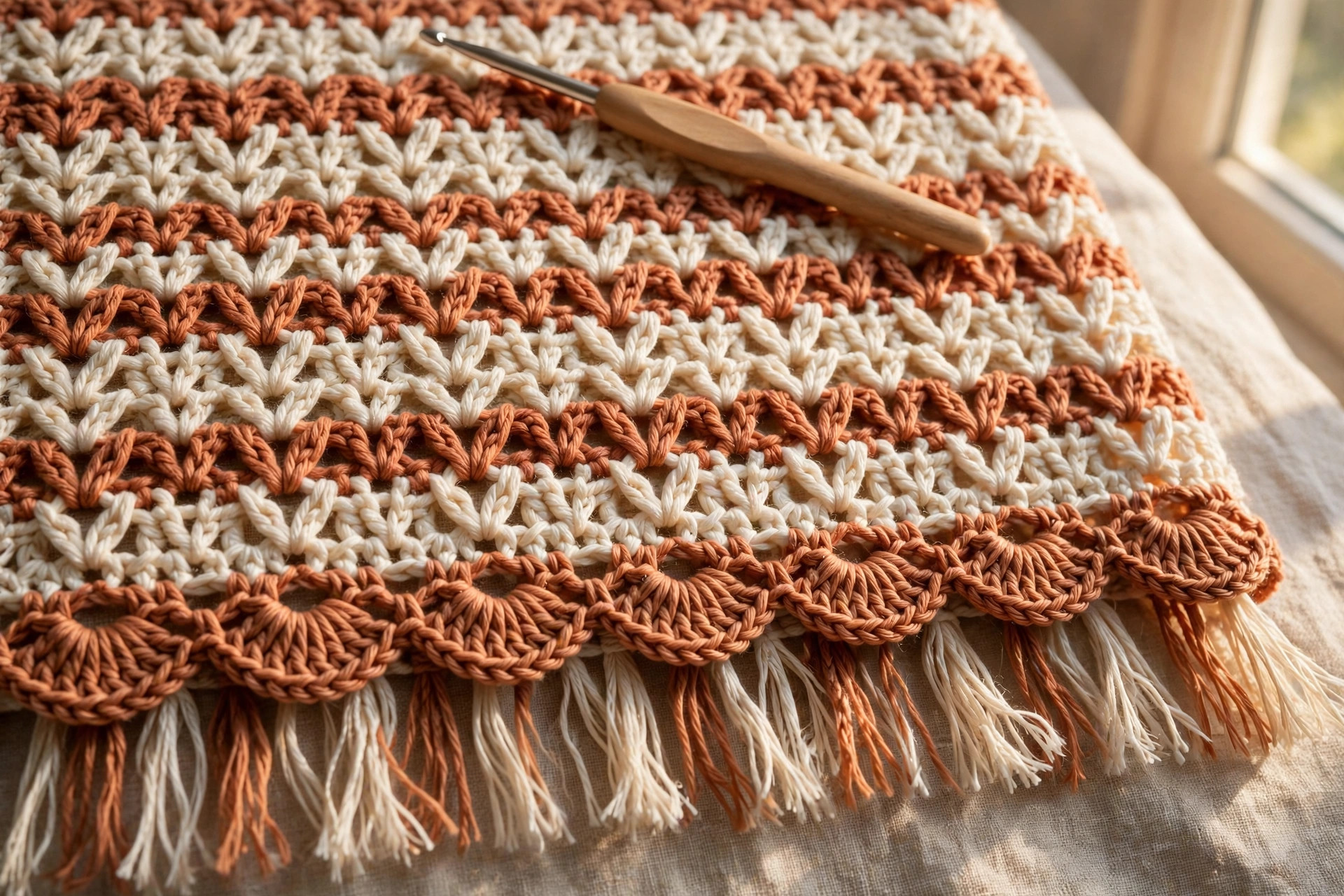
The whole poncho is two identical panels, each following the same rhythm: six rows of plain half-double crochet in the main color, then a two-row V-stitch stripe in the contrast color, repeated until the panel is long enough.
Panels — make 2
With color A and a 5.5 mm hook, chain the foundation chain for your size: Kids ch 50, S/M ch 68, L/XL ch 80.
- Row 1 (RS): hdc in 3rd ch from hook and in each ch across. (Kids 48 hdc, S/M 66 hdc, L/XL 78 hdc)
- Rows 2–6: ch 2 (does not count as a st), turn, hdc in each st across.
- Row 7 (V-stitch stripe, color B): join color B. Ch 3 (counts as dc), skip 1 st, V-st in next st, *skip 2 sts, V-st in next st; rep from * to last 3 sts, skip 1 st, dc in each of last 2 sts. (Kids 15 V-sts, S/M 21 V-sts, L/XL 25 V-sts)
- Row 8 (color B): ch 2 (does not count as a st), turn, hdc in each dc and each ch-1 sp across. (Kids 48 hdc, S/M 66 hdc, L/XL 78 hdc)
Count your stitches after Row 8: you should be back to exactly 48, 66, or 78. The V-stitch row works out perfectly on any stitch count that is a multiple of 3, which is why all three sizes are multiples of 3. If your count is off, count the Vs instead: there should be 15, 21, or 25 of them.
- Rows 9–40: repeat this 8-row sequence four more times: 6 rows of hdc in color A, then Rows 7–8 (V-stitch row + hdc row) in color B. After the fourth repeat you are at Row 40, with 5 V-stitch stripes so far.
Finishing rows by size (all hdc in color A unless noted, then fasten off):
| Size | Rows 41–46 | Rows 47–48 | Rows 49–54 | Rows 55–56 | Rows 57+ |
|---|---|---|---|---|---|
| Kids (45 rows) | hdc, 5 rows (41–45) | — | — | — | — |
| S/M (58 rows) | hdc, 6 rows | Rows 7–8 in B | hdc, 6 rows | Rows 7–8 in B | hdc, 2 rows (57–58) |
| L/XL (63 rows) | hdc, 6 rows | Rows 7–8 in B | hdc, 6 rows | Rows 7–8 in B | hdc, 7 rows (57–63) |
Tip: carry the unused color loosely up the side of the panel instead of cutting it after every stripe. The side edge hides inside the seam, so the carried strands never show.
Shell hem edging
Work this edging in color B along the bottom edge of each panel (the last row you crocheted). The setup row adds one stitch so the shells divide evenly for all three sizes.
- Setup row: with color B, join at the bottom edge. Ch 1, sc in each st across, working 2 sc in the last st. (Kids 49 sc, S/M 67 sc, L/XL 79 sc)
- Shell row: ch 1, turn, sc in first sc, *skip 2 sc, 5 dc in next sc, skip 2 sc, sc in next sc; rep from * across, ending with sc in last sc. (Kids 8 shells, S/M 11 shells, L/XL 13 shells)
Fasten off and weave in the ends. Repeat on the second panel, then lay both panels side by side and check the stripes line up; if one is a row or two longer, block the shorter one gently to match before seaming.
Assembly — the order that actually matters
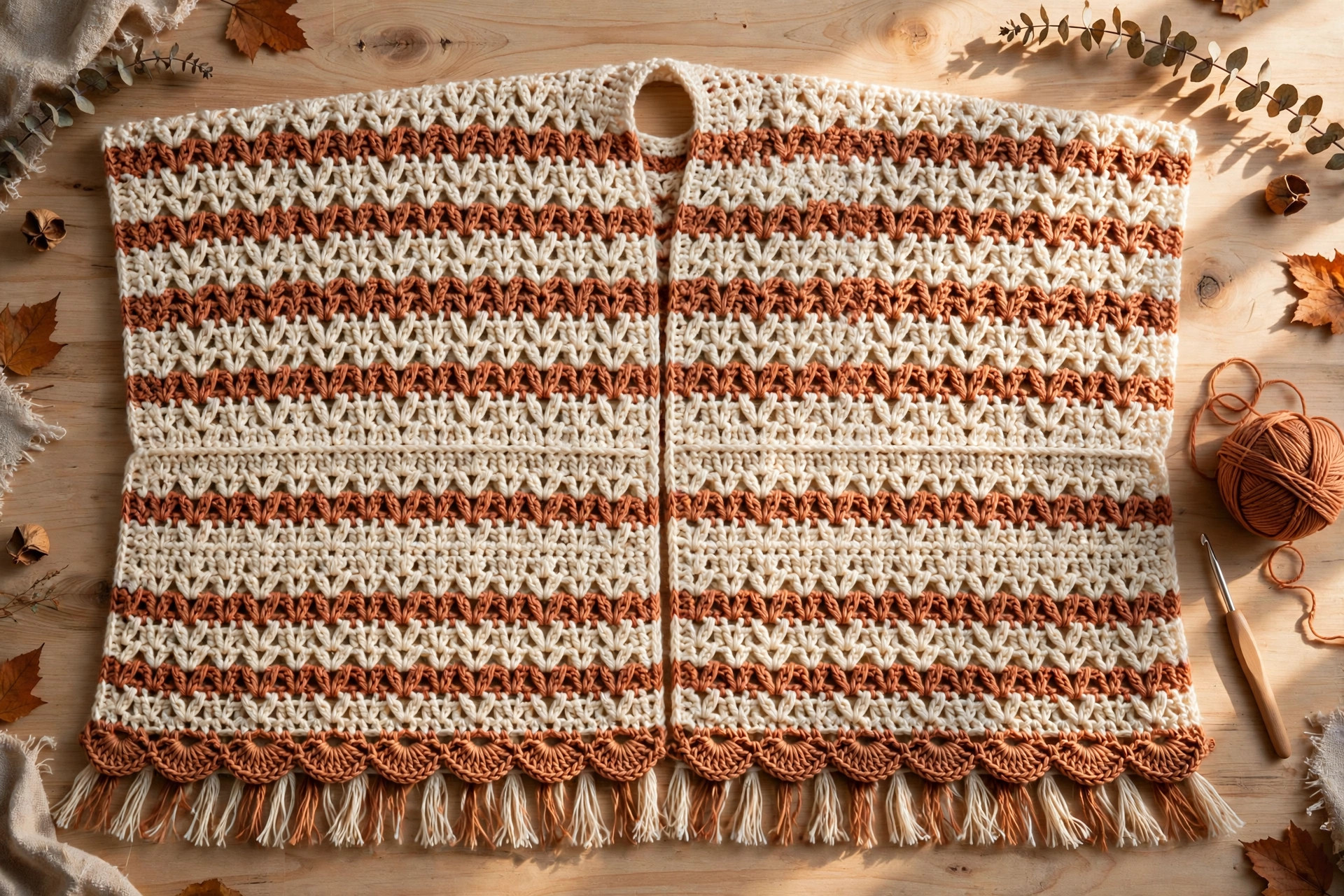
- Lay the panels together. Place the two panels right sides facing, shell hems lined up at the bottom. Pin the top edge (the foundation-chain edge) and both side edges.
- Seam the shoulders. With color A and a tapestry needle, whipstitch the top edges together from each outer corner inward, leaving the center open for the neck. Seam 4 in (12 sts) in from each side for Kids, 6 in (18 sts) for S/M, 7 in (21 sts) for L/XL. The unseamed center is the neck opening: 8 in Kids, 10 in S/M, 12 in L/XL.
- Seam the sides. From the hem, whipstitch up each side edge, stopping before the top. Seam 11 in (25 rows) for Kids, 14 in (32 rows) for S/M, 16 in (36 rows) for L/XL. The unseamed section at the top of each side is the arm opening: about 9 in Kids, 11 in S/M, 12 in L/XL.
- Try it on. Turn the poncho right side out and try it on before weaving in the seam ends. The neck should sit flat without gaping, and your arms should slip through the side openings without pulling. If the neck feels tight, unpick an inch of shoulder seam on each side; if it gapes, take the seam in by an inch.
- Weave in all ends. Work the tails into the wrong side for at least 2 in, changing direction once so they can't wriggle out in the wash.
Neckline
A tidy neckline makes the whole poncho look store-bought. Work it in color B, poncho right side out.
- Round 1: join color B at a shoulder seam. Ch 1, work sc evenly around the neck opening, about 1 sc per stitch or row-end. (About 48 sc Kids, 60 sc S/M, 72 sc L/XL.) Join with a sl st to the first sc.
- Round 2: ch 1, sc in each sc around. Join with a sl st.
- Round 3: ch 1, *sc in next sc, ch 2, skip 1 sc; rep from * around, ending with a sl st in the first sc. This gives the neck a soft picot edge that stops it stretching out of shape.
Fasten off and weave in the ends. If your neck opening ended up a little wide, work Round 1 with a sc2tog decrease every 8th stitch to pull it in gently.
Fringe
Fringe is optional, but it is what makes this poncho look like the one in the photos, and it takes under twenty minutes.
- Cut strands of color B 12 in (30 cm) long: wrap the yarn around a hardcover book about 40 times, then cut along one edge.
- Fold 3 strands in half to make a loop. Push the loop through the center stitch of a shell from the wrong side, pull the loose ends through the loop, and tug snug.
- Attach one bundle in the center of each shell and one in each single crochet between the shells, along both hems: 17 bundles per panel for Kids, 23 for S/M, 27 for L/XL.
- Trim the fringe so all bundles hang to the same length, about 5 in (13 cm) from the hem.
Tip: mix the two colors in the fringe for a tweedy look. If the poncho is for a child, keep the fringe short (about 3 in).
Finishing touches
Take twenty unhurried minutes here: it's the difference between "homemade" and "handmade."
Block it. Lay the poncho flat on a towel, pin it to the finished measurements, and mist it lightly with water. Let it dry completely before you wear it. Blocking evens out the stitches, relaxes the stripes, and makes the shell hem lie flat. Acrylic responds best to gentle steam: hold a steam iron an inch above the fabric (never press it down) and let the heat set the shape.
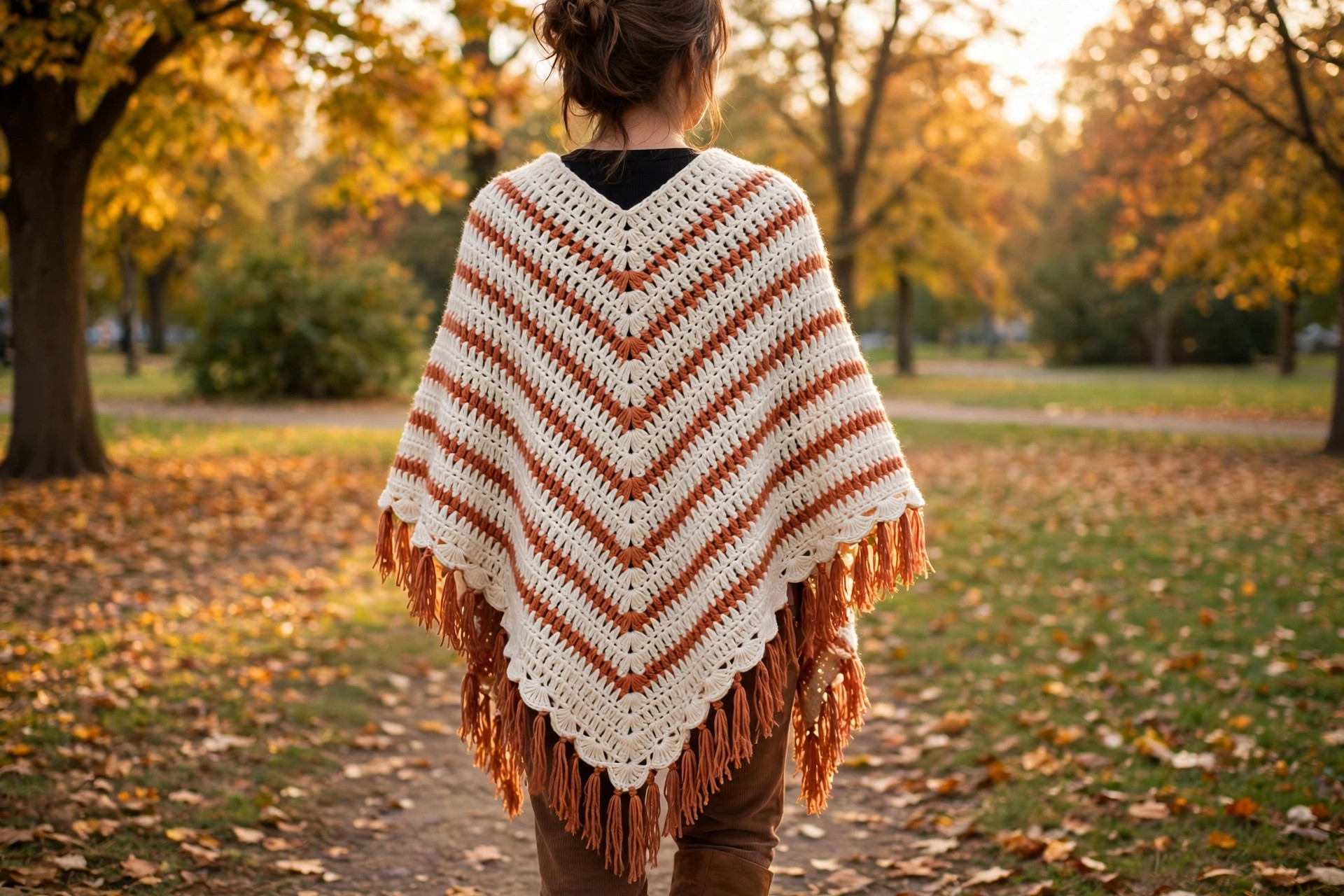
Check the drape. Put the poncho on and look at it from the back in a mirror. The two hems should hang level; if one side is longer, re-block the shorter panel.
Three cute variations to try next
Once you've made one poncho, you'll want to play with the formula. Same two-rectangle construction, three personalities:
- Chunky winter poncho. Switch to bulky (#5) yarn and a 6.5 mm hook, and work the panel in the S/M stitch counts. Your gauge will be looser, so the poncho comes out bigger and cozier, and works up in a single weekend. Pair it with our oversized sweater crochet pattern for the full cozy-season wardrobe.
- Spring cotton poncho. Use DK-weight (#3) cotton with a 4.0 mm hook and work the L/XL stitch counts for an airy layer. Skip the fringe and work two extra shell rows on the hem for a lacy edge. It layers beautifully over our crochet circle vest pattern.
- Festive stripes. Keep the same pattern but change the contrast color every two stripes: terracotta, mustard, sage, rust. A four-color sequence turns the poncho into a statement piece and uses up half balls from your yarn basket. If you like easy color play, the crochet shawl pattern uses the same stripe rhythm in a wrap you can wear three ways.
And if this project gave you the garment bug, the crochet cardigan sweater pattern is the next step up: same half-double crochet comfort, with sleeves and a button band. Or keep it simple with the free crochet shrug pattern, another two-rectangle project.
Troubleshooting tips
- Your panel is a trapezoid, wider at one end. You are adding or dropping stitches at the edges. The ch 2 turning chain does not count as a stitch, so the first hdc goes in the very first stitch and the last hdc in the top of the last stitch below. Count every few rows until the habit sticks.
- The V-stitch row has the wrong number of Vs. Count the stitches in the row below, not the Vs. All three sizes are multiples of 3 (48, 66, 78), so if the count is right, the Vs work out: 15, 21, or 25.
- The shell hem doesn't divide evenly. The setup row adds exactly one stitch (2 sc in the last stitch), giving 49, 67, or 79 sc. If you forgot the extra stitch, just work a sc in the last two stitches instead of one.
- The neck opening gapes. Seam one more inch of shoulder on each side, or work neckline Round 1 with a sc2tog decrease every 6th stitch. A neck opening 1–2 in smaller still fits over the head.
- The side seams pull when you move your arms. Your arm opening is too small. Unpick the side seam by 2 in on each side and re-sew: ponchos are supposed to move freely.
- The fringe looks scraggly. Trim it with sharp scissors while the poncho is hanging, not lying flat: let the bundles hang straight, then trim across in one cut.
Frequently asked questions
Is this crochet poncho pattern really free?
Yes, the complete pattern above is free, no email signup, no PDF purchase required.
What skill level is this poncho pattern?
Confident beginner. If you can chain, half-double crochet, and double crochet, you have every skill this pattern needs. The V-stitch is explained stitch by stitch, and there is no shaping anywhere.
How long does it take to make?
About 6–8 hours for adult S/M: roughly 5 hours crocheting, 30 minutes seaming, and 30–45 minutes for the neckline, shell hem, and fringe. The Kids size takes about 4 hours.
How much yarn do I need?
For adult S/M, about 600 yds of the main color and 300 yds of the contrast color in worsted-weight yarn. Kids needs about 350 yds and 200 yds; L/XL needs about 700 yds and 350 yds.
Can I make the poncho longer or wider?
Easily. For a wider panel, add stitches in multiples of 3 so the stripes and shell hem still divide evenly. For a longer panel, add rows in multiples of 8 (one full stripe repeat). Always make both panels the same.
Can I sell the finished ponchos I make?
Yes! You may sell finished ponchos made from this pattern in small batches (craft fairs, markets, gifts). Please credit Little Loop Finds as the pattern designer with a link back to this page.
More free patterns to try
If this poncho was fun, keep the hook moving. The free crochet ruana pattern is the poncho's open-front cousin, the crochet shawl pattern turns the same stripe rhythm into a wrap you can wear three ways, the hexagon sweater crochet pattern is the next step up in garment making, and the crochet pocket scarf pattern is a quick one-evening project for leftover contrast yarn.