Free crochet shawl pattern: willow lace triangle shawl
An elegant top-down lace triangle shawl in dusty rose with a cream picot edge — worked in one soothing V-stitch repeat with self-checking stitch counts, from a tiny setup row to a 150 cm wingspan wrap.

Wearables · Crochet
- Finished size
- About 150 cm / 59 in wingspan
- Making time
- About 12–18 hours
- Hook
- 5.5 mm, worsted-weight yarn
- Rows
- 34 rows + picot edging
- Skill
- Beginner
In this post
If you've been hunting for a crochet shawl pattern that's actually free, actually elegant, and doesn't require decoding a cryptic chart — the Willow shawl is the one. It's a top-down triangle worked in simple V-stitches (just double crochet and chains), it grows by exactly one stitch-repeat per side every row so you always know where you are, and it finishes with a cream picot edge that looks far fancier than it is. Drape it over your shoulders on a chilly evening and try not to feel like the main character.
Why you'll love this free crochet shawl pattern
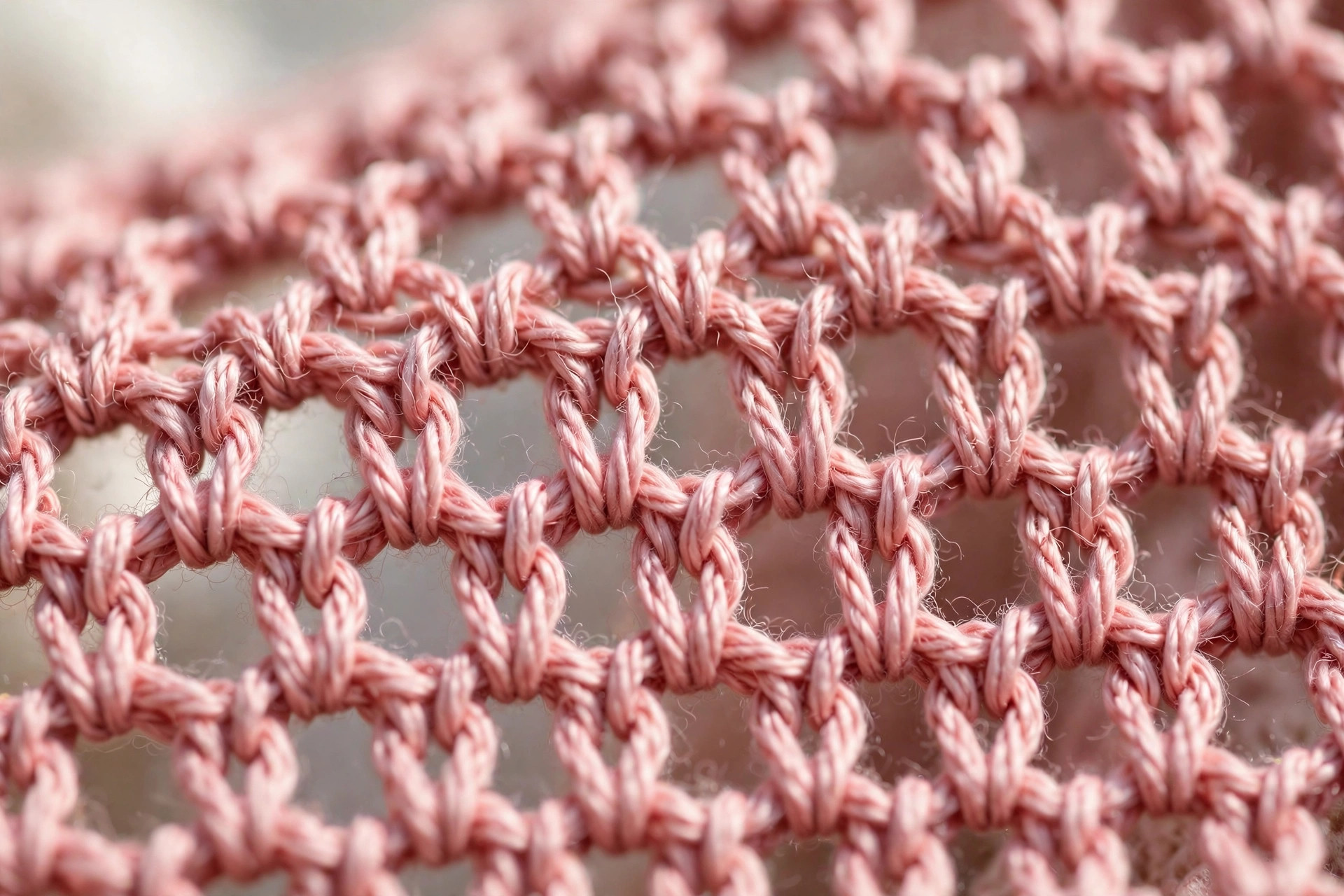
Most free shawl patterns ask you to choose between boring and bewildering: either endless rows of plain double crochet, or a lace chart that looks like an engineering schematic. The Willow was designed to dodge both. The entire body is one two-line repeat — a V-stitch (two double crochets sharing a chain space) worked into every chain space, with increases at the two edges and around a center spine. After three rows your hands know it by heart, and from then on it's pure rhythm.
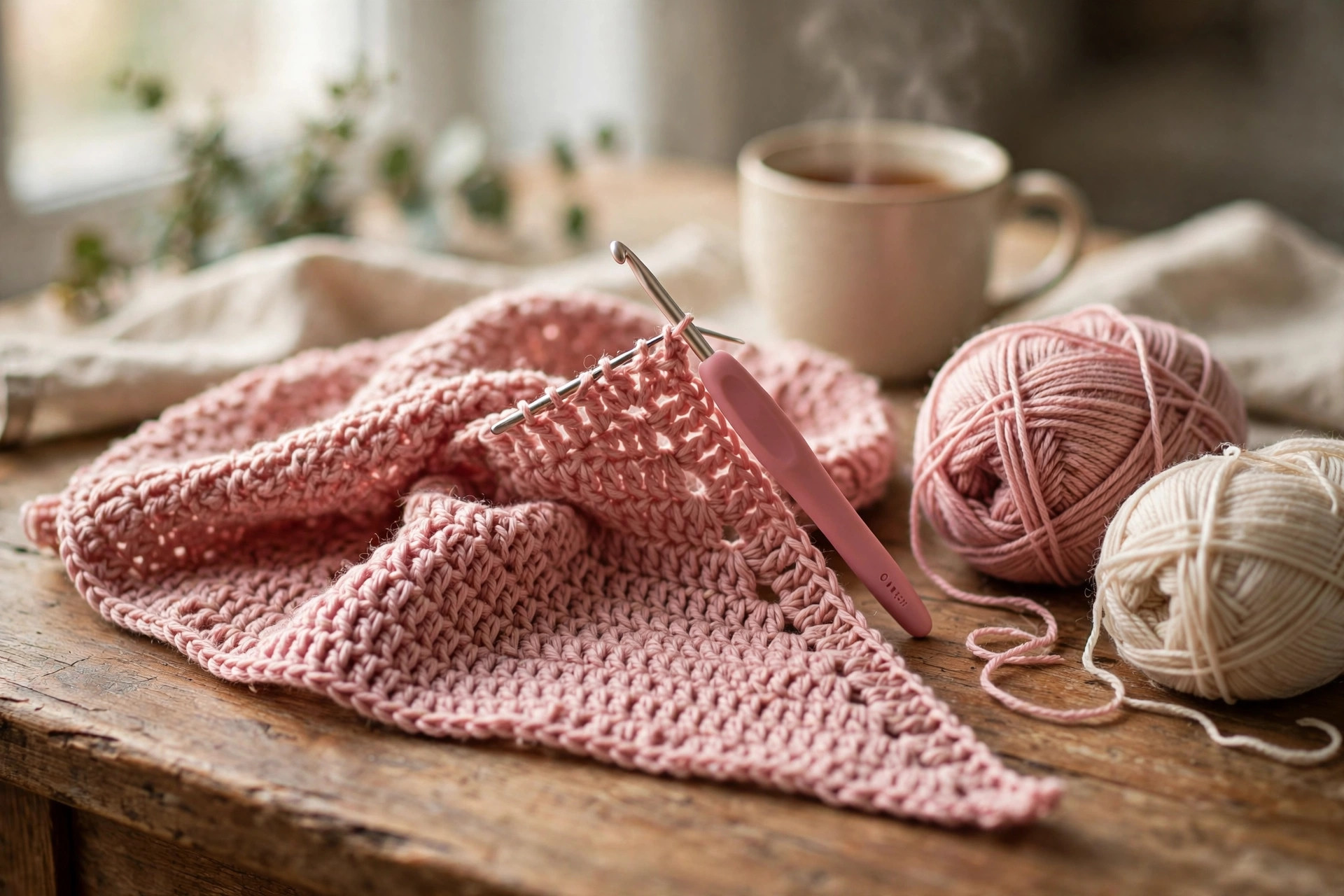
The shaping math is the best part. Because every row adds exactly one V-stitch to each wing, your stitch count is self-checking: on row 12 you should count 12 V-stitches per side, full stop. No "pattern says 143 stitches but I have 141" mysteries at midnight. And because it's top-down, you can try it on (well, drape it) as you go and stop early for a kerchief or keep going for a full wrap — the edging works after any row.
It's also one of the most economical statement pieces you can crochet. Four skeins of worsted-weight yarn — often under $20 total if you shop sales — becomes a shawl that looks boutique-bought. Compare that to the $60–$120 price tag on a similar lace wrap in a store, and this is the rare project that's both cheaper and better-fitting than the alternative, because you made it to your exact taste.
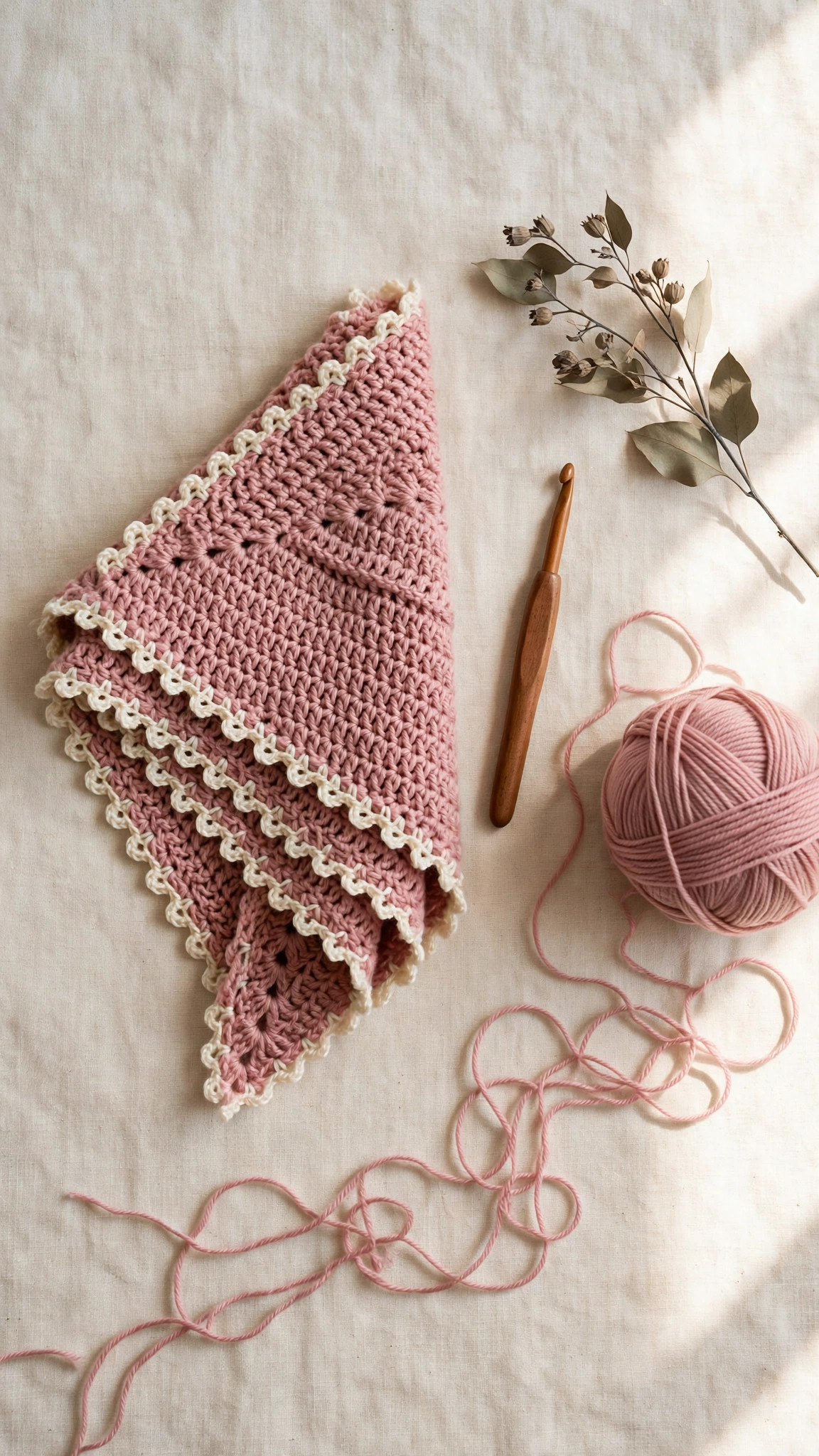
Materials you'll need
| Supply | What to get |
|---|---|
| Main color (dusty rose) | Worsted-weight (#4) acrylic or wool blend, about 750 m / 820 yds — roughly four 200 m skeins |
| Contrast color (cream) | Worsted-weight (#4), about 50 m / 55 yds for the picot edge |
| Crochet hook | 5.5 mm (I-9) |
| Notions | Tapestry needle, 2 stitch markers, scissors |
| For blocking | Blocking mats (or clean towels), rust-proof pins, a spray bottle |
A quick note on yarn: this shawl is very forgiving of fiber choice. Acrylic is the budget-friendly pick and blocks decently with steam; a wool or wool-blend blooms beautifully when wet-blocked and gives you that soft, drapey fabric you see in the photos. What matters most is buying enough from the same dye lot — lace eats less yarn than solid fabric, but running out at row 30 with no matching skein is a special kind of heartbreak. When in doubt, buy the extra skein; it becomes a hat (our free crochet hat pattern is the perfect one-skein companion).
Size, gauge and skill level
- Finished size: about 150 cm (59 in) wingspan × 62 cm (24 in) deep at the center spine, after blocking. Lace relaxes a lot when blocked, so don't panic if it looks small fresh off the hook.
- Gauge: roughly 2 V-stitches = 5 cm (2 in) wide and 2 rows = 4 cm (1.5 in) tall, measured after blocking. Gauge isn't critical — if yours differs, your shawl will simply land a little bigger or smaller. The triangle shaping works at any gauge because the increases are proportional.
- Skill level: adventurous beginner. You need chain, double crochet and slip stitch — that's the entire stitch vocabulary. The only "new" thing is the V-stitch, which is just two double crochets in the same space, and it's explained stitch by stitch below. If you can already work a granny square, you already have every skill this shawl needs — our autumn acorn granny square makes a perfect warm-up motif if you want one.
Abbreviations — US terms
| Abbreviation | Meaning |
|---|---|
| ch | chain |
| dc | double crochet |
| sc | single crochet |
| sl st | slip stitch |
| sp(s) | space(s) |
| st(s) | stitch(es) |
| V-st | V-stitch: (dc, ch 1, dc) in the same stitch or space |
| RS | right side |
Reading the pattern: "V-st in next ch-1 sp" means work one double crochet, chain 1, and one more double crochet all into that chain space. The turning "ch 4" at the start of each body row counts as one double crochet plus one chain — it forms the first V-stitch's other half with the stitches that follow.
The pattern (US terms)
The shawl is worked top-down in rows, starting at the neck with a tiny setup row and growing outward. Four increases happen every row — one at each edge and two flanking the center spine — which is what keeps it a perfect triangle. Place a stitch marker in the center ch-2 space and move it up each row; it's your North Star. Count your V-stitches per wing at the checkpoints below. Thirty seconds of counting now saves thirty minutes of frogging later.
Setup row
Ch 4, then work (dc, ch 1, dc, ch 2, dc, ch 1, dc) into the 4th chain from the hook. Turn.
You now have one V-stitch per wing (2 wings), separated by a ch-2 space at the center. Stitch count: 4 dc + 2 ch-1 sps + 1 ch-2 sp.
Body rows — the only repeat you'll ever need
- Row 2: Ch 4 (counts as dc + ch 1). V-st in the first st. V-st in each ch-1 sp across to the center ch-2 sp. Work (dc, ch 1, dc, ch 2, dc, ch 1, dc) in the center ch-2 sp. V-st in each ch-1 sp across. V-st in the last st. Turn.
- Rows 3–34: Repeat Row 2.
That's the entire body. Each row adds exactly one V-stitch to each wing, so row number = V-stitches per wing. Use the checkpoints:
| Row | V-stitches per wing | Total double crochets |
|---|---|---|
| 1 (setup) | 1 | 4 |
| 10 | 10 | 44 |
| 20 | 20 | 84 |
| 34 | 34 | 140 |
Tip: if your count is off by one on a wing, the culprit is almost always the edge — either a forgotten V-st in the first/last stitch or working into the turning chain instead of the last stitch. Count the ch-1 spaces along one edge: they should equal your row number.
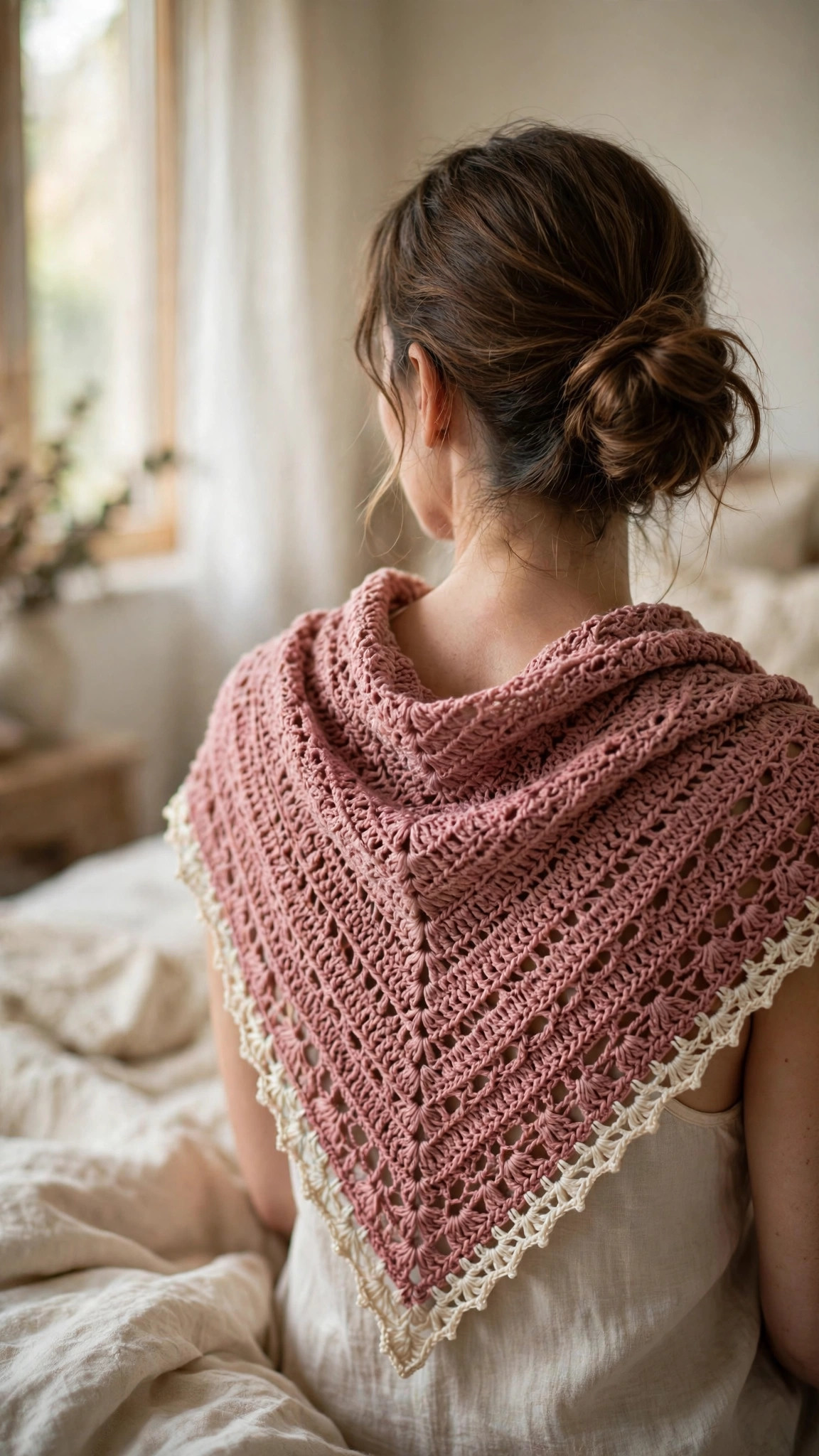
Color note: the photos show the body in dusty rose with a cream edge. Work all 34 body rows in your main color; the contrast color joins only for the edging.
Picot edging (contrast color)
Turn so the right side faces you. Join the contrast color with a sl st in the first dc of Row 34.
Ch 1, sc in the same st. Now work along the wing with this simple rule: sc in each dc, and in each ch-1 sp work (sc, ch 3, sl st in the 3rd ch from the hook) — that little chain loop is the picot. Every stitch has exactly one job, so there's nothing to count: 34 V-stitches per wing gives you 68 sc + 34 picots per wing.
When you reach the center ch-2 sp, work (sc, ch 2, sc) into it — this makes the pretty point at the bottom tip of the triangle. Continue the same rule up the second wing, ending with sc in the last st. Fasten off and weave in all ends.
Want a neater neck edge? (optional): with the main color and RS facing, join at one top corner and work 2 sc in the side of each row (one around the turning chain, one in the edge V-stitch) to the other corner — 68 sc per side. It gives the neck a clean, non-curling finish.
Blocking & finishing
Don't skip blocking — it's what transforms the shawl from "nice" to "wow." Soak the finished shawl in lukewarm water with a drop of wool wash for 15 minutes, gently squeeze (never wring), and roll it in a clean towel to remove excess water. Pin it out on blocking mats: anchor the two top corners first, stretch the neck edge straight, then pull the center point down to its full depth and pin. Ease each picot into shape with your fingers. Leave until completely dry — usually 24 hours. The lace will open up, the triangle will lie perfectly flat, and the drape will soften dramatically.
Three ways to wear your shawl
One shawl, three personalities — this is why triangle shawls earn their drawer space:
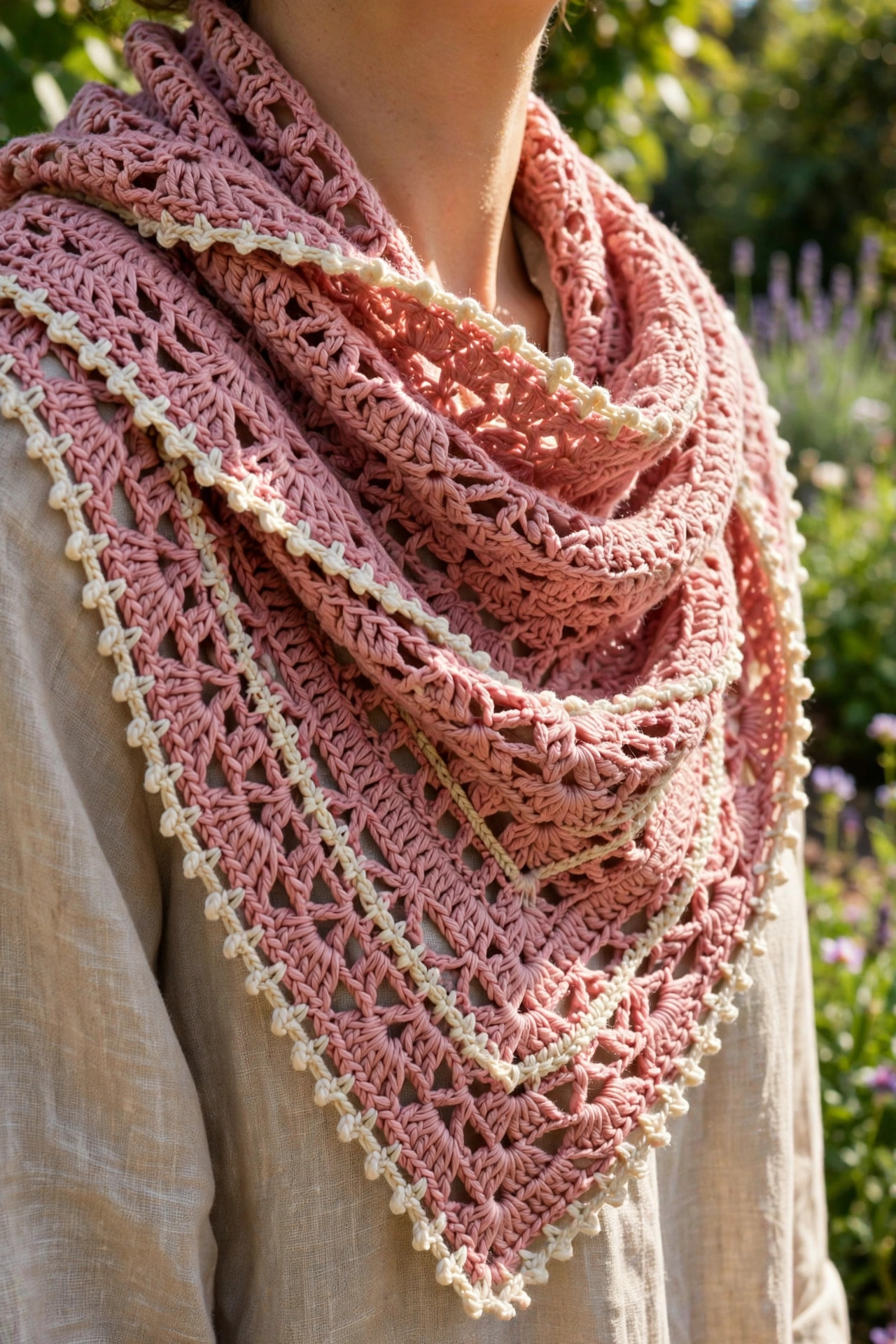
- The classic drape. Point down the back, ends crossed loosely in front. The cream picots peek out along the bottom edge exactly like the hero photo. This is the everyday look — jeans, boots, done.
- The bandana kerchief. Fold the shawl in half (point to neck edge) once, wrap it bandana-style with the point in front, and knot the ends at the nape. Suddenly it's a completely different accessory, and it uses up zero extra yarn.
- The belted wrap. Drape it evenly over your shoulders like a shawl-collar cardigan and cinch with a slim belt at the waist. The lace opens beautifully when it's pulled taut, and it turns the shawl into evening wear.
Colorway ideas: the dusty rose + cream combo photographs like a dream, but this pattern is a chameleon. Try a soft gray body with a blush edge, a deep teal monochrome (skip the contrast and work the edging in the main color), or raid your stash for a striped version — change colors every 6 rows and the V-stitch stripes look intentional and designer. If meditative big-row projects are your happy place, our star blanket scratches the same itch at blanket scale.
Troubleshooting tips
- My triangle isn't lying flat — it's rippling or cupping. You almost certainly missed an increase. Each row needs all four: both edges AND the center spine. Count V-stitches per wing (should equal the row number) and check the marker is still in the center ch-2 sp.
- One wing is longer than the other. A skipped edge V-stitch on one side. Count the ch-1 spaces along each edge — the short side tells you exactly where the repeat broke down. Frog back to that row; with only one repeat to memorize, you'll be back on track in minutes.
- The center spine is drifting sideways. You're working the center stitches into a ch-1 sp instead of the ch-2 sp. The ch-2 space is visibly bigger — keep the marker in it and you'll never lose it.
- It looks tiny / I'm worried about size. Unblocked lace always looks smaller than its destiny. Measure after blocking, not before — the fabric typically grows 15–25% in blocking. If it's still small, just keep going: the edging works after ANY row.
- Big gaps at the turning-chain edge. The ch-4 counts as a dc + ch-1, so treat it gently — don't yank it tight or leave it loose. Consistent, relaxed turning chains give you the straightest edges.
- Running out of yarn. First, don't panic: stop at the end of any complete row, work the picot edging, and you have a finished (slightly smaller) shawl — the pattern is valid at every row. If buying more, match the dye lot; alternating old and new skeins every 2 rows hides any slight color shift.
Frequently asked questions
Is this crochet shawl pattern really free?
Yes — the complete pattern above is free, no email signup, no PDF purchase required. If you'd like to support the site, sharing the post or saving it on Pinterest is the kindest thank-you.
I'm a beginner — can I really crochet a whole shawl?
Honestly, a shawl like this is one of the best second or third projects you can pick. The stitch vocabulary is tiny (chain, double crochet, slip stitch), there's no shaping to memorize beyond "one more V per side each row," and the checkpoints tell you instantly if something's off. Give yourself a week of evenings and you'll surprise yourself.
How much yarn do I need?
About 750 m (820 yds) of worsted-weight yarn for the main color — roughly four 200 m skeins — plus about 50 m (55 yds) of contrast for the edge. Buy all of the main color in one dye lot. If you're substituting DK or chunky yarn, the triangle math still works; your shawl will just come out smaller or larger, so check the finished measurements as you go.
Can I make it bigger or smaller?
Easily — that's the beauty of top-down construction. For a smaller kerchief, stop around row 20 (about 90 cm wingspan). For a dramatic full wrap, keep repeating the body row to row 44+ (buy extra yarn first — each 10 rows adds roughly 200 m). The picot edging works after any row, no math adjustments needed.
Do I really have to block it?
For lace, blocking isn't optional garnish — it's half the project. An unblocked lace shawl looks crumpled and small; blocked, the stitches open, the edges straighten, and the drape goes from stiff to fluid. Even a quick steam-block (hover a steam iron, don't press) makes a visible difference if you're impatient.
Can I sell the finished shawls I make?
Yes! You may sell finished shawls made from this pattern in small batches (craft fairs, Etsy, gifts). Please credit Little Loop Finds as the pattern designer with a link back to this page. The pattern text and photos themselves may not be redistributed, republished, or sold. Shawls also make spectacular gifts — pair one with our Christmas stocking pattern for a handmade holiday gift set.
More free patterns to try
If the Willow's slow rhythm was your idea of a good time, keep the hook moving. The star blanket is the same meditative stitching at blanket scale, the autumn acorn granny square is a quick motif fix between big rows, the little lamb baby snuggle gift set turns your new finishing skills toward the sweetest baby gift, and the autumn acorn granny square is a great first motif if a friend asks you to teach them.
The box below contains an Etsy link. If you buy through it, we may earn a small commission at no extra cost to you. Learn more.
No time to make one?
Short on time? Find handmade crochet shawls from independent makers on Etsy.
Browse on Etsy (opens Etsy in a new tab)