Crochet circle vest pattern: one-piece mandala vest
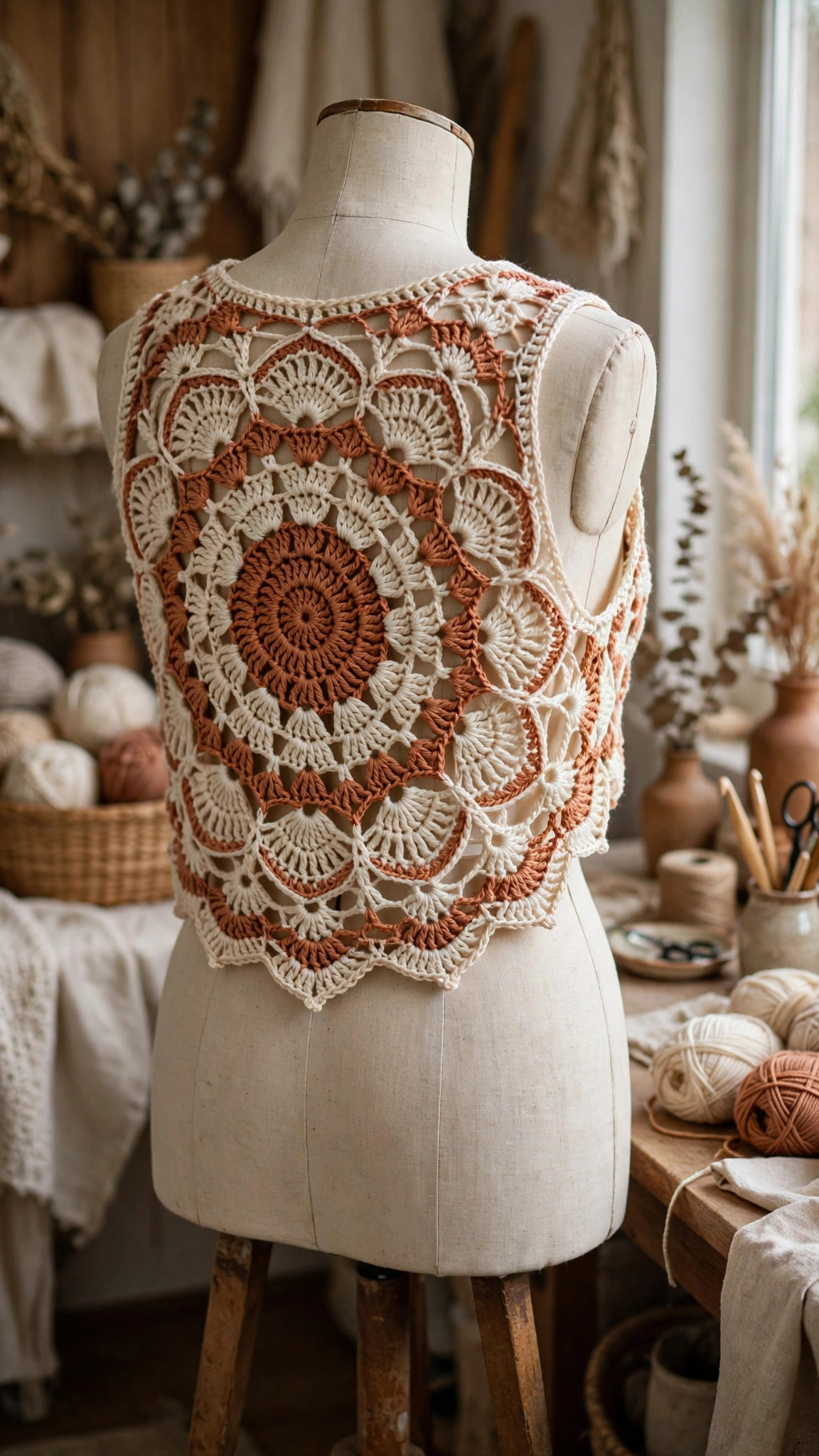
A circle vest worked in one seamless piece from the center of your back outward — lacy shell rounds alternating with calm double crochet rounds, a clever chain-and-skip armhole round, and a swishy full-circle hem with no sewing at all.

Wearables · Crochet
- Finished size
- About 78–82 cm / 31–32 in diameter
- Making time
- About 10–14 hours
- Hook
- 4.5 mm, DK-weight yarn
- Rounds
- 24 rounds, one seamless piece
- Skill
- Beginner
In this post
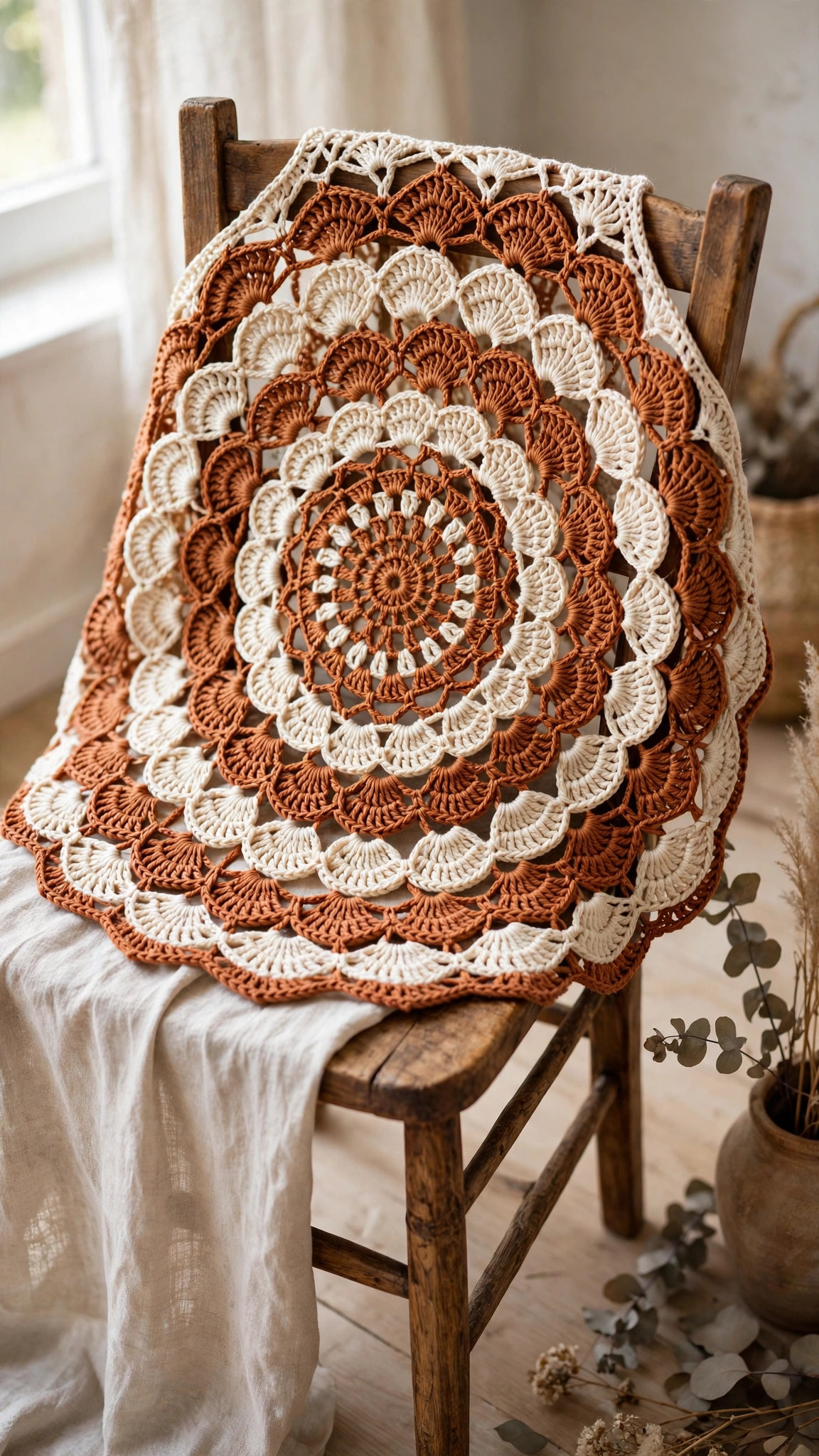
There is a special kind of magic in a garment that starts as a tiny ring in your palm and grows, round after round, into something you can wear. This crochet circle vest pattern is exactly that. It begins at the center of your back with a small mandala, grows outward in lacy shell rounds alternating with calm double crochet rounds, sprouts two armholes in a single clever round — no sewing, no seams at all — and keeps growing to a swishy, full-circle hem you can wear over anything.
Why you'll love this crochet circle vest pattern
Most garment patterns ask a lot before you have anything to show for it: separate fronts and backs, shoulder seams, sleeves to set in. This vest asks for none of that — one piece, no seams, and if something goes wrong you will see it within a round or two and can fix it flat.
It is also forgiving on fit. A circle vest does not need to match a bust measurement like a fitted cardigan. It drapes from the shoulders and falls open at the front, so slightly small reads as a pretty cropped layer and slightly big as a dramatic floaty wrap.
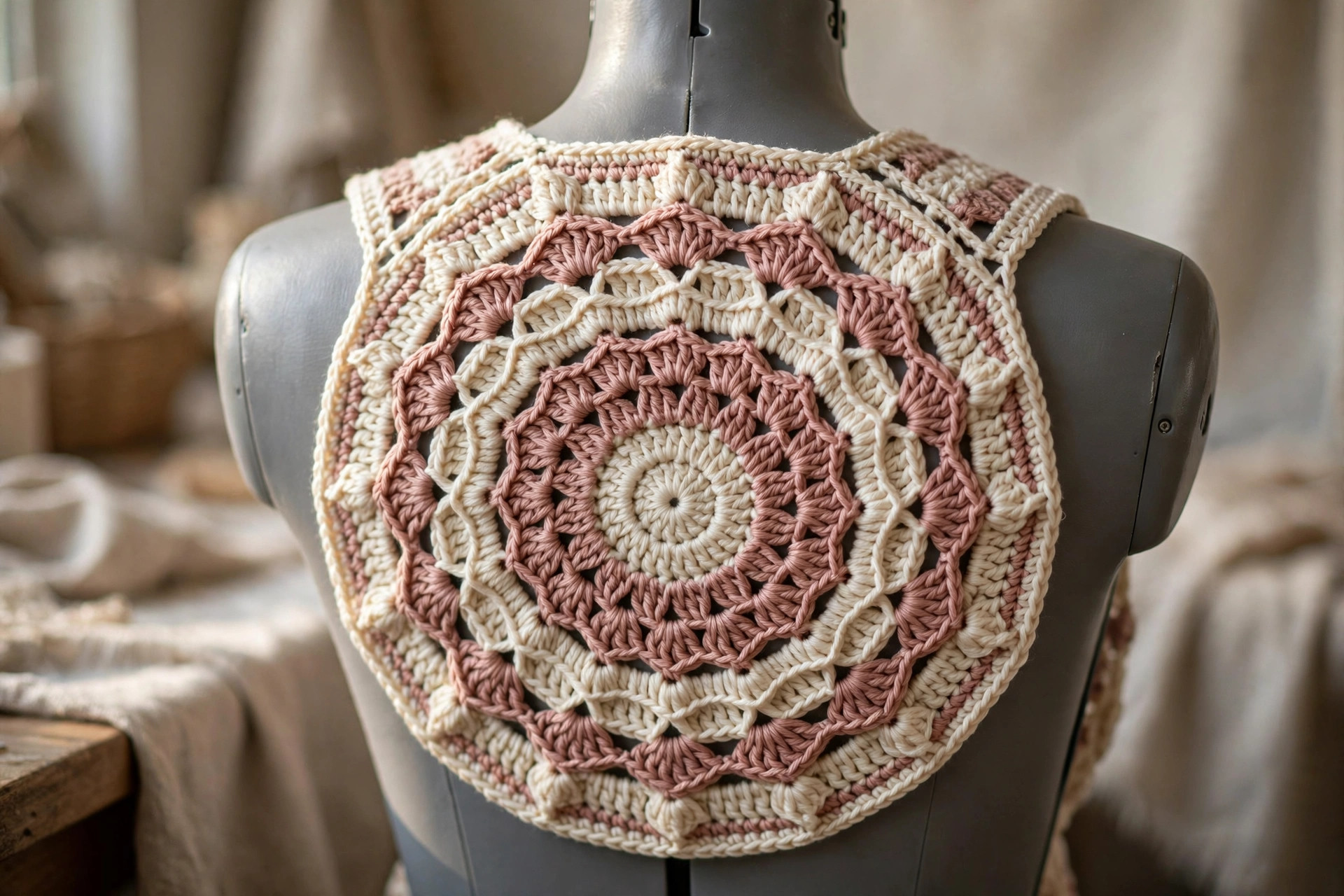
And then there is the mandala. The center sits between your shoulder blades and the shells radiate out like ripples. If you have admired our crochet doily patterns, this is that same center-out geometry, scaled up until it becomes clothing.
Materials you'll need
| Supply | What to get |
|---|---|
| Main yarn | DK-weight (#3) cotton or cotton-blend yarn, about 600 g / roughly 1,450 m (1,585 yd) |
| Crochet hook | 4.5 mm |
| Stitch markers | At least 4, locking type recommended |
| Tapestry needle | For weaving in ends |
| Scissors | For trimming tails |
| Tape measure | For checking diameter at the checkpoints |
| Optional | A contrasting colour (about 100 g) for a two-tone edging |
Choose drape over structure. Cotton, cotton blends and soft acrylic DK let the circle fall in soft folds; stiff or springy yarn fights it. Gradient cakes are spectacular here — the colour changes land in perfect concentric rings. Hold back about 20 g for the final edging.
Size, gauge and skill level
- Finished size: one size, about 78–82 cm (31–32 in) across the circle laid flat and lightly blocked — hip to mid-thigh at the back, with the front opening falling in two soft points.
- Gauge: 16 dc and 9 rows = 10 cm (4 in) with a 4.5 mm hook in DK. Gauge helps, but the diameter checkpoints matter more — check the diameter, not just the swatch.
- Skill level: adventurous beginner to intermediate. Comfortable with double crochet, working in rounds, and reading a stitch count.
Diameter checkpoints — check these as you go:
| Stage | Diameter (approx.) |
|---|---|
| After Round 4 (first shells) | 11 cm (4.5 in) |
| After Round 7 (second shells) | 19 cm (7.5 in) |
| After Round 10 (third shells) | 27 cm (10.5 in) |
| After Round 13 (fourth shells) | 35 cm (14 in) |
| After Round 16 (armhole round) | 40–42 cm (16 in) across |
| Finished, after Round 24 and blocking | 78–82 cm (31–32 in) |
If your circle is more than 2 cm smaller than a checkpoint, go up to a 5.0 mm hook for the rest of the vest. If it is bigger and rippling, drop to a 4.0 mm hook. Small corrections early are invisible; big corrections late are not.
Making it smaller or larger:
- Smaller (child, petite, or cropped): form armholes at Round 13 instead of Round 16, skipping and chaining 22 for each armhole, then work two shell sections after the armholes instead of three. Each section removed takes about 9–10 cm off the diameter.
- Larger (plus size, or a long duster vest): add rounds before the armholes — one extra pair of increase rounds plus one extra shell round (to 156 stitches), skipping and chaining 32 per armhole. Then work the post-armhole rounds as written.
- Easiest change of all: change yarn and hook, not the pattern. Sport-weight with a 4.0 mm hook runs smaller; worsted with a 5.5 mm hook runs bigger. The stitch counts never change.
Abbreviations — US terms
| Abbreviation | Meaning |
|---|---|
| MR | magic ring |
| ch | chain |
| sl st | slip stitch |
| sc | single crochet |
| dc | double crochet |
| st(s) | stitch(es) |
| sp | space |
| Shell | 5 dc worked into the same stitch |
| Rnd | round |
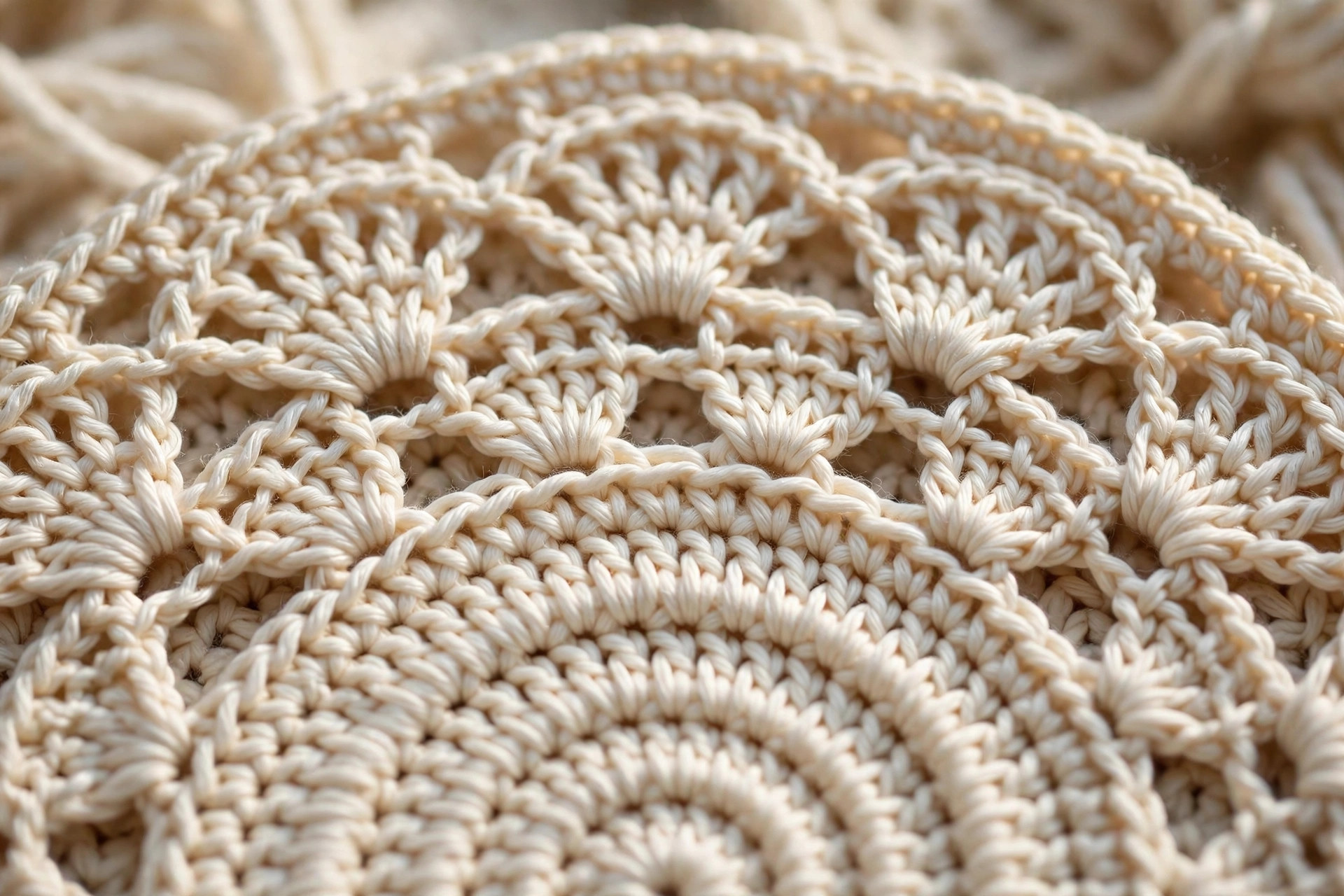
The shell, explained once: a shell here is always 5 double crochets in one stitch. On a shell round, the repeat across every 6 stitches is: shell in the next stitch, skip 2 stitches, single crochet in the next stitch, skip 2 stitches. Shell, skip, anchor, skip. Once your hands learn that rhythm, you can work shell rounds while watching television.
How the increases work: every plain double crochet round adds exactly 12 stitches, spread evenly. That number keeps every total divisible by 6 — exactly what the shell rounds need. If a round ends in a number that does not divide by 6, something went wrong, and it is worth finding before you build a shell round on top of it.
The pattern (US terms)
Work in joined rounds throughout. Join each round with a slip stitch to the top of the beginning chain-3, and do not turn — the right side always faces you. The chain-3 counts as a double crochet throughout. On plain rounds the count is double crochets; on the armhole round it is double crochets plus chains; on shell rounds it is shells plus anchors, with the stitch total the round is built on.
Rnd 1: MR, ch 3, 11 dc into ring, join. Pull the ring snug. (12 dc)
Rnd 2: Ch 3, dc in same st, 2 dc in each st around, join. (24 dc)
Rnd 3: Ch 3, dc in same st, [dc in next st, 2 dc in next st] repeat around, join. (36 dc)
Rnd 4 — Shell round: Ch 1, [shell in next st, skip 2 sts, sc in next st, skip 2 sts] repeat around, join to first sc. (6 shells, 6 sc; built on 36 sts)
Lay your work flat: a neat little mandala about 11 cm across. This tiny circle is the center of your back.
Rnd 5: Ch 3, work 1 dc into every dc of each shell and 2 dc into every sc anchor, spreading 12 increases evenly around, join. (48 dc)
Rnd 6: Ch 3, dc in same st, [dc in next 3 sts, 2 dc in next st] repeat around, join. (60 dc)
Rnd 7 — Shell round: Ch 1, [shell in next st, skip 2 sts, sc in next st, skip 2 sts] repeat around, join. (10 shells, 10 sc; built on 60 sts)
Rnd 8: As Rnd 5 — 1 dc in every shell dc, 2 dc in every sc anchor, join. (72 dc)
Rnd 9: Ch 3, dc in same st, [dc in next 5 sts, 2 dc in next st] repeat around, join. (84 dc)
Rnd 10 — Shell round: Ch 1, [shell in next st, skip 2 sts, sc in next st, skip 2 sts] repeat around, join. (14 shells, 14 sc; built on 84 sts)
By now the circle should lie flat at about 27 cm across. If it cups, your increases are too tight — consider the larger hook for the next section. If it ruffles, count a shell round carefully; ruffles almost always start with one extra increase hiding in a shell.
Rnd 11: As Rnd 5. (96 dc)
Rnd 12: Ch 3, dc in same st, [dc in next 7 sts, 2 dc in next st] repeat around, join. (108 dc)
Rnd 13 — Shell round: Ch 1, [shell in next st, skip 2 sts, sc in next st, skip 2 sts] repeat around, join. (18 shells, 18 sc; built on 108 sts)
Rnd 14: As Rnd 5. (120 dc)
Rnd 15: Ch 3, dc in same st, [dc in next 9 sts, 2 dc in next st] repeat around, join. (132 dc)
Stop and measure: about 40 cm across. The center should sit between your shoulder blades. Last easy moment to adjust size: for a larger vest, add one increase round (144 dc) and one shell round here, before the armholes.
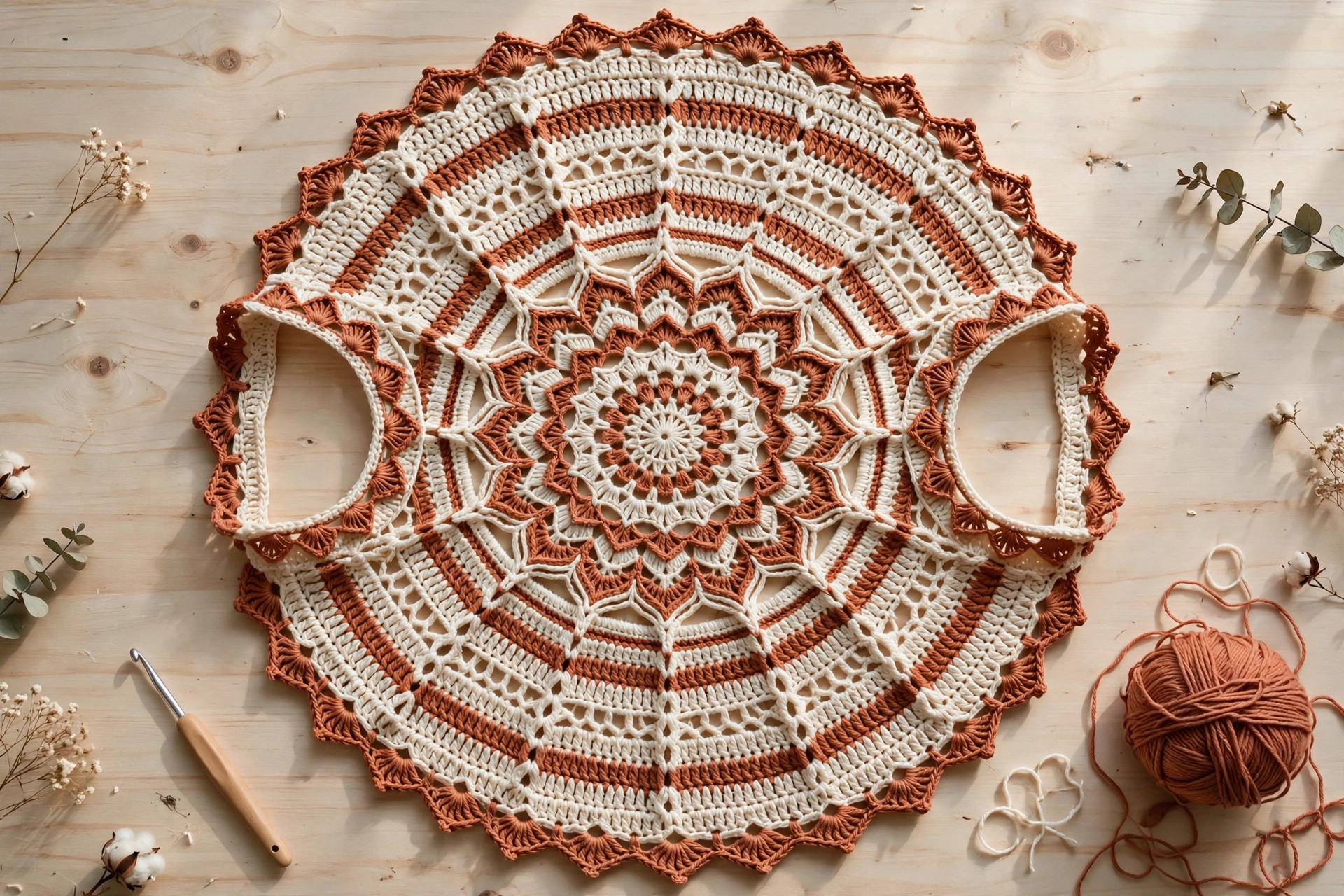
Rnd 16 — ⚑ ARMHOLE ROUND (the important one): Lay the circle flat, right side up, with the start of the round at the bottom. Work: ch 3, dc in each of the next 39 sts (40 dc for the first front), ch 26, skip the next 26 sts (first armhole), dc in each of the next 39 sts (40 dc across the back), ch 26, skip the next 26 sts (second armhole), dc in each remaining st, join. (80 dc + 52 ch = 132 sts total)
Nothing is cut and nothing is sewn — you are bridging two sections with chains, and the skipped stitches form the lower edge of each armhole. Hold the piece up: two loops should hang like little handles.
Rnd 17: Ch 3, dc in each dc and 1 dc in each chain around — treating the armhole chains as stitches. Add 12 increases evenly across the back and front sections only (not across the chains), join. (144 dc)
Working into the chains is the fiddliest moment in the pattern. Go slowly; the armhole edging in Finishing touches tidies any loose stitches.
Rnd 18 — Shell round: Ch 1, [shell in next st, skip 2 sts, sc in next st, skip 2 sts] repeat around, join. (24 shells, 24 sc; built on 144 sts)
Rnd 19: As Rnd 5. (156 dc)
Rnd 20: Ch 3, dc in same st, [dc in next 11 sts, 2 dc in next st] repeat around, join. (168 dc)
Rnd 21 — Shell round: Ch 1, [shell, skip 2, sc, skip 2] repeat around, join. (28 shells, 28 sc; built on 168 sts)
Rnd 22: As Rnd 5. (180 dc)
Rnd 23: Ch 3, dc in same st, [dc in next 13 sts, 2 dc in next st] repeat around, join. (192 dc)
Rnd 24 — Final shell edging: Ch 1, [shell in next st, skip 2 sts, sc in next st, skip 2 sts] repeat around, join. (32 shells, 32 sc; built on 192 sts)
Fasten off — but try the vest on before weaving in a single end. If you want more length, rejoin the yarn and add one more increase round plus a shell round (about 5 cm more diameter) now, rather than after blocking. If the size is right, breathe out. You made clothing in a circle.
Finishing touches
Weave in ends properly. Weave each tail back and forth in three directions through the backs of double crochet stitches — on a garment that gets pulled over shoulders, one pass is not enough.
Armhole edging (do not skip this). Join yarn at the underarm point of one armhole. Round 1: 1 sc into every skipped stitch along the lower edge and 1 sc into the side of each chain stitch along the upper edge, join. Round 2: ch 1, sc in each sc around, join, fasten off. Repeat for the second armhole. This strengthens the edge and lets you adjust fit — work Round 2 firmly for a smaller armhole.
Block it — this is not optional. Wet-block or steam-block the vest laid out as a full circle, coaxing it to 78–82 cm across and smoothing each shell flat. Pin the outer edge every few shells if your yarn is springy. Let it dry completely before moving it.
Add a closure if you like one. The vest is designed to fall open, but a button, a shawl pin, or a short tie at the upper chest (two 20 cm chains worked from the front edges) all suit it.
Three ways to make it yours
- Boho festival vest. Work the vest as written in an earthy cotton, then add fringe: cut 25 cm strands and attach three with a lark's head knot into every shell along the final round. An hour of work, a hundred percent more drama.
- Elegant evening layer. Use a fine DK with sheen in black, deep plum or charcoal, and work the final two rounds in a metallic-thread yarn. Over a plain dress it reads as a boutique lace layer — and our crochet shawl pattern uses the same shell rhythm in a triangle.
- Cosy autumn gilet. Switch to worsted-weight yarn and a 5.5 mm hook, follow every count exactly, and stop after Round 21. You get a thicker, warmer vest over jumpers — the wearable cousin of a crochet cardigan, with no sleeves to fit.
A small flower pinned at the shoulder is a lovely flourish, and a motif from our crochet flower pattern takes about fifteen minutes.
Troubleshooting tips
- The circle cups like a bowl. You are not increasing enough for your tension. Check a checkpoint: if under size, go up a hook size and add one extra increase round before the next shell round.
- The edge ruffles and waves. Too many stitches. Count your last plain round carefully — one stray extra increase per repeat adds twelve unwanted stitches. Frog back one round and recount.
- The armholes feel too tight. Next time, skip and chain 30 instead of 26. This time, block them open and work the edging loosely — a tight single crochet edging steals surprising room.
- The armholes sit too high or low. Placement is controlled by diameter, not round number. For a longer back, add a section before Round 16; for a cropped fit, form them at Round 13.
- The vest rotates when worn. Check the armholes are opposite each other — one placed off-center twists the whole drape. A light chest closure also stops the drift.
Frequently asked questions
Is this circle vest pattern really free?
Yes — the complete pattern, including the armhole round and finishing edging, is free right here on the blog, with no signup needed. Saving it on Pinterest or sharing it with a crochet friend is the nicest way to say thanks.
How long does it take to make?
About 10–14 hours for most crocheters. The mandala up to the armholes takes a third of the time; the big outer rounds take the rest, but they are pure rhythm. Allow an extra hour for blocking and the armhole edging.
Can a beginner make this vest?
An adventurous beginner, yes. If you can double crochet, count stitches and work in rounds, you have every core skill here — the shell stitch is taught in the pattern. For a smaller wearable first, try the crochet scarf patterns for beginners, then come back to the vest.
How do I make the vest bigger?
Add rounds before the armholes, not after: one extra pair of increase rounds and one extra shell round before Round 16 (to 156 stitches), chaining and skipping 32 per armhole. The full rules are in the Size section. Worsted-weight yarn and a bigger hook also works, with no maths at all.
What yarn works best for a circle vest?
DK cotton or a cotton blend, about 600 g as written. Drape is everything — a stiff yarn will fight your circle. Gradient cakes are a shortcut to a designer look. In a lighter cotton the same counts come out smaller and lacier, perfect over swimwear — see our free crochet swimsuit pattern for a matching make.
Can I sell vests made from this pattern?
Yes — you may sell finished vests in small batches, at markets or online, with credit to Little Loop Finds as the designer and a link back to this page where possible. The pattern text and photos themselves may not be copied, redistributed or sold.
Why does my vest look smaller than the photos while I am making it?
Until the armholes go in you are looking at a doily, and a doily always looks small. Trust the diameter checkpoints instead: at 40 cm across you are only halfway to the finished diameter, and the post-armhole rounds add more size than you expect. Lay it flat, measure, and keep going.
More free patterns to try
If a center-out project has hooked you, stay in the round a little longer. A handmade garment is a wonderful next step, a lacy triangle makes a perfect weekend follow-up, and the miniature mandalas that inspired this vest are ideal for practising tension between bigger projects. However you wear your vest — over dresses, denim or swimwear — wear it knowing it began as twelve stitches in a ring. That never stops being a little bit wonderful.
The box below contains an Etsy link. If you buy through it, we may earn a small commission at no extra cost to you. Learn more.
No time to make one?
Short on time? Find handmade crochet circle vests from independent makers on Etsy.
Browse on Etsy (opens Etsy in a new tab)