Free crochet pocket scarf pattern: cozy 70-inch wrap
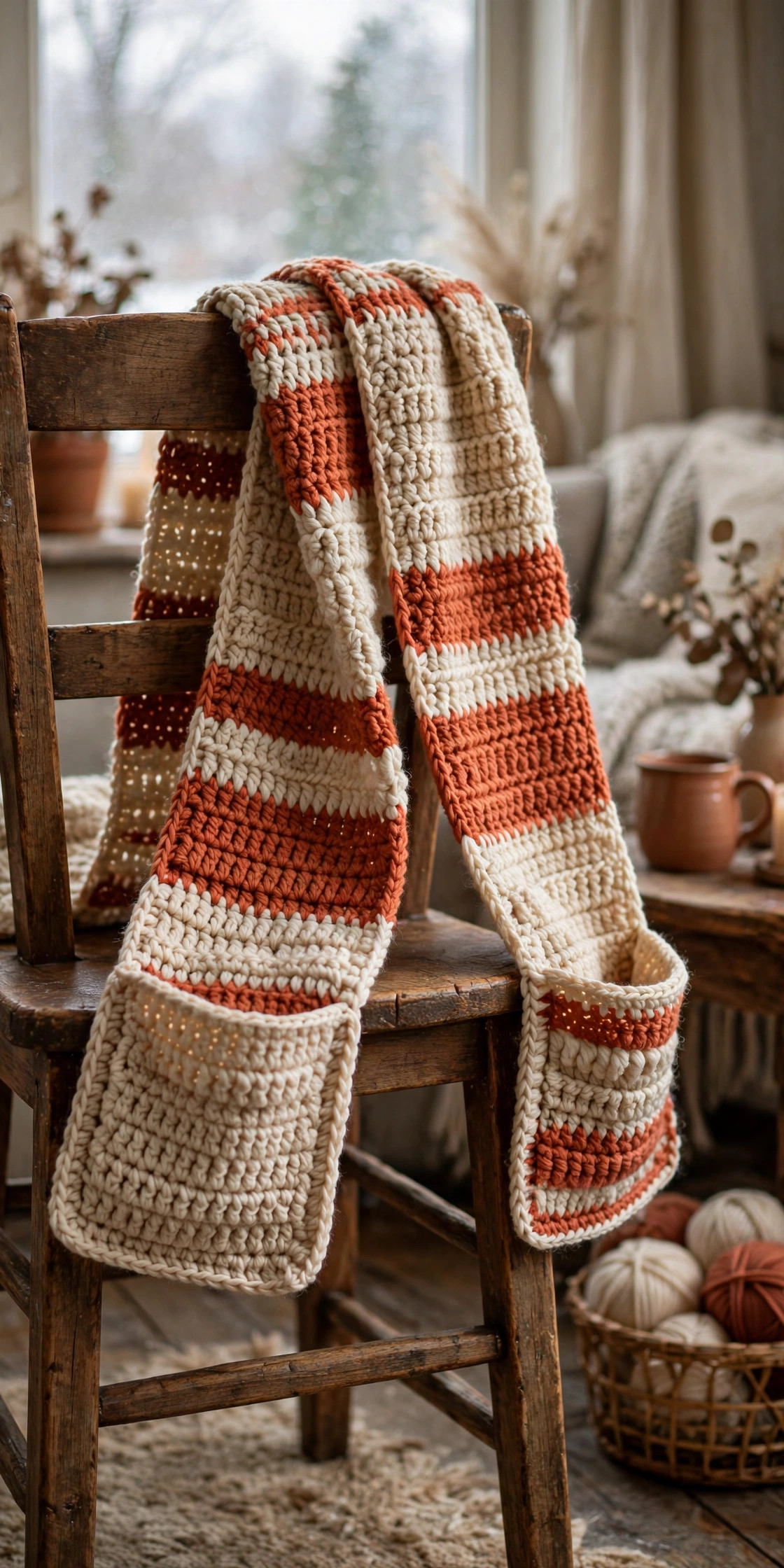
A cozy 70-inch pocket scarf — part scarf, part shawl — worked flat in one long panel of nubby lemon-peel texture with worsted yarn and a 6.0 mm hook, then folded and seamed into two deep roomy pockets. One easy stitch repeat, no shaping, pure TV crochet.

Wearables · Crochet
- Finished size
- About 70 × 10 in / 178 × 25 cm
- Making time
- About 10–12 hours
- Hook
- 6.0 mm, worsted-weight yarn
- Skill
- Beginner, one stitch repeat
- Skill
- Beginner
In this post
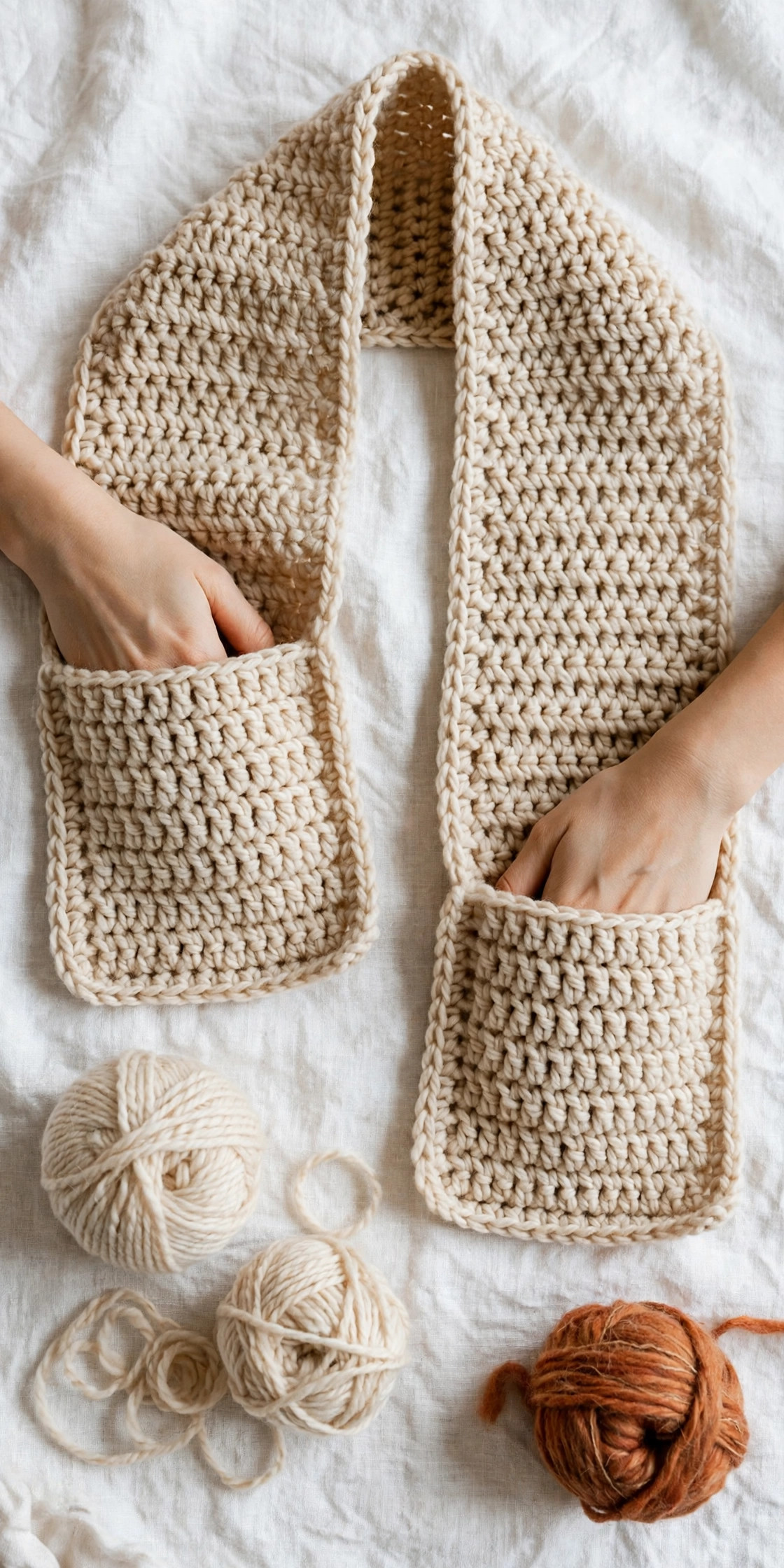
A pocket scarf is the best of everything: the warmth of a shawl, the ease of a scarf, and two roomy pockets that swallow your hands, your phone, and the cold. This original free crochet pocket scarf pattern gives you a long, ~70-inch textured wrap in a simple lemon-peel stitch — worked flat in one long rectangle, then each end is folded up and seamed to form deep, cozy pockets. One stitch repeat, no shaping, no colorwork: just rhythmic, meditative crochet that turns into the thing you'll reach for every single chilly morning.
Why you'll love this crochet pocket scarf pattern
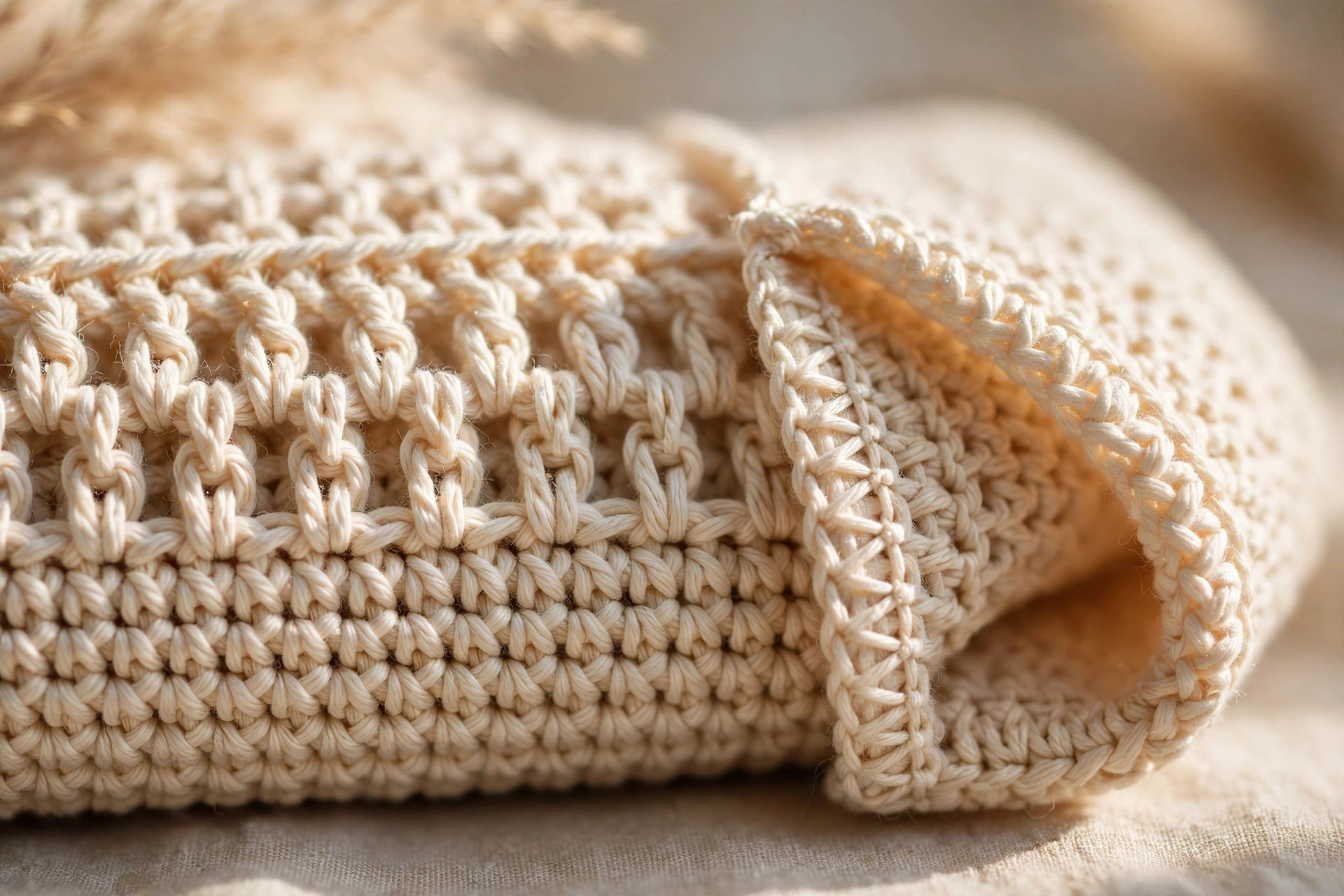
Most pocket scarf patterns are either gorgeous but fussy (cables you can't memorize, pockets that are sewn-on afterthoughts) or simple but boring (a flat rectangle that reads "blanket, but narrow"). This design lands in the sweet spot: the lemon-peel stitch — alternating single and double crochet — gives you a richly textured, nubby fabric that looks far more complicated than it is, and it's completely reversible, so both sides of your scarf look finished.
The pockets are the real magic. Because they're formed by folding the scarf's own ends and seaming the sides — not sewn on as separate pieces — they're deep, sturdy, and perfectly matched to the fabric. Each one is about 9.5 inches deep and 10 inches wide: big enough for your hands, your phone, your keys, and a lip balm. And since there's exactly one stitch repeat to memorize (sc, dc, sc, dc…), this is true TV crochet — the kind of project your hands keep working while your eyes stay on the show.
Materials you'll need
| Supply | What to get |
|---|---|
| Main yarn | Worsted-weight (#4) acrylic or wool blend, about 1,000 yards (5 balls of 100 g / 200 yd) |
| Crochet hook | 6.0 mm (J-10) |
| Tapestry needle | For seaming the pockets and weaving in ends |
| Stitch markers | A few, for marking the 10-inch pocket folds |
| Notions | Scissors, measuring tape, row counter (optional but handy) |
A quick note on yarn choice: a smooth worsted acrylic or wool blend is the ideal pick — it shows off the lemon-peel texture and keeps the pockets sturdy enough to actually hold things. Avoid very fuzzy or novelty yarns; they hide the stitch texture and make the pocket seams harder to work. If you want the scarf a touch drapier, go up to a 6.5 mm hook; a touch denser, drop to 5.5 mm — just re-check the gauge below.
Size, gauge and skill level
- Finished size: about 178 cm × 25 cm (70 in × 10 in). Each pocket: about 24 cm (9.5 in) deep × 25 cm (10 in) wide.
- Gauge: 12 stitches × 10 rows = 10 cm (4 in) in lemon-peel stitch, unblocked. If your swatch comes out wider than 10 cm, go down a hook size; narrower, go up. Gauge matters here — it controls the finished length — so take five minutes to swatch.
- Skill level: beginner. You need chain, single crochet, and double crochet. The lemon-peel rhythm (sc, dc, sc, dc…) takes about one row to learn and then it's pure autopilot.
If this is your very first wearable, the easy beginner crochet patterns roundup is a great warm-up before you start — this scarf makes a perfect second project.
Abbreviations — US terms
| Abbreviation | Meaning |
|---|---|
| ch | chain |
| sc | single crochet |
| dc | double crochet |
| st(s) | stitch(es) |
| rep | repeat |
| RS / WS | right side / wrong side |
| crab st | crab stitch — reverse single crochet (explained below) |
| FO | fasten off |
A note on the lemon-peel stitch: every row is simply sc, dc repeated across. Because you always work a single crochet into the top of a double crochet and a double crochet into the top of a single crochet, the texture builds itself — a nubby, pebble-like fabric that's identical on both sides. No counting beyond keeping your stitch total at 30.
The pattern (US terms)
One rectangle, two folds, four seams — that's the whole construction. The stitch count at the end of every row is in parentheses. Count your stitches for the first few rows until the rhythm locks in; after that, the texture itself tells you if you've gone wrong (a sc sitting on a sc will look visibly "off").
The main panel — one long rectangle
- Foundation: Ch 31.
- Row 1: sc in 2nd ch from hook, dc in next ch, sc in next ch; rep from * across — 30 sts.
- Rows 2–175: ch 1, turn; sc in first st, dc in next st; rep from * across — 30 sts each row.
- Do not fasten off yet — you'll use the working yarn for the first pocket seam in a moment. Measure your panel: it should be about 70 inches long and 10 inches wide. (Don't panic if you're an inch off; see Troubleshooting.)
Keeping track of 175 rows: clip a stitch marker into the fabric every 25 rows (at the 25th, 50th, 75th, 100th, 125th and 150th rows). When you reach the 175th row, you'll know without counting from the start. Alternatively, every 2.5 rows equals 1 inch — so a quick tape-measure check at 35 inches tells you you're exactly halfway.
Forming the pockets
- Lay the panel flat with the RS facing up. The lemon-peel texture is reversible, so "RS" just means the side you like best.
- At one short end, measure 10 inches (25 rows) up from the edge and mark the fold line with stitch markers. Fold the end UP along the line so it lies against the body of the scarf — the fold itself becomes the bottom of the pocket.
- With your tapestry needle and the working yarn (or a fresh strand of matching yarn), whipstitch through both layers along each side edge, from the fold up to the raw end — a 10-inch seam on each side. Keep your stitches small and even, working just inside the edge stitch so the seam is nearly invisible.
- Repeat steps 2–3 at the other end. FO and weave in all tails.
- Check each pocket: slide your hand in. It should be about 9.5 inches deep (a little depth is lost in the fold) and open all the way across. If a seam puckers, the fix is in Troubleshooting below.
Why fold instead of sewing on separate pockets? Folded pockets have no weak join where a sewn-on pocket could tear, the texture matches perfectly (it is the same fabric), and the fold at the bottom is rounded and soft instead of a sharp sewn corner. It's the sturdiest pocket construction there is.
Finishing the pocket openings
The chain edge now forms the top opening edge of each pocket. For a neat, professional-looking edge that resists stretching:
- Join yarn at one corner of a pocket opening.
- Ch 1, sc in each ch across the opening — 30 sc.
- Optional rolled edge: work crab stitch (reverse single crochet) back across: insert hook into the next st to the RIGHT, yarn over, pull up a loop, yarn over, pull through both loops; rep across. This gives a tidy corded edge that keeps the pocket mouth from flaring.
- FO, weave in the end. Repeat for the second pocket.
If you've never worked a crab stitch, practice the motion on a scrap first — it feels backwards for about six stitches, then clicks.
Finishing touches
This is a big, simple piece, so the finishing is what makes it look boutique instead of homemade. Take twenty unhurried minutes:
Weave in ends invisibly. Work each tail through the backs of several stitches in a zigzag, then trim close. On a 70-inch scarf, a poking-out tail will find you every time you wear it — be thorough now.
Block lightly. You don't need to pin this out aggressively. Lay the scarf flat, mist it lightly with water (or steam it gently if your yarn allows), pat the pockets into neat rectangles, and let it dry flat. Blocking evens out the lemon-peel texture and relaxes the fold lines into soft, permanent creases.
Shape the pockets. While the scarf is still slightly damp, press each pocket flat with your hands so the seams sit straight and the opening lies flat. A pocket that dried crooked stays crooked.
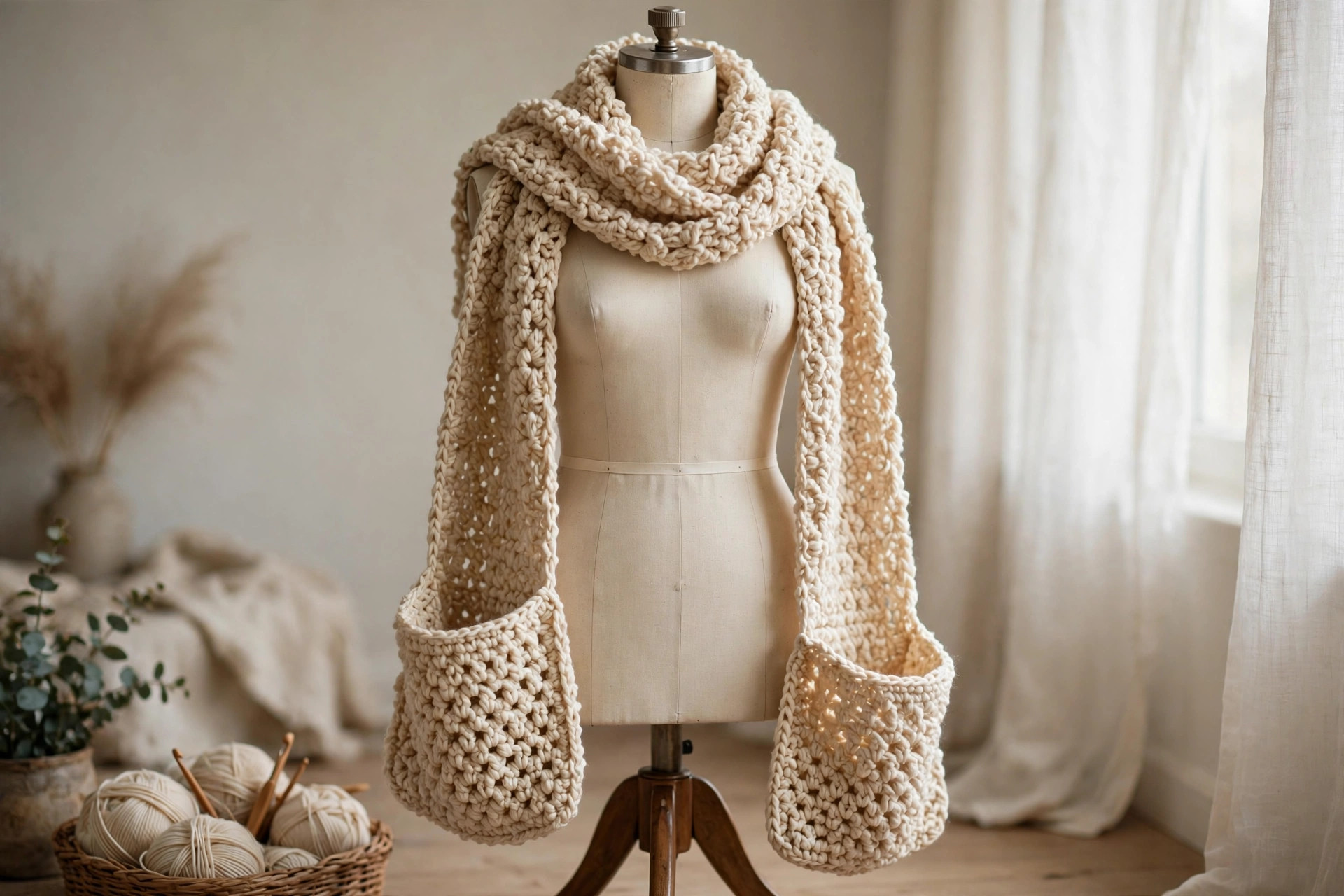
The drape test. Wrap the scarf around your neck once and let the ends hang. The pockets should sit at about hip level and lie flat against you. If they flip outward, the pocket openings want one more row of crab stitch for weight — see the variation note below.
Three cozy variations to try next
Same construction, three personalities — once you've made one pocket scarf, the template is yours:
- Sunset stripes. Change color every 25 rows for bold, even stripes — 175 rows divides into exactly 7 stripes, so each end's 25-row pocket fold is precisely one stripe. Make stripes 1 and 7 the same color and both pockets match perfectly. Weave in ends as you go, or you'll have a dozen tails waiting at the end.
- Chunky weekend version. Use bulky (#5) yarn with an 8.0 mm hook: ch 26, work 25 sts across in lemon peel, and crochet 140 rows for the same 70-inch length (bulky gauge runs about 10 sts and 8 rows per 4 inches). Fold 10 inches (20 rows) for the pockets. It works up in about half the time and feels like wearing a blanket.
- The pocket cowl. Want the pockets without the full 70 inches? Work just 125 rows (50 inches) and fold 8 inches (20 rows) at each end for shallower pockets. Wear it doubled around your neck — the pockets sit right at your chest, perfect for keeping hands warm on a dog walk.
And if this project gave you the wearable bug, the crochet shawl pattern uses the same meditative rhythm at a bigger, drapier scale, while the crochet cardigan sweater pattern is the natural next step up in garment-making.
Troubleshooting tips
- Your edges are curling. Lemon peel barely curls, but a tight foundation chain can pull the ends in. Blocking fixes mild curl; for stubborn curl, work the foundation chain with a hook one size larger than the rest of the project.
- You keep losing the sc/dc rhythm. The rule is one sentence: single crochet into every double crochet, double crochet into every single crochet. Glance at the stitch below before you work into it — the tall posts are the dc's, the short tight ones are the sc's.
- Your stitch count drifted from 30. Almost always an accidental increase at the row ends (working into the turning chain). Count every few rows for the first 25 rows; after that the rhythm holds itself.
- A pocket is shallower than 9.5 inches. You folded more than 10 inches, or your row gauge runs small. Measure the fold — not the row count — at exactly 10 inches and you'll land right.
- A side seam puckers. You pulled the whipstitches too tight. Seams should be snug but not cinched — the seam yarn should lie as loosely as the fabric itself. Unpick and re-sew with a lighter hand; it takes five minutes.
- The whole scarf came out too long or too short. Easy fix, because there is no shaping: every 2.5 rows equals 1 inch. Want a 64-inch scarf? Work 160 rows. Want 76? Work 190. Just keep the 10-inch (25-row) pocket folds the same.
Frequently asked questions
Is this crochet pocket scarf pattern really free?
Yes — the complete pattern above is free, no email signup, no PDF purchase required. If you'd like to support the site, sharing the post or saving it on Pinterest is the kindest thank-you.
What skill level is this pattern?
Beginner. If you can chain, single crochet, and double crochet, you have every skill this pattern needs. There is no shaping, no colorwork, and only one stitch repeat — the only "advanced" moment is the optional crab-stitch edge, which is genuinely optional.
How long does it take to make?
About 10–12 hours total: roughly 9–10 hours of crocheting the 175-row panel (it's long but mindless — perfect TV crochet), plus an hour or so for folding, seaming, edging the pockets, and weaving in ends. Most makers finish it over a week or two of evenings. The crochet scarf patterns for beginners roundup has quicker one-evening options if you want instant gratification first.
How much yarn do I need?
About 1,000 yards of worsted-weight (#4) yarn — five 100 g / 200 yd balls — plus a little extra for the pocket seams and edging. If you're stash-busting with partial balls, weigh as you go: you'll use roughly 200 yards per 14 inches of panel.
Can I sell the finished scarves I make?
Yes! You may sell finished scarves made from this pattern in small batches (craft fairs, Etsy, gifts). Please credit Little Loop Finds as the pattern designer with a link back to this page. The pattern text and photos themselves may not be redistributed, republished, or sold.
Can I make it in a different stitch?
Absolutely — any reversible, non-curling stitch works with this construction, since the pockets are just folded ends. Keep the panel 10 inches wide and the folds at 10 inches, and adjust your row count to hit 70 inches using your stitch's row gauge. (Rows needed = 70 × your rows-per-inch.)
More free patterns to try
If this wrap was fun, keep the hook moving. The crochet scarf patterns for beginners roundup has quicker scarves for every skill level, the crochet shawl pattern takes the same meditative rhythm to a drapier scale, the free crochet hat pattern makes the perfect matching set for this scarf, the crochet cardigan sweater pattern is the natural next step into garments, and the easy beginner crochet patterns collection is full of confidence-building next projects.
The box below contains an Etsy link. If you buy through it, we may earn a small commission at no extra cost to you. Learn more.
No time to make one?
Short on time? Find handmade pocket scarves from independent makers on Etsy.
Browse on Etsy (opens Etsy in a new tab)