3 easy crochet blanket patterns for beginners
Three original beginner-friendly blanket patterns in US terms: a striped double-crochet lap blanket, a pastel granny-stripe baby blanket, and a textured puff-stitch throw — every row with exact stitch counts so your edges stay straight.

Patterns · Crochet
- Finished sizes
- 90×110 cm / 75×90 cm / 100×120 cm
- Making time
- 10–30 hours per blanket
- Hooks
- 5.0–6.0 mm, worsted-weight yarn
- Patterns
- 3 original designs, US terms
- Skill
- Beginner
In this post
- Why these three blanket patterns work for beginners
- Materials you'll need
- Size, gauge and skill level
- Abbreviations — US terms
- Pattern 1: Campfire Stripes lap blanket
- Pattern 2: Pastel Rainbow granny-stripe baby blanket
- Pattern 3: Cloud Puff textured throw
- Make it yours: colorway ideas
- Troubleshooting tips
- Frequently asked questions
- More free patterns to try
If you've been hunting for easy crochet patterns for blankets that are genuinely beginner-friendly — no confusing charts, no "just fudge it" moments, no running out of yarn at row 40 — these three are for you. Each one uses only basic stitches, each comes with exact stitch counts you can check as you go, and each is an original Little Loop Finds design, so you won't find the same pattern reprinted anywhere else.
There's a striped lap blanket in cozy double crochet, a pastel granny-stripe baby blanket, and a textured puff-stitch throw that looks far fancier than it is. Pick the one that matches your yarn stash and your patience level, and you'll have a finished blanket — not another UFO (unfinished object) in the closet.
Why these three blanket patterns work for beginners
Most blanket patterns fail beginners in the same three ways: the foundation chain math is wrong so the edges slant, the stitch counts drift silently row by row, or the pattern assumes you'll "just know" how to change colors neatly. These three were written to eliminate all of that. Every row tells you exactly how many stitches you should have, the color changes happen at the row ends where they're easy, and each pattern includes the foundation-chain formula so you can resize confidently instead of guessing.
Materials you'll need
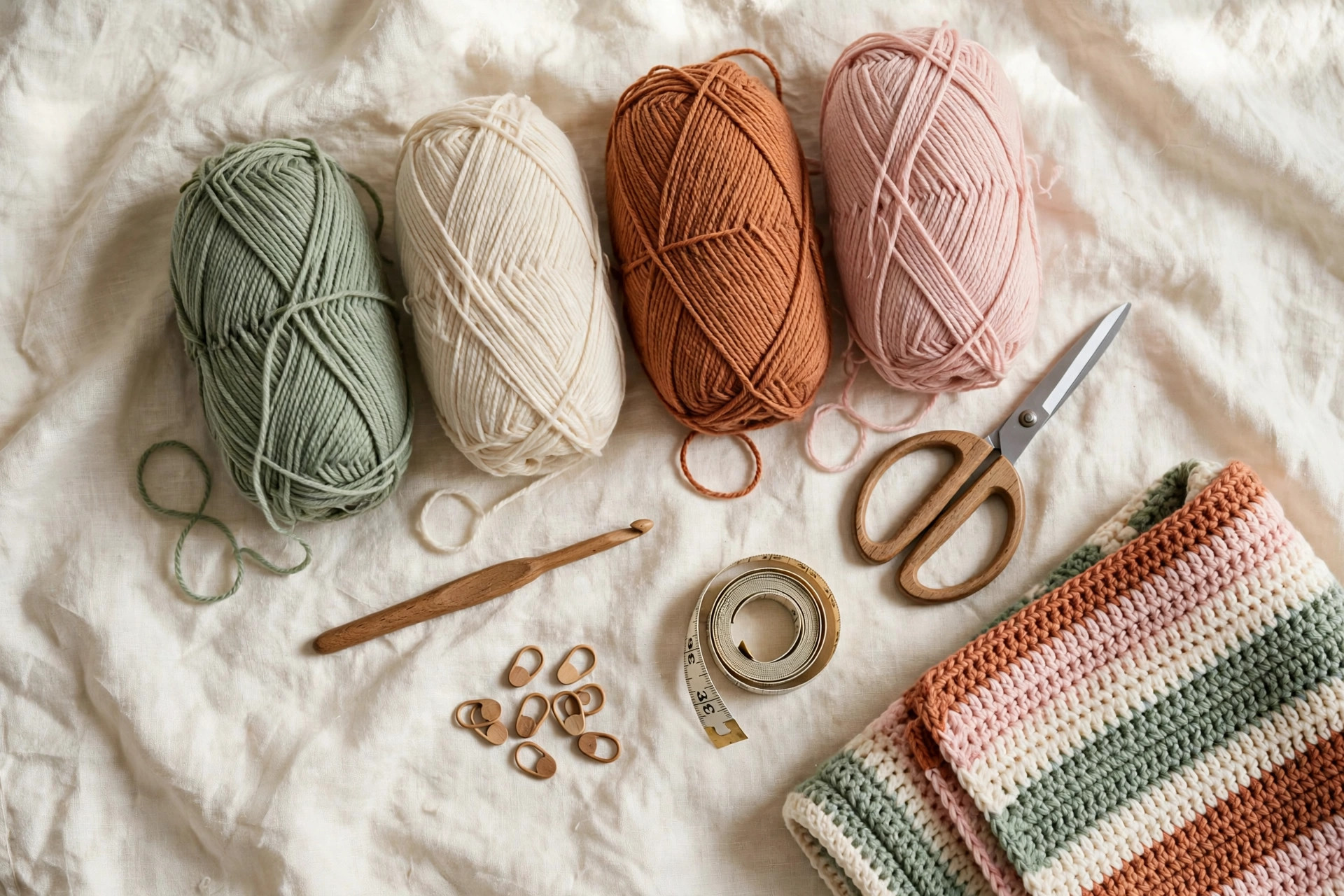
You don't need all of this at once — pick one pattern and shop your stash first. The table below covers all three.
| Supply | What to get |
|---|---|
| Yarn | Worsted-weight (#4) acrylic or wool blend; see each pattern for colors and amounts |
| Crochet hooks | 5.5 mm (I-9), 5.0 mm (H-8), and 6.0 mm (J-10) — one per pattern |
| Notions | Tapestry needle, scissors, stitch markers, tape measure |
A quick note on yarn: for your first blanket, choose a smooth, light-to-medium-colored acrylic or wool blend. Dark, fuzzy, or novelty yarns hide your stitches, and when you can't see your stitches you can't count them — and counting is the whole game. Save the bouclé for blanket number three.
Size, gauge and skill level
- Finished sizes: lap blanket ≈ 90 × 110 cm (36 × 43 in); baby blanket ≈ 75 × 90 cm (30 × 36 in); throw ≈ 100 × 120 cm (40 × 47 in).
- Gauge: given per pattern below. Blanket gauge doesn't need to be perfect — a centimeter here or there just makes your blanket slightly bigger or smaller — but checking it once against a 10 cm swatch saves you from a blanket that's 20 cm off.
- Skill level: adventurous beginner. You should know how to chain, single crochet, and double crochet. The puff stitch (pattern 3) is taught from scratch below, and if any stitch feels rusty, our easy beginner crochet patterns roundup is the perfect warm-up.
Abbreviations — US terms
| Abbreviation | Meaning |
|---|---|
| ch | chain |
| sc | single crochet |
| dc | double crochet |
| puff | puff stitch (see below) |
| st(s) | stitch(es) |
| rep | repeat |
| RS | right side |
The puff stitch, step by step: [yarn over, insert hook into the stitch, yarn over, pull up] twice in the same stitch (5 loops on hook), yarn over and pull through all 5 loops, chain 1 to close the puff. One stitch that looks like a little popcorn kernel.
Changing colors cleanly: work the last stitch of the old color until two loops remain on the hook, yarn over with the new color and pull through. The new color now sits ready for the turning chain, and the color change lands exactly at the row edge with no blip.
Pattern 1: Campfire Stripes lap blanket
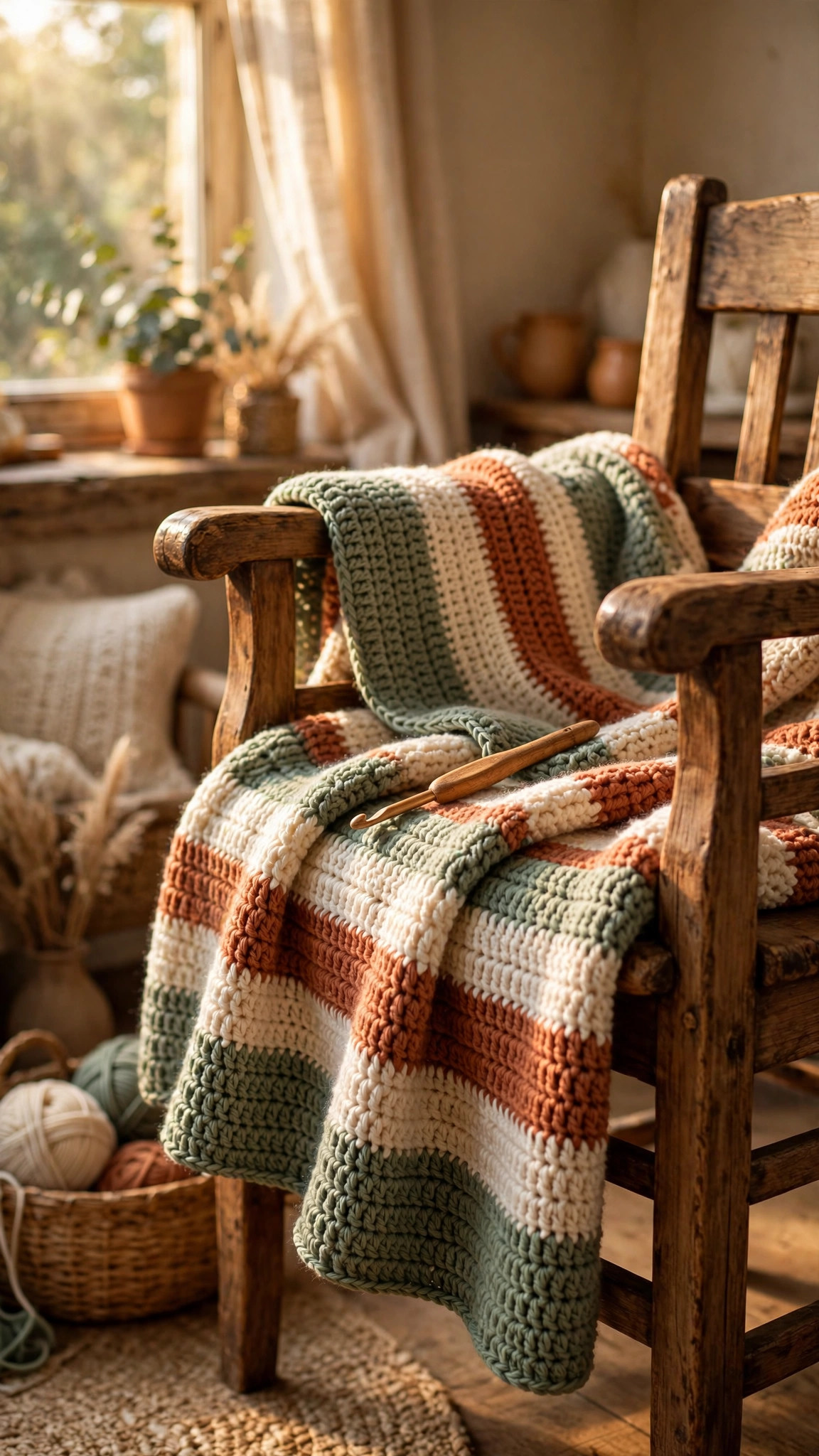
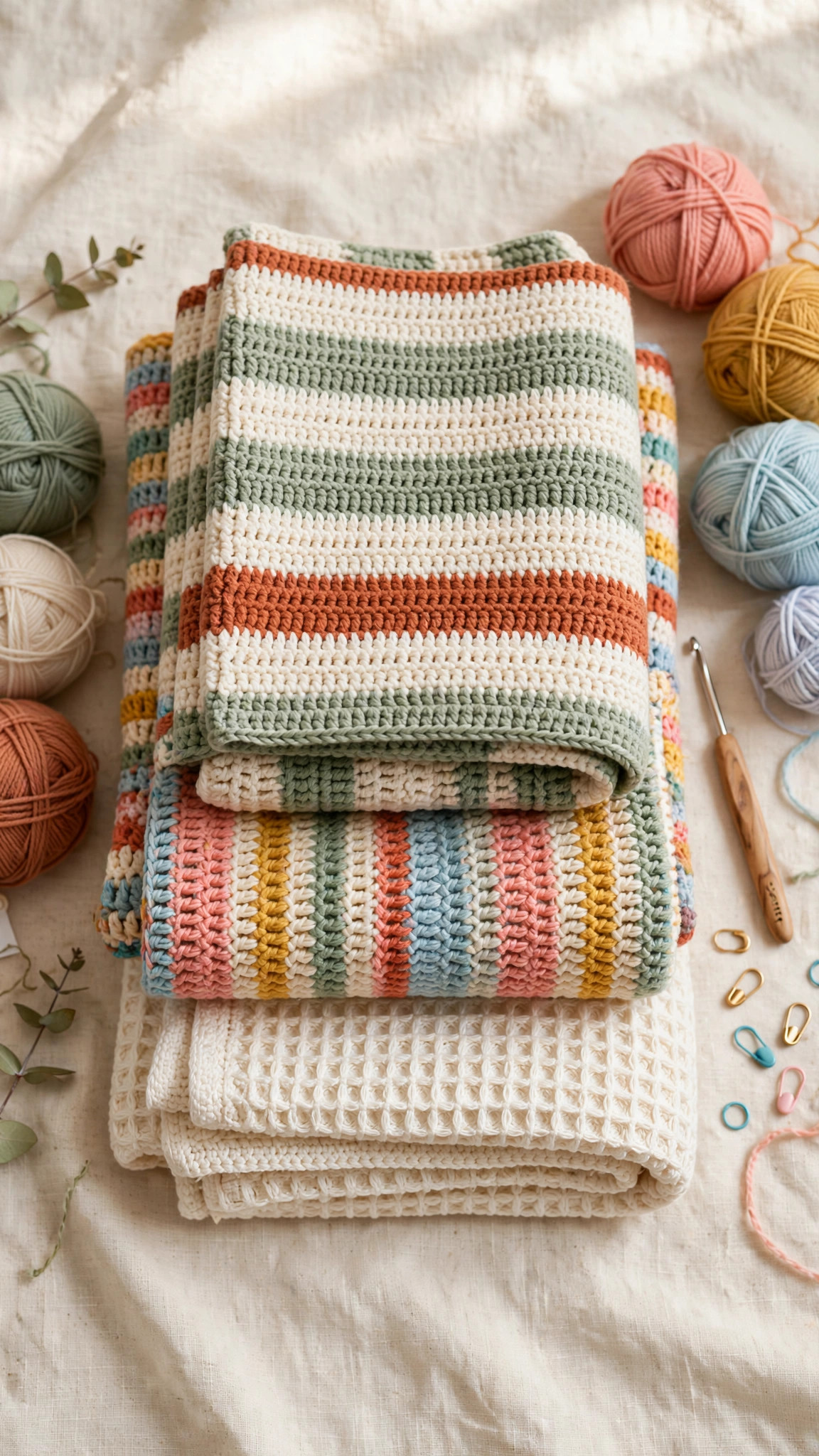
The classic first blanket: rows of double crochet in wide, satisfying stripes. It grows fast, the stripes keep it interesting, and the finished blanket is the perfect couch size. If you've only ever made scarves, this is your graduation project — and if you loved the rhythm of our crochet shawl pattern, this is the same meditative stitching at blanket scale.
Materials
- Worsted-weight (#4) yarn: Color A sage green (~300 g / 3 skeins), Color B cream (~200 g / 2 skeins), Color C terracotta (~200 g / 2 skeins)
- 5.5 mm (I-9) hook
Size & gauge
- Finished size: ≈ 90 × 110 cm (36 × 43 in) after border.
- Gauge: 12 dc and 8 rows = 10 cm (4 in). If your swatch is wider than 10 cm, go down a hook size; narrower, go up.
Pattern
Foundation: Ch 115.
Row 1: Dc in the 4th ch from hook and in each ch across. (112 dc — count them; this number never changes.)
Rows 2–88: Ch 3 (counts as first dc), turn, dc in each st across. (112 dc every row.)
Stripe sequence — change colors on the last yarn-over of the last stitch of the row, every 2 rows:
| Rows | Color |
|---|---|
| 1–2 | A (sage) |
| 3–4 | B (cream) |
| 5–6 | C (terracotta) |
| 7–8 | B (cream) |
Repeat this 8-row sequence 11 times total (88 rows). Because each stripe is exactly 2 rows, you can carry the unused colors loosely up the side edge instead of cutting — just twist them around each other every few rows so they don't snag.
Why 88 rows? At gauge, 8 rows = 10 cm, so 88 rows = 110 cm. If your gauge differs, work until the blanket measures about 108 cm long, ending after a full 8-row repeat so the stripes stay symmetrical.
Finishing
Border, Round 1: Join B (cream) in any corner. Work sc evenly around: 1 sc in each stitch across the top and bottom (112 each side), 1 sc in the side of each row up the sides (88 each side), and 3 sc in each corner stitch. (≈ 408 sts.)
Round 2: Sc in each st around, working 3 sc in the center stitch of each corner. Fasten off and weave in all ends — do the side-carried strands first, since they're the longest.
Block lightly if your edges curl: dampen, pin to measurements, and let dry flat.
Tips
- Count row 1 and row 10. If those are right, the middle takes care of itself — but a dropped stitch at row 3 becomes a slanted edge at row 80.
- Mark the right side. Clip a stitch marker to the front of row 1. Stripes look identical on both sides, but your border and weaving look tidier if you always know which side is up.
- The turning chain gap. If you get a little hole where the ch-3 meets the row, try chaining 2 instead — many crocheters get a neater edge. Just be consistent.
Pattern 2: Pastel Rainbow granny-stripe baby blanket
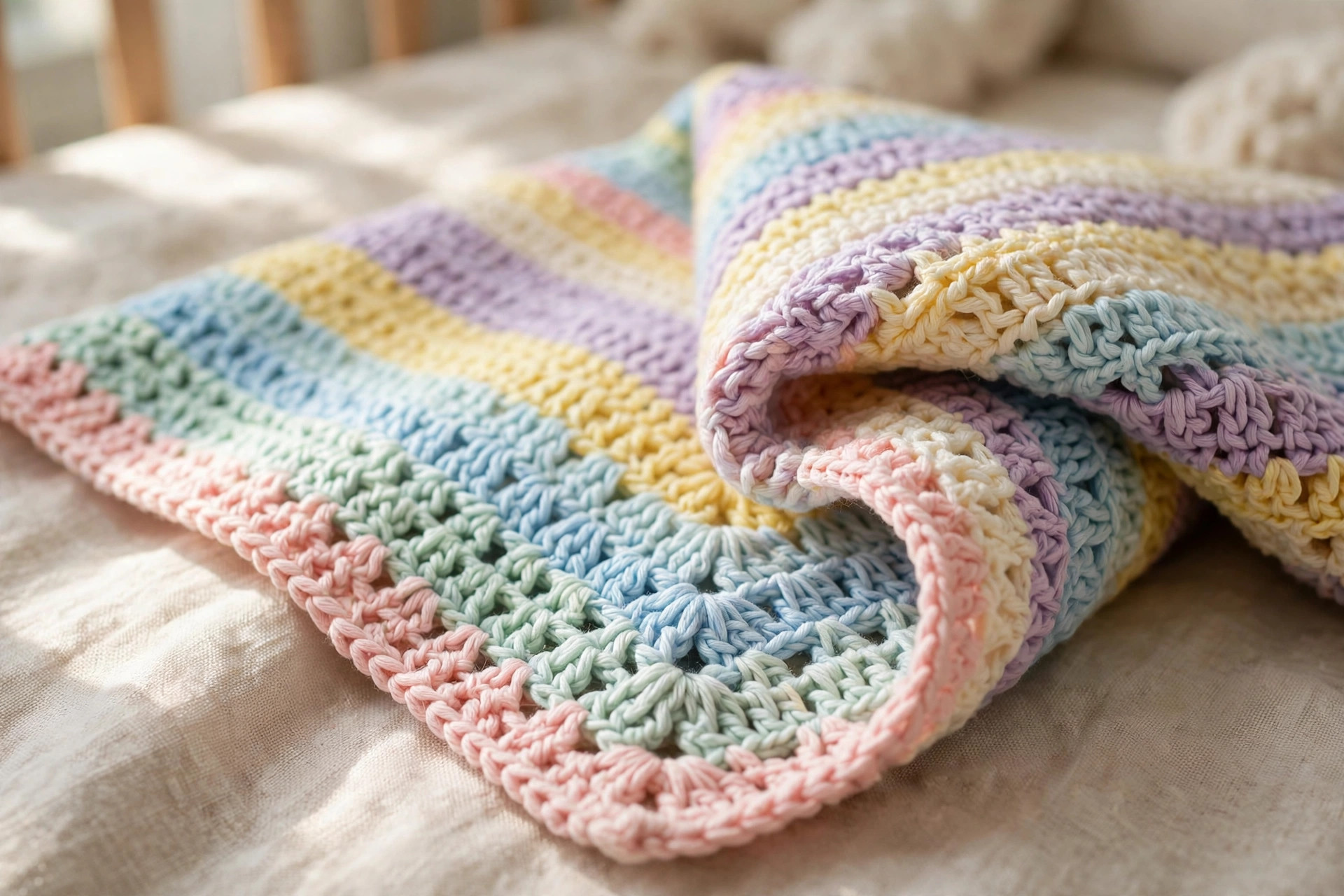
Granny stripes are the baby-blanket cheat code: clusters of 3 double crochets worked into the gaps of the previous row, which means no stitch-counting anxiety — the gaps tell you exactly where to put your hook. This version uses five pastel colors in rotation for a soft rainbow effect, and it coordinates beautifully with handmade gifts like our little lamb baby snuggle gift set.
Materials
- Worsted-weight (#4) yarn in 5 pastel colors — blush pink, mint, sky blue, butter yellow, lavender (~120 g / just over 1 skein each; 600 g total)
- 5.0 mm (H-8) hook
Size & gauge
- Finished size: ≈ 75 × 90 cm (30 × 36 in) after border.
- Gauge: one 3-dc cluster ≈ 2.5 cm wide; 4 pattern rows ≈ 6 cm tall. Exact gauge matters less here because the clusters are self-spacing.
Pattern
Foundation: Ch 103 (any multiple of 3, plus 1 — so 103, 133, 163… for other widths).
Row 1: 3 dc in the 4th ch from hook, *skip 2 ch, 3 dc in next ch; rep from * until 3 ch remain, skip 2 ch, 1 dc in last ch. (33 clusters + 1 edge dc = 100 dc.)
Row 2: Ch 3 (counts as dc), turn, 2 dc in the first space (between the turning chain and the first cluster — this plus the ch-3 forms the edge cluster), *3 dc in the next space between clusters; rep from * across, 1 dc in the last space (between the final cluster and the turning chain). (33 clusters + edge stitches = 100 sts — same as Row 1.)
Rows 3–60: Repeat Row 2, changing color every 2 rows and cycling through your 5 colors in order. The clusters always go into the spaces — never into the tops of stitches — which is why the rows stay perfectly aligned without counting.
Check yourself at row 4: lay the blanket flat. The edges should be straight and every row should have 33 clusters. If a cluster went missing, you'll see a gap in the stripe rhythm — frog back to the mistake now, not at row 40.
Finishing
Border, Round 1: Join your first color in any corner. Sc evenly around: 1 sc in each stitch or space across top and bottom, 1 sc in the side of each row, 3 sc in each corner.
Round 2: Repeat Round 1. Fasten off, weave in ends. For a baby blanket, weave ends extra carefully — split the yarn tail and weave each ply in a different direction so nothing works loose in the wash.
Tips
- The edge cluster trick (2 dc in the first space on Row 2) is what keeps the sides straight. Don't skip it or the blanket will narrow every row.
- Two-row stripes, no ends: carry colors up the side exactly like Pattern 1.
- Make it bigger: add multiples of 3 to the foundation chain and work more 2-row stripes. A 100-stitch-wide version at 80 rows makes a generous toddler blanket.
Pattern 3: Cloud Puff textured throw
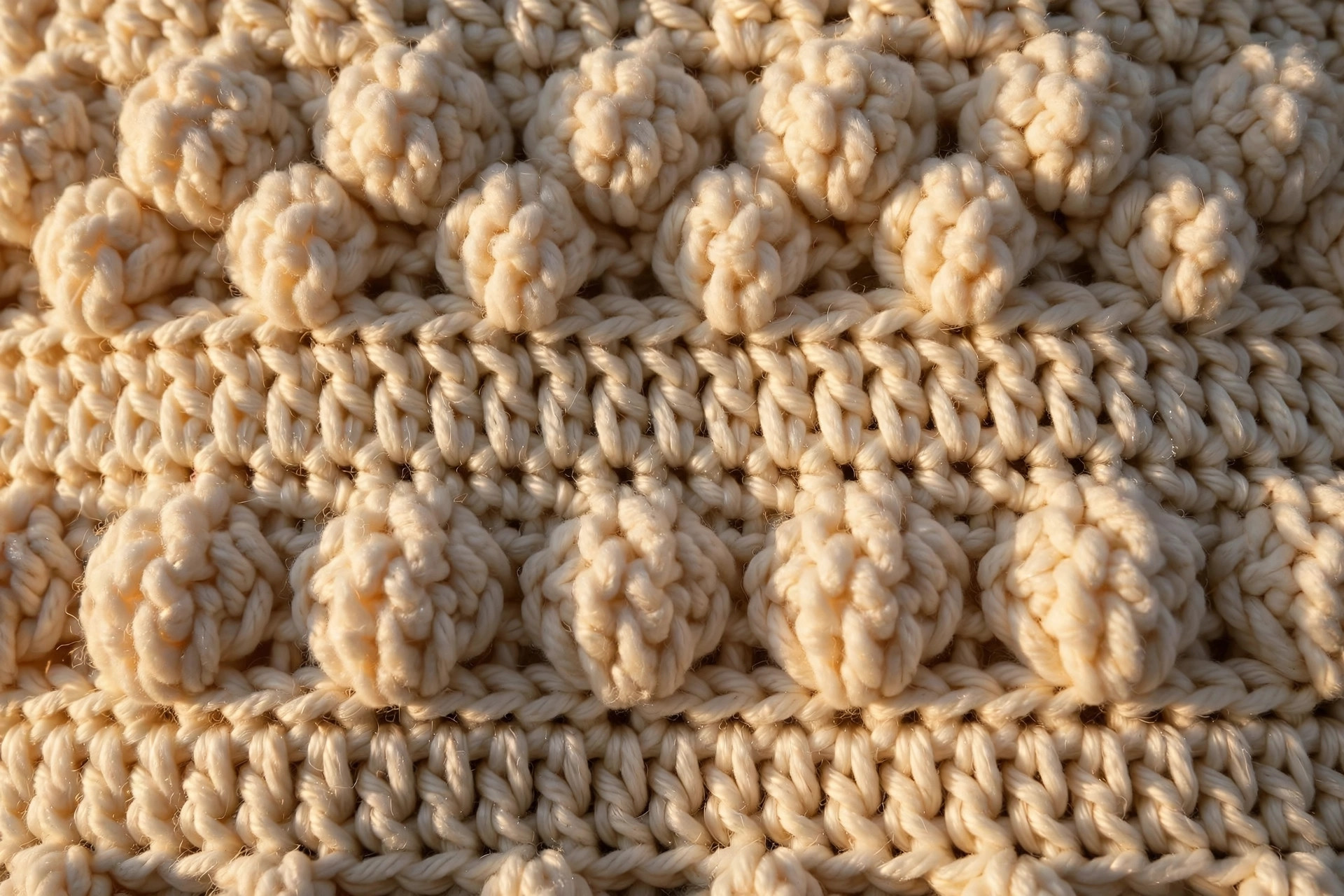
This is the "wait, a beginner made that?" blanket. Alternating bands of double crochet and puff-stitch rows create a rich, touchable texture from just two stitch patterns on repeat. In cream or ivory it's pure cozy minimalism. It's also the heaviest yarn-eater of the three, so check the amounts before you start.
Materials
- Worsted-weight (#4) yarn in cream or ivory, ~900 g (9 skeins) — texture eats yarn, buy one extra skein
- 6.0 mm (J-10) hook (the larger hook keeps the puff bands soft and drapey)
Size & gauge
- Finished size: ≈ 100 × 120 cm (40 × 47 in) after border.
- Gauge: 14 sc = 10 cm; puff band rows ≈ 1.4 cm tall, dc rows ≈ 1.6 cm tall.
Abbreviations used here
Just one extra: puff = [yarn over, insert hook in st, yarn over, pull up] twice in the same stitch (5 loops on hook), yarn over, pull through all 5 loops, ch 1 to close.
Pattern
Foundation: Ch 142 (any even number of chains works for other widths — the stitch count must stay odd).
Row 1: Sc in the 2nd ch from hook and in each ch across. (141 sc.)
Row 2: Ch 1, turn, sc in each st across. (141 sc.)
Row 3: Ch 3 (counts as dc), turn, dc in each st across. (141 dc.)
Rows 4–6: Repeat Row 3 three more times. (4 dc rows total.)
Row 7 (puff row): Ch 1, turn, sc in first st, *puff st in next st, sc in next st; rep from * across. (70 puffs + 71 sc = 141 sts — the count never changes because each puff uses exactly one stitch.)
Row 8: Ch 1, turn, sc in each st across, working into the top of each puff and each sc. (141 sc.)
Bands: Repeat Rows 3–8 eleven more times (12 bands total = 72 rows).
Final rows: Work 4 rows of dc (as Row 3), then 2 rows of sc (as Row 2). Fasten off. (Total: 80 rows ≈ 120 cm long.)
A note on the puff rows: they will look ruffled and tight while you work them — that's normal. The following sc row pulls everything into line, and the whole band relaxes after blocking. Don't frog a puff row because it looks wavy mid-row.
Finishing
Border, Round 1: Join yarn in any corner. Sc evenly around: 1 sc per stitch on top and bottom, 1 sc per row on the sides, 3 sc in each corner.
Round 2: *Sc in each st across to the corner, 3 sc in corner st; rep around. Fasten off and weave in ends.
Give this one a proper blocking — pin it out to 100 × 120 cm while damp. The puff bands bloom beautifully and the blanket will drape instead of curl.
Tips
- Keep puffs loose. If your puffs are drum-tight, go up half a hook size for the puff rows only. Tight puffs make the blanket stiff and eat even more yarn.
- Count the sc rows, not the puff rows. Rows 2 and 8 are your checkpoints: both must have 141 sc. If they do, the puff rows between them are correct by construction.
- Yarn chicken insurance: weigh your remaining yarn when you finish band 8. You need roughly a third of the total for the last 4 bands plus border — if you're short, make the final dc section 2 rows instead of 4.
Make it yours: colorway ideas
Once you've made one, the same three patterns become completely different blankets in new colors:
- Modern neutral: Pattern 1 in charcoal, oatmeal, and rust — sophisticated enough for a living room, easy enough for TV crocheting.
- Nursery rainbow: Pattern 2 in saturated brights instead of pastels. The granny stripe was born for rainbow yarn cakes.
- Coastal calm: Pattern 3 in soft blue-gray. The puff texture catches the light like waves — it's stunning in a single muted color.
And if blankets have given you the big-project bug, the star blanket is our showpiece round blanket, while the autumn acorn granny square is the perfect small-square practice if you want to try join-as-you-go construction next.
Troubleshooting tips
- Your edges are slanting inward or outward. You added or lost stitches. For Patterns 1 and 3, count the next sc/dc row — it must match the foundation count (112 / 141). For Pattern 2, count clusters per row (33).
- The foundation chain is too tight and the bottom edge puckers. Redo it with a hook one size larger, then switch back to the pattern hook for row 1. This is the single most common blanket problem and the easiest to fix.
- Stripes have little blips of the wrong color at the edge. You're changing color one stitch too late (or early). Change on the last yarn-over of the last stitch of the row — not after the turning chain.
- The blanket is growing wider as you go. Your turning chain is being worked into as a stitch on the way back. The ch-3 counts as the first dc — so skip the very first stitch of the row and work into the second.
- Puff rows look messy and uneven. They always do mid-row. Finish the following sc row before judging, and keep your closing chain-1 snug but not strangling.
- Your blanket curls like a scroll. That's tension plus gravity on a narrow piece — it relaxes as the blanket gains weight and width. A proper blocking at the end fixes the rest.
Frequently asked questions
How long does it take to crochet a blanket?
Longer than a weekend, shorter than you fear. The lap blanket takes most beginners 15–20 hours — about two weeks of evening sessions. The baby blanket works up faster at 10–15 hours because granny clusters are speedy. The textured throw is slowest at 20–30 hours since puff stitches eat time along with yarn. An hour a night finishes any of these within a month.
How much yarn do I need for a crochet blanket?
For these three, exactly: the lap blanket needs ~700 g of worsted-weight yarn, the baby blanket ~600 g, and the textured throw ~900 g (textured stitches consume roughly 30% more yarn than plain double crochet). When in doubt, buy one extra skein — running out mid-blanket in a different dye lot is worse than having leftovers.
What is the easiest crochet stitch for a blanket?
Double crochet, full stop. It's tall so the blanket grows quickly, it's simple enough to work without looking down, and — as Pattern 1 proves — plain double crochet in good stripes looks genuinely beautiful. If you can double crochet a dishcloth, you can double crochet a blanket; the only difference is stamina. Our crochet dishcloths make the perfect practice swatch before you commit to 88 rows.
Can I make these blankets bigger or smaller?
Yes — each pattern includes its foundation-chain formula. Pattern 1: any number of chains (just keep the stitch count consistent). Pattern 2: a multiple of 3, plus 1. Pattern 3: any even number of chains. For length, work more or fewer rows/bands, always ending after a complete stripe or band repeat so the design stays symmetrical.
Do I really need to block a crochet blanket?
For Patterns 1 and 2, blocking is optional — a light steam or damp press just tidies the edges. For Pattern 3, yes, block it: the puff bands genuinely transform, lying flatter and looking far more even. You don't need fancy equipment — a towel on the floor, some rust-proof pins, and patience.
Can I sell blankets I make from these patterns?
Yes! You may sell finished blankets made from these original patterns in small batches — craft fairs, Etsy, gifts, all fine. Please credit Little Loop Finds as the designer with a link back to this page. The pattern text and photos themselves may not be redistributed, republished, or sold.
More free patterns to try
Keep that hook moving. The star blanket is our round showpiece blanket for when you want a centerpiece project, the crochet shawl uses the same relaxing double-crochet rhythm in a wearable size, the autumn acorn granny square teaches you motif joining for a future patchwork blanket, and the easy beginner crochet patterns roundup has smaller projects for practicing new stitches before your next blanket.