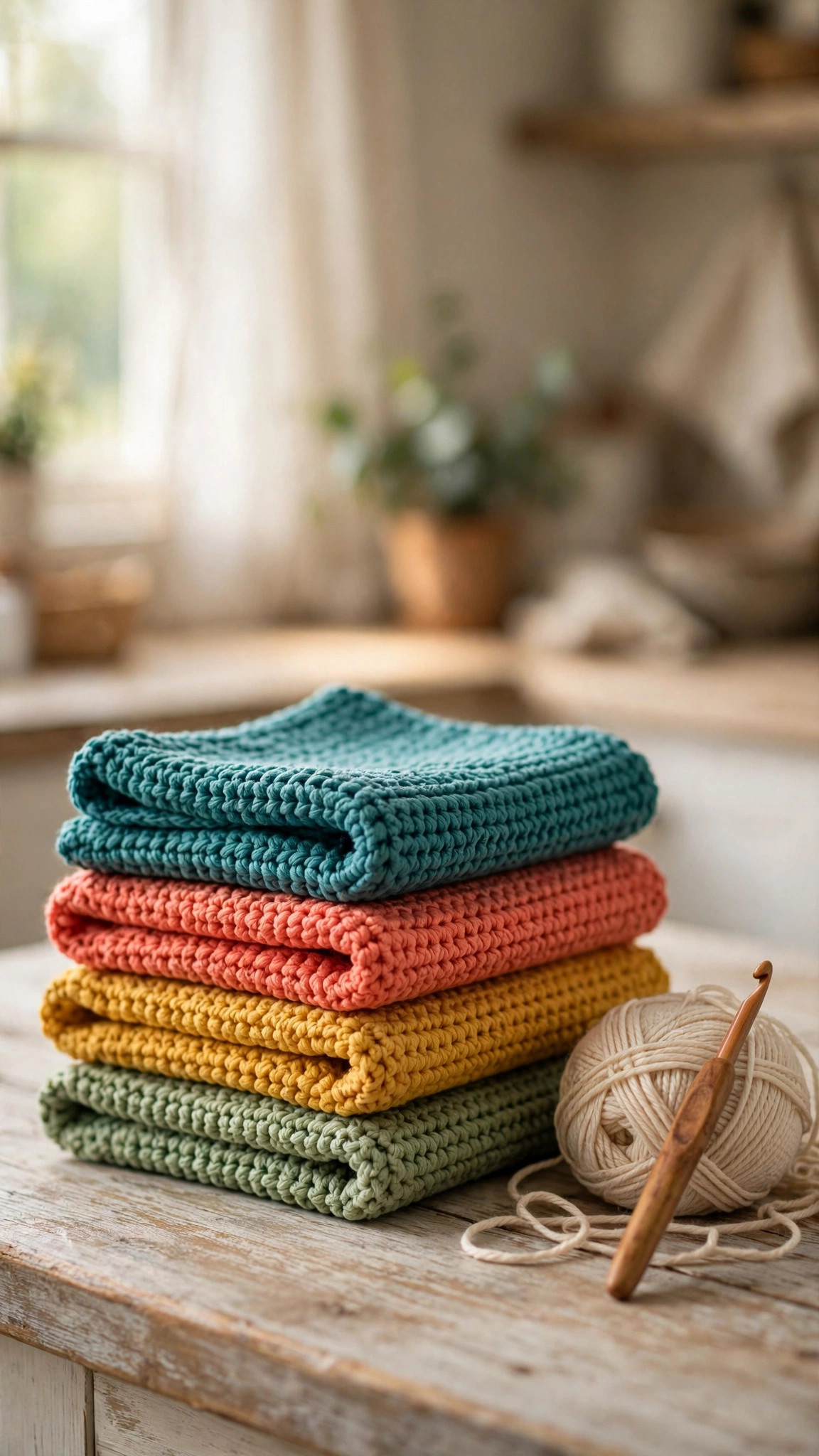
Free crochet dishcloth patterns: 3 easy cotton cloths
Three original dishcloth designs — a ribbed everyday cloth, a thick waffle-weave scrubber and a double-layer round scrubby — with exact stitch counts for every row and round, all in absorbent 100% cotton.

Kitchen · Crochet
- Finished sizes
- 13–20 cm / 5–8 in
- Making time
- About 1–2 hours each
- Hook & yarn
- 5.0–5.5 mm, cotton yarn
- Patterns
- 3 original designs
- Skill
- Beginner
In this post
- Why you'll love these free crochet dishcloth patterns
- The one yarn rule for dishcloths
- Gauge, finished sizes and skill level
- Pattern 1: Everyday ribbed dishcloth
- Pattern 2: Waffle-weave dishcloth
- Pattern 3: Round spiral scrubby
- Caring for your cotton dishcloths
- Turn a stack into a gift
- Troubleshooting tips
- Frequently asked questions
- More free patterns to try
If your kitchen drawer is full of thin, sad store-bought cloths that push water around instead of soaking it up, it's time to crochet your own. These three free crochet dishcloth patterns were designed as a complete set: a ribbed everyday cloth for wiping counters, a thick waffle-weave cloth with real scrubbing power, and a double-layer round scrubby for dishes. Each one takes just an hour or two, uses basic stitches, and comes with exact stitch counts for every row and round — no guesswork, no frogging.
Why you'll love these free crochet dishcloth patterns
Most free dishcloth patterns are a plain square of single crochet with no explanation of why cotton matters or how to get a professional edge. These three were designed to fix that. The ribbed cloth teaches back-loop texture, the waffle cloth teaches front-post stitches (the gateway to every textured stitch you'll ever learn), and the round scrubby teaches increases in the round — the same math behind hats, baskets, and amigurumi. Make all three and you've quietly learned half the skills in crochet.
They're also the ultimate stash-busters and gift-makers. A stack of three cloths tied with twine plus a bar of nice soap is a housewarming gift that looks like it cost far more than the hour it took. And if you enjoy quick, satisfying makes, our autumn acorn granny square is another one-evening stash-buster with the same giftable charm.
The one yarn rule for dishcloths
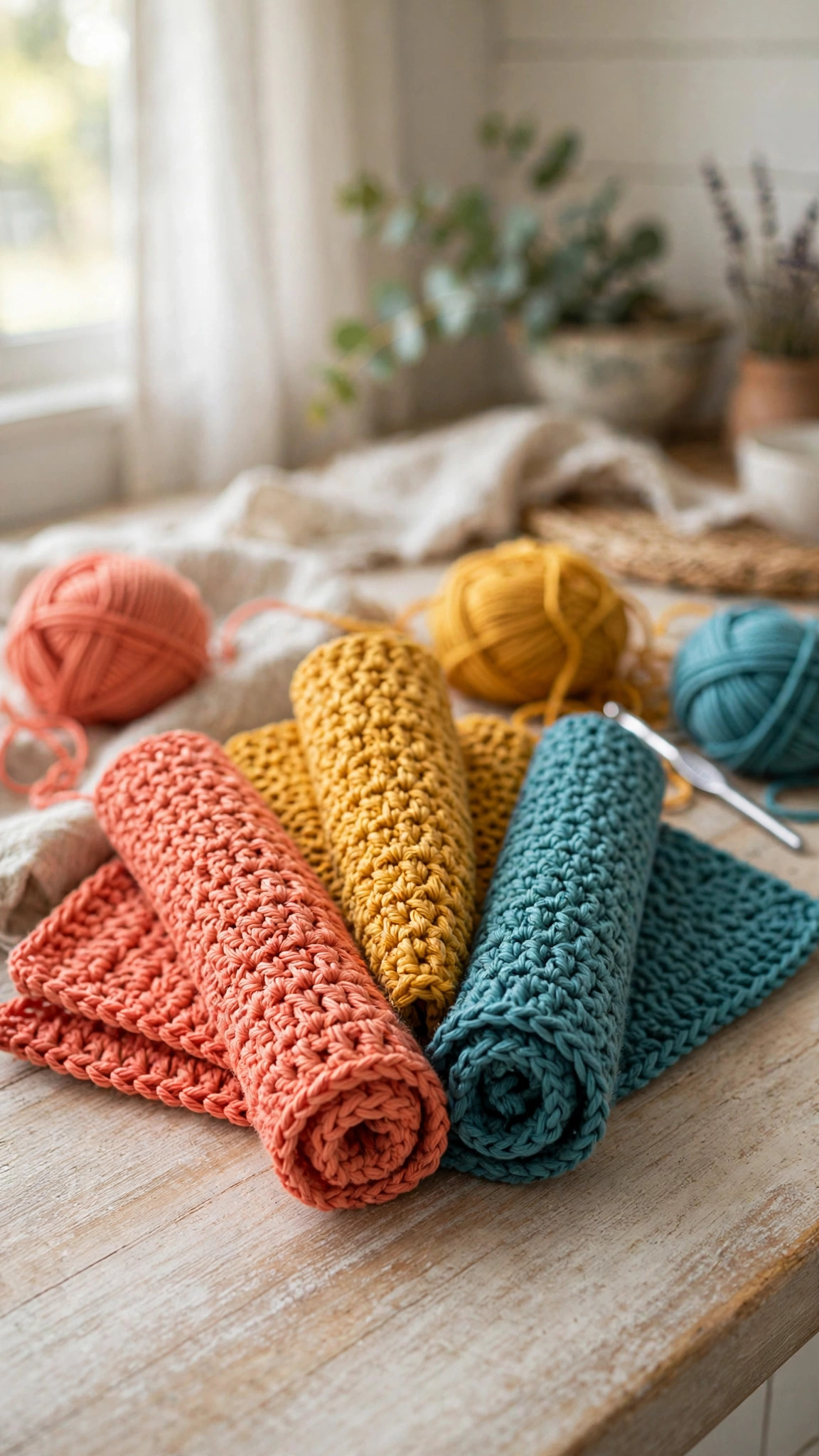
There is exactly one non-negotiable rule: use 100% cotton yarn. Acrylic doesn't absorb water — it just smears it around — and it melts if it touches a hot pan. Cotton gets softer and more absorbent with every wash, survives hot water and bleach-free disinfecting, and at the end of its life you can compost it. Look for worsted-weight (#4) kitchen cotton; one 60 g ball makes a square cloth with yarn to spare.
| Supply | What to get |
|---|---|
| Yarn | Worsted-weight (#4) 100% cotton — about 45 g for the ribbed cloth, 70 g for the waffle cloth, 50 g for the scrubby |
| Crochet hook | 5.0 mm (H-8) for the ribbed cloth and scrubby; 5.5 mm (I-9) for the waffle cloth |
| Notions | Tapestry needle, scissors, one stitch marker (for the scrubby) |
A note on color: light and medium colors show off texture best in photos and make it easier to see your stitches while you work. Very dark cotton (navy, black) is genuinely harder to crochet — save it for your second batch.
Gauge, finished sizes and skill level
- Finished sizes: ribbed cloth about 17 cm (6.75 in) square; waffle cloth about 20 cm (8 in) square; round scrubby about 13 cm (5 in) across and double-thick.
- Gauge: 16 single crochet = 10 cm (4 in) with a 5.0 mm hook; 14 double crochet = 10 cm with a 5.5 mm hook. Gauge isn't critical here — if your cloth comes out a centimeter bigger or smaller, it still wipes counters beautifully.
- Skill level: confident beginner. Pattern 1 needs only chain and single crochet. Pattern 2 adds the front-post double crochet, fully explained below. Pattern 3 needs a magic ring and basic increases.
Pattern 1: Everyday ribbed dishcloth
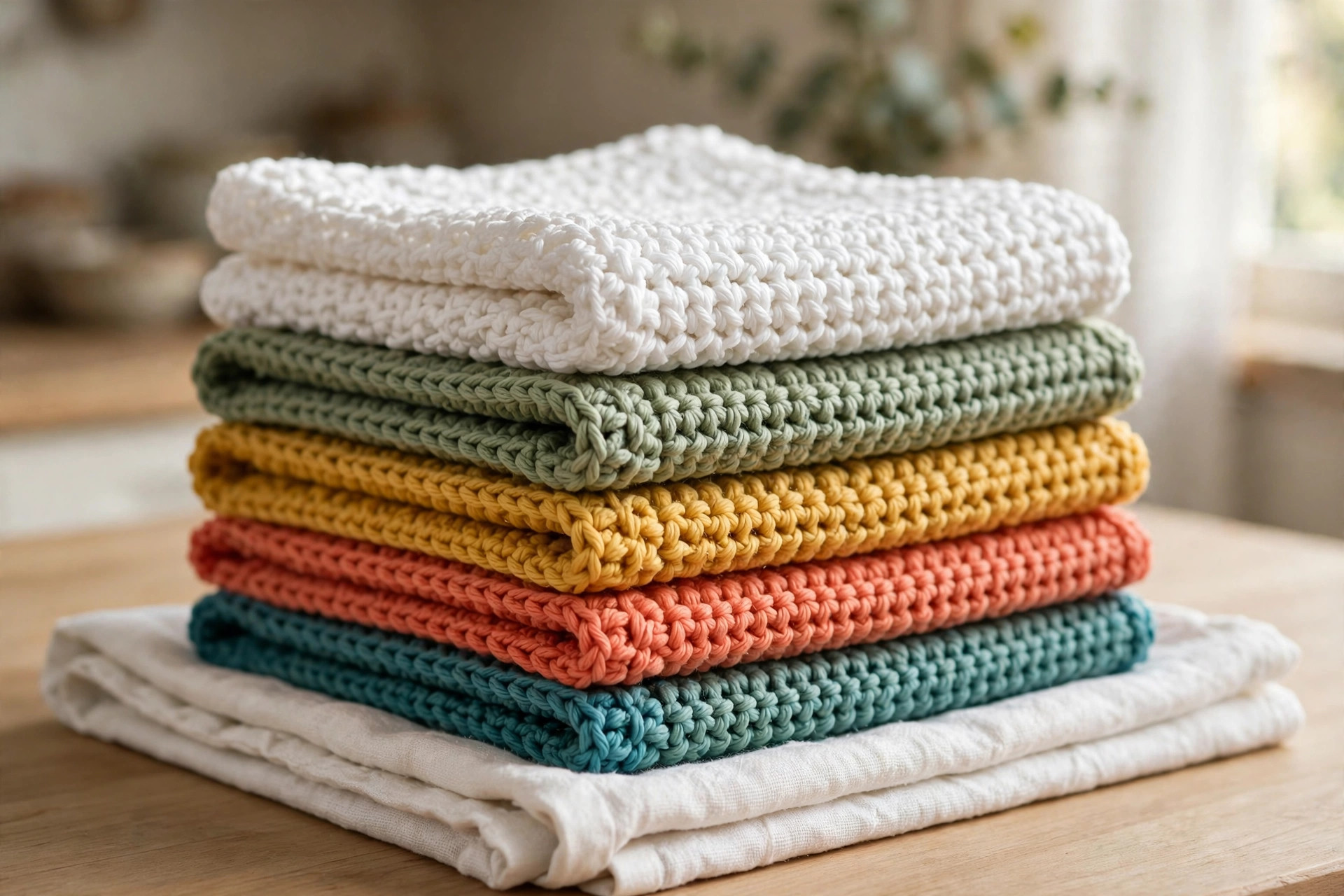
This is the workhorse of the set — the cloth you'll reach for fifty times a day. Working every row in the back loop only creates soft ribs that trap crumbs and give the fabric a pleasant stretch, and a simple single-crochet border keeps the edges lying flat wash after wash.
Materials
- About 45 g worsted-weight 100% cotton
- 5.0 mm (H-8) hook
Size & gauge
- About 17 cm (6.75 in) square after a light blocking.
- Gauge: 16 sc × 18 rows = 10 cm (4 in).
Abbreviations
- ch — chain
- sc — single crochet
- BLO — back loop only (work into the back loop of the stitch, leaving the front loop free — this creates the rib)
- st(s) — stitch(es)
- RS / WS — right side / wrong side
Pattern
- Foundation: Ch 28.
- Row 1 (RS): Sc in 2nd ch from hook and in each ch across (27 sts).
- Rows 2–30: Ch 1, turn, sc in BLO of each st across (27 sts).
- Border round: Do not fasten off. With RS facing, ch 1 and sc evenly around all four sides: 27 sc across the top, 3 sc in the corner, 30 sc down the side (one per row-end), 3 sc in the corner, 27 sc across the bottom, 3 sc in the corner, 30 sc up the side, 3 sc in the corner. Join with a sl st to the first sc (126 sts). Fasten off.
Tip: count 27 stitches at the end of Row 1 before going further — the last chain is easy to miss, and every later row depends on it.
Finishing
Weave in both ends with a tapestry needle, working the tail through the backs of several stitches in two different directions so it can't wriggle loose in the wash. If the edges curl slightly, lay the cloth flat, spritz with water, and press gently with your hands — cotton blocks beautifully with almost no effort.
Tips
- If your ribs aren't showing, you're probably working under both loops out of habit. Check the first few rows: you should see a distinct front loop sitting unworked on the surface.
- Uneven side edges almost always mean inconsistent turning chains. The ch-1 at the start of each row is just a step up, not a stitch — never work into it.
- Make three in a gradient of one color family (sage, teal, sea-glass) for a gift set that looks professionally curated.
Pattern 2: Waffle-weave dishcloth
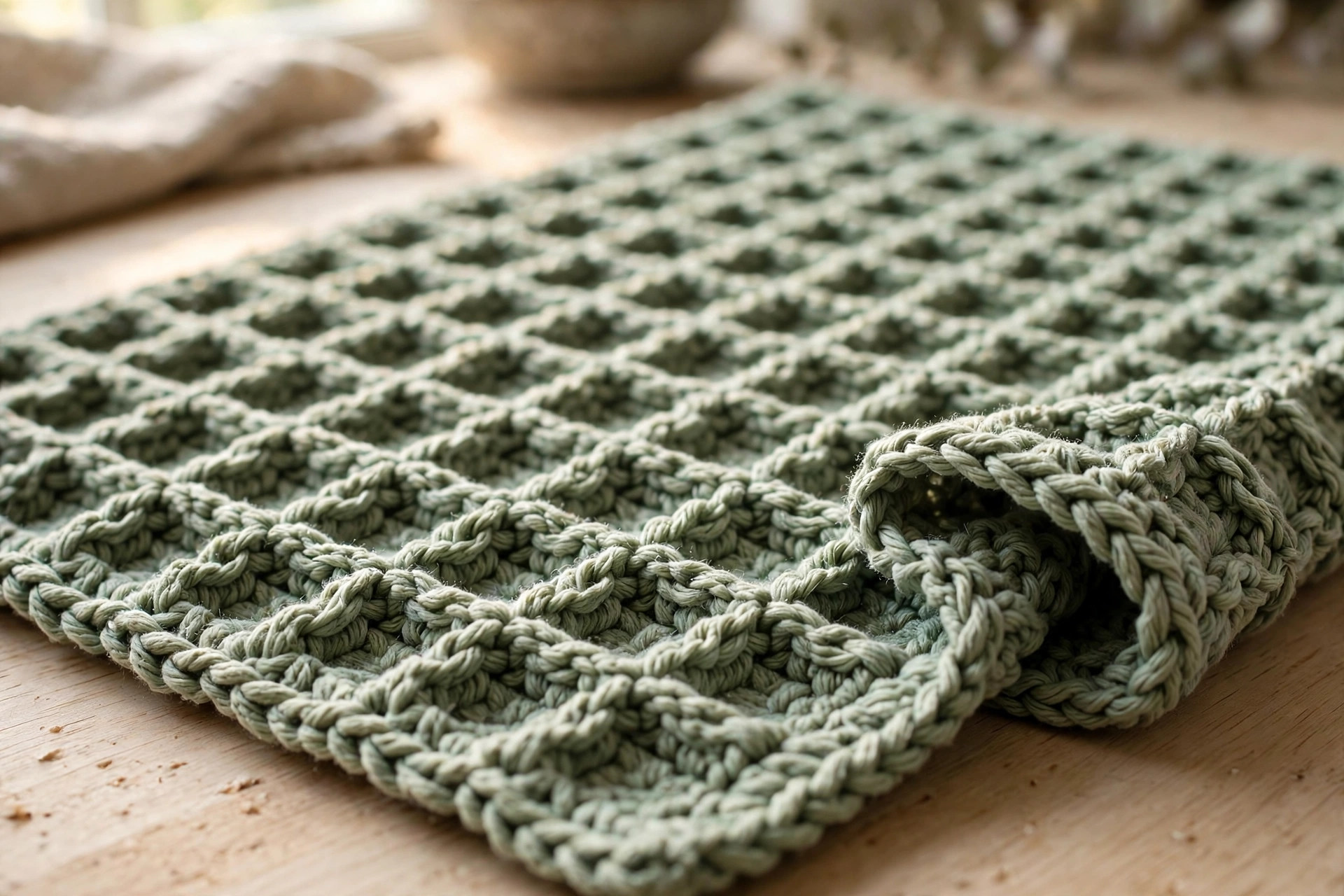
This is the heavy-duty member of the set. Alternating rows of front-post double crochet build a deep waffle grid that's textured on both sides — all those little pockets hold soapy water and give you real scrubbing power without any scratchy yarn. Yes, it eats more yarn than plain single crochet (about 50% more), and yes, it's worth it.
Materials
- About 70 g worsted-weight 100% cotton
- 5.5 mm (I-9) hook — the slightly larger hook keeps the dense waffle fabric pliable
Size & gauge
- About 20 cm (8 in) square.
- Gauge: 14 dc = 10 cm (4 in). Row gauge doesn't matter — you'll work to a measurement.
Abbreviations
- ch — chain
- dc — double crochet
- FPdc — front-post double crochet: yarn over, insert the hook from front to back to front around the post of the indicated stitch (instead of into its top), then complete the double crochet as normal. The post pops forward, creating the raised waffle rib.
- st(s) — stitch(es)
Pattern
- Foundation: Ch 31.
- Row 1 (RS): Dc in 3rd ch from hook and in each ch across. The turning chain does not count as a stitch (29 dc).
- Row 2: Ch 2 (does not count as a stitch), turn, dc in first st, FPdc around each of next 2 sts, dc in next st 9 times, dc in last st (29 sts).
- Row 3: Ch 2 (does not count as a stitch), turn, dc in first st, dc in next 2 sts, FPdc around next st, dc in next 2 sts 8 times, FPdc around next st, dc in last st (29 sts).
- Rows 4+: Repeat Rows 2–3 until the piece measures about 20 cm (8 in) square — roughly 7 more repeats — ending with a Row 3.
- Border round: With RS facing, ch 1 and sc evenly around: 29 sc across the top and bottom, about one sc per row-end along each side, 3 sc in each corner st. Join with a sl st, fasten off.
Notice how the single FPdc in Row 3 lands on the plain double crochet sitting between each pair of FPdc from Row 2 — that offset is what builds the waffle grid instead of straight ribs.
Tip: post stitches naturally pull your tension tighter. Consciously relax your grip on FPdc rows; if the fabric feels like cardboard, that's your cue, not a design flaw.
Finishing
Weave in the ends as for Pattern 1. The waffle texture can cup slightly off the hook — lay it flat, mist with water, and let it dry under a book overnight. One blocking is all it ever needs.
Tips
- Can't see where to insert the hook for an FPdc? Tilt the work toward you — the posts of the previous row stand up in a neat row like fence posts.
- Running short on yarn? The waffle cloth is the hungriest of the three; start it with a full fresh ball, not leftovers.
- This stitch pattern also makes an excellent washcloth — work the same pattern to 15 cm square for a face-sized version.
Pattern 3: Round spiral scrubby
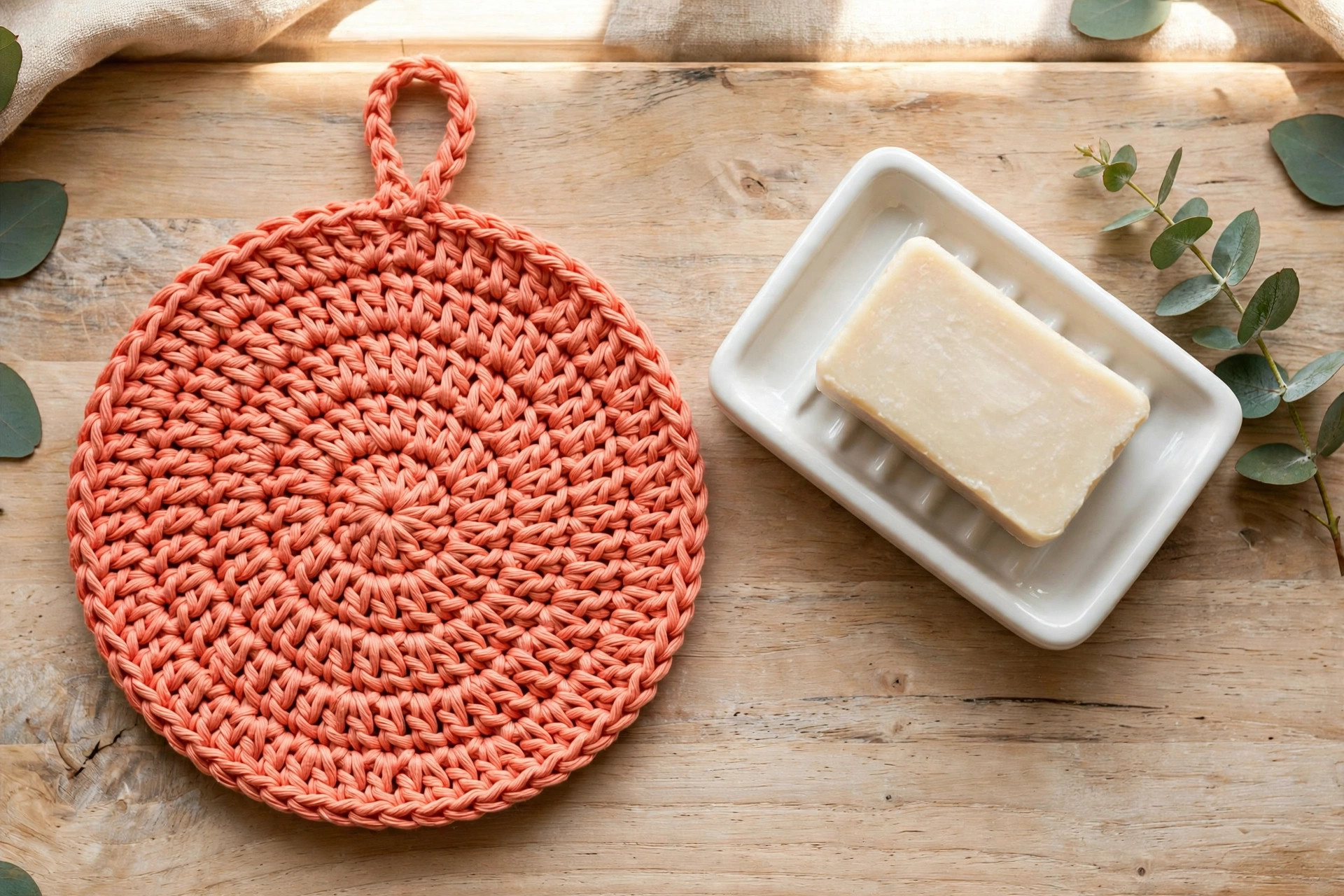
Two identical circles joined into one thick pad, finished with a hanging loop so it can drip-dry by the sink. The spiral construction means no visible seam, and the double layer gives it the heft of a store-bought sponge with none of the plastic. This is the pattern that converts skeptics — make one and you'll never buy sponges again.
Materials
- About 50 g worsted-weight 100% cotton
- 5.0 mm (H-8) hook
- Stitch marker
Size & gauge
- About 13 cm (5 in) across, double thickness. Gauge is not critical.
Abbreviations
- MR — magic ring
- hdc — half double crochet
- inc — increase (2 hdc in the same stitch)
- sl st — slip stitch
- R — round
Pattern — make 2 identical circles
Work in a continuous spiral. Mark the first stitch of each round and move the marker up as you go.
- R1: MR, 10 hdc (10 sts)
- R2: Inc in each st (20 sts)
- R3: [Hdc, inc] × 10 (30 sts)
- R4: [2 hdc, inc] × 10 (40 sts)
- R5: [3 hdc, inc] × 10 (50 sts)
- R6: [4 hdc, inc] × 10 (60 sts)
- R7: Hdc in each st (60 sts)
Fasten off the first circle. Do not fasten off the second — continue straight into the joining round.
Joining round: Hold both circles together with their wrong sides facing inward. Working through both layers at once: ch 1, sc in each st around (60 sts), sl st to the first sc.
Hanging loop: Ch 12, sl st into the same stitch (or the next one), fasten off leaving a 15 cm (6 in) tail. Thread the tail onto a tapestry needle and weave it through the base of the loop several times, then into the pad — the loop carries the wet weight of the scrubby, so anchor it well.
Tip: the spiral's stitch counts are the classic increase circle — if your edge starts to wave, you've added too many stitches somewhere; count R6 before moving on, because 60 is the number everything else depends on.
Finishing
Weave in all ends, giving the loop tail extra passes as noted above. No blocking needed — the double layer sits flat on its own.
Tips
- For extra scrubbing texture, work Rounds 5–6 through the back loop only — it creates a ridged surface on the outside of the pad without changing any stitch counts.
- A shorter loop (ch 8) fits over a tap; a longer one (ch 16) hangs from a cabinet knob. Adjust to your sink.
- In a contrasting color, the spiral reads as a decorative trivet — same pattern, new job.
Caring for your cotton dishcloths
Cotton dishcloths are gloriously low-maintenance, with three small caveats. First, expect about 5% shrinkage on the first hot wash — the patterns above are sized so they land exactly right after that first wash, so don't panic when they come out of the dryer slightly smaller. Second, wash them hot with your towels and skip the fabric softener, which coats cotton fibers and slowly kills absorbency; a splash of white vinegar in the rinse keeps them fresh instead. Third, retire them honestly: when a cloth gets thin or starts to smell despite washing, compost it (it's 100% cotton) and crochet a replacement in an evening. That's the whole beautiful cycle.
Turn a stack into a gift
A set of three cloths — one of each pattern — folded, tied with twine, and paired with a bar of handmade soap is a housewarming, hostess, or holiday gift that costs almost nothing and looks entirely intentional. For Christmas baskets, tuck a cloth set in beside our Christmas spiral ornaments; for a holiday hostess gift, pair the stack with our quilted Christmas poinsettia wreath. And a ribbed cloth worked in soft, undyed cotton makes a gentle baby washcloth — bundle it with the little lamb baby snuggle gift set for a baby shower.
Troubleshooting tips
- My cloth isn't absorbent at all. Check your yarn label — if it says acrylic (or anything other than 100% cotton), that's the problem. Acrylic physically can't absorb water. Re-crochet in cotton and keep the acrylic one as a dusting cloth.
- The waffle cloth feels stiff as a board. Two likely causes: tension too tight on the post stitches, or too small a hook. Consciously loosen your FPdc rows, and don't be afraid to go up to a 6.0 mm hook — drape matters more than exact size here.
- My round scrubby is wavy like a potato chip. Too many increases — count Rounds 5 and 6 carefully (50 and 60 stitches). One extra increase early compounds into a ruffle by the edge.
- My round scrubby cups upward like a bowl. The opposite problem: too few stitches, or tension tightening as the rounds grow. Count, and relax your grip on the outer rounds.
- The ribbed cloth's edges are uneven. You're working into the turning chain on some rows and not others. The ch-1 is a step up, never a stitch — the first real stitch of the row goes into the first stitch of the previous row.
- The hanging loop pulls out. The loop tail needs at least three or four passes through the pad's stitches, changing direction each time. A single straight weave will slide out when wet.
- Sides of the waffle cloth pull inward. Post stitches draw the fabric in slightly — this is normal and the border round evens it out. If it's dramatic, your foundation chain was too tight; chain with a hook one size larger next time.
Frequently asked questions
Are these crochet dishcloth patterns really free?
Yes — all three complete patterns above are free, no email signup and no purchase required. If they save you from buying sponges for a year, sharing the post or saving it on Pinterest is a lovely thank-you.
What is the best yarn for crochet dishcloths?
Worsted-weight 100% cotton, without exception. It's absorbent, survives hot washes, softens with age, and won't melt near a hot pan. Avoid acrylic, wool (it felts), and anything labeled "super bulky" — too thick to be practical.
Can I use acrylic yarn if that's what I have?
You can crochet the patterns with it — the stitch counts work in any yarn — but the result won't function as a dishcloth. Acrylic doesn't absorb water. Use it for a practice run if you like, then remake in cotton for the real thing.
How long does one dishcloth take to make?
About 1–2 hours each: the ribbed cloth is the fastest (under an hour once you're in rhythm), the waffle takes a little longer because post stitches are slower, and the scrubby sits in the middle. An evening comfortably produces the full set of three.
Can I sell the finished dishcloths I make?
Yes! You may sell finished cloths made from these patterns in small batches — craft fairs, Etsy, gifts. Please credit Little Loop Finds as the pattern designer with a link back to this page. The pattern text and photos themselves may not be redistributed, republished, or sold.
Why is my waffle cloth smaller than the stated size?
Front-post stitches compress the fabric — that's what makes the texture. If you're more than 2 cm under, your tension is tight; block it with steam and it will relax close to size. Next time, try the 5.5 mm hook or consciously loosen up.
Can a total beginner make the waffle pattern?
Yes — it's only double crochet plus one new stitch, and the FPdc is explained step by step in the abbreviations. Make the ribbed cloth first (one evening), and the waffle will feel like a natural next step rather than a leap.
More free patterns to try
Finished your kitchen set and hungry for more? The star blanket takes the increase-in-the-round skills from the scrubby up to showpiece scale, the autumn acorn granny square is another quick, giftable stash-buster for evenings between bigger projects, and the woodland nursery mobile turns small crocheted pieces into nursery decor. Happy hooking!
The box below contains an Etsy link. If you buy through it, we may earn a small commission at no extra cost to you. Learn more.
No time to make one?
Short on time? Find handmade crochet dishcloths from independent makers on Etsy.
Browse on Etsy (opens Etsy in a new tab)