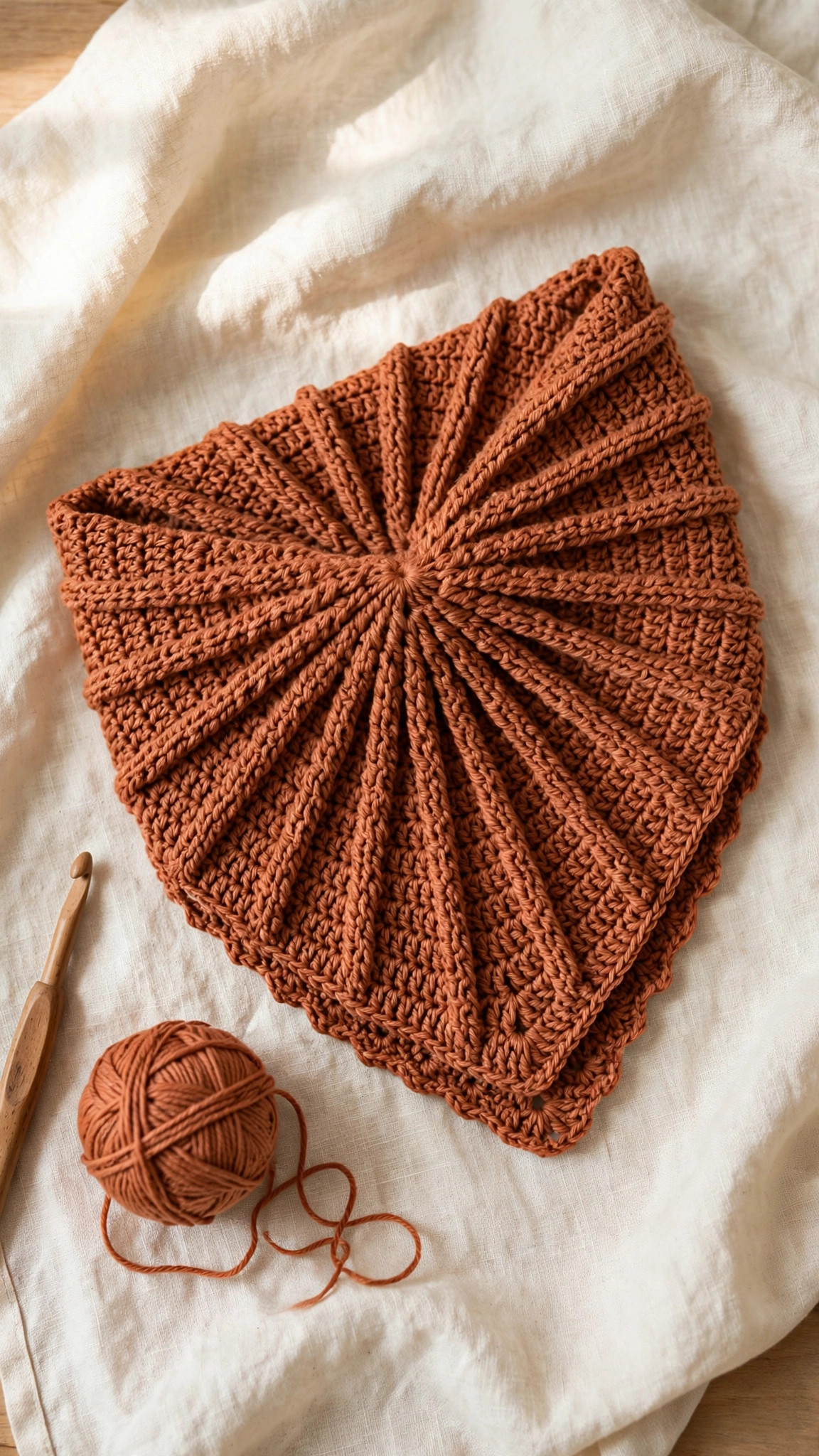
Easy beginner crochet patterns: your first 3 projects
Three original starter projects in US terms — a dishcloth, a headband and a granny square — each teaching exactly one new skill, with verified stitch counts on every row and a troubleshooting section for every common beginner mistake.

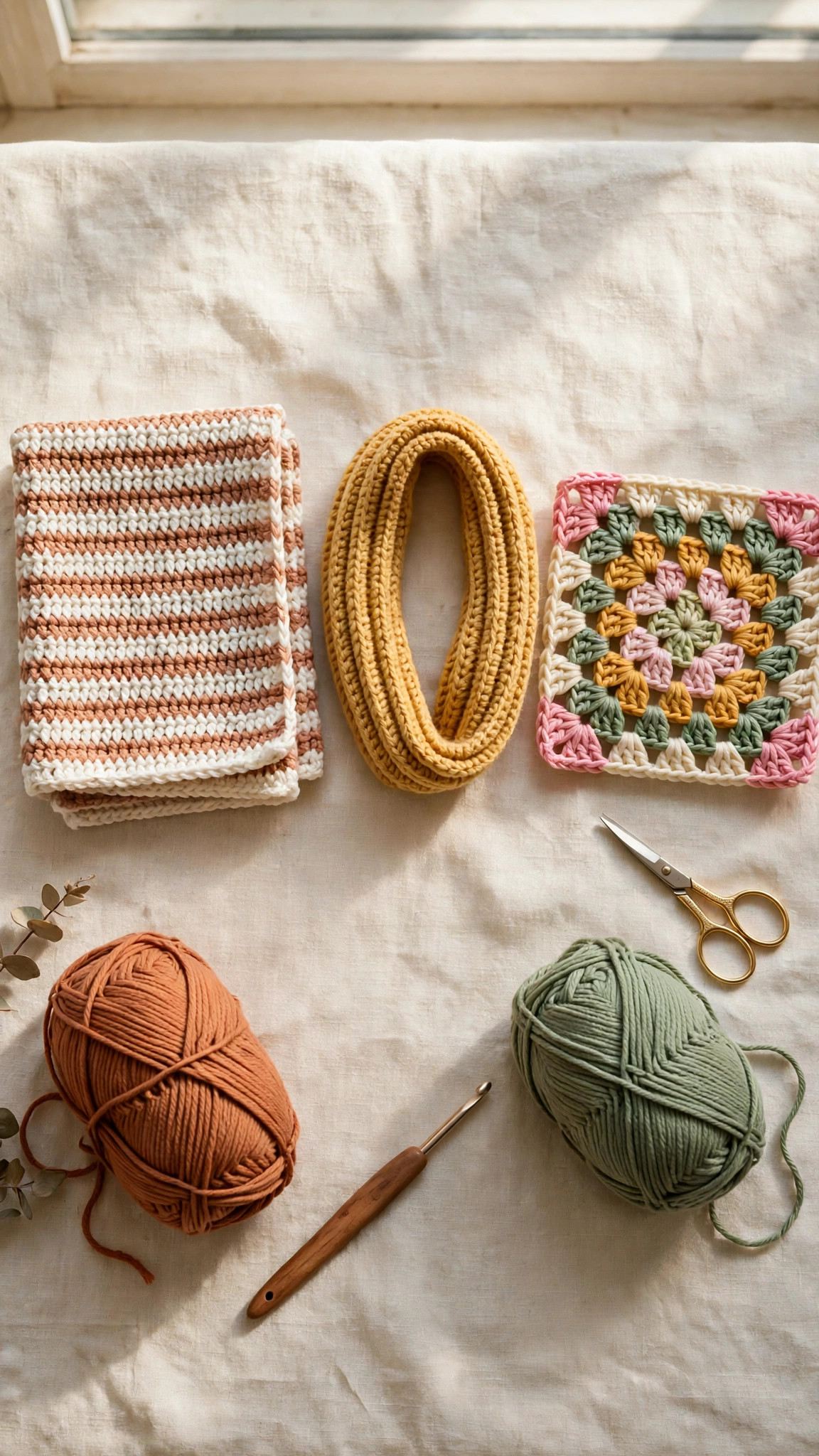
Beginner guide · Crochet
- Projects
- 3 finished starter projects
- Making time
- About 5–7 hours total
- Hooks
- 5.0 mm + 5.5 mm, worsted yarn
- Stitches
- ch, sc, hdc, dc
- Skill
- Absolute beginner
In this post
- Key takeaways
- The beginner roadmap: how the three projects build on each other
- Before you start: yarn, hooks and the four stitches
- Abbreviations — US terms
- Project 1: the everyday dishcloth
- Project 2: the ribbed headband
- Project 3: the classic granny square
- Beginner troubleshooting: the 7 mistakes everyone makes
- What to make next
- Frequently asked questions
- More free patterns to try
If you've just bought your first hook and a skein of yarn, the hardest part of learning crochet isn't the stitches — it's deciding what to actually make first. Too many beginners start with a blanket, stall out at row 40, and never pick the hook up again. The fix is simple: start small, finish fast, and let each finished project teach you exactly one new skill.
That's what this guide does. It's a "first 3 projects" roadmap: a dishcloth that teaches tension and the single crochet, a headband that adds the half double crochet and turning rows, and a granny square that puts the double crochet to work in the round. All three patterns are original designs written for this post, in US terms, with the stitch count of every row and round verified — count your stitches and you'll know immediately if you've gone off track.
Key takeaways
- Project order matters. Dishcloth → headband → granny square builds one new skill per project, and each one finishes in a single sitting.
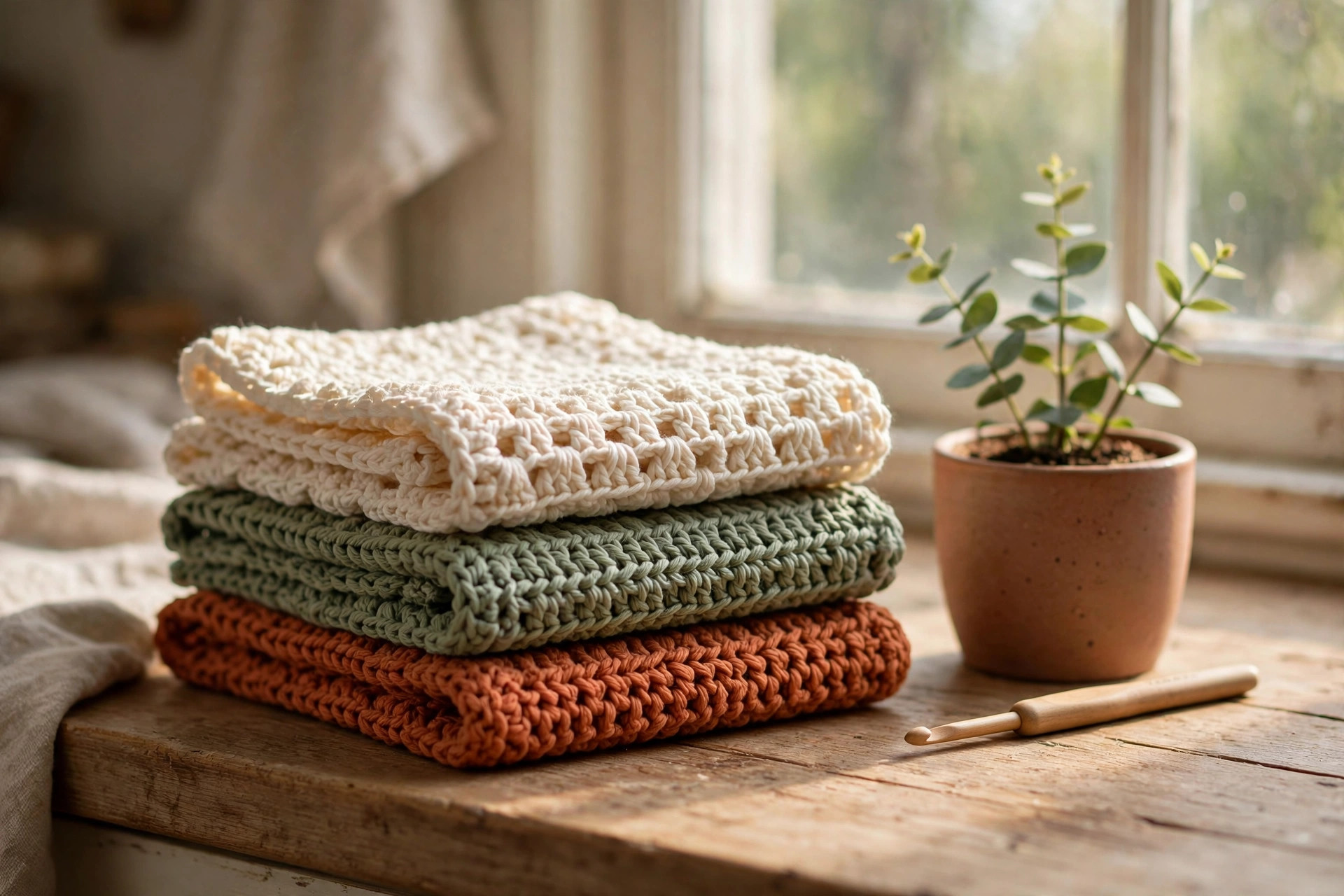
- Cotton for the dishcloth, acrylic for the rest. 100% cotton worsted for the dishcloth (it needs to absorb water); soft acrylic worsted for the headband and granny square (forgiving and cheap to frog).
- Count every row until it's automatic. Every pattern below prints the stitch count in parentheses — if your count doesn't match, rip back now, not later.
- Tension is the real beginner skill. Not speed, not fancy stitches. All three projects are designed to train your hands to make even, consistent stitches.
The beginner roadmap: how the three projects build on each other
Most "easy crochet patterns" lists throw twenty projects at you with no logic behind the order. Here's the logic here: each project introduces exactly one new technique and practices everything that came before.
| Project | New skill you learn | Stitches used | Time |
|---|---|---|---|
| 1. Everyday dishcloth | Tension, turning rows, even edges | ch, sc | 1–2 hours |
| 2. Ribbed headband | The hdc, back-loop ribbing, seaming | ch, hdc | 2–3 hours |
| 3. Classic granny square | The dc, working in the round, corners | ch, sl st, dc | 1–2 hours |
By the time you finish the granny square, you know all four foundational stitches — chain, single crochet, half double crochet, double crochet — and that's about 90% of what most patterns ever ask for.
Before you start: yarn, hooks and the four stitches
You don't need a craft-store haul. For all three projects:
| Supply | What to get |
|---|---|
| Cotton yarn | Worsted-weight (#4) 100% cotton, about 50 g, in a light color (cream, sage or pale blue — dark yarn hides your stitches) |
| Acrylic yarn | Worsted-weight (#4) acrylic, about 100 g total in 2–3 colors you like together |
| Crochet hooks | 5.0 mm (H-8) and 5.5 mm (I-9) — one hook per project below |
| Notions | Tapestry needle, scissors, 2–3 stitch markers |
Which hook for what: the dishcloth and granny square use the 5.0 mm hook; the headband uses the 5.5 mm for a softer, stretchier fabric. If you only own one, use the 5.0 mm for everything — your projects will come out slightly firmer, which is fine.
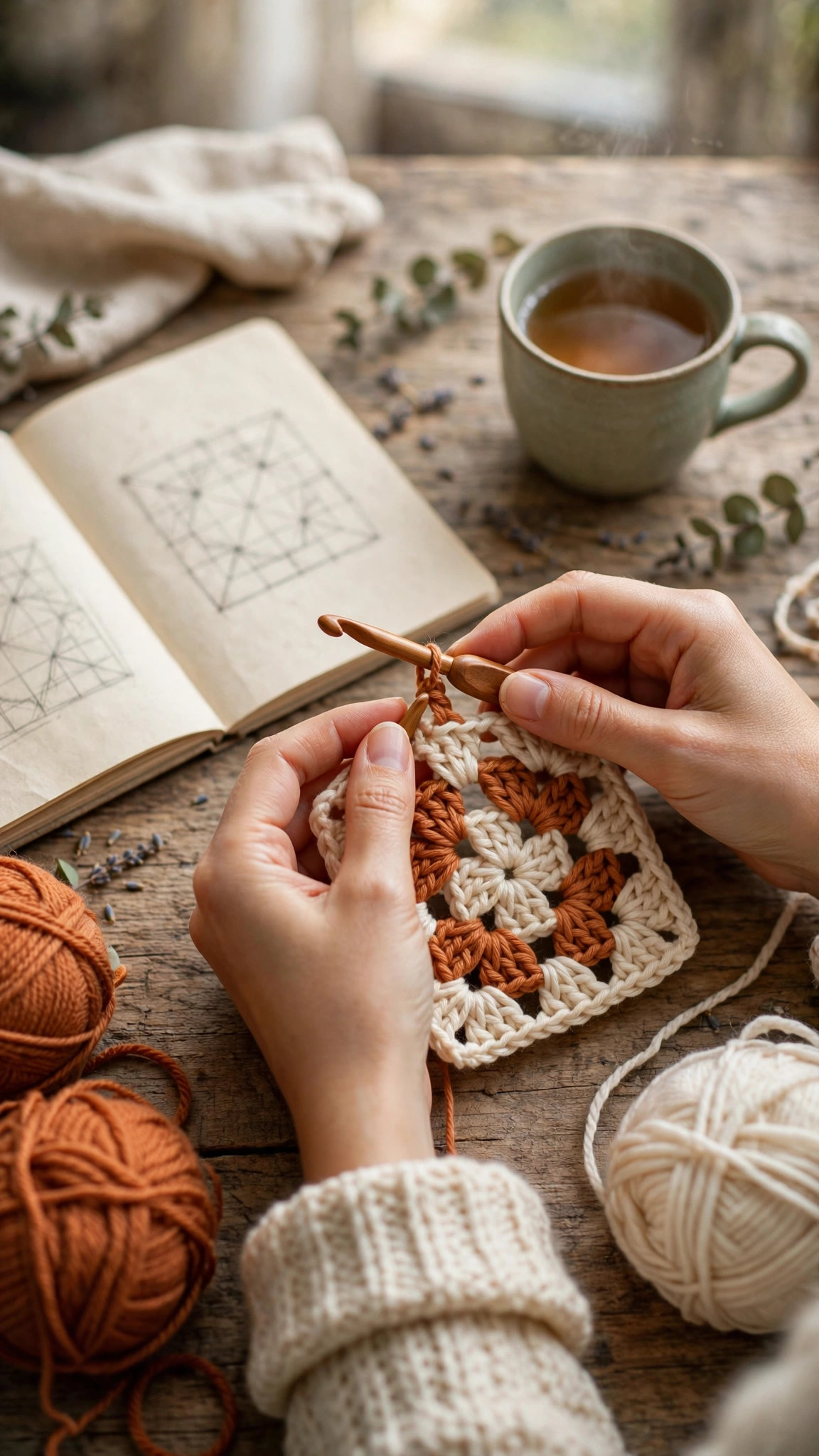
The four stitches in one paragraph. The chain (ch) is the foundation every project starts from. The single crochet (sc) is short and dense — perfect for the dishcloth. The half double crochet (hdc) is the middle child, a little taller and softer — the headband's stitch. The double crochet (dc) is tall and fast, which is why granny squares grow so quickly. Watch one video of each, practice a few rows, and you're ready for Project 1.
Abbreviations — US terms
| Abbreviation | Meaning |
|---|---|
| ch | chain |
| sc | single crochet |
| hdc | half double crochet |
| dc | double crochet |
| sl st | slip stitch |
| BLO | back loop only |
| st(s) | stitch(es) |
| sp | space |
| FO | fasten off |
US vs UK terms: this post uses US terminology, where a double crochet is the tall stitch. In UK terms that same stitch is called a treble crochet. If you're following along with a UK tutorial video, translate accordingly — the stitches are identical, only the names differ.
Project 1: the everyday dishcloth
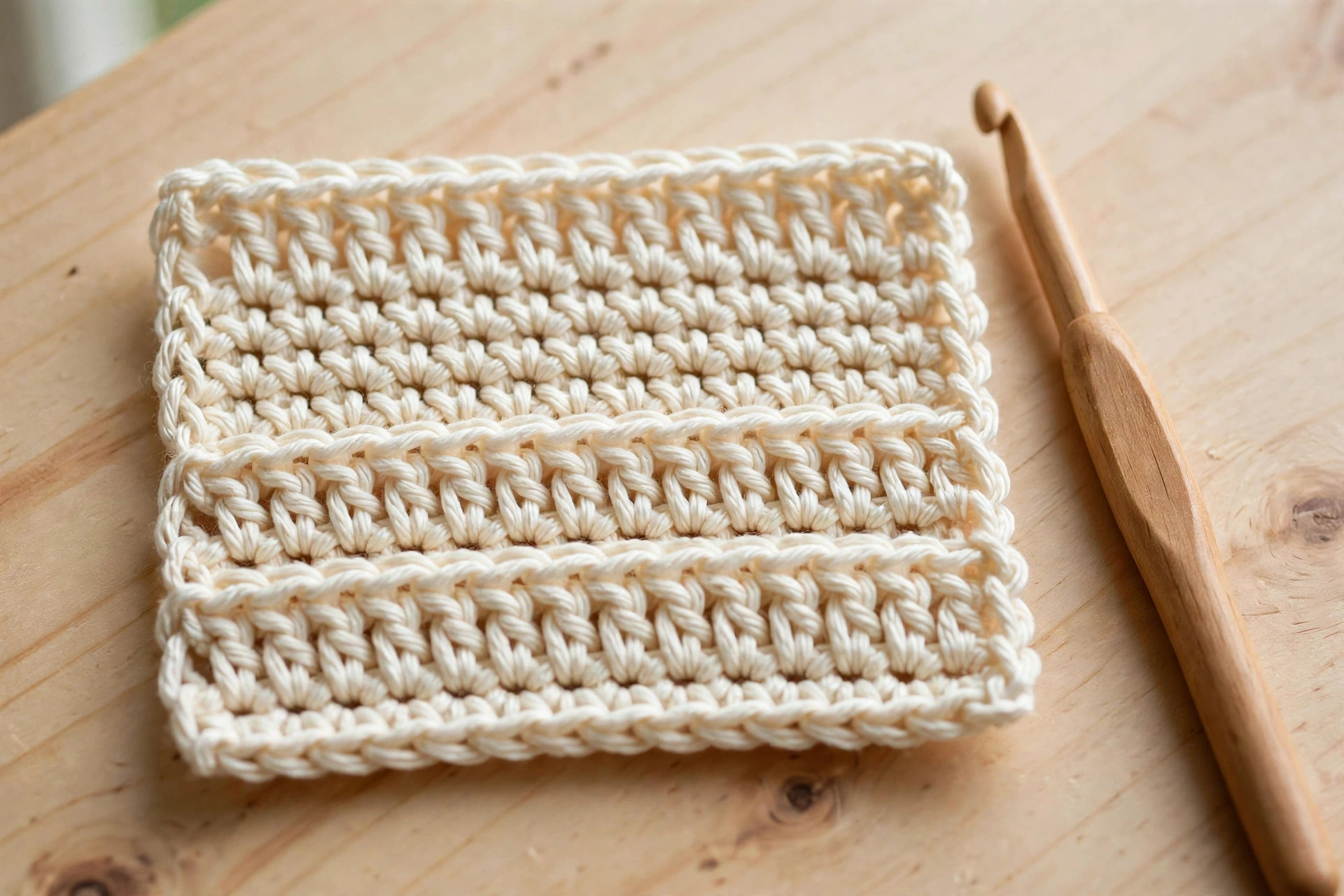
The humble dishcloth is the perfect first project: it's flat, it's small, and nobody cares if the edges wobble a little — it's going to live by the sink. But don't mistake it for a throwaway. Thirty-two rows of single crochet is the fastest way to train even tension, and even tension is the skill every later project depends on.
Materials
- 100% cotton worsted-weight (#4) yarn, about 50 g in a light color
- 5.0 mm (H-8) crochet hook
- Tapestry needle for weaving in ends
Size & gauge
- Finished size: about 20 cm × 20 cm (8 × 8 in)
- Gauge: about 15 sc × 16 rows = 10 cm (4 in). If yours is very different, your dishcloth will just be a bit bigger or smaller — no stress.
Pattern
- Foundation: ch 31.
- Row 1: sc in 2nd ch from hook, sc in each ch across (30 sc).
- Rows 2–32: ch 1, turn, sc in each st across (30 sc). That's 32 rows total.
- Finishing: FO, leaving a 15 cm (6 in) tail. Weave in both ends with the tapestry needle.
Count check: every row must end with 30 stitches. If you have 29, you skipped a stitch at the end of the row (the most common beginner error). If you have 31, you worked into the turning chain — don't. The turning chain (ch 1) doesn't count as a stitch in single crochet.
Tips
- Mark your edges. Put a stitch marker in the first and last stitch of Row 1. When your edges start drifting, the markers show you exactly where each row ends.
- Cotton has no stretch, so keep your chains relaxed. A tight foundation chain will make your dishcloth trapezoid-shaped — if that happens, chain with a hook one size bigger next time.
- Done with this one? Our crochet dishcloths free patterns collection takes the same single-crochet skills further with textured variations.
Project 2: the ribbed headband
Project 2 adds the half double crochet and a new texture trick: working in the back loop only (BLO) creates stretchy ribbing that hugs your head. You'll also learn to seam — joining the short ends into a loop. It's your first step from flat pieces into wearable crochet.
Materials
- Worsted-weight (#4) acrylic yarn, about 60 g in any color
- 5.5 mm (I-9) crochet hook
- Tapestry needle, scissors
Size & gauge
- Finished size: about 48 cm (19 in) circumference × 7.5 cm (3 in) wide — fits an average adult head. The ribbing stretches, so it fits a range of sizes.
- Gauge: about 13 hdc × 10 rows = 10 cm (4 in), measured unstretched.
Pattern
- Foundation: ch 17.
- Row 1: hdc in 3rd ch from hook (the skipped 2 ch count as your first hdc), hdc in each ch across (15 hdc).
- Rows 2–44: ch 2, turn, hdc in BLO of each st across (15 hdc). That's 44 rows total.
- Check your length: the strip should measure about 44 cm (17 in) unstretched. If you're between sizes, add or remove rows in pairs — but keep the stitch count at 15 every row.
- Finishing: bring the two short ends together, right sides out. With the tapestry needle and a 30 cm (12 in) tail, whipstitch the ends together through both loops. FO and weave in the ends.
Count check: 15 hdc every single row. The back-loop-only fabric can make stitches hard to see — count after every 5 rows until you're confident.
Tips
- Back loop only means the loop farthest from you as you look at the row. It leaves the front loop free, which forms the ribbed ridge. If your fabric looks flat instead of ribbed, you're going through both loops — check your hook placement.
- Don't pull the seam tight. A puckered seam will dig into your forehead. Whipstitch loosely and evenly.
- Next step: the free crochet headband pattern uses the same ribbed technique in a wider, twisted style — a great second headband once this one is done.
Project 3: the classic granny square
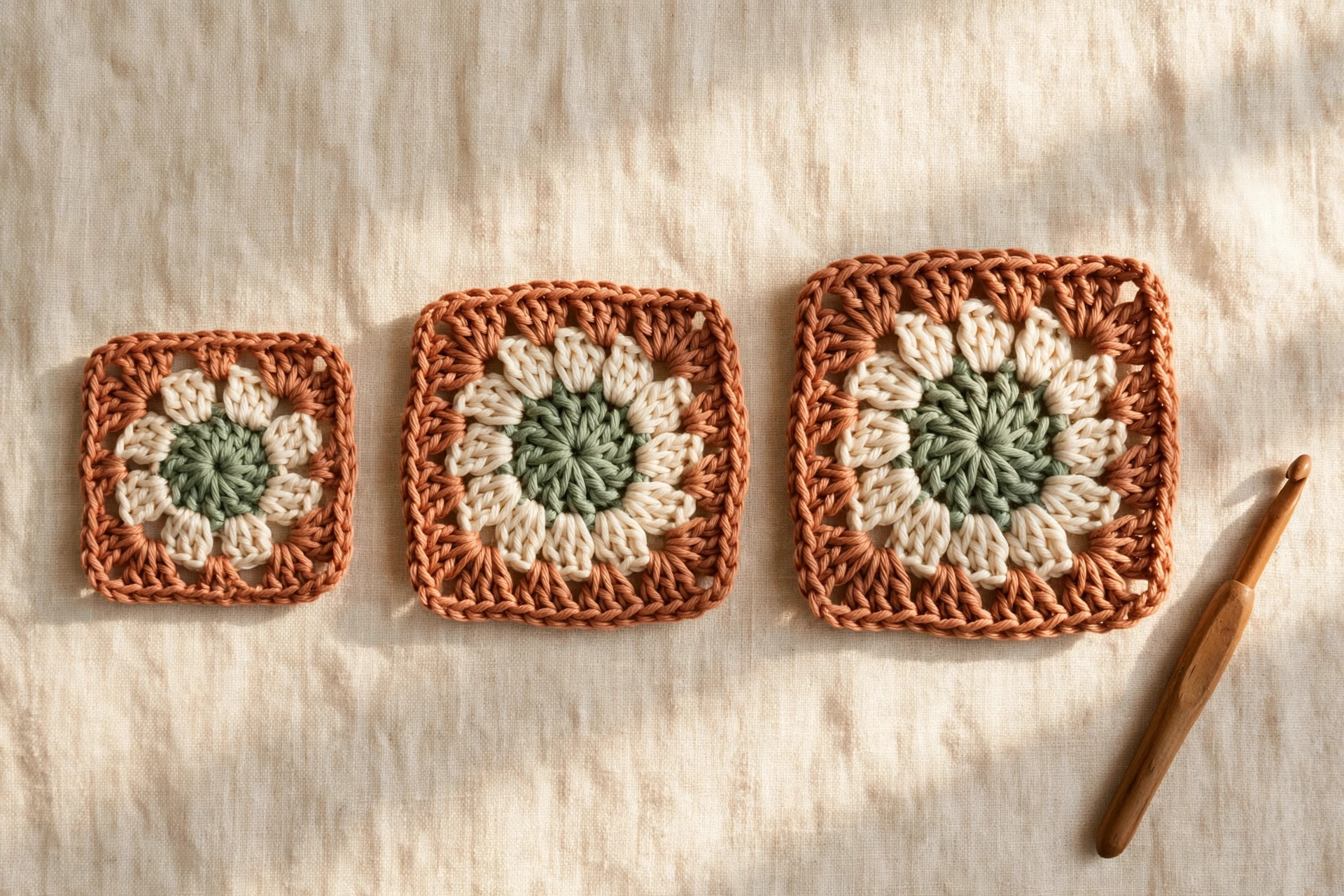
The granny square is the rite of passage. It teaches the double crochet, working in the round, and the magic of corner chain-spaces that make the square grow perfectly flat. Learn this one square and you can make blankets, bags, cardigans and coasters — it's the most versatile motif in crochet.
Materials
- Worsted-weight (#4) acrylic or cotton in 2–3 colors, about 30 g total
- 5.0 mm (H-8) crochet hook
- Tapestry needle, scissors
Size & gauge
- Finished size: about 15 cm (6 in) square after 3 rounds
- Gauge: not critical — squares are forgiving. Just keep your tension consistent.
Pattern
Work in joined rounds. The ch-3 at the start of each round counts as your first dc.
- Round 1: Make a magic ring (or ch 4 and join with a sl st). Ch 3, 2 dc into the ring, ch 2, (3 dc into the ring, ch 2) × 3. Join with a sl st to the top of the ch-3. (12 dc, 4 ch-2 corner spaces)
- Round 2: Sl st into the next 2 dc and into the corner ch-2 sp. Ch 3, (2 dc, ch 2, 3 dc) in the same corner sp — that's your first corner. In each of the remaining 3 corner spaces, work (3 dc, ch 2, 3 dc). Join with a sl st to the top of the ch-3. (24 dc total — 8 groups of 3 dc — and 4 corners)
- Round 3: Sl st across to the next corner sp. Ch 3, (2 dc, ch 2, 3 dc) in the corner, 3 dc in the side space between corners, then in each corner (3 dc, ch 2, 3 dc) with 3 dc in each side space between them. Join with a sl st to the top of the ch-3. (36 dc total — 12 groups of 3 dc — and 4 corners)
- Finishing: FO, leaving a 15 cm (6 in) tail. Weave in all ends, working the tails along the back of the stitches so they disappear.
Count check: Round 1 should have 4 clusters of 3 dc. Round 2 should have 8 clusters. Round 3 should have 12 clusters, with one 3-dc group sitting in each side space. If a side of your square is bowing, you worked an extra group somewhere — count the clusters per side.
Color changes: to get the classic striped look, fasten off at the end of any round and join the new color with a slip stitch in any corner space. Weave the extra ends in as you go — future you will be grateful.
Tips
- Corners are the whole trick. Every corner is always (3 dc, ch 2, 3 dc). The ch-2 is what turns the corner; forget it and your square becomes a circle.
- The magic ring alternative: if the magic ring frustrates you, chain 4, slip stitch to form a ring, and work Round 1 into the ring. Slightly less tidy, completely functional.
- Squares multiply. Make four and whipstitch them together for a placemat; make twenty and you're halfway to a baby blanket. Our autumn acorn granny square is a lovely next square once the classic feels easy.
Beginner troubleshooting: the 7 mistakes everyone makes
- Wavy, uneven edges. You added or dropped stitches at the ends of rows. Put markers in the first and last stitch of every project until you can spot them by feel.
- The foundation chain is too tight. Your first row curls and the fabric trapezoids. Chain with a hook one size bigger, or consciously loosen your grip on the chain only.
- Holes in the granny square corners. You skipped the ch-2 in a corner. Corners are always 3 dc, ch 2, 3 dc — no exceptions.
- The headband seam puckers. You whipstitched too tightly or through one loop only. Go through both loops, keep it loose, and stretch the seam gently after sewing.
- Stitches look different sizes. Totally normal for week one. The dishcloth exists precisely to fix this — by row 32 your hands will have evened out. Don't frog the whole thing; finish it and compare row 1 with row 32.
- Yarn keeps splitting. Cheap or loosely-plied yarn splits when the hook catches a strand instead of the whole loop. Slow down, watch the hook tip enter the stitch, and consider a smoother acrylic.
- Hands cramp. You're gripping the hook like a dagger. Hold it like a pencil, relax your shoulders, and take a stretch break every 20 minutes. Ergonomic hooks help if it persists.
What to make next
Finished all three? You now know the four foundational stitches, which unlocks most of the beginner patterns on this site:
- Turn your granny squares into something bigger — easy crochet patterns for blankets shows how motifs become afghans.
- Try a quick win: the free crochet heart pattern takes 20 minutes and teaches increases worked in the round.
- Make a 15-minute motif that builds on your granny square skills — the crochet flower pattern is the perfect next small project.
Frequently asked questions
Is this beginner guide really free?
Yes — all three patterns above are complete and free, with no signup or purchase. If the guide helped you, saving it on Pinterest or sharing it with a friend who's learning is the best thank-you.
What yarn and hook should a complete beginner buy first?
One skein of light-colored worsted-weight (#4) acrylic, one small ball of 100% cotton in the same weight, and a 5.0 mm (H-8) hook. That's under $10 at most craft stores and covers every project in this guide. Light colors matter — you need to see your stitches.
How long will the three projects take?
A relaxed weekend: 1–2 hours for the dishcloth, 2–3 for the headband, 1–2 for the granny square. Most beginners finish all three in 5–7 hours of actual crocheting, spread over two or three evenings.
Do I need to learn US or UK crochet terms?
This guide uses US terms (single crochet, half double crochet, double crochet). Most free patterns online are in US terms, so learn these first — but always check a pattern's terms before starting, since a UK "double crochet" is a US "single crochet" and mixing them up will wreck your sizing.
What if my edges are wavy or my square won't lie flat?
Don't start over — finish the piece first. Wavy edges come from adding or dropping stitches at row ends (see the troubleshooting section), and a cupped granny square usually means one missed corner chain. Both fix themselves with practice; your third attempt will look dramatically better than your first.
Can I sell finished items made from these patterns?
Yes. You may sell finished dishcloths, headbands and granny squares made from these original patterns in small batches — please credit Little Loop Finds as the designer with a link back. The pattern text and photos may not be redistributed or resold.
More free patterns to try
Once the basics feel comfortable, keep the momentum going. Our crochet dishcloths free patterns add textured variations to Project 1's single crochet, the free crochet headband pattern takes Project 2's ribbing into a wider twisted style, and the autumn acorn granny square is a seasonal follow-up once the classic square feels easy.