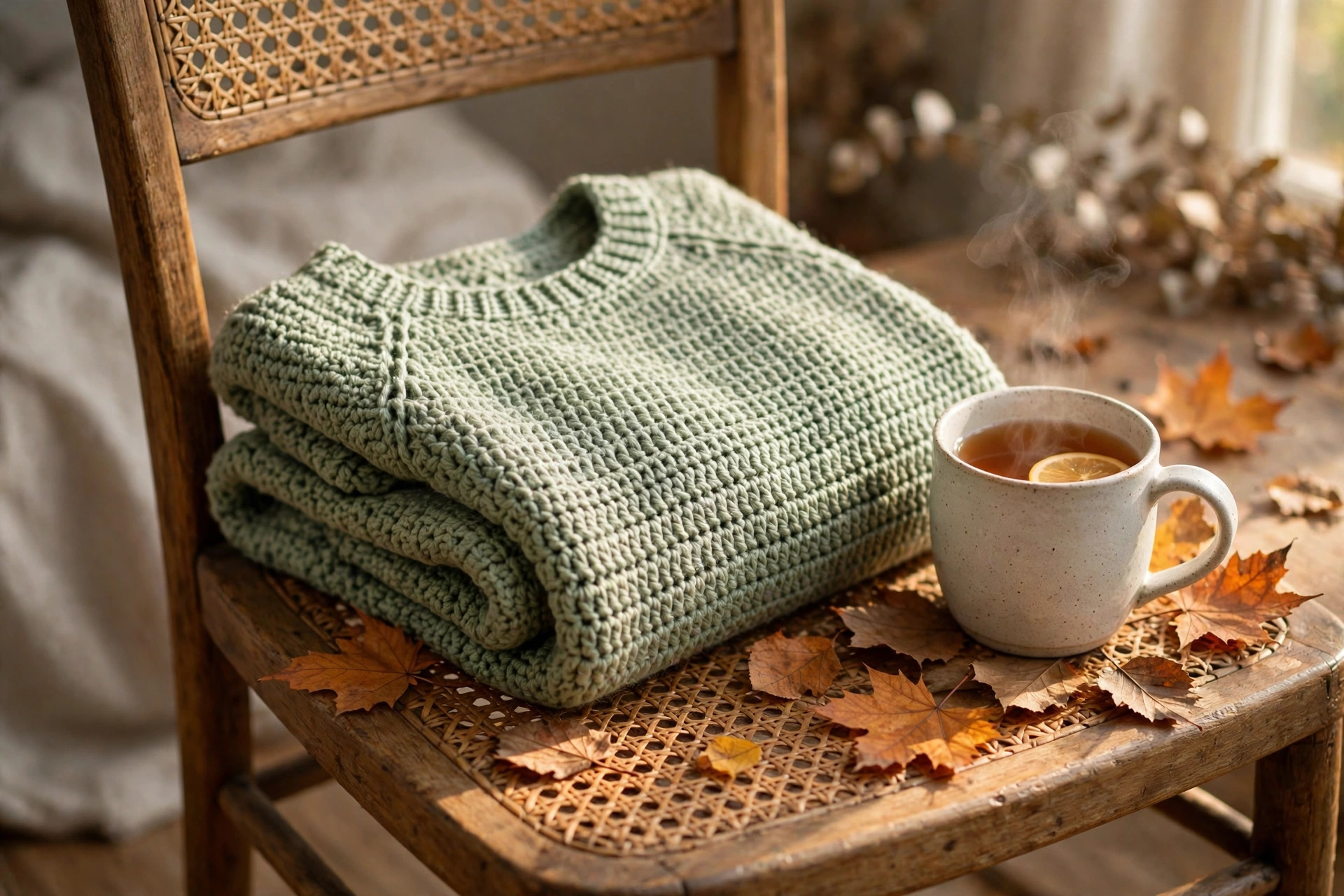
Simple Crochet Sweater Pattern: Easy Pullover
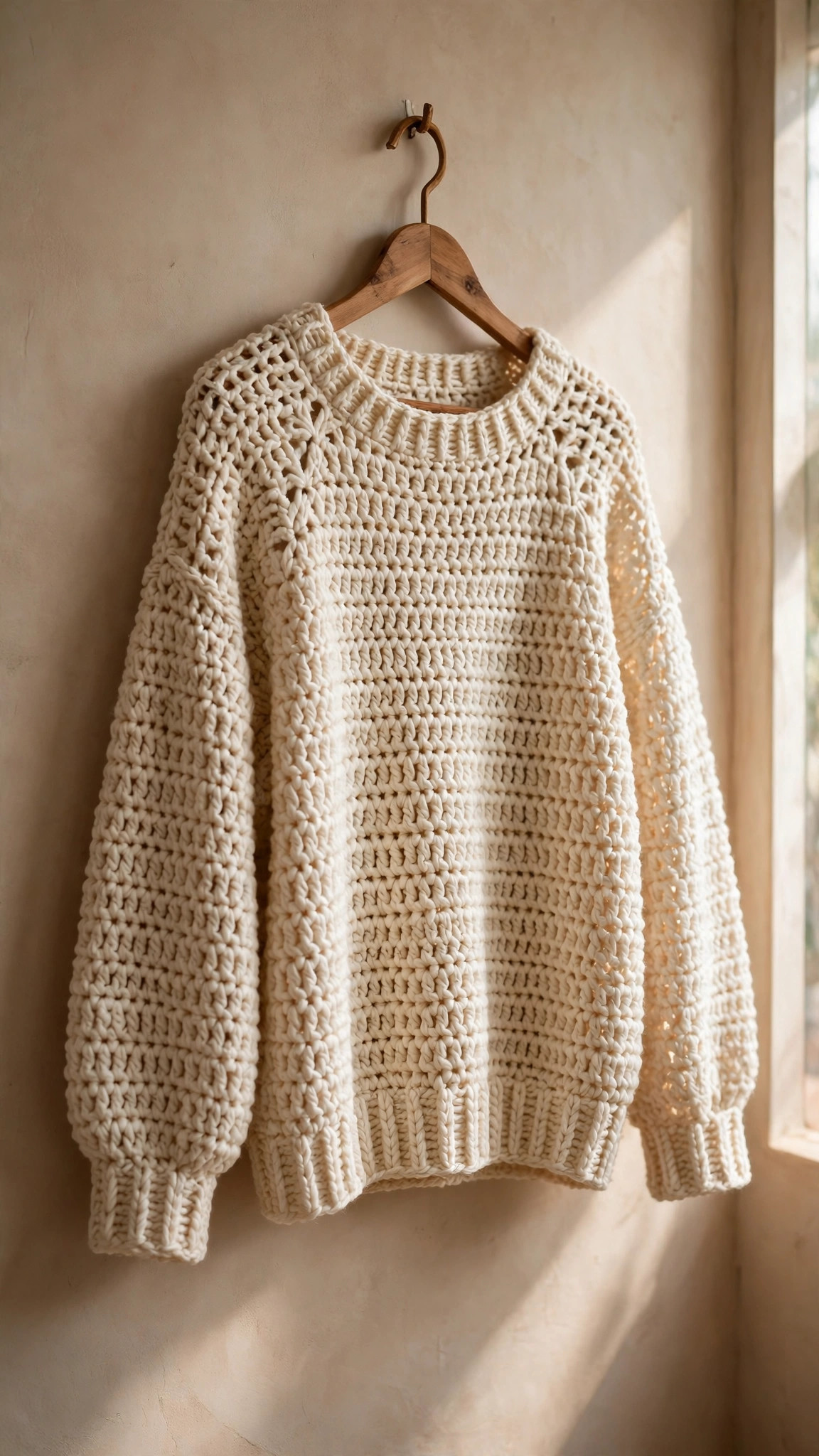
A cosy top-down raglan pullover in double crochet: original design, US terms, seven sizes from XS to 3X.

Wearables · Crochet
- Finished sizes
- XS to 3X, 7 sizes
- Making time
- About 20-32 hours
- Hook
- 6.0 mm, worsted yarn
- Design
- Seamless raglan, original
- Skill
- Advanced Beginner
In this post
- Table of contents
- Why you'll love this simple sweater crochet pattern
- Materials you'll need
- Size, gauge and skill level
- Abbreviations, US terms
- The simple crochet sweater pattern (US terms)
- Finishing touches
- Tips and tricks
- Variations to try next
- Troubleshooting tips
- Frequently asked questions
- More free patterns to try
Every crocheter remembers their first sweater. This simple crochet sweater pattern is designed to be that sweater: an original top-down raglan pullover worked almost entirely in double crochet, with no seaming, no complicated shaping, and a fit you can try on as you go. If you can chain, double crochet, and increase, you can make this.
The construction is the clever part. You start at the neckline, increase at four raglan seams to shape the yoke, then split off the sleeves and work the body straight down. Because there are no pieces to sew together, you can slip the yoke over your head at any point and check the fit before you commit to the body length. It comes in seven sizes, from XS to 3X, so the whole household can have one.
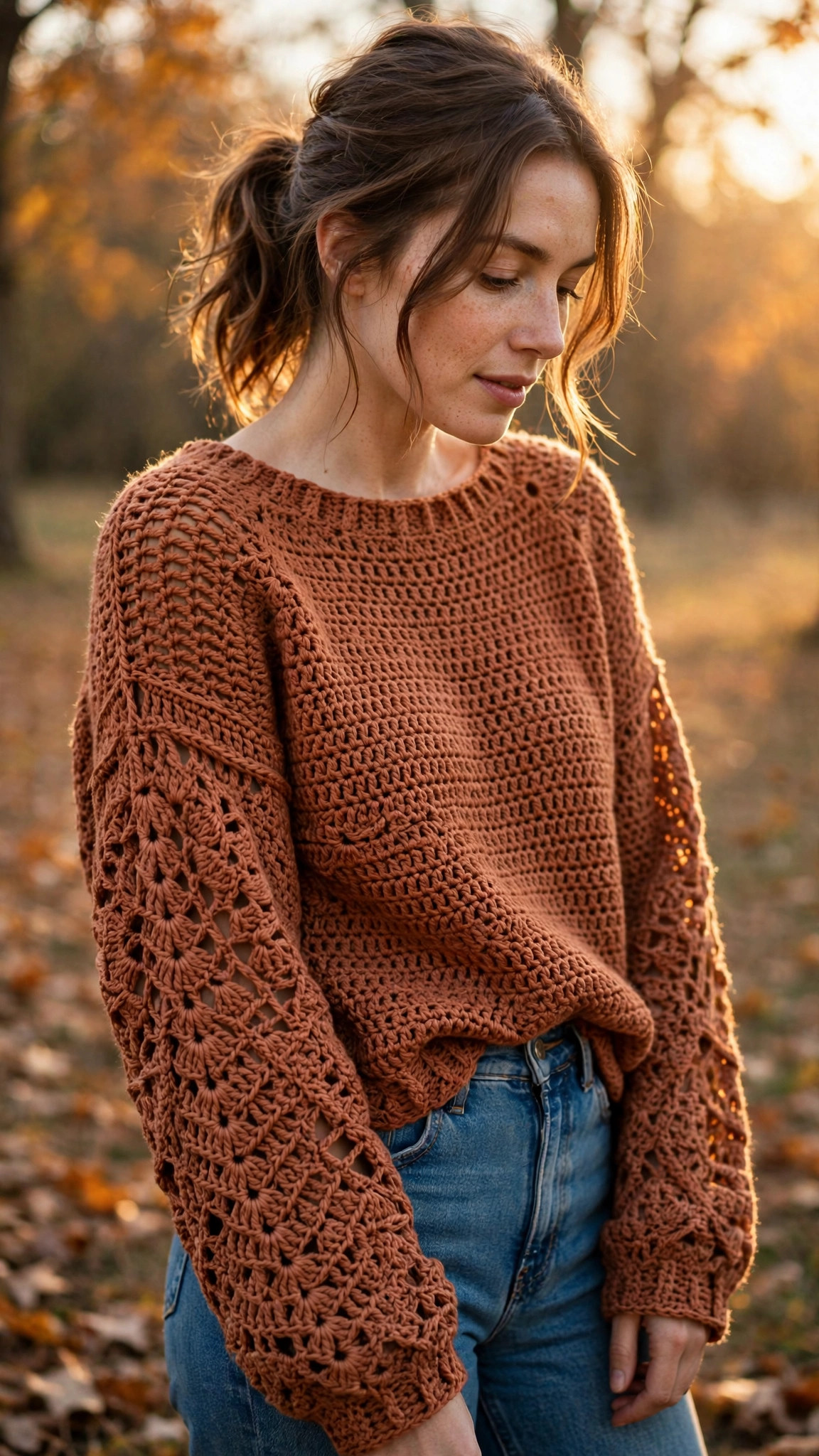
Wear it oversized with leggings or tucked into jeans. This is the kind of sweater that looks store-bought but feels handmade in the best possible way, because it was made by you, for you.
Table of contents
- Why you'll love this simple sweater crochet pattern
- Materials you'll need
- Size, gauge and skill level
- Abbreviations, US terms
- The simple crochet sweater pattern (US terms)
- Finishing touches
- Tips and tricks
- Variations to try next
- Troubleshooting tips
- Frequently asked questions
- More free patterns to try
Why you'll love this simple sweater crochet pattern
First sweaters fail for predictable reasons: confusing shaping, pieces that never line up when sewn, and a fit you cannot check until the very end. This pattern removes all three at once. The top-down raglan construction means nothing to seam. The increases happen at four visible corner lines, so you always know where you are. And because the sweater grows downward from the neck, you can try it on after the yoke, after the split, and halfway down the body.
It is also a genuinely relaxing make. Once the yoke is done, the body is just round after round of double crochet, the perfect rhythm for evenings in front of a show. The sleeves are worked in the round too, picked up straight from the yoke, so there is no cap shaping to second guess.
The fit is relaxed with about 4 inches of positive ease, which drapes rather than clings and forgives small gauge wobbles. Make it in a soft neutral for an everyday staple or a rich autumn colour for a statement piece. If wearables are becoming your thing, our crochet cardigan sweater pattern uses similar top-down shaping with an open front, and it is the natural second project after this one.
Materials you'll need
| Supply | What to get |
|---|---|
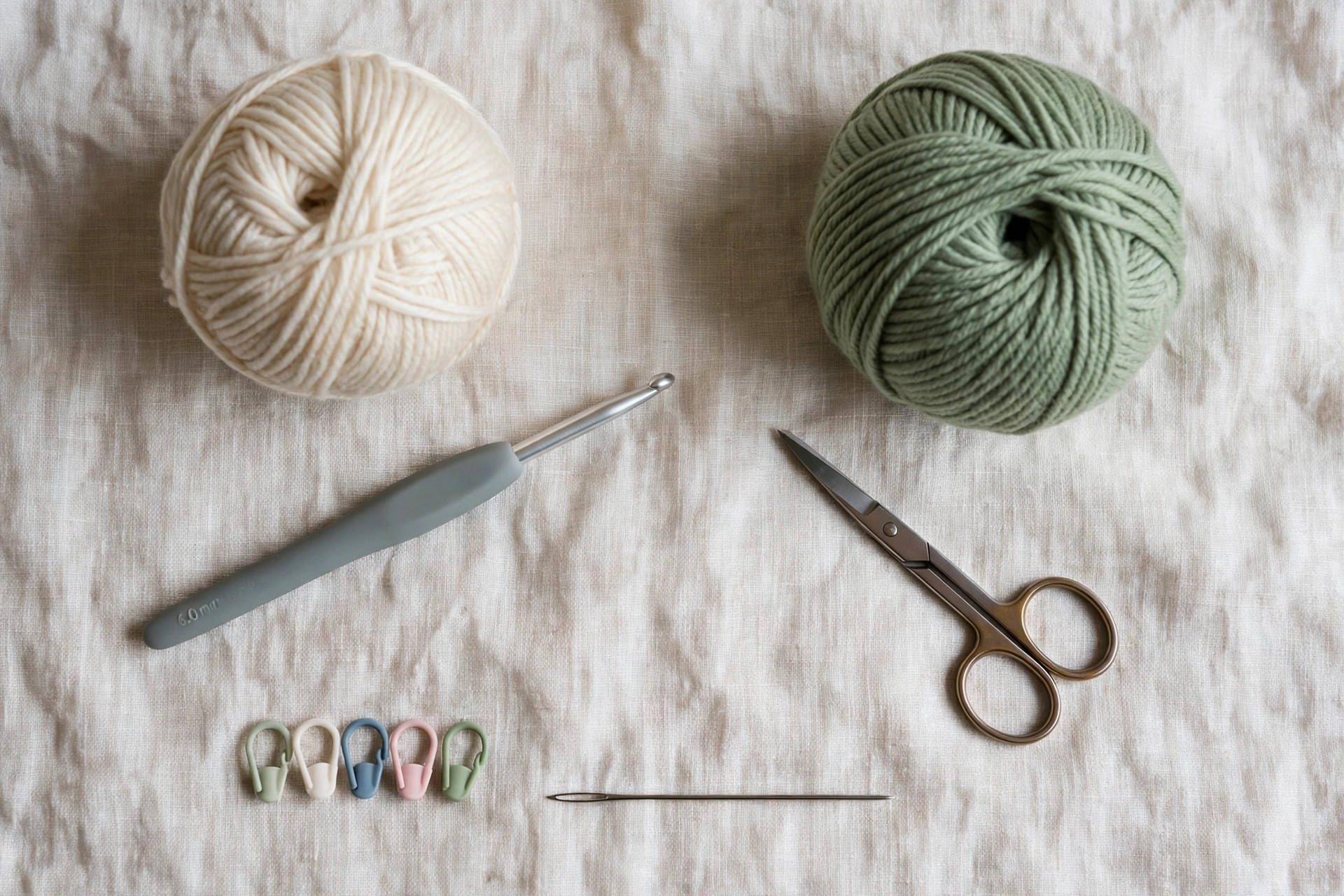
| Worsted yarn | #4 worsted-weight yarn, see yardage table below (choose a soft acrylic or acrylic blend for easy care) |
| Crochet hook | 6.0 mm (J) |
| Stitch markers | At least 4, for the raglan corners |
| Tapestry needle | For weaving in ends |
| Notions | Scissors, measuring tape |
| Size | To fit bust | Approx. yardage |
|---|---|---|
| XS | 30-32 in / 76-81 cm | 850 yds / 777 m |
| S | 34-36 in / 86-91 cm | 950 yds / 869 m |
| M | 38-40 in / 97-102 cm | 1,050 yds / 960 m |
| L | 42-44 in / 107-112 cm | 1,200 yds / 1,097 m |
| XL | 46-48 in / 117-122 cm | 1,350 yds / 1,234 m |
| 2X | 50-52 in / 127-132 cm | 1,500 yds / 1,372 m |
| 3X | 54-56 in / 137-142 cm | 1,650 yds / 1,509 m |
Pick a yarn with a little bounce rather than a stiff cotton: the raglan drape looks best in something soft. A smooth worsted shows off the clean double crochet fabric, while a lightly heathered yarn hides uneven tension beautifully. If you are between sizes, simply make the next size up: the pattern is graded generously, so sizing up reads as intentional slouch.
A note on the hook: 6.0 mm with worsted yarn gives an open, drapey fabric. If you crochet very tightly, try 6.5 mm so the yoke slips over your head comfortably.
Size, gauge and skill level
The sweater is worked top-down: neckline first, then the yoke with raglan increases, then the body and sleeves are worked separately in the round. Sizes are written as XS (S, M, L, XL, 2X, 3X) throughout.
| Size | Finished bust | Yoke rounds after setup | Approx. time |
|---|---|---|---|
| XS | 36 in / 91 cm | 11 | About 20 hours |
| S | 40 in / 102 cm | 12 | About 22 hours |
| M | 44 in / 112 cm | 13 | About 24 hours |
| L | 48 in / 122 cm | 14 | About 26 hours |
| XL | 52 in / 132 cm | 15 | About 28 hours |
| 2X | 56 in / 142 cm | 16 | About 30 hours |
| 3X | 60 in / 152 cm | 17 | About 32 hours |
- Gauge: 12 dc and 8 rows = 4 in (10 cm) in worsted yarn with a 6.0 mm hook, blocked lightly. For a sweater, gauge is the difference between a garment and a disappointment: work a 6-inch swatch, wash it as you will wash the sweater, and measure honestly before you start.
- Skill level: advanced beginner. You should be comfortable with chains, double crochet, working in joined rounds, and counting stitches. The only new skill is the raglan increase, and it repeats identically at all four corners.
- Fit: designed with about 4 in (10 cm) of positive ease at the bust. The body length is custom: work to your preferred length.
Abbreviations, US terms
| Abbreviation | Meaning |
|---|---|
| ch | chain |
| dc | double crochet |
| sc | single crochet |
| sl st | slip stitch |
| inc | increase: 2 dc in the same stitch |
| dec | decrease: dc 2 together |
| st(s) | stitch(es) |
| sp | space |
| R | round |
| BLO | back loop only |
| FO | fasten off |
| [ ] | total stitch count at the end of the round |
A note on joined rounds: the chain 3 at the start of each round counts as the first double crochet. Join to the top of that chain 3 and keep the join at the back of the sweater.
The simple crochet sweater pattern (US terms)
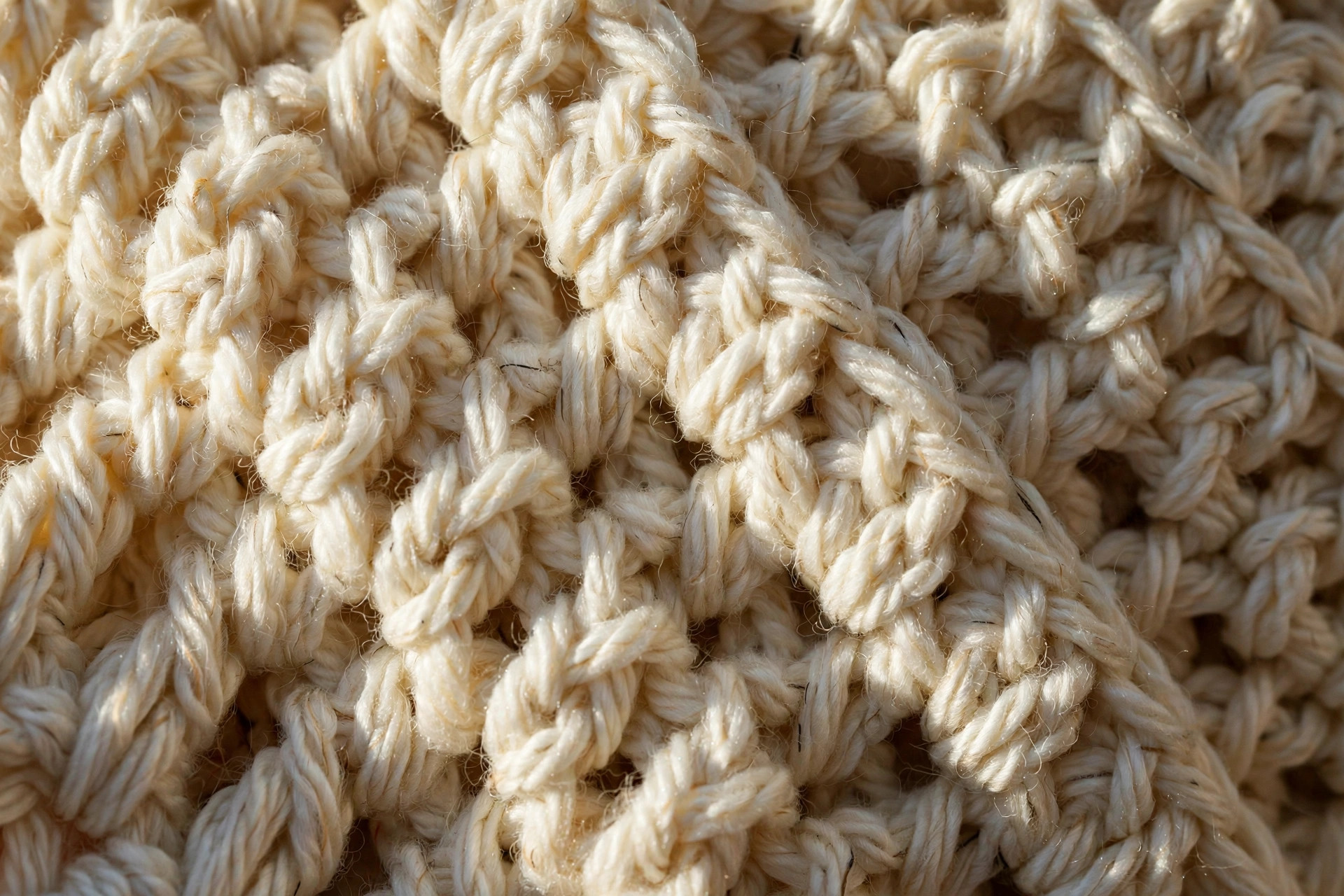
Work top-down in joined rounds. Sizes are written XS (S, M, L, XL, 2X, 3X). Where only one number appears, it applies to all sizes. Place a stitch marker in each of the four corner chain spaces on the setup round and move the markers up each round.
Neckline and yoke setup
Chain 56 (60, 64, 68, 72, 76, 80). Join with a sl st to the first chain, taking care not to twist.
Setup round: ch 3 (counts as dc), dc in next 7 (8, 9, 10, 11, 12, 13) sts [half of front], work a raglan corner: (2 dc, ch 2, 2 dc) in the next st and place a marker in the ch-2 sp, dc in next 10 (11, 12, 13, 14, 15, 16) sts [sleeve], corner in next st, dc in next 16 (16, 16, 18, 18, 18, 18) sts [back], corner in next st, dc in next 10 (11, 12, 13, 14, 15, 16) sts [sleeve], corner in next st, dc in last 8 (9, 10, 11, 12, 13, 14) sts [other half of front], join with sl st to top of ch 3. [68 (72, 76, 80, 84, 88, 92) dc plus 4 corner spaces]
Yoke increases
Yoke rounds: ch 3, dc in each dc across to the first marked corner, work (2 dc, ch 2, 2 dc) in each marked ch-2 sp, dc in each dc between corners, join with sl st to top of ch 3.
Repeat the yoke round 11 (12, 13, 14, 15, 16, 17) times. Each round adds 4 dc at every corner, so the yoke grows by 16 stitches per round and the four raglan lines lengthen evenly.
Try the yoke on now: it should slip over your head comfortably and the corners should sit near the points of your shoulders. If the neckline feels tight, your gauge is tight: go up half a hook size and recheck. If the corners sit past your shoulders, work one fewer yoke round. This try-on is the whole advantage of top-down construction, so use it.
Split for body and sleeves
Split round: ch 3, dc across the front panel to the first marked corner, dc in the corner ch-2 sp, ch 6 (6, 8, 8, 10, 10, 12) for the underarm, skip all sleeve stitches to the next marked corner, dc in that corner ch-2 sp, dc across the back panel to the next marked corner, dc in the corner ch-2 sp, ch 6 (6, 8, 8, 10, 10, 12) for the second underarm, skip the second sleeve's stitches to the last marked corner, dc in that corner ch-2 sp, dc across the remaining front stitches, join with sl st to top of ch 3. [132 (142, 156, 168, 182, 192, 206) sts]
The sleeve stitches wait on hold: leave them on stitch holders or spare yarn. Remove the corner markers now; you will not need them again.
Body
Work even in double crochet until the body measures your desired length from the underarm. Join each round with a sl st to the top of the chain 3.
- Body rounds: ch 3, dc in each st around, join. [132 (142, 156, 168, 182, 192, 206)]
Work 34 (36, 38, 40, 42, 44, 46) body rounds for a hip-length sweater, or fewer for a cropped look and more for tunic length. Try it on as you go: the fabric relaxes a little with wear, so stop about half an inch short of your target length.
Sleeves
With the body on hold, rejoin yarn at the centre of one underarm chain.
Sleeve setup: ch 3, dc across the underarm chain sts, dc in each held sleeve st around, dc across to the start, join. [60 (64, 70, 74, 80, 84, 90) sts]
Work 4 rounds even, then begin gentle tapering toward the wrist:
- Decrease round: ch 3, dc2tog, dc in each st to the last 2 sts, dc2tog, join. [2 sts decreased]
- Work 5 rounds even, then repeat the decrease round.
Repeat this rhythm (5 even rounds, 1 decrease round) 4 (4, 5, 5, 6, 6, 7) times, then work even until the sleeve measures about 17 in (43 cm) from the underarm, or 1.5 in short of your desired cuff position. [44 (48, 50, 54, 56, 60, 64) sts remaining]
Repeat for the second sleeve.
Cuffs and neckline ribbing
Sleeve cuffs: ch 1, sc in each st around, join. Work 6 rounds of sc in BLO for a stretchy ribbed cuff. FO.
Neckline ribbing: join yarn at the back of the neckline. Ch 1, sc in each chain around the neck opening, join. Work 3 rounds of sc in BLO. FO.
Bottom hem (optional): join yarn at the side of the body hem. Ch 1, sc in each st around, join, then work 4 rounds of sc in BLO for a matching ribbed hem. This gives the sweater a polished, store-bought finish and stops the hem from rolling.
Finishing touches
Weave in every end. Thread each tail onto the tapestry needle and run it through the backs of nearby stitches for at least 2 inches, changing direction once so it locks. Do them all now, while the sweater is inside out, and trim flush.
Close any underarm gaps. The spot where the underarm chain meets the held sleeve stitches sometimes leaves a small hole. Thread a short tail of matching yarn onto the tapestry needle and close it with two or three small stitches on the inside.
Block lightly. Lay the sweater flat on a towel, pat it into shape, and mist lightly with water. Let it dry completely. Blocking evens out the double crochet fabric and relaxes the raglan lines so they lie flat.
Try it on one final time. Check the yoke depth, the sleeve length, and the body length. If a sleeve came out a touch long, the ribbed cuff can be folded back for a styled look.
Tips and tricks
A few details that separate a first sweater from a favourite sweater:
Swatch like you mean it. Wash and dry your swatch exactly as you will wash the sweater. Acrylic relaxes and wool blooms: the gauge on a fresh swatch is not the gauge you will wear. Ten minutes here saves ten hours of rework.
Count after the split. The split round is the only fiddly moment in the whole pattern. Count your body stitches immediately after it: 132 (142, 156, 168, 182, 192, 206). If the number is off, the mistake is in the skipped sleeve stitches or the underarm chains, and it is far easier to fix now than ten rounds later.
Try it on in stages. After the yoke, after the split, halfway down the body, before the cuffs. Each checkpoint takes thirty seconds and each one can save the project.
Variations to try next
One pullover is a wardrobe; several is a collection:
- Striped raglan. Change colours every 6 body rounds for classic Breton-style stripes. Carry the unused colour up the inside loosely, or cut and weave: with worsted yarn, cutting gives the neater result.
- Cropped and cosy. Stop the body at 26 rounds and work the ribbed hem immediately for a cropped sweater that pairs with high-waisted jeans. The free crochet hoodie pattern is the natural next step once you love the cropped length.
- Tunic length. Add 10 to 12 extra body rounds and skip the ribbed hem for a long tunic to wear over leggings.
- Oversized statement. Make two sizes up, add 4 extra body rounds, and wear it slouchy off one shoulder. If maximum cosiness is the goal, the oversized sweater crochet pattern free leans even further into the slouch.
Troubleshooting tips
- The neckline will not fit over my head. Your foundation chain or first rounds are too tight. Chains are often tighter than the rows that follow: chain with a hook one size larger, or work the foundation chain loosely on purpose.
- The yoke is too pointy at the corners. You are working the corner as (2 dc, ch 2, 2 dc) correctly, but pulling the chain-2 space tight. Leave the chain space relaxed so the corner lies flat instead of puckering.
- The body flares like a tent. You added stitches accidentally, usually by working into the slip stitch join or the chain 3. Count a full round: the number must match the split-round count exactly.
- One sleeve is longer than the other. You worked a different number of rounds or decreases. Count rounds on each sleeve from the underarm: they must match, and the decrease rounds must fall at the same heights.
- The underarm has a hole. Normal at the split: close it from the inside with a yarn tail and a tapestry needle, as described in finishing.
- The sweater grew after washing. Some yarns relax significantly. Wash and block your swatch first, and if the yarn grows, start with the smaller size or subtract 5 percent from the body length.
Frequently asked questions
Is this simple crochet sweater pattern really free?
Yes, the complete pattern above is free, with no email signup and no PDF purchase required.
I have never made a garment. Is this too ambitious?
This pattern was written for exactly you: no seaming, no separate pieces to align, and you try it on at every stage.
How much yarn do I need for each size?
From about 850 yards for XS up to about 1,650 yards for 3X in worsted-weight yarn. The yardage table in the materials section lists every size, and buying one extra skein is always wise.
How long does it take to crochet this sweater?
Roughly 20 hours for XS up to about 32 hours for 3X at a relaxed pace. The yoke takes the most concentration; the body rounds are rhythmic double crochet.
Can I make the sleeves longer or shorter?
Yes. Work more or fewer even rounds before the cuff ribbing. Measure from your underarm to your wrist and stop about 1.5 inches short, since the ribbed cuff adds length and the fabric relaxes.
What is the best yarn for a first crochet sweater?
A soft worsted-weight acrylic or acrylic blend. It is affordable, machine washable, and forgiving of tension wobbles. Save the luxury fibres for sweater number two, when your gauge is dialled in.
Can I sell finished sweaters made from this pattern?
Yes! You may sell finished sweaters in small batches. Please credit Little Loop Finds as the designer.
More free patterns to try
If this pullover gave you the garment bug, keep going. The hexagon sweater crochet pattern builds a sweater from two simple hexagons, and the oversized sweater crochet pattern free is pure cosy slouch. For a quick palate cleanser between garments, our batch-mate the crochet cat beanie pattern is a fun one-evening hat with adorable ears.