Ripple Blanket Crochet Pattern (Free Wave Throw)
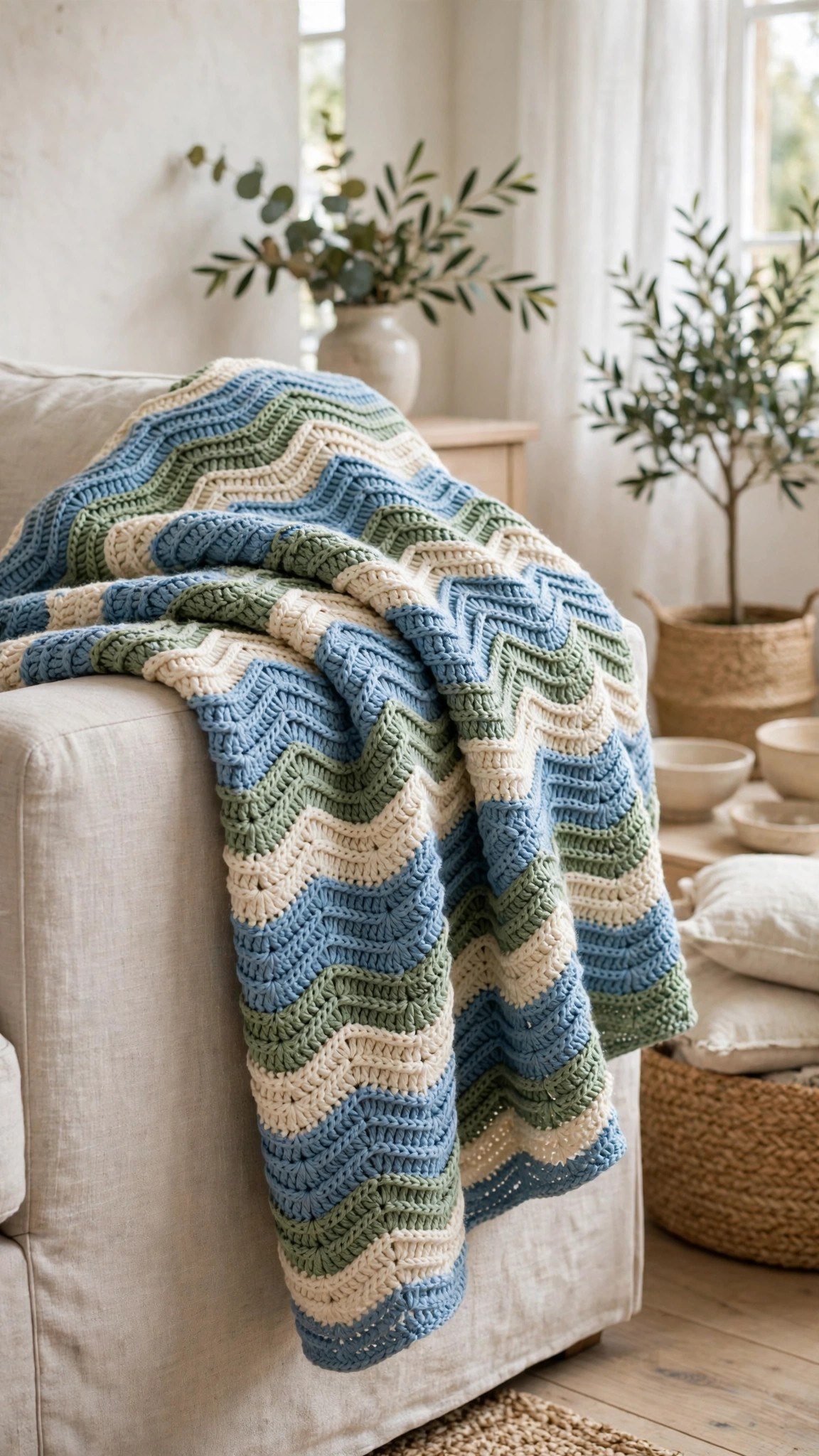
Crochet a gentle wave throw in sea blue, sage and cream with soft rolling ripples in about eighteen hours, then drape it over your favorite sofa.

Patterns · Crochet
- Finished size
- 48 x 58 in throw
- Making time
- 18 hours
- Hook
- US J-10 (6.0 mm)
- Set
- Blanket, border
- Skill
- Easy
In this post
- Key Takeaways
- Table of Contents
- Why You Will Love This Ripple Blanket
- Finished Size, Skill Level, and Time
- Materials You Need
- Abbreviations (US Terms)
- Gauge and Sizing Notes
- Part 1: The Foundation and the First Waves
- Part 2: The Color Stripes and Keeping the Waves Even
- Part 3: The Border and Finishing
- Variations: Colors, Sizes, and Uses
- Troubleshooting a Blanket That Does Not Wave
- Care Instructions
- Frequently Asked Questions
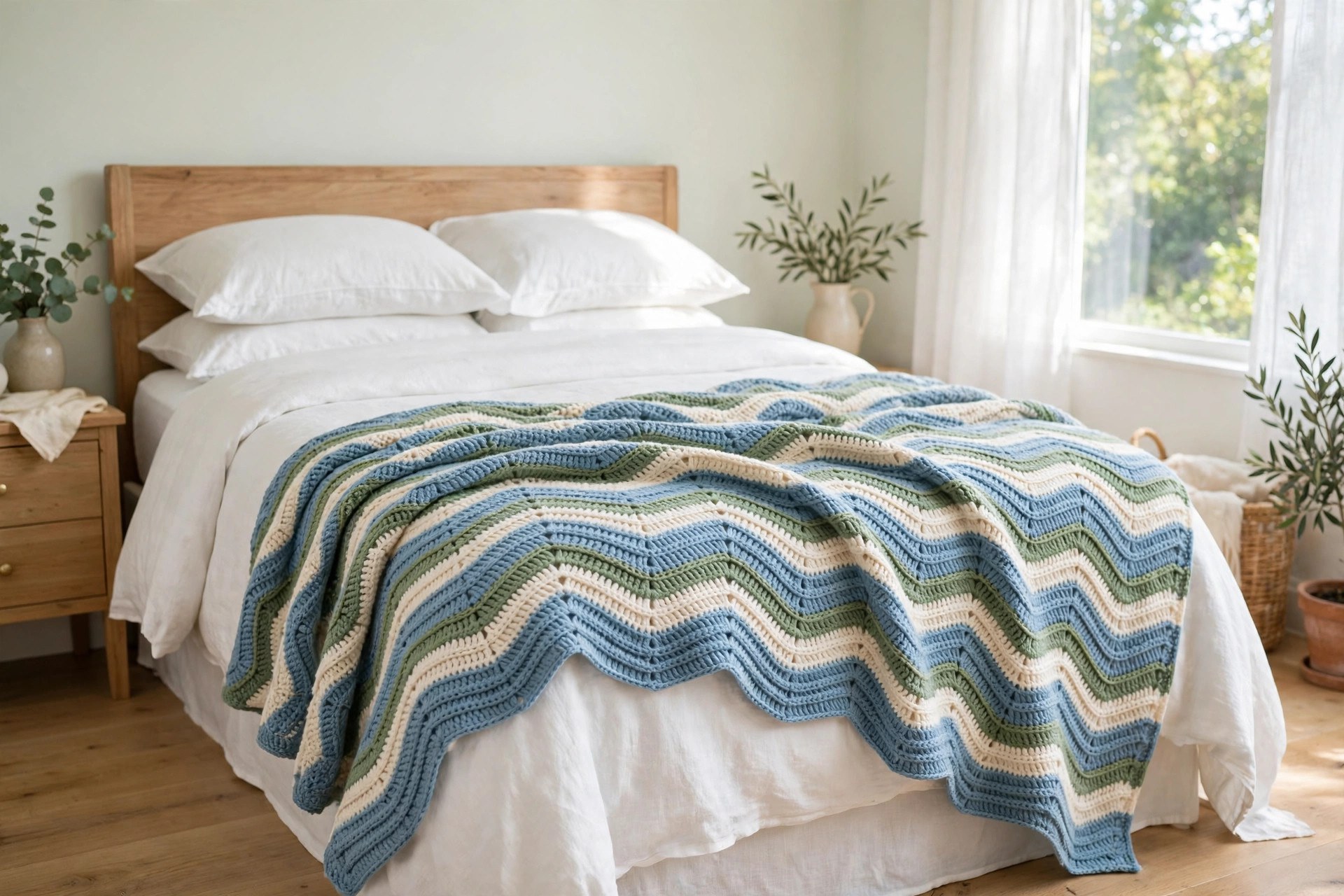
A ripple blanket is the softest wave you can make with a hook. This free ripple blanket crochet pattern makes a gentle wave throw in soft sea blue, sage green, and cream, with rolling hills and valleys that flow across the whole blanket. It is calm, classic, and made to be draped over a sofa or folded at the foot of a bed.
This is an original Little Loop Finds design, written in US terms and completely free. The blanket is worked in rows of double crochet, with simple increases at the peaks and decreases at the valleys, and the waves form by themselves once you learn the repeat.
A quick note on scope: this post is about one specific stitch, the ripple wave stitch, a gentle rolling wave with soft rounded peaks. It is not a chevron, which is a sharp zigzag with pointed peaks. If you want a bold pointed zigzag instead, our chevron crochet pattern is the one to make.
Key Takeaways
- Free original pattern: a Little Loop Finds original design, written in US terms, and completely free.
- A gentle wave throw: a ripple wave stitch blanket, 48 by 58 inches, with soft rounded waves.
- Three soft colors: sea blue, sage green, and cream in six row stripes.
- Simple construction: double crochet worked in rows, with one 14 stitch repeat to learn.
- An 18 hour project: one blanket takes about 18 hours, spread over a few weeks.
Table of Contents
- Why You Will Love This Ripple Blanket
- Finished Size, Skill Level, and Time
- Materials You Need
- Abbreviations (US Terms)
- Gauge and Sizing Notes
- Part 1: The Foundation and the First Waves
- Part 2: The Color Stripes and Keeping the Waves Even
- Part 3: The Border and Finishing
- Variations: Colors, Sizes, and Uses
- Troubleshooting a Blanket That Does Not Wave
- Care Instructions
- Frequently Asked Questions
Why You Will Love This Ripple Blanket
A ripple blanket is the kind of project that feels like a holiday from fussy patterns. Once you learn the 14 stitch repeat, your hands can work on their own, and the waves rise and fall across the rows without any counting beyond the repeat. It is rhythmic, relaxing, and perfect for an evening in front of a film.
The gentle waves are what make this blanket special. Sharp zigzags look bold and graphic, but soft ripples look calm and handmade, like rolling hills or a quiet sea. The three colors flow from one stripe to the next, and the wave shape keeps the stripes interesting even though the stitch itself never changes.
Finished Size, Skill Level, and Time
- Finished size: 48 inches wide by 58 inches long, including the border. Each wave repeat is about 4 inches wide, and there are 11 waves across the blanket.
- Skill level: Easy. You need a foundation chain, double crochet, increases, decreases, and a simple color change.
- Time: about 18 hours per blanket: 2 hours for the foundation and first waves, 12 hours for the striped body, 2 hours for the border, and 2 hours for weaving in ends and blocking.
Materials You Need
| Item | What to get |
|---|---|
| Yarn, sea blue | Worsted weight (size 4) yarn in sea blue, 500 yards |
| Yarn, sage green | Worsted weight (size 4) yarn in sage green, 500 yards |
| Yarn, cream | Worsted weight (size 4) yarn in cream, 400 yards |
| Hook | US J-10 (6.0 mm), or the size that gives you the gauge below |
| Notions | Tapestry needle, scissors, tape measure, stitch markers |
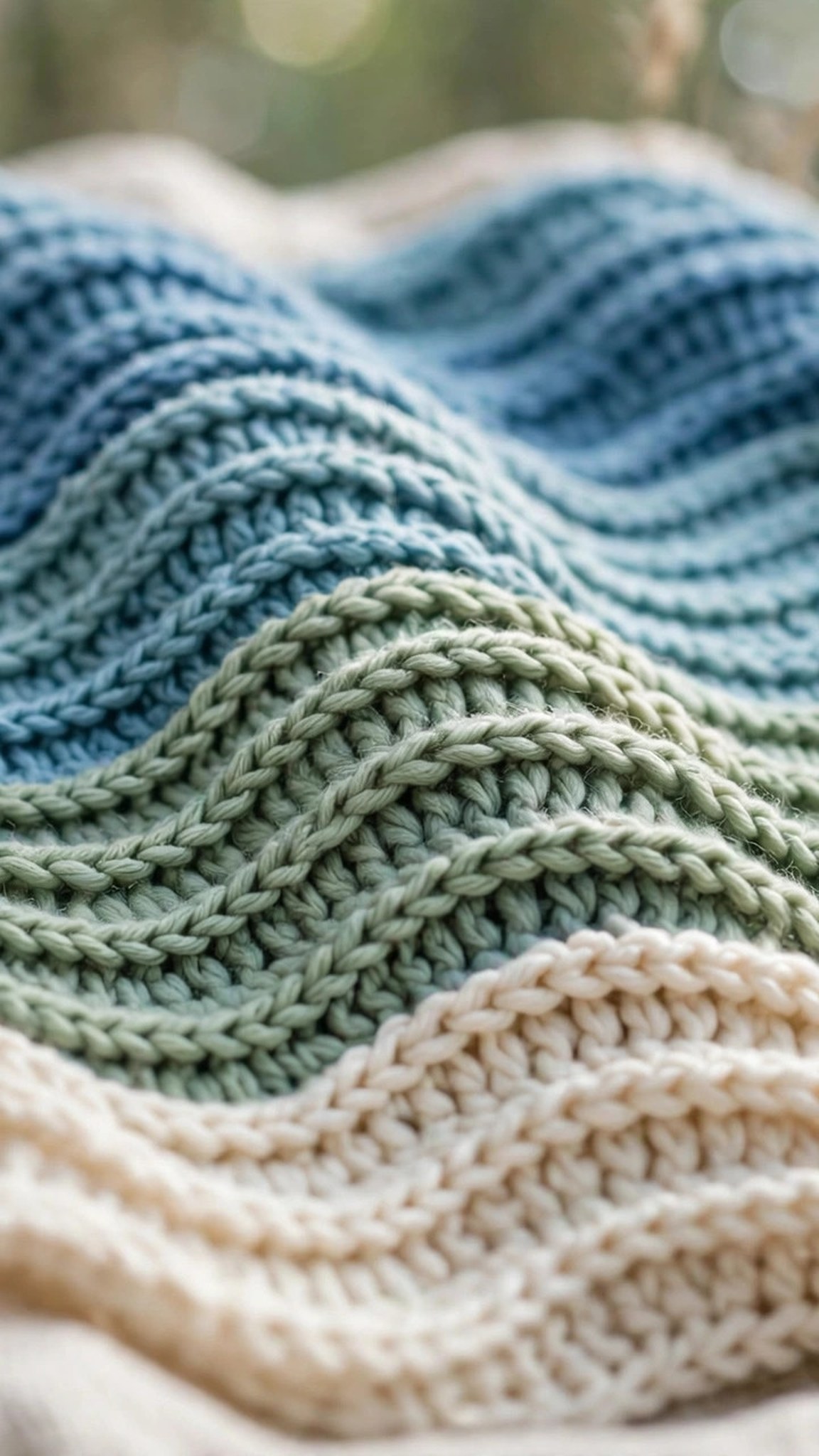
Worsted weight yarn is the best choice for a ripple blanket because it works up at a good speed, the fabric drapes softly, and the waves hold their shape without going stiff. A smooth acrylic or wool blend yarn is a good pick, because it is warm, it washes well, and the colors stay bright. Avoid very fuzzy yarns, because they hide the wave shape, and avoid stiff cotton, because it does not drape well over a sofa.
Abbreviations (US Terms)
- ch = chain
- sl st = slip stitch
- sc = single crochet
- dc = double crochet
- dc2tog = double crochet 2 together (work 2 dc as one stitch, decreasing by 1 stitch)
- inc = increase (2 dc in the same stitch)
- st(s) = stitch(es)
- rep = repeat
Gauge and Sizing Notes
Gauge matters on a ripple blanket because the wave repeat sets both the width and the look of the waves. Work a swatch of one full repeat, 14 dc stitches and 7 rows, in the main color. It should be about 4 inches wide and 4 inches tall. If it is wider, go down a hook size. If it is narrower, go up a hook size.
The blanket is 155 stitches wide, which is 11 repeats of 14 stitches plus the turning chain. To make a wider blanket, add 14 stitches for each extra wave. To make a narrower blanket, take away 14 stitches for each wave you remove. Count your stitches at the end of every pattern row for the first ten rows, because the increases and decreases must balance exactly, and one missed stitch will pull the whole wave out of line.
Mark the first peak of each wave with a stitch marker on the first pattern row. The markers show you where the peaks are, and you can check at a glance that each new row lines up with the one below. If a peak drifts to the left or the right, you have missed a stitch somewhere, and it is easier to fix it now than ten rows later.
Part 1: The Foundation and the First Waves
The foundation is a long chain, then one plain row of double crochet that gives the waves a straight base to grow from. Work the chain loosely, because a tight foundation chain will pull the lower edge in and make the blanket narrower at the bottom than at the top.
The Foundation Row
With sea blue, ch 158.
- Row 1: dc in the 4th ch from the hook and in each ch across. (155 dc)
The row should be about 48 inches long. Lay it flat and measure it, because this row sets the width of the whole blanket. If it is much shorter than 48 inches, your chain is too tight, so go up a hook size for the chain only and start again. Our c2c crochet blanket pattern uses a different corner to corner start if you want to compare methods.
The First Wave Rows
Now work the ripple pattern row. The repeat is 14 stitches, and it is worked 11 times across the row. Read the repeat slowly the first few times, and trust the stitch markers to keep you on track.
- Row 2: ch 3 (counts as dc), (dc in each of the next 2 sts, dc2tog, dc in each of the next 2 sts, 2 dc in the next st, dc in the next st, 2 dc in the next st, dc in each of the next 2 sts, dc2tog, dc in the next st) rep 11 times. (155 dc)
- Row 3: ch 3 (counts as dc), (dc in each of the next 2 sts, dc2tog, dc in each of the next 2 sts, 2 dc in the next st, dc in the next st, 2 dc in the next st, dc in each of the next 2 sts, dc2tog, dc in the next st) rep 11 times. (155 dc)
Work rows 2 and 3 in sea blue. Each row should still have 155 stitches, because every decrease at a valley is balanced by an increase at a peak. The waves should already be visible after row 3, with soft peaks where you worked 2 dc in one stitch and gentle valleys where you worked dc2tog. If the edge pulls in, you have worked one decrease too many. If the edge flares out, you have worked one increase too many, so count the row again stitch by stitch.
Part 2: The Color Stripes and Keeping the Waves Even
The body of the blanket is the same pattern row repeated, with a color change every six rows. Work the stripes in order, sea blue, sage green, cream, and repeat, and carry the yarn neatly up the side so the edges stay tidy.
The Stripe Plan
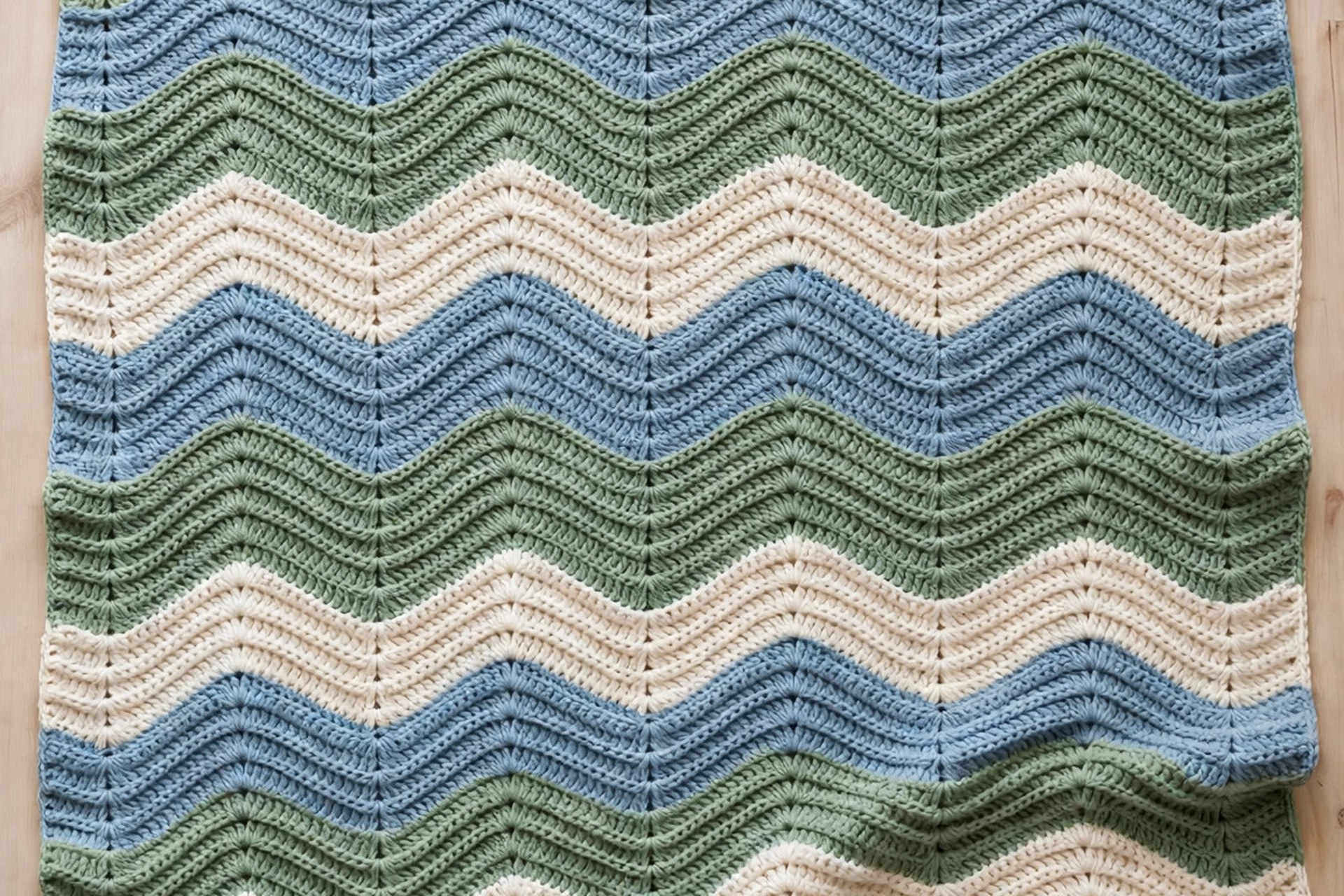
Work the blanket in 6 row stripes, changing color at the end of every 6th row. The full plan is:
- Rows 1 to 6: sea blue
- Rows 7 to 12: sage green
- Rows 13 to 18: cream
- Rows 19 to 24: sea blue
- Rows 25 to 30: sage green
- Rows 31 to 36: cream
Keep repeating the three color order, sea blue, sage green, cream, until you have worked 96 rows in total. That is 16 stripes, and the blanket will end on a cream stripe. The blanket should be about 55 inches long before the border, which brings it to 58 inches once the border is added.
Changing Color
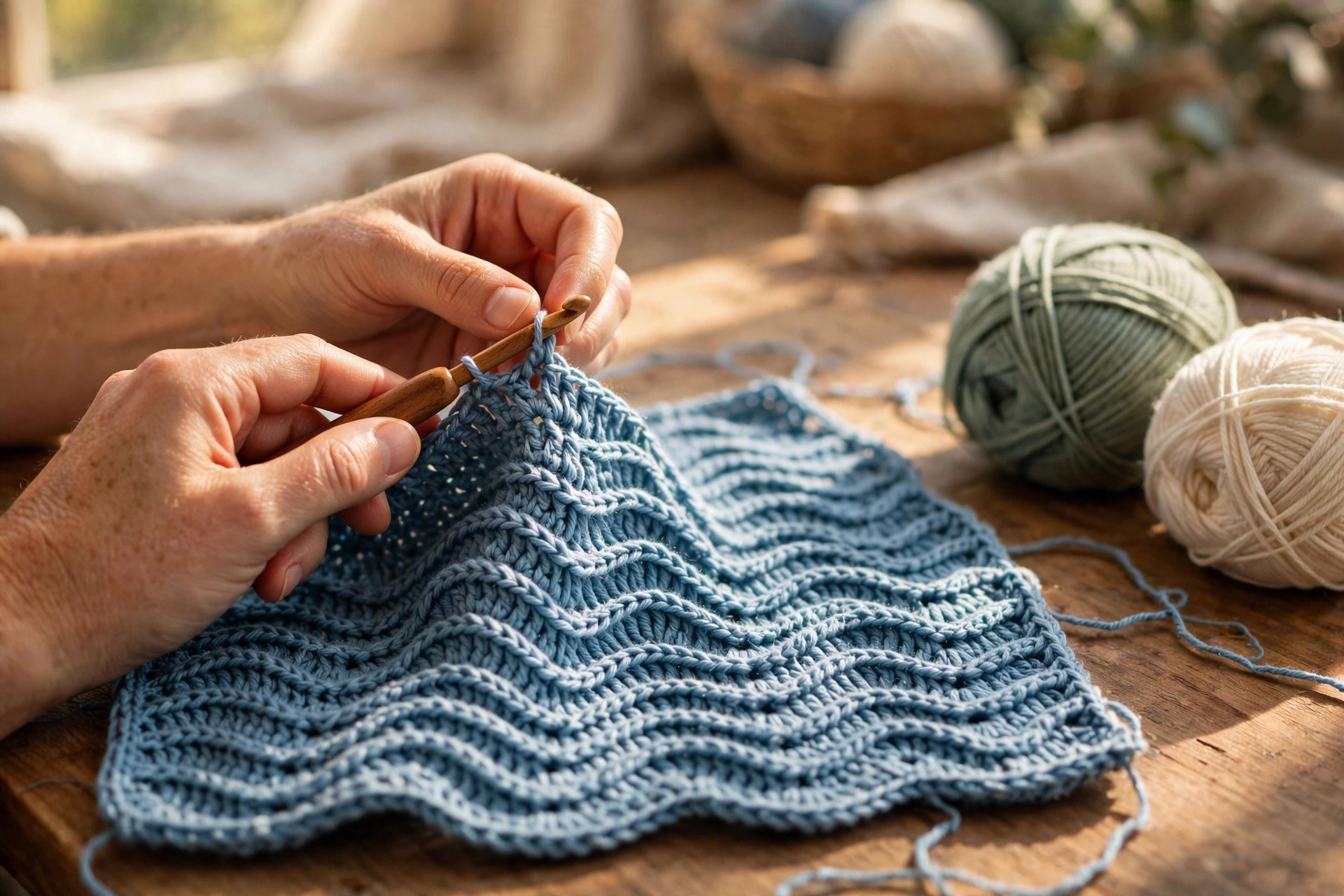
To change color, work the last dc of the old color until two loops remain on the hook, then yarn over with the new color and pull it through both loops. Cut the old color, leaving a 6 inch tail to weave in later. Turn, and work the next row in the new color. Change color at the end of a row, never in the middle, because a mid row change would cut a wave in half.
Work the first stitch of each new color firmly, because the first stitch of a stripe is the one most likely to loosen and leave a gap. If the edge looks loose, work the turning chain a little tighter on the first row of each stripe. Our temperature blanket crochet pattern uses the same end of row color change if you want another striped project to practice on.
Keeping the Waves Even
Count your stitches at the end of every row for the first ten rows, then every five rows after that. Each row must have 155 stitches. If a row has 154, you have worked one decrease too many, so check the valleys. If a row has 156, you have worked one increase too many, so check the peaks.
Check the wave alignment every few rows by folding the blanket in half lengthwise. The peaks on the top half should sit directly over the peaks on the bottom half. A small drift early on becomes a big slant by row 50, so fix it while it is small.
Part 3: The Border and Finishing
The border frames the waves and stops the edges from curling. Work it in cream, in two rounds of single crochet and one round of double crochet, and keep your stitches even around the corners.
The Border
With cream, join the yarn at any corner of the blanket.
- Round 1: ch 1, work 1 sc in each st across the top edge, 3 sc in the corner st, 1 sc in each row end down the side edge, 3 sc in the corner st, 1 sc in each st across the bottom edge, 3 sc in the corner st, 1 sc in each row end up the side edge, 2 sc in the starting corner, join with a sl st to the first sc.
- Round 2: ch 1, work 1 sc in each st around, working 3 sc in each corner st, join.
- Round 3: ch 3 (counts as dc), work 1 dc in each st around, working 2 dc, ch 2, 2 dc in each corner st, join.
Fasten off and weave in the ends. The border should be about 2 inches wide, and the blanket should measure 48 inches by 58 inches. Lay the blanket flat and check that the corners are square, because a border worked too tightly will pull the corners in and make the blanket look pinched. Our chunky yarn crochet blanket patterns use the same three round border if you want a thicker throw in the same style.
Weaving In Ends and Blocking
Weave in every yarn tail with the tapestry needle, working the tail through the back of the stitches for about 2 inches, then trimming it close. There are 16 stripes, so there are about 32 tails to weave in, plus the border tails. Work through them a few at a time, because leaving them all to the end makes the finishing feel endless.
Block the blanket by laying it flat on clean towels, spraying it lightly with cool water, and shaping the waves so the peaks line up. Let it dry fully before you fold it or use it.
Variations: Colors, Sizes, and Uses
- Ocean blues: work the stripes in three shades of blue, dark, medium, and pale, for a blanket that looks like rolling sea waves.
- Autumn ripple: work the stripes in rust, mustard, and cream for a warm autumn throw that suits a wooden sofa.
- Baby blanket size: work 7 waves instead of 11, with a foundation chain of 102, for a baby blanket about 30 inches wide.
- Bed size throw: work 15 waves instead of 11, with a foundation chain of 214, for a wide throw about 64 inches across.
- Single color ripple: work the whole blanket in one soft color, such as cream or pale grey, for a calm blanket where the wave texture does all the talking. Our star blanket crochet pattern makes a lovely matching piece in the same single color.
Troubleshooting a Blanket That Does Not Wave
- My blanket is flat with no waves. You may be working the increases and decreases in the wrong places. Check that the peaks sit over the peaks of the row below, and the valleys over the valleys.
- My blanket slants to one side. The repeat has slipped by one stitch. Fold the blanket in half and find the row where the peaks stop lining up, then fix that row.
- My edges pull in. Your turning chain is too tight, or you are missing the last stitch of each row. Work the turning chain loosely and count the last stitch every row.
- My edges flare out. You are working an extra stitch at the end of each row, probably into the turning chain. Stop working into the turning chain, and count your stitches.
- My stripes look uneven. One color is worked more loosely than the others. Check your gauge in each color, because even the same yarn line can vary slightly by dye lot.
- My waves look pointy, not gentle. Your hook is too small, or your increases are too tight. Go up a hook size and work the peak stitches loosely so the wave rounds out.
Care Instructions
Hand wash a ripple blanket in cool water with a mild detergent, and press the water out gently without wringing. Reshape the blanket while it is damp, lay it flat on a clean towel, and let it dry fully away from direct heat. A ripple blanket is a big piece, so it takes a full day to dry, and it should be turned over once so both sides dry evenly. Fold it loosely for storage, because hanging a heavy blanket will stretch the waves out of shape.
Frequently Asked Questions
Is this ripple blanket pattern good for beginners?
Yes, it is best for a confident beginner. You need a foundation chain, double crochet, increases, and decreases. One blanket takes about 18 hours, so it is a good project to work on over a few weeks.
What is the difference between a ripple and a chevron blanket?
A ripple has gentle rounded waves with soft peaks, while a chevron has sharp pointed zigzags. This pattern is a ripple, with rounded peaks made from 2 dc in one stitch. If you want a sharp zigzag, our chevron crochet pattern is the one to make.
How many stitches are in each wave repeat?
Each wave repeat is 14 stitches, and the blanket has 11 repeats across, plus the turning chain, for 155 stitches in total. To make the blanket wider, add 14 stitches for each extra wave.
What yarn is best for a ripple blanket?
Worsted weight acrylic or wool blend yarn is the best choice, because it is warm, it drapes well, and the colors stay bright. Sea blue, sage green, and cream are lovely together. Avoid very fuzzy yarns, because they hide the wave shape, and avoid stiff cotton, because it does not drape well.
How do I keep the waves lined up?
Count your stitches at the end of every row for the first ten rows, then every five rows after that, and mark the first peak of each wave with a stitch marker. Fold the blanket in half every few rows and check that the peaks sit directly over each other.
How do I wash a ripple blanket?
Hand wash it in cool water with a mild detergent, press the water out without wringing, and lay it flat to dry. It takes a full day to dry, so turn it over once, and fold it loosely for storage instead of hanging it.
Can I sell blankets made from this pattern?
Yes, you may sell finished blankets made from this free pattern, with credit to Little Loop Finds. Do not sell or republish the pattern text itself. A ripple throw in soft blues with a matching easy crochet patterns for blankets project makes a lovely set for a market stall.
Happy stitching, and may your little ripple blanket bring calm waves to every quiet evening ahead.