Chevron Crochet Pattern (Free Zigzag Blanket)
Stitch a cozy zigzag throw blanket with bold chevron stripes and a classic ripple stitch.
Patterns · Crochet
- Finished size
- 40 in wide, 48 in long
- Making time
- 12 to 15 hours
- Hook
- US I-9 (5.5 mm)
- Set
- Stitch, blanket, border and finishing
- Skill
- Easy
In this post
- Key Takeaways
- Table of Contents
- Why You Will Love the Chevron Stitch
- Finished Size, Skill Level, and Time
- Materials You Need
- Abbreviations (US Terms)
- Gauge and Sizing Notes
- Part 1: The Chevron Stitch, Row by Row
- Part 2: The Zigzag Throw Blanket
- Part 3: Color Changes and Finishing
- Variations: Sizes, Colors, and Projects
- Troubleshooting Wavy Edges and Lost Peaks
- Care Instructions
- Frequently Asked Questions
Few stitch patterns are as instantly cheerful as the chevron. Those bold zigzag peaks and valleys turn simple stripes of color into a blanket that looks like it took far more skill than it really did. This free chevron crochet pattern teaches you the classic zigzag ripple stitch, then uses it to make a cozy striped throw blanket you will reach for all winter.
This is an original Little Loop Finds design, written in US terms and completely free. The chevron stitch is built from one repeating row: double crochet, a peaked increase at the top of each zigzag, and a three stitch decrease at the bottom of each valley. Once you work the first two rows, the rhythm clicks and the blanket practically makes itself.
A quick note on scope: this post is about the chevron zigzag stitch and a throw blanket made with it. It is not a chevron baby blanket with a different stitch count, and it is not a chevron scarf, though the stitch section below works for scarves too if you start with a shorter chain. If you want other blanket projects, you will find links to them below.
Key Takeaways
- Free original pattern: this chevron crochet pattern is a Little Loop Finds original design, written in US terms, and completely free.
- Classic zigzag ripple: one repeating row of double crochet, peaked increases, and three stitch decreases makes the chevron shape.
- Beginner friendly: if you can chain and double crochet, you can make this blanket, because the whole stitch is one repeat.
- A real throw blanket: about 40 inches wide and 48 inches long in worsted weight yarn, big enough for the couch.
- Endless color play: change colors every two or four rows for stripes, or work it in two colors for a modern look.
Table of Contents
- Why You Will Love the Chevron Stitch
- Finished Size, Skill Level, and Time
- Materials You Need
- Abbreviations (US Terms)
- Gauge and Sizing Notes
- Part 1: The Chevron Stitch, Row by Row
- Part 2: The Zigzag Throw Blanket
- Part 3: Color Changes and Finishing
- Variations: Sizes, Colors, and Projects
- Troubleshooting Wavy Edges and Lost Peaks
- Care Instructions
- Frequently Asked Questions
Why You Will Love the Chevron Stitch
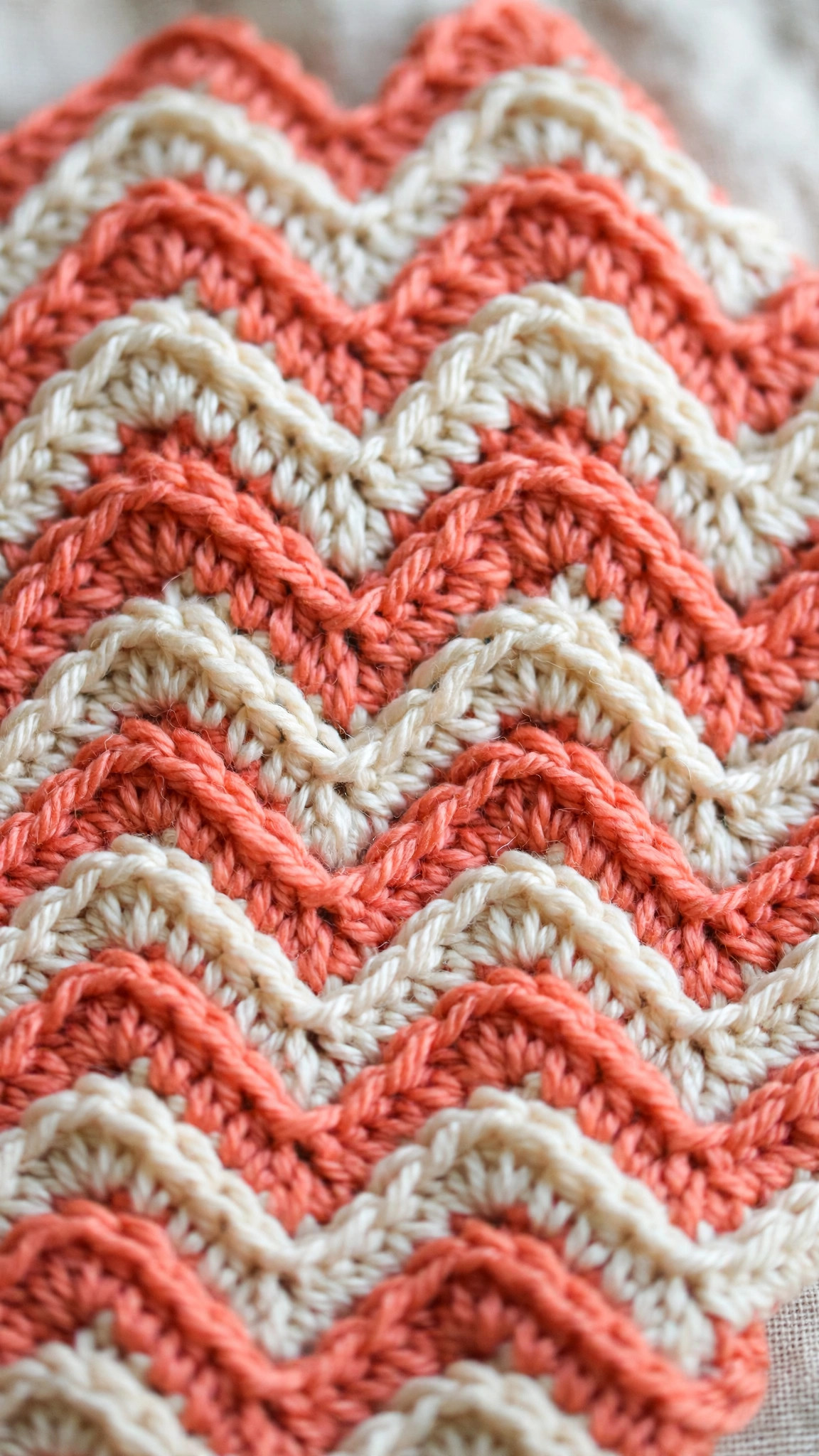
The chevron stitch is one of the most satisfying patterns in crochet. It looks complex, with sharp peaks and deep valleys, but it is really just double crochet with two simple moves: three stitches worked into one chain space to make a peak, and three stitches worked together to make a valley. The peaks and valleys line up row after row, so the zigzag appears on its own, like magic, as you work.
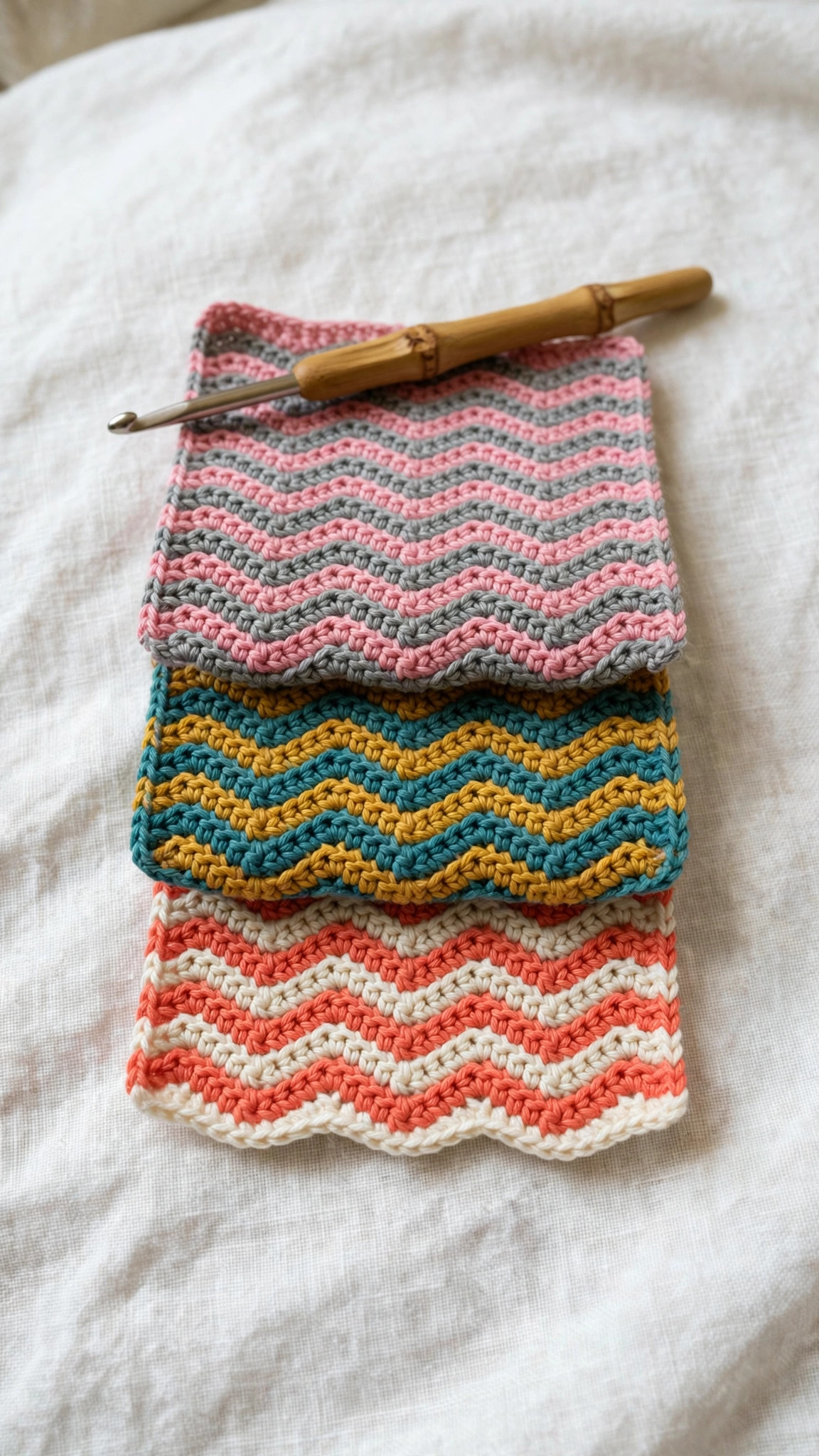
Chevron is also a wonderful stash buster. Because the pattern is worked in rows, you can change colors whenever you like, and every color change lands on a clean straight row. Leftover skeins in coral, teal, mustard, and cream become a striped throw that looks planned, not patched together.
This blanket makes a generous gift too. A chevron throw suits almost any living room, and the zigzag reads as modern rather than old fashioned.
Finished Size, Skill Level, and Time
- Finished size: about 40 inches wide and 48 inches long, a generous couch throw, in worsted weight yarn.
- Skill level: Easy. You need a starting chain, double crochet, and the three stitch decrease, which is explained step by step below.
- Time: about 12 to 15 hours total, spread over a week or two of relaxed evening stitching. The stitch repeat is fast once it clicks, and the blanket grows by several inches every sitting.
Materials You Need
| Item | What to get |
|---|---|
| Yarn, main colors | Worsted weight (medium 4) acrylic or cotton blend, about 1,200 yards total across 3 to 5 colors |
| Yarn, per color | About 250 to 300 yards of each color if you use four colors in equal stripes |
| Hook | US I-9 (5.5 mm), or the size that gives you a soft, drapey fabric with your yarn |
| Notions | Tapestry needle, scissors, stitch markers |
Acrylic yarn is the best choice for a blanket that will be used every day, because it is washable, affordable in many colors, and soft enough for bare legs on a cold evening. A cotton blend gives beautiful stitch definition and a slightly heavier drape. Whichever you choose, buy all the yarn for one color at the same time so the dye lots match.
Abbreviations (US Terms)
- ch = chain
- sl st = slip stitch
- sc = single crochet
- dc = double crochet
- dc3tog = double crochet 3 together (decrease over 3 stitches)
- st(s) = stitch(es)
- sp = space
- rep = repeat
Gauge and Sizing Notes
Gauge for a chevron blanket is measured across one full zigzag repeat, not across a few stitches. One repeat of this pattern, which is 14 stitches wide, measures about 5 inches across in worsted weight yarn with a 5.5 mm hook. Fourteen stitches make one peak and one valley, so count your peaks to check your width: eight peaks make a blanket about 40 inches wide.
To make the blanket wider or narrower, add or remove repeats of 14 chains from your starting chain. Each repeat adds about 5 inches of width. To make a baby blanket about 30 inches wide, start with 6 repeats. To make a bed sized throw about 55 inches wide, start with 11 repeats. The length is up to you: just keep working rows until the blanket is as long as you want it.
Part 1: The Chevron Stitch, Row by Row
The chevron stitch is worked in rows, and every row is the same. The foundation chain is a multiple of 14, plus 10. That formula gives you whole zigzag repeats with a neat four stitch slope at each edge. For the throw blanket in this pattern, chain 122, which is 14 times 8, plus 10, and gives you 8 peaks across.
First, practice on a small swatch before you start the blanket. Chain 38, which is 14 times 2, plus 10, and work the rows below. A swatch shows you how the peaks and valleys form, and it lets you check your gauge before you commit to a whole blanket.
Row 1
The first row is worked into the foundation chain. The chain 3 at the start counts as your first double crochet.
- Ch 3 (counts as dc), dc in 4th ch from hook, dc in next 2 ch. (4 dc: the left edge slope)
- Skip 2 ch, dc in next 3 ch, (dc, ch 2, dc) in next ch, dc in next 3 ch, skip 2 ch, dc3tog over next 3 ch. This is the repeat. The (dc, ch 2, dc) in one chain makes the peak, and the dc3tog makes the valley.
- Repeat the repeat across the row.
- End the row with dc in next 3 ch, dc in last ch. (4 dc: the right edge slope) Turn.
After Row 1, check your work: you should see the first zigzags forming, with a peak where you worked (dc, ch 2, dc) into one chain and a valley where you worked three stitches together. The edges should be straight, with four double crochet stitches on each side.
Row 2 and All Following Rows
Every row after the first is worked the same way, with the peaks landing on top of the peaks below and the valleys landing on top of the valleys below.
- Ch 3 (counts as dc), dc in next 3 sts. (4 dc: the edge slope)
- Skip 2 sts, dc in next 3 sts, (dc, ch 2, dc) in the ch-2 space of the peak below, dc in next 3 sts, skip 2 sts, dc3tog over next 3 sts. This is the repeat.
- Repeat the repeat across the row.
- End the row with dc in next 3 sts, dc in the top of the turning ch. Turn.
The trick to straight edges is the last stitch of every row: always work a double crochet into the top of the turning chain from the row below. If your edges start to slant, you are almost certainly missing that last stitch or adding an extra one, so count your edge stitches every few rows.
Working the dc3tog Decrease
The valley decrease sounds fussy, but it is just three half finished double crochets joined at the top. Yarn over, insert the hook in the next stitch, yarn over and pull up a loop, yarn over and pull through two loops. You now have two loops on the hook. Repeat that in the next two stitches, so you have four loops on the hook, then yarn over and pull through all four loops. That is one dc3tog, and it pulls three stitches into a single neat point at the bottom of the valley.
Part 2: The Zigzag Throw Blanket
Now you know the stitch, the blanket is the same row repeated until it is long enough. This section gives you the full blanket in a four color stripe sequence, but you can use any colors you like and change them whenever you wish.
Starting the Blanket
With your first color, chain 122. Work Row 1 as written above, then work Row 2 and all following rows the same way. You will have 8 peaks and 8 valleys across the row, with 4 double crochet stitches on each edge.
Work 4 rows in your first color, then change to your second color and work 4 rows. Continue in this order: 4 rows of each color, cycling through your four colors, until the blanket measures about 48 inches long. That is about 60 rows in total, though your row count will vary with your tension.
Stripe Ideas
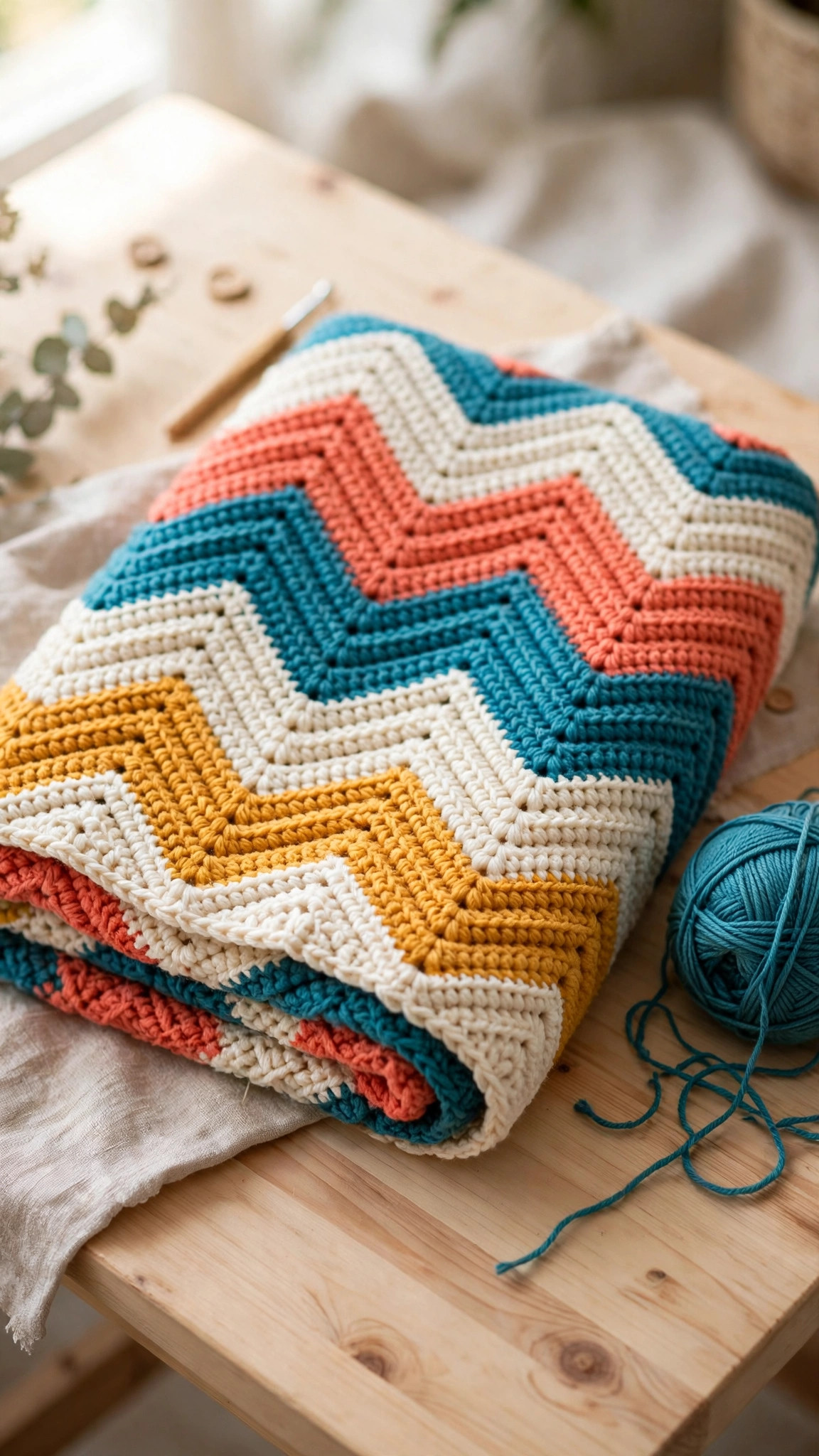
- Classic four color stripes: 4 rows each of coral, cream, teal, and mustard, repeated. This is the version in the photos.
- Two color modern: 6 rows of cream and 6 rows of charcoal, repeated. The zigzag does all the work, and the blanket suits a modern living room.
- Rainbow fade: 2 rows each of seven colors, moving from warm reds through yellows and greens to blues and purples. A rainbow chevron is a showstopper in a childs room.
Part 3: Color Changes and Finishing
Changing Colors Cleanly
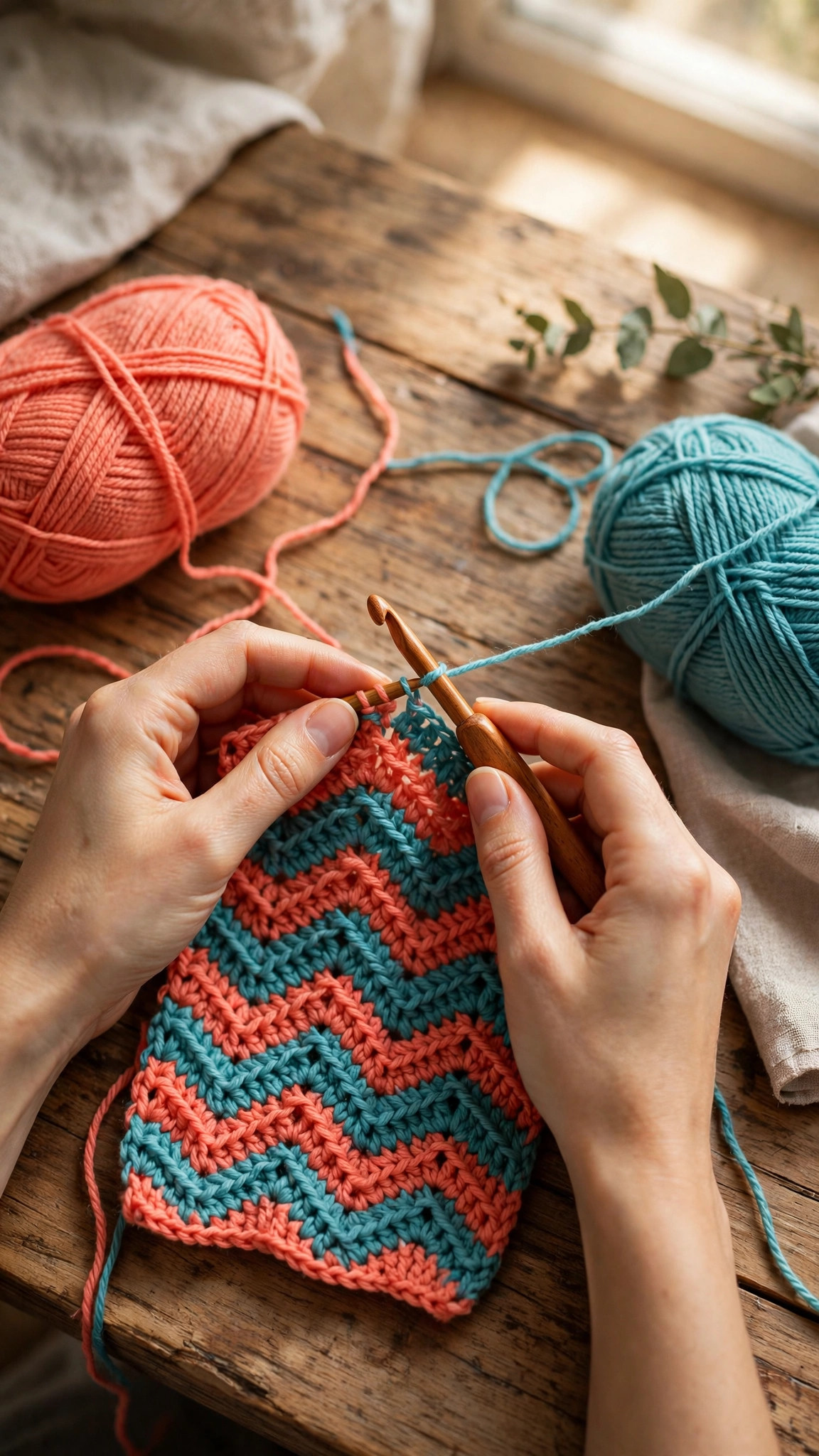
Change colors at the end of a row, never in the middle. Work the last double crochet of the row until you have two loops left on the hook, then drop the old color, yarn over with the new color, and pull it through both loops. Chain 3 with the new color and turn. This joins the new color neatly with no knot and no loose loop at the edge.
Leave a tail of about 6 inches when you cut the old color. You will weave these tails in later, and a longer tail is much easier to work with than a short one.
The Border
A simple border frames the zigzag and tidies the edges. It also hides any unevenness in your edge stitches, so do not skip it.
- Round 1: With any color, join with a slip stitch in any corner. Work single crochet evenly around all four sides, working 3 sc in each corner stitch. On the long sides, work one single crochet in the end of each row. On the short sides, work one single crochet in each stitch. Join with a slip stitch to the first sc.
- Round 2: Chain 1, single crochet in each stitch around, working 3 sc in each corner stitch. Join with a slip stitch and fasten off.
Weaving In Ends
Weave every tail in with a tapestry needle, running it through the back of several stitches in the same color, then back the other way for an inch. Trim the tail close to the fabric. A well woven tail will not work loose in the wash, and it keeps the back of the blanket as neat as the front.
Variations: Sizes, Colors, and Projects
- Baby blanket: chain 94 (14 times 6, plus 10) for 6 peaks, about 30 inches wide, and work until it is about 36 inches long. Soft pastels suit a nursery. Our easy crochet patterns for blankets has more simple blanket ideas if you want a matching set.
- Bed sized throw: chain 164 (14 times 11, plus 10) for 11 peaks, about 55 inches wide, and work until it is about 65 inches long. You will need about 2,000 yards of yarn.
- Chevron scarf: chain 38 for 2 peaks, about 10 inches wide, and work until it is about 60 inches long. A chevron scarf in two colors is a quick weekend gift. Our basic crochet scarf patterns has more scarf ideas.
- Chevron pillow: chain 66 (14 times 4, plus 10) for 4 peaks, about 20 inches wide, and work a square. Make two squares, sew three sides together, add a pillow form, and sew the last side closed.
- Table runner: chain 52 for 3 peaks, about 15 inches wide, and work until it is about 40 inches long. A chevron runner in holiday colors dresses up a dining table.
If you love striped blankets, the chunky yarn crochet blanket patterns collection has thicker, faster blankets in the same spirit, and the star blanket crochet pattern makes a round blanket with a completely different shape. For a floral blanket to pair with this throw, the crochet sunflower blanket pattern is a sunny match, and the crochet mandala pattern makes a beautiful round accent piece for the same couch.
Troubleshooting Wavy Edges and Lost Peaks
- My edges slant inward. You are missing the last double crochet of the row. Always work into the top of the turning chain from the row below, and count your edge stitches: four double crochet on each side, every row.
- My edges flare outward. You are adding an extra stitch at the start or end of the row. The chain 3 counts as a stitch, so do not work another double crochet into the same spot.
- My peaks are not lining up. Your peaks must land in the chain 2 space of the peak below, not in a stitch beside it. Find the little hole at the top of each peak and work (dc, ch 2, dc) into it.
- My valleys look messy. The dc3tog must span exactly three stitches: one before the valley point, the valley stitch itself, and one after it. Count the stitches as you work the decrease, and keep your tension even.
- The blanket curls at the edges. This usually means your foundation chain is tighter than your rows. Use a hook one size larger for the foundation chain only, then switch back to your regular hook for the rows.
- My stripes are not straight. Color changes happen at the end of a row, and the new color starts with the chain 3. If a stripe looks stepped, you changed color in the middle of a row. Unpick back to the end of the previous row and change there.
Care Instructions
Machine wash your chevron blanket on a gentle cold cycle if you used acrylic yarn, and lay it flat to dry so the zigzags keep their shape. If you used a cotton blend, hand wash in cool water with mild soap and lay flat to dry. Do not hang a wet crochet blanket, because the weight of the water pulls the stitches out of shape.
Frequently Asked Questions
Is the chevron stitch good for beginners?
Yes, it is one of the best first stitch patterns to learn after the basic stitches. You only need to know how to chain and double crochet, plus the three stitch decrease, which is explained step by step above. The repeat is short and rhythmic, so most crocheters memorize it after two or three rows.
How many chains do I need for a chevron blanket?
The foundation chain is a multiple of 14, plus 10. For a throw about 40 inches wide, chain 122, which gives you 8 peaks. For a baby blanket about 30 inches wide, chain 94 for 6 peaks. Each repeat of 14 chains adds about 5 inches of width.
Why does my chevron look wavy instead of zigzag?
A wavy chevron usually means the peaks and valleys are landing in the wrong spots. Peaks must be worked into the chain 2 space of the peak below, and valleys must be worked as a dc3tog over the three stitches at the valley point. If you work the peak into a regular stitch instead of the chain space, the zigzag flattens into a wave.
How much yarn do I need for a chevron blanket?
A throw about 40 by 48 inches in worsted weight yarn takes about 1,200 yards in total. If you use four colors in equal stripes, that is about 300 yards of each color. A baby blanket takes about 700 yards, and a bed sized throw takes about 2,000 yards.
Can I make a chevron blanket in one color?
Absolutely, and it looks wonderful. A single color chevron shows off the texture of the peaks and valleys beautifully, especially in a soft cream or a rich jewel tone. The zigzag shape is the star, so the blanket does not need color changes to look impressive.
Does chevron use more yarn than straight rows?
Yes, a little more, because the peaks add extra stitches and the stitch pattern is taller than plain double crochet. Expect to use about 10 to 15 percent more yarn than a plain double crochet blanket of the same size, which is already included in the yardage above.
Can I use the chevron stitch for other projects?
Yes, the same stitch works for scarves, pillow covers, table runners, and even garments like cardigans and ponchos. Just start with a foundation chain that fits the width you need, using the multiple of 14 plus 10 formula, and work the same two rows until the piece is the length you want.
Happy stitching, and may your blanket be full of sharp peaks, deep valleys, and colors that make you smile every time you pick it up.