C2C Crochet Blanket Pattern (Free Baby Blanket)
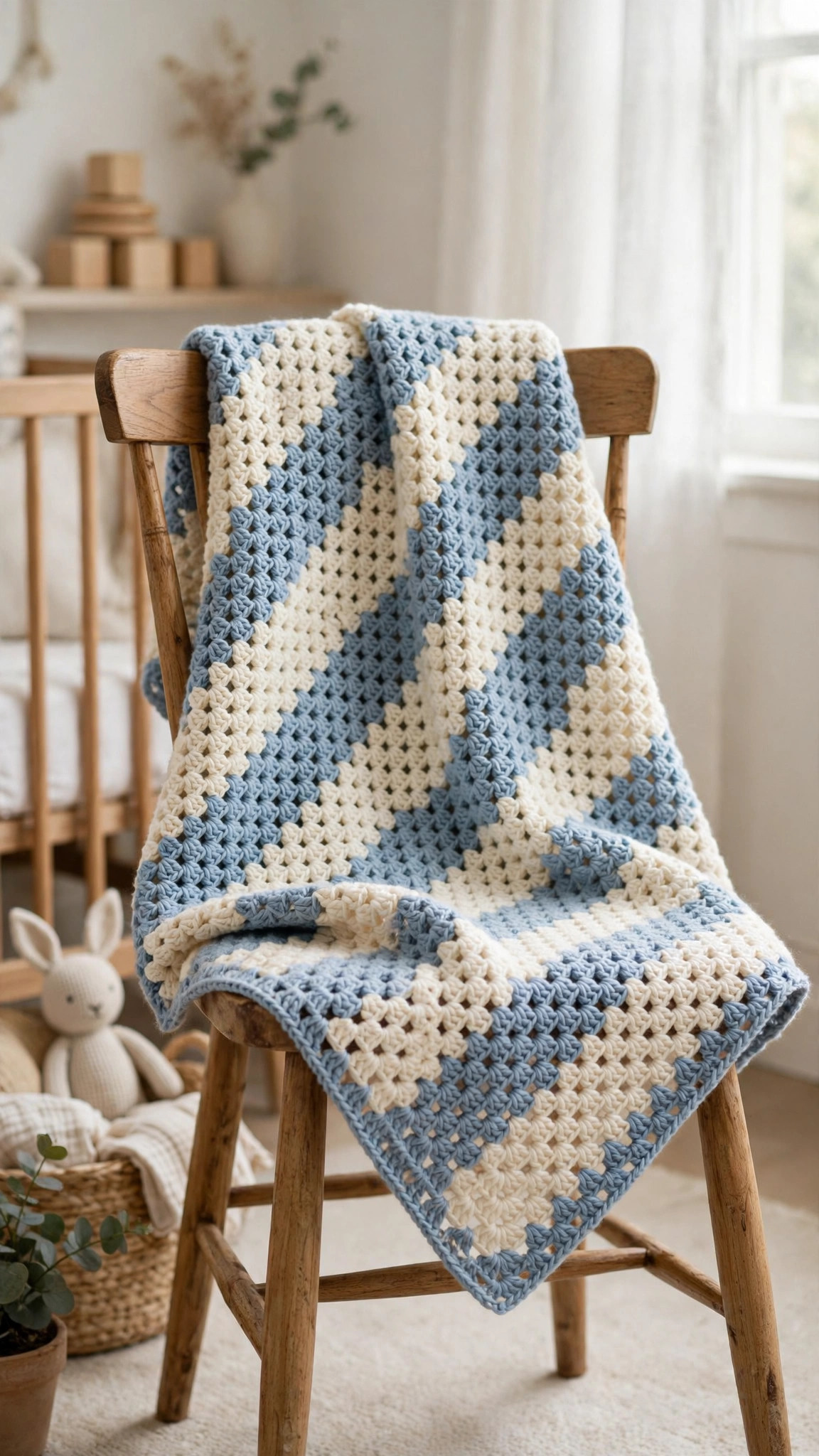
Crochet a striped C2C baby blanket in the corner to corner box stitch in about ten hours, then finish it with a simple border.

Patterns · Crochet
- Finished size
- 26 in square
- Making time
- 10 hours
- Hook
- US I-9 (5.5 mm)
- Set
- Blanket, border
- Skill
- Easy
In this post
- Key Takeaways
- Table of Contents
- Why You Will Love C2C Crochet
- Finished Size, Skill Level, and Time
- Materials You Need
- Abbreviations (US Terms)
- Gauge and Sizing Notes
- How the C2C Box Stitch Works
- Part 1: Increasing to the Middle
- Part 2: Decreasing to the Far Corner
- Part 3: The Border and Finishing
- Variations: Colors, Sizes, and Uses
- Troubleshooting a C2C Blanket That Leans
- Care Instructions
- Frequently Asked Questions
A C2C crochet blanket pattern is the fastest way to make a beautiful striped blanket. This free C2C crochet blanket pattern teaches you the corner to corner box stitch, then walks you through a striped baby blanket worked on the diagonal, one little block at a time. It works up in about 10 hours, and the color changes happen naturally as you go.
This is an original Little Loop Finds design, written in US terms and completely free. Each block is just a chain 3 and 3 double crochets, and the blanket grows row by row from one corner to the opposite corner. If you can crochet a double crochet, you can crochet C2C.
A quick note on scope: this post is about one specific C2C blanket, a striped baby blanket in two colors worked in the diagonal box stitch. It is not a C2C graphghan with a picture chart, and it is not a granny square blanket. If you want a plain square blanket to compare, our easy crochet patterns for blankets has several row by row options.
Key Takeaways
- Free original pattern: a Little Loop Finds original design, written in US terms, and completely free.
- The C2C box stitch: a diagonal blanket made of small double crochet blocks.
- Beginner friendly: chain 3 and 3 double crochets, repeated in a simple rhythm.
- A 10 hour blanket: one baby blanket takes about 10 hours of relaxed stitching.
- Built in stripes: two colors change every 6 rows, with no extra weaving.
Table of Contents
- Why You Will Love C2C Crochet
- Finished Size, Skill Level, and Time
- Materials You Need
- Abbreviations (US Terms)
- Gauge and Sizing Notes
- How the C2C Box Stitch Works
- Part 1: Increasing to the Middle
- Part 2: Decreasing to the Far Corner
- Part 3: The Border and Finishing
- Variations: Colors, Sizes, and Uses
- Troubleshooting a C2C Blanket That Leans
- Care Instructions
- Frequently Asked Questions
Why You Will Love C2C Crochet
C2C crochet feels like magic the first time you try it. You start with one tiny block in a corner, and row by row the blanket grows on the diagonal until it is a full square. There is no long starting chain to count, and no turning chain to lose track of, which is why so many crocheters call it their favorite blanket method.
C2C is also wonderfully portable. Each row is short at the start, so you can work a few rows on the couch or in the car without a huge blanket in your lap. The stripes in this pattern change every 6 rows, so you always have a new color to look forward to. Our corner to corner crochet patterns roundup has more C2C ideas if this blanket gets you hooked.
Finished Size, Skill Level, and Time
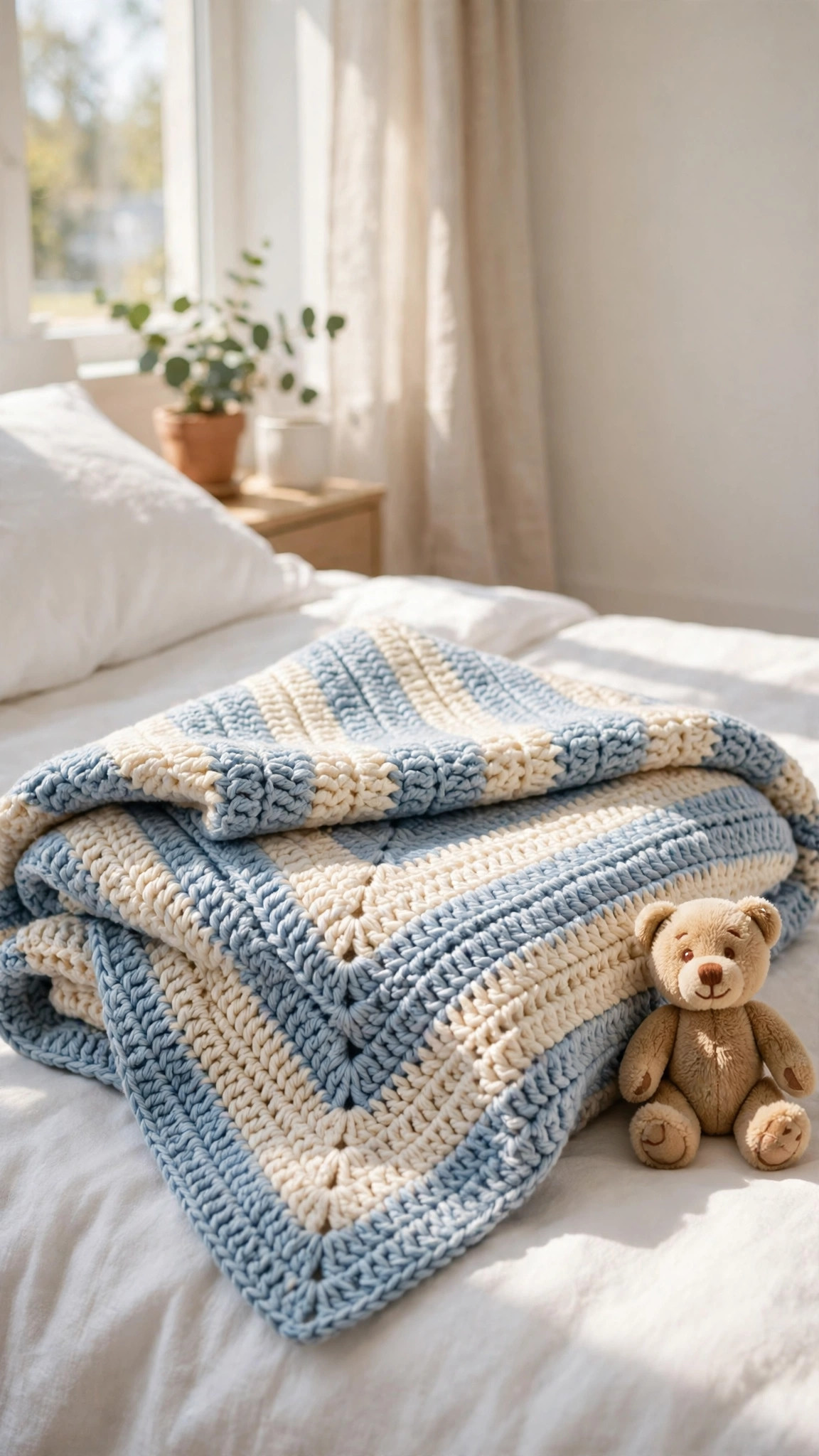
- Finished size: about 26 inches square, including the border, a perfect baby blanket or lap blanket.
- Skill level: Easy. You need a chain, double crochet, and slip stitch, plus a simple increase and decrease.
- Time: about 10 hours per blanket: 5 hours for the increasing half, 4 hours for the decreasing half, 1 hour for the border and weaving in ends.
Materials You Need
| Item | What to get |
|---|---|
| Yarn, color A | Worsted weight (size 4) yarn in soft blue, 400 yards |
| Yarn, color B | Worsted weight (size 4) yarn in cream, 400 yards |
| Yarn, color C | Worsted weight (size 4) yarn in a border color, such as navy, 100 yards |
| Hook | US I-9 (5.5 mm), or the size that gives you the gauge below |
| Notions | Tapestry needle, scissors, stitch markers |
Worsted weight yarn is the best choice for a C2C blanket because each block shows up clearly, the fabric is warm but drapes nicely, and the blanket washes easily. A smooth acrylic or cotton blend works well. Choose two colors with good contrast so the stripes read clearly, and a darker border color to frame them. Avoid fuzzy yarns, because they hide the block edges and make counting harder. For a baby blanket, pick soft, washable yarn and skip any yarn with metallic thread.
Abbreviations (US Terms)
- ch = chain
- sl st = slip stitch
- dc = double crochet
- st(s) = stitch(es)
- sp(s) = space(s)
- rep = repeat
Gauge and Sizing Notes
Gauge matters because C2C blocks set the size of the whole blanket. Work a small swatch first: crochet 4 blocks in a row, then 4 rows tall. It should measure about 4 inches square, so each block is about 1 inch. If your swatch is wider, go down a hook size. If it is narrower, go up a hook size.
Count your blocks at the end of every row, because a missed block makes the blanket lean. The increasing half adds exactly one block per row, and the decreasing half removes exactly one block per row. Place a stitch marker in the first block of each row so you can find your place after a break. Keep your chain 3 spaces snug and even, because loose chains make the blanket wavy.
How the C2C Box Stitch Works
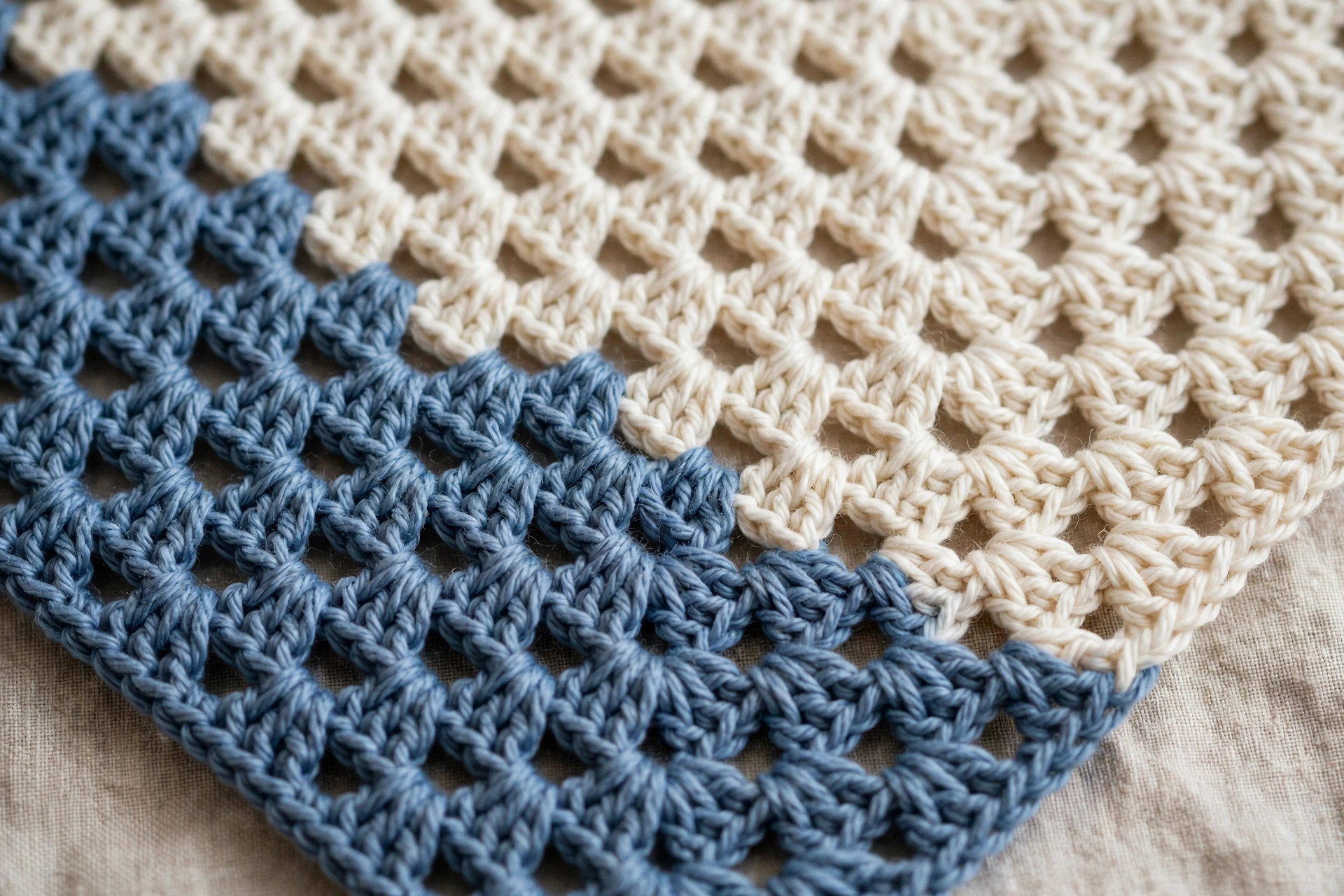
A C2C blanket is made of little blocks, and each block is a chain 3 plus 3 double crochets worked into a chain space. The blanket starts at one corner with a single block, grows one block wider every row until it reaches full width, then shrinks one block narrower every row until it ends in the opposite corner.
To increase, you start each row with a new block: chain 6, double crochet in the 4th chain from the hook and in the next 2 chains. That is your first block. Then slip stitch into the chain 3 space of the next block below, chain 3, and work 3 double crochets into the same space. Repeat across the row. Every increase row has exactly one more block than the row before it.
To decrease, you do not start with a new block. Instead, you slip stitch across the first block of the row below, slip stitch into its chain 3 space, then chain 3 and work 3 double crochets into that same space. Work blocks across the row, and slip stitch into the last chain 3 space without working a block there. Every decrease row has exactly one fewer block than the row before it. That is the whole technique. Everything else in this pattern is stripes and counting.
Part 1: Increasing to the Middle
Work rows 1 to 24 in color A for rows 1 to 6, color B for rows 7 to 12, color A for rows 13 to 18, and color B for rows 19 to 24. Change colors at the start of a row, and carry the unused color loosely up the side if you like, or fasten off and rejoin. The blanket grows from the bottom right corner toward the top left.
Row 1
With color A, ch 6, dc in the 4th ch from the hook and in the next 2 ch. (1 block)
Turn your work. This single block is the bottom corner of the blanket. It looks tiny, and that is exactly right.
Row 2
Ch 6, dc in the 4th ch from the hook and in the next 2 ch, sl st into the ch-3 sp of the block below, ch 3, 3 dc in the same sp. (2 blocks)
Turn. Each row from here follows the same rhythm: start with a new chain 6 block, then work a block into every chain 3 space of the row below.
Rows 3 to 24
- Increase row: ch 6, dc in the 4th ch from the hook and in the next 2 ch, *sl st into the next ch-3 sp, ch 3, 3 dc in the same sp; rep from * across the row. Turn.
Row 3 has 3 blocks, row 4 has 4 blocks, and so on, until row 24 has 24 blocks. Count the blocks at the end of every row. If a row has the wrong number, the mistake is almost always a missed slip stitch into a chain 3 space, so check each space before you turn.
Change to color B at the start of row 7, back to color A at row 13, and to color B again at row 19. When you change color, finish the last double crochet of the old row with the new color, pulling the new yarn through the final 2 loops on the hook. Weave in the color change tails as you go, because 576 blocks make a lot of ends to chase later. At the end of row 24, the blanket is a right triangle 24 blocks wide and 24 blocks tall, about 24 inches on each straight side. Our chunky yarn crochet blanket patterns use the same diagonal growth if you want a faster chunky version.
Part 2: Decreasing to the Far Corner
Work rows 25 to 47 in color B for rows 25 to 30, color A for rows 31 to 36, color B for rows 37 to 42, and color A for rows 43 to 47. Each row now has one fewer block than the row before it, and the blanket shrinks toward the top left corner.
Row 25
Turn, sl st in each of the first 3 dc, sl st into the ch-3 sp, ch 3, 3 dc in the same sp, *sl st into the next ch-3 sp, ch 3, 3 dc in the same sp; rep from * across until the last ch-3 sp, sl st into the last ch-3 sp. Turn. (23 blocks)
The slip stitches across the first block are what remove it. Do not work a block into the last chain 3 space either, because that is what removes the block on the other side. If your row still has 24 blocks, you worked into the last space by mistake.
Rows 26 to 47
- Decrease row: turn, sl st in each of the first 3 dc, sl st into the ch-3 sp, ch 3, 3 dc in the same sp, *sl st into the next ch-3 sp, ch 3, 3 dc in the same sp; rep from * across until the last ch-3 sp, sl st into the last ch-3 sp. Turn.
Row 26 has 22 blocks, row 27 has 21 blocks, and so on, until row 47 has 1 block. Change to color A at the start of row 31, back to color B at row 37, and to color A again at row 43. The last few rows are very short, and the final row is a single block in the top corner. Fasten off color A and weave in every end with a tapestry needle. The blanket should now be a square about 24 inches on each side, with clean diagonal stripes running from one corner to the other. Our christmas blanket crochet pattern uses the same decrease rhythm in festive colors if you want a holiday version.
Part 3: The Border and Finishing
A border smooths the stepped edges of a C2C blanket and gives it a finished look. Work 2 rounds in color C for a neat frame.
Round 1 of the Border
Join color C with a sl st in any corner. Ch 1, and work sc evenly around the whole blanket, working about 2 sc into the side of each block along the edges and 3 sc into each corner. Join with a sl st to the first sc. Each side should have about 48 single crochets, plus 3 in each corner.
Round 2 of the Border
Ch 1, sc in each sc around, working 3 sc in the center stitch of each corner, join with a sl st to the first sc. Fasten off and weave in the ends. Block the blanket if you like: lay it flat on a towel, pin the corners square, mist it lightly with water, and let it dry flat. A blocked C2C blanket lies beautifully flat, and the stripes look crisp and even. The finished blanket measures about 26 inches square.
Variations: Colors, Sizes, and Uses
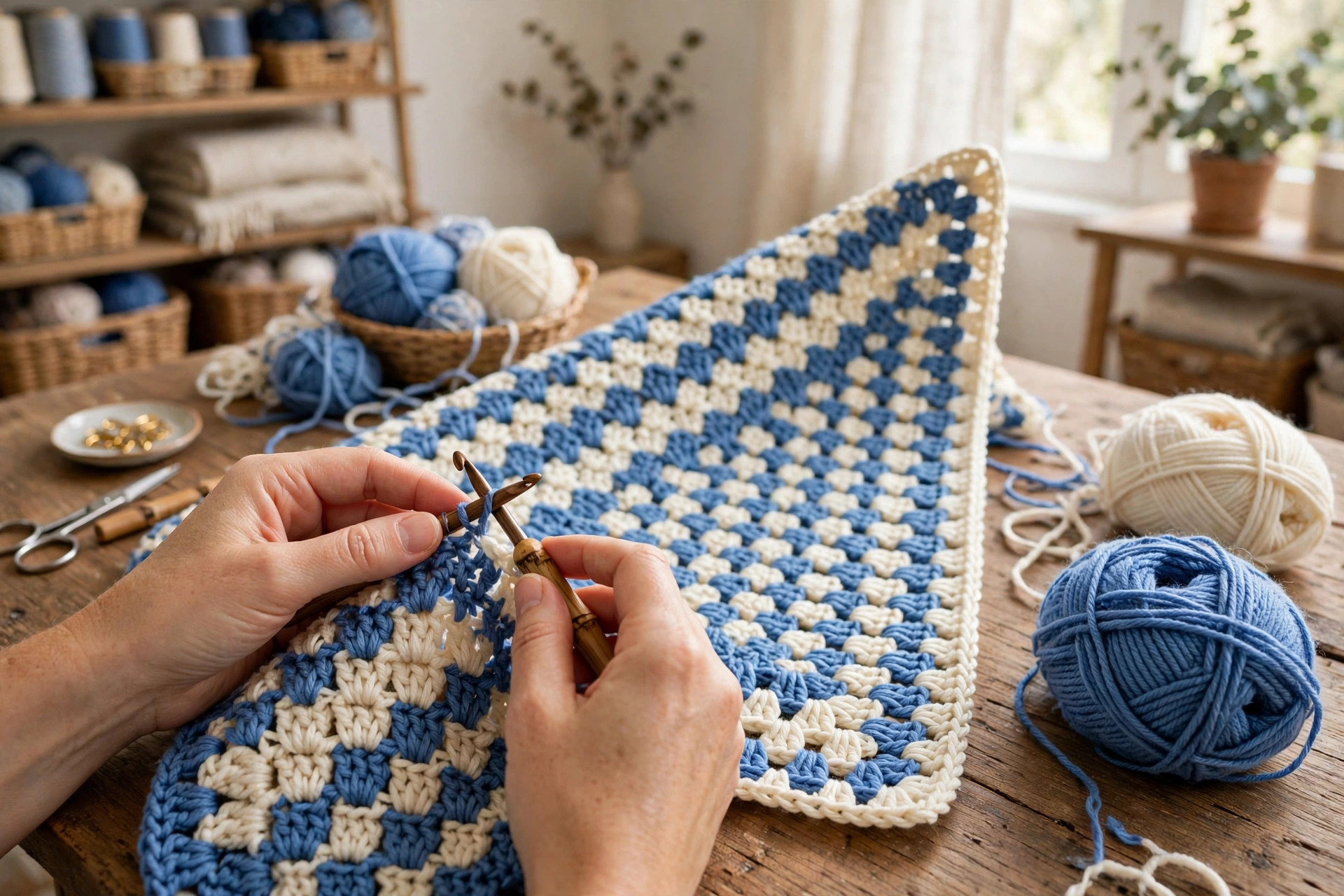
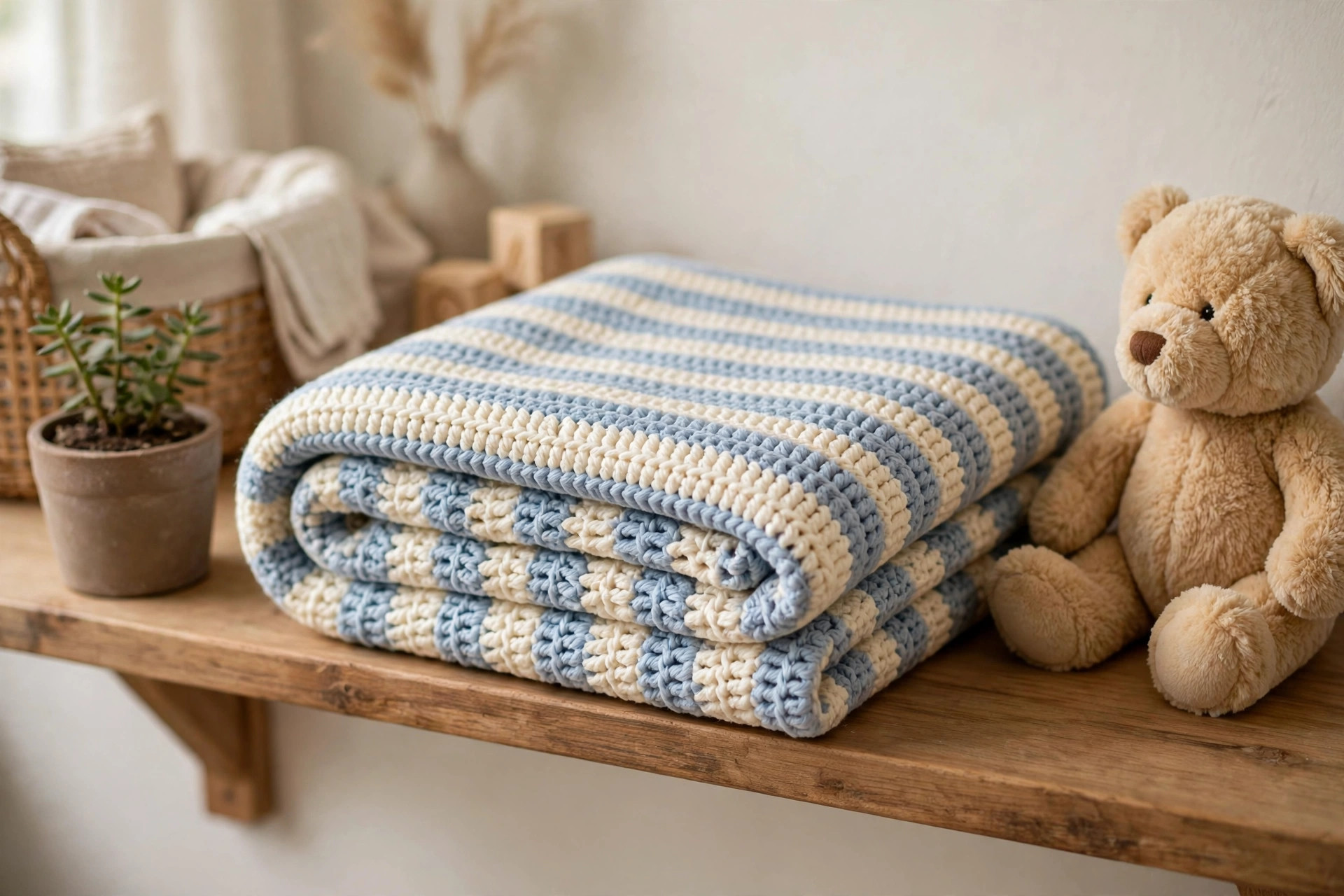
- Classic baby stripes: soft blue and cream, the colorway in the photos. Our african flower crochet pattern makes a lovely matching motif blanket for the same nursery.
- Rainbow stripes: change color every 6 rows through the rainbow for a bright playroom blanket.
- Neutral throw: cream and soft grey with a navy border for a calm living room throw.
- Bigger throw: increase to 40 blocks instead of 24, then decrease for 79 rows total, for a throw about 42 inches square.
- A scarf: increase to 8 blocks, work 6 rows even by increasing on one side and decreasing on the other, then decrease to a point.
- A cushion cover: stop at 16 blocks wide and work a square, then sew two squares together around a cushion pad, or browse our crochet sunflower blanket pattern for another sunny square blanket idea.
Troubleshooting a C2C Blanket That Leans
- My blanket leans to one side. You missed a block on one edge. Count the blocks in the last few rows, and find the row where the count changed by 2 instead of 1.
- My edges are wavy. Your chain 3 spaces are too loose. Keep them snug, and go down a hook size if the fabric still ripples.
- My stripes look uneven. The color changes happened mid row instead of at the row start. Always change color at the start of a row, on the last yarn over of the previous row.
- My corners are rounded, not square. The border corners need 3 single crochets in the center stitch. Add a second border round if the first one still rounds off.
- My blanket is a rectangle, not a square. The increase and decrease counts do not match. You must increase for 24 rows and decrease for 23 rows, ending with 1 block.
- My slip stitches show on the front. Slip stitch loosely, and keep them on the back of the work by turning the blanket the same way each row.
Care Instructions
Hand wash a C2C blanket in cool water with a mild detergent, and press the water out gently without wringing. Reshape the blanket while it is damp, pulling the corners square, and let it dry flat on a clean towel. Keep it out of direct sunlight so the colors do not fade. If you used acrylic yarn, the blanket can go in the washing machine on a gentle cold cycle, then dry flat. Check the border now and then, and re-stitch any loose end before it unravels.
Frequently Asked Questions
Is C2C crochet hard for beginners?
No, C2C is one of the easiest blanket methods for a beginner. Each block is just a chain 3 and 3 double crochets, and the increase and decrease are the same two moves repeated. Most crocheters learn it in one evening.
How many blocks are in a C2C baby blanket?
This baby blanket has 576 blocks: 300 blocks in the increasing half, rows 1 to 24, and 276 blocks in the decreasing half, rows 25 to 47. You do not need to count them all, just count the blocks in each row as you work it.
How much yarn do I need for a C2C baby blanket?
You need about 400 yards of color A, 400 yards of color B, and 100 yards of border color C, for about 900 yards in total. Buy one extra ball of each main color so you do not run short near the far corner.
Can I make a C2C blanket with a picture chart?
Yes, C2C is the classic graphghan method. Each block on the chart is one square, and you change colors block by block instead of row by row. Start with a simple chart, such as a heart, before you try a detailed picture.
Why is my C2C blanket a triangle?
You only worked the increasing half. A C2C blanket is a triangle until you start decreasing. Once you work the decrease rows, the second half grows and the triangle becomes a square.
What hook size is best for C2C?
A 5.5 mm hook with worsted weight yarn gives blocks about 1 inch square, which is a good size for a baby blanket. A 6.0 mm hook makes a softer drape for a throw, and a 5.0 mm hook makes firmer blocks for a bag.
Can I sell blankets made from this pattern?
Yes, you may sell finished blankets made from this free pattern, with credit to Little Loop Finds. Do not sell or republish the pattern text itself. A striped C2C blanket in a gift bag makes a lovely market stall bundle, and pairs nicely with our easy blanket patterns roundup.
Happy stitching, and may your little blocks grow into a blanket someone reaches for every day.