Mens crochet scarf pattern free: ribbed herringbone scarf
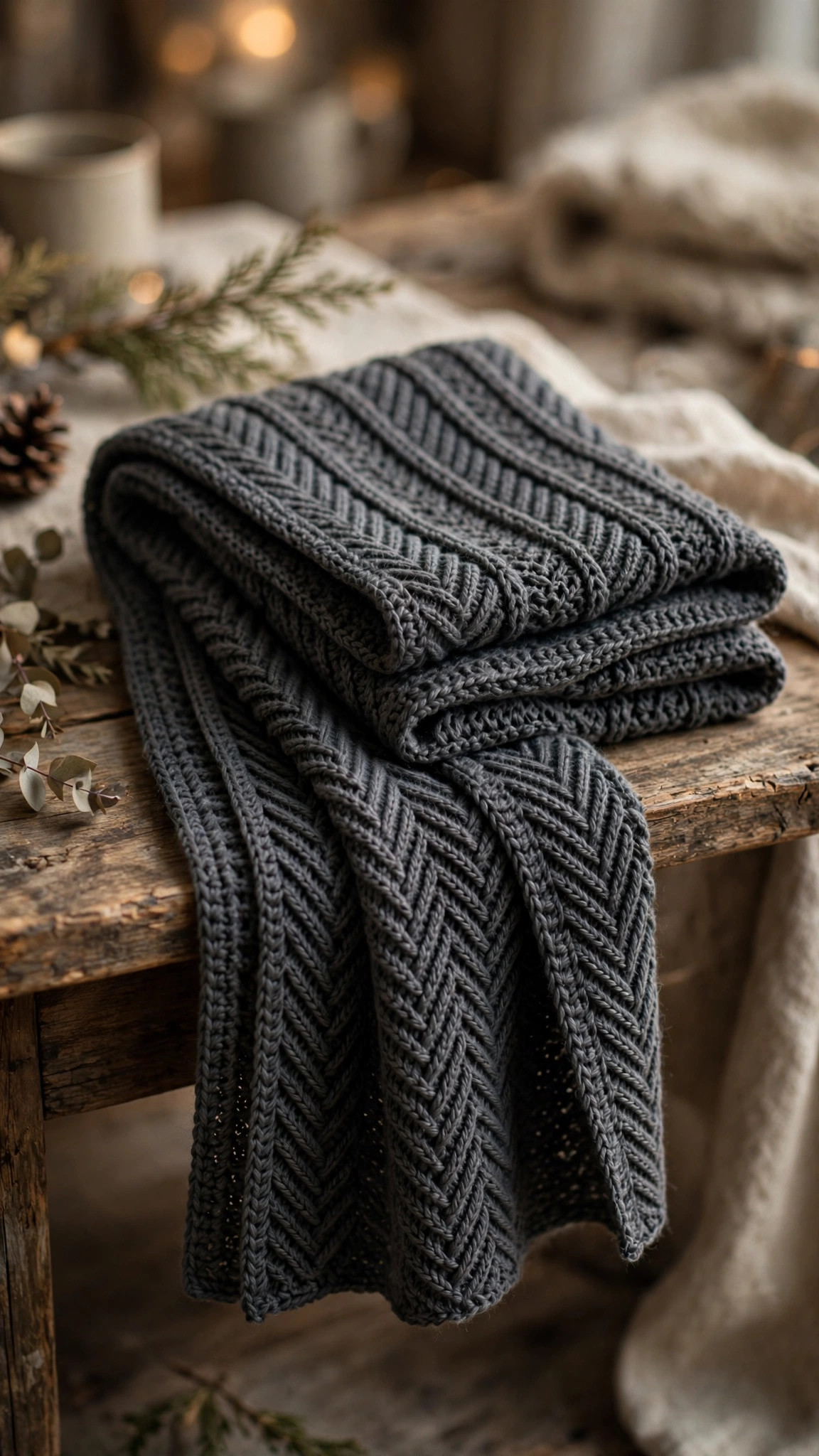
A tailored men's scarf in herringbone half double crochet with neat ribbed end bands and optional short fringe — one repeated row, worked flat, in a warm woven-look fabric that goes with every winter coat.

Scarves · Crochet
- Finished size
- About 20 x 178 cm / 8 x 70 in
- Making time
- About 10–12 hours
- Hook
- 5.5 mm, worsted-weight yarn
- Rows
- 150 rows, one-row repeat
- Skill
- Easy
In this post
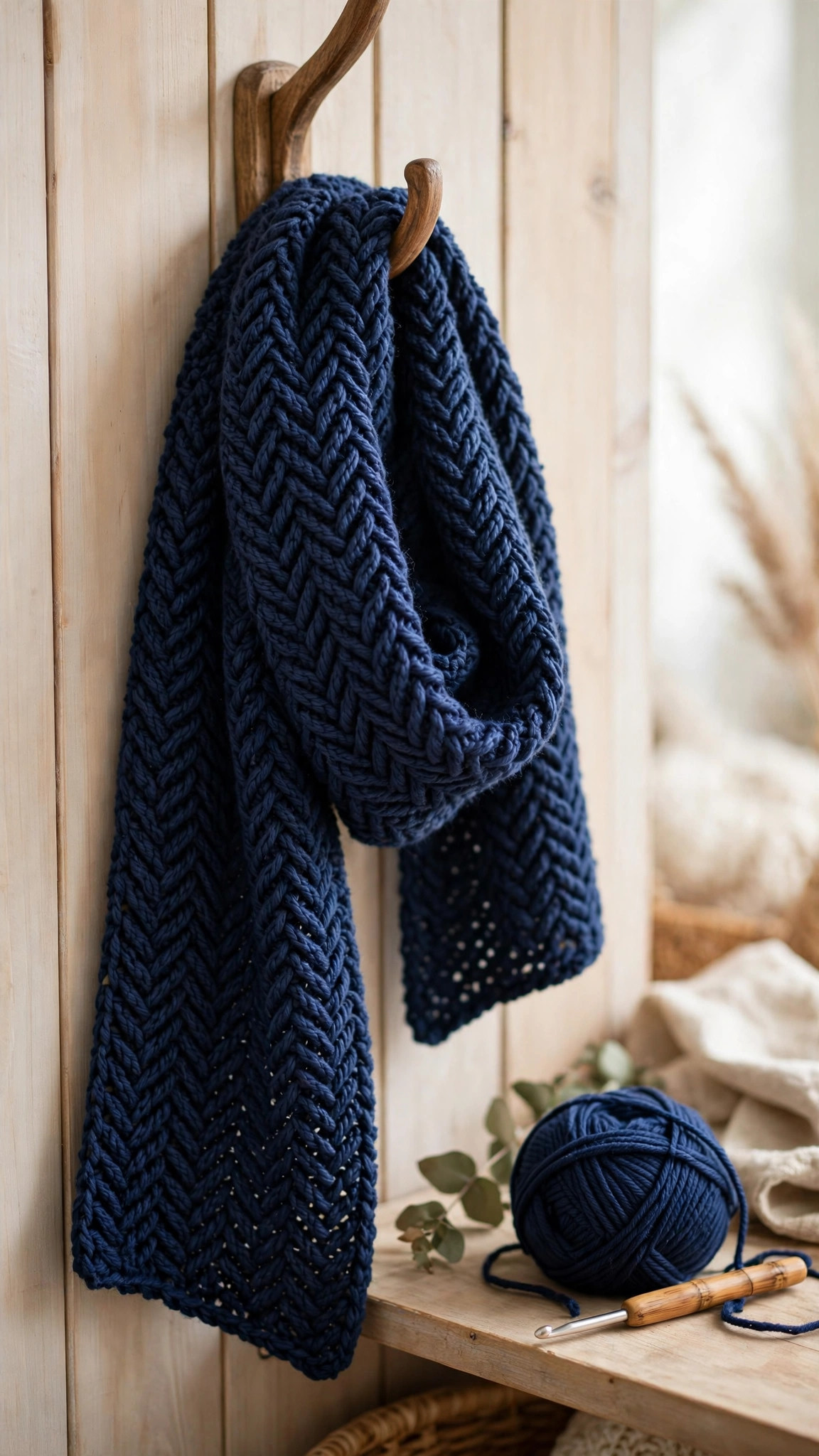
Every winter I watch the same thing happen: someone I love wraps a thin, curling, too-short scarf around his neck, tugs it twice, and pretends it is doing anything at all. This mens crochet scarf pattern free design is my answer to that scarf — long enough to fold and loop properly, wide enough to cover a neck and chest, and worked in a ribbed herringbone stitch that looks woven and tailored, never lacy or fussy.
The herringbone half double crochet creates that subtle diagonal, fabric-like texture you usually see in good knitwear, the ribbed end bands keep the edges flat, and the optional short fringe adds just enough movement. Make it in charcoal, navy, forest, or heather grey and it goes with every coat he owns.
Why you'll love this mens crochet scarf pattern
Most free men's scarf patterns fall into two camps: endless rows of plain single crochet that bore you by row thirty, or complicated cables that unravel your patience by row three. This one sits happily in the middle. The herringbone stitch is a one-row repeat — the same motion from start to finish — but the finished fabric looks like you did something clever. That diagonal slant reads as woven cloth rather than obvious crochet, exactly the understated look most men ask for when they say, "nothing fancy, please."
The dimensions matter just as much. At 178 cm (70 in) long, this scarf folds in half, loops through itself in that classic Parisian knot, and still leaves two generous tails at chest level. At 20 cm (8 in) wide, it covers the gap between coat collar and chin where the wind gets in. Shorter, narrower versions always felt like samples to me. This one feels like a real garment.
It is also wonderfully forgiving. Small tension wobbles disappear into the texture, the ribbed bands disguise your first and last edges, and the fabric is warm without being stiff. If you have been browsing easy scarf ideas for new crocheters and waiting for one that looks store-bought, this is the one I would hand you first.
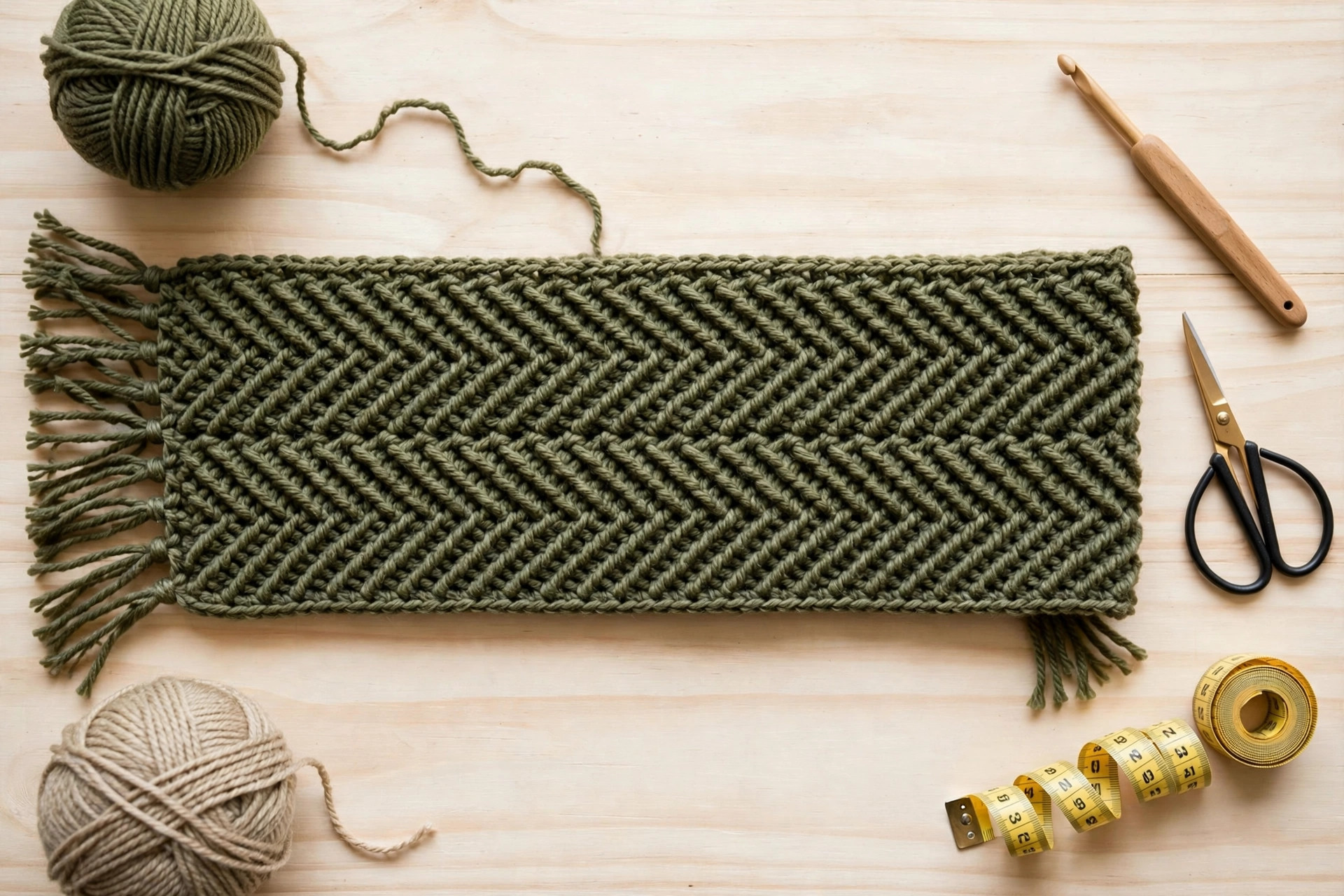
Materials you'll need
| Supply | What to get |
|---|---|
| Main yarn | Worsted-weight (#4) acrylic or acrylic-wool blend in charcoal, navy, forest, brown or heather grey, about 450 g (roughly 800 m / 875 yd) |
| Crochet hook | 5.5 mm (I-9) |
| Yarn needle | Large-eye tapestry needle for weaving in ends and attaching fringe |
| Scissors | Sharp pair for fringe trimming |
| Measuring tape | For checking width, length and fringe |
| Stitch markers | 2, optional but helpful for marking row 1 and counting rows |
| Card or book for fringe | About 12 cm (5 in) wide, optional, for cutting even fringe strands |
A quick note on yarn choice, because for a men's scarf it makes or breaks the result. Choose a smooth worsted yarn with good stitch definition — a standard acrylic or acrylic-wool blend is ideal. It shows the herringbone slant crisply and stands up to daily wear, machine washing, and being stuffed into coat pockets, all of which will happen. Avoid very dark black for your first one if you can — the stitches are harder to see under evening light. Charcoal gives you the same smart look with stitches you can count. Avoid fluffy or boucle yarns; they swallow the texture.
Buy in one dye lot if you can. A scarf is one long rectangle viewed all at once, and a dye shift halfway down shows as a visible band. If you cannot match lots, work the end bands and fringe in a contrasting color and place the change at a band, where it looks like a design choice — because now it is one.
Size, gauge and skill level
- Finished size: about 20 cm (8 in) wide by 178 cm (70 in) long, before fringe. Optional fringe adds about 10 cm (4 in) to each end.
- Gauge: 12 herringbone half double crochets × 8 rows = 10 cm (4 in) square with a 5.5 mm hook, after light blocking. Gauge matters here, because it decides your finished width and how fast you use your yarn — make the swatch, it takes ten minutes.
- Skill level: easy / confident beginner. You should know how to chain and work a half double crochet. The herringbone variation is taught in full below. If you can count to 26 reliably, you can make this scarf.
To swatch: chain 16, work row 1 as in the pattern (14 stitches), then work herringbone rows for 12 rows, and measure the middle 12 stitches and 8 rows without stretching. Too wide? Drop to a 5.0 mm hook. Too narrow? Go up to a 6.0 mm hook. Check your width again at rows 20, 60, and 100 — five seconds of measuring is the whole secret to straight edges.
If this is your very first wearable, our roundup of easy beginner crochet patterns is a kind place to warm up first — then come back, because a scarf is the most satisfying second project in all of crochet.
Fit notes: 178 cm suits most adults for a fold-and-loop wear. For a shorter wearer, stop the body at 152 cm (60 in). For a tall wearer or serious cold, extend to 190 cm (75 in) and buy an extra 100 g ball before you start.
Abbreviations — US terms
| Abbreviation | Meaning |
|---|---|
| ch | chain |
| hdc | half double crochet |
| HHDC | herringbone half double crochet (explained below) |
| BLO | back loop only |
| st(s) | stitch(es) |
| sl st | slip stitch |
| FO | fasten off |
A note on turning chains: the ch-2 at the start of a row counts as the first hdc or HHDC. When a row says (26), that is 25 worked stitches plus the turning chain. Work into the very last stitch — the top of the previous turning chain — on every row. Skipping it is the number one cause of the famous shrinking scarf.
The pattern (US terms)
Worked flat, back and forth in rows, from one ribbed end band to the other. The scarf is a rectangle — no increases, no decreases, no shaping. Your only jobs are to keep 26 stitches in every row, keep your edges straight, and stop when it is long enough. Clip a marker into the side every 20 rows so you can count length without recounting 100-plus rows.
Before you start — the herringbone half double crochet, slowly
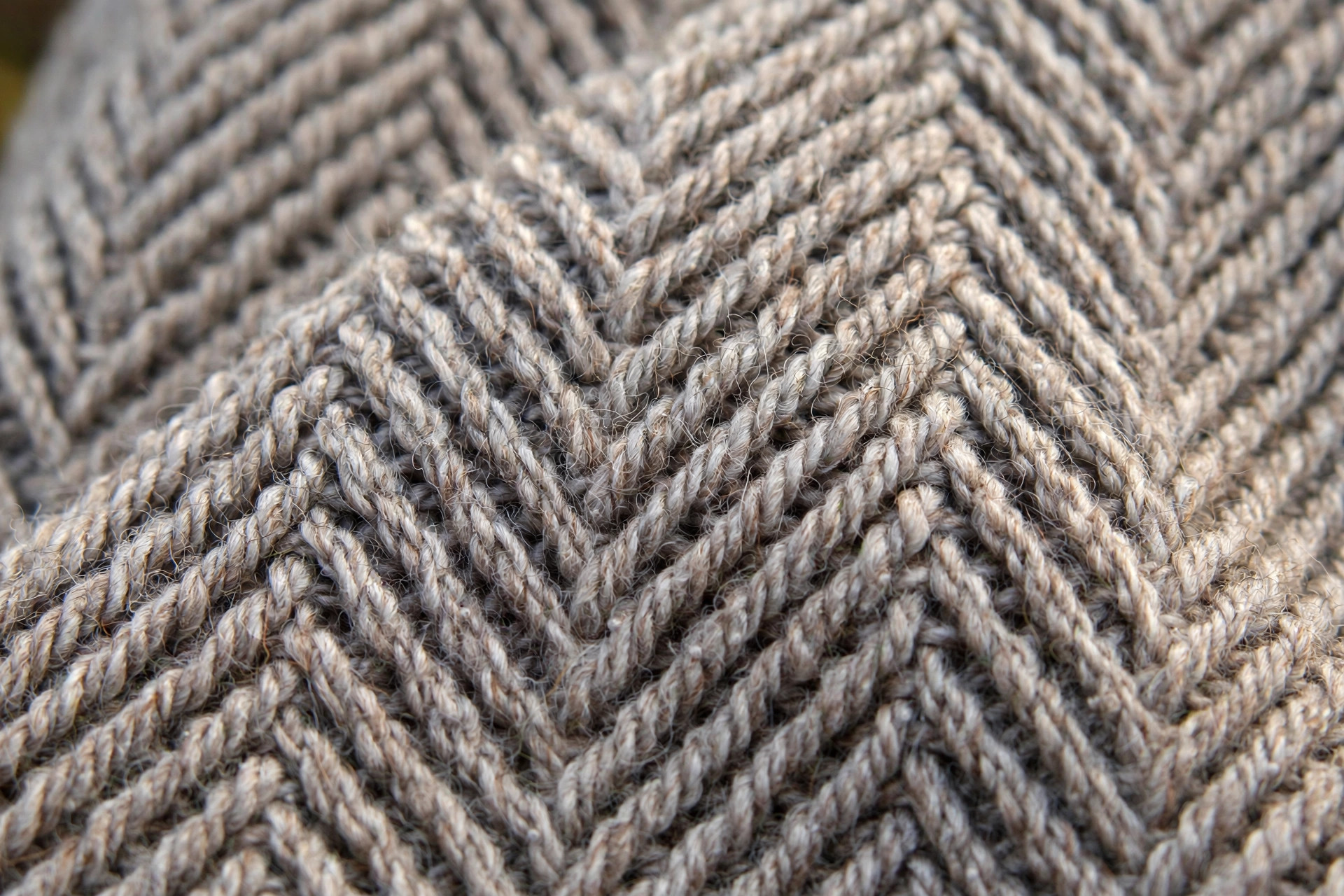
A normal hdc: yarn over, insert hook, yarn over and pull up a loop (3 loops on hook), yarn over and pull through all 3. A herringbone hdc changes just one moment: yarn over, insert hook into the next stitch, yarn over and pull a loop straight through the first loop on your hook — that sliding-through is the whole trick — then yarn over and pull through the remaining 2 loops on your hook. That little slide makes the stitch lean and lock into its neighbor, and row after row of leaning stitches stack into the diagonal herringbone grain.
Practice on your swatch until your hands do it without commentary. The common wobble is pulling that first loop through too tightly, which makes the next insertion a fight. Keep the slide loose; the stitch should glide, not squeak. After ten rows your fabric will show clear diagonal lines — your confirmation you have it right. If it looks like ordinary hdc, slow down for three stitches and watch the slide happen.
Foundation and ribbed start band
- Foundation: ch 28 loosely. If your chains tend to tighten, make this chain with a 6.0 mm hook and switch to 5.5 mm for row 1 — a tight foundation chain is what makes one short edge of a scarf pucker.
- Row 1: hdc in the 3rd ch from the hook and in each ch across (26)
- Row 2: ch 2, turn, hdc in BLO of each st across, working the last hdc into the top of the turning ch (26)
- Rows 3–5: repeat Row 2 (26) — 3 more rows
You now have a 5-row ribbed band about 4 cm deep. Worked in the back loop only, each row leaves a raised ridge like the cuff of a good sweater. This band gives the end weight so the scarf hangs straight, resists curling, and frames the body between two tidy edges. Count at the end of row 5 — exactly 26 stitches, and every row to row 150 keeps that same 26.
Main body — the herringbone repeat
- Row 6: ch 2, turn, HHDC in the 2nd st (the turning ch is your first stitch), HHDC in each st across, working the last HHDC into the top of the turning ch (26)
- Rows 7–145: repeat Row 6 (26) — 139 more rows of herringbone
That is the body. One row, repeated, until the piece measures about 168 cm (66 in) from the foundation edge — the final band will bring you to roughly 178 cm. Follow the measurement if your gauge differs from mine, because finished length is what the wearer feels, not row totals. Measure flat, without stretching, along the center.
Rhythm tips: count at the end of every row for the first twenty rows, then every fifth row — the two danger stitches are the first one after the turn (easy to work twice) and the turning-chain top at the far end (easy to skip). Join new balls at the end of a row, never mid-row, and leave 15 cm tails to weave along the ridges where they vanish.
Around row 30 the fabric may look slightly slanted in your hands. Do not correct it row by row. Herringbone relaxes square with the bands anchoring both ends and a light block at the finish. Trust the bands.
Ribbed end band and fastening off
- Row 146: ch 2, turn, hdc in BLO of each st across, working the last hdc into the top of the turning ch (26)
- Rows 147–150: repeat Row 146 (26) — 4 more rows
- FO, leaving a 15 cm tail. Weave the tail back and forth along the ridge lines three times, trim flush.
Check your rectangle before fringe: about 20 cm wide, about 178 cm long, both bands the same depth, edges parallel. Blocking below will coax most small wobbles right.
Finishing touches
This short section is the difference between a scarf that looks crocheted-at-home and one that gets asked about in elevators.
Block it lightly. Soak the scarf in lukewarm water with a drop of wool wash for 15 minutes, lift it out supporting its weight, roll it in a towel to press out the water, then lay it flat and pat — do not pull — it into a true 20 × 178 cm rectangle. Pin the corners if you can, and let it dry completely. The grain will settle and the bands will lie crisp.
Weave in every end like you mean it. A scarf is handled, yanked, and washed; a skimpy woven end will work itself out by February. Weave each tail in three directions along the hidden ridge lines, at least 4 cm per direction, then trim flush.
Add the fringe (optional but recommended). For each end: cut 52 strands, each about 25 cm (10 in) long — wrap yarn around a book or card about 12 cm wide and cut once for even strands. Take 2 strands together, fold in half, push the folded loop through one stitch space along the end band, pull the loose ends through, and tug snug. Repeat across all 26 stitches. Trim both fringes to a clean, even 10 cm (4 in) with a ruler as your guide. Short, even fringe reads tailored; long, sparse fringe reads homemade. If the wearer is a true no-fringe person, skip it — the ribbed bands finish the ends beautifully on their own.

Three handsome variations to try next
Once you have one of these off the hook, the variations suggest themselves. Same stitch count, same rhythm, three very different scarves:
- Two-tone team scarf. Work rows 1–50 in color A, rows 51–100 in color B, and rows 101–150 back in color A. Join colors at row ends only, and choose fringe in the band color of each end. Men who would never request a scarf will request this one.
- The pocket upgrade. Fold up the last 25 cm at each end, sew the side edges down with whipstitches through both layers, and you have deep hand-warmer pockets at both tails. If pockets sound like your kind of clever, our crochet pocket scarf pattern takes that idea further — but this fold-up version is a weeknight-fast alternative.
- Chunky quick-make version. Swap to bulky (#5) yarn and an 8.0 mm hook, chain 20 for 18 stitches, and work the same construction — 5 ribbed rows, herringbone until it measures 160 cm, 5 ribbed rows. Enormously cozy and done in a weekend. Skip the fringe; a clean band edge suits the scale better.
Troubleshooting tips
- My scarf is getting narrower. You are skipping the last stitch — the top of the previous turning chain. It hides against the edge and pretends not to be a stitch. Count to 26 at the end of every row for a while, and frog back to where the count first dropped if it has already narrowed.
- My edges are wavy. Usually a tension seesaw: tight turning chains and loose row middles. Relax the ch-2, keep your yarn feed consistent, and let light blocking settle the rest.
- The herringbone slant is not showing. Check the slide-through: that first pulled loop must travel through the first loop on the hook before you pull through two. If you pull through all three, you are making regular hdc. Fuzzy or very dark yarn also hides the slant until blocking.
- The fabric feels stiff. Your hook is small for your tension, or your slide-through is too tight. Go up a hook size and loosen that first slide — a scarf should drape softly, not hold its shape like a cracker.
- One end band puckers. That is a tight foundation chain, every time. Next scarf, size up the hook for the chain only. This scarf: blocking helps a great deal, and fringe over the band hides the rest.
- I keep losing count mid-row. Work in blocks of five with a tiny pause, and clip a marker into the edge every 20 rows so a recount never means starting from zero.
- My fringe looks scraggly. More strands, shorter length, sharper trim. Two strands per stitch at 10 cm, trimmed against a ruler, is the formula — add strands rather than combing hopefully.
Frequently asked questions
Is this mens crochet scarf pattern really free?
Yes — the complete pattern is right here, free, with no email signup and nothing held back. Every row, the fringe method, and the variations are included above. Saving the pin or sharing this post is the kindest thank-you.
What skill level do I need for this scarf?
Confident beginner to easy. You need a chain and a half double crochet before you start; the herringbone stitch is taught step by step and is a five-minute learn — one changed moment inside a stitch you already know. No increasing, decreasing, or fitting, which makes this an ideal first garment-scale project.
How long does it take to make?
About 10–12 hours for most crocheters — a four-evenings-plus-a-weekend project. Herringbone rows move faster than plain single crochet because each stitch is taller. The chunky variation cuts that to roughly 4–5 hours.
How much yarn do I actually need?
About 450 g (around 800 m / 875 yd) of worsted-weight yarn for the full 178 cm scarf with fringe. Versions at 190 cm want an extra 100 g ball. Buy it all in one dye lot; a rectangle this long shows a dye shift as a clear band.
Can I make this scarf wider or narrower?
Easily. The stitch works over any count, so add or remove chains in pairs: chain 32 for a wider 24 cm scarf (30 stitches), or chain 24 for a slimmer 17 cm scarf (22 stitches). Whatever number row 1 gives you is your number for all 150 rows — adjust yarn by roughly 15 percent per 4 stitches.
Can I sell scarves made from this pattern?
Yes — you are welcome to sell finished scarves made from this pattern in small batches, at markets or in your shop. Please credit Little Loop Finds as the designer with a link back to this page where you can. The pattern text and photos themselves may not be copied or sold.
More free patterns to try
Finished his scarf and immediately been asked for the matching set? It happens every time. A free crochet hat in the same yarn completes the gift set, and free leg warmers round out a cold-weather bundle for everyone else who saw the scarf and started hinting.
The box below contains an Etsy link. If you buy through it, we may earn a small commission at no extra cost to you. Learn more.
No time to make one?
Short on time? Find handmade crochet scarves for men from independent makers on Etsy.
Browse on Etsy (opens Etsy in a new tab)