Irish Lace Crochet Patterns Free: Motifs, Mesh & Edging
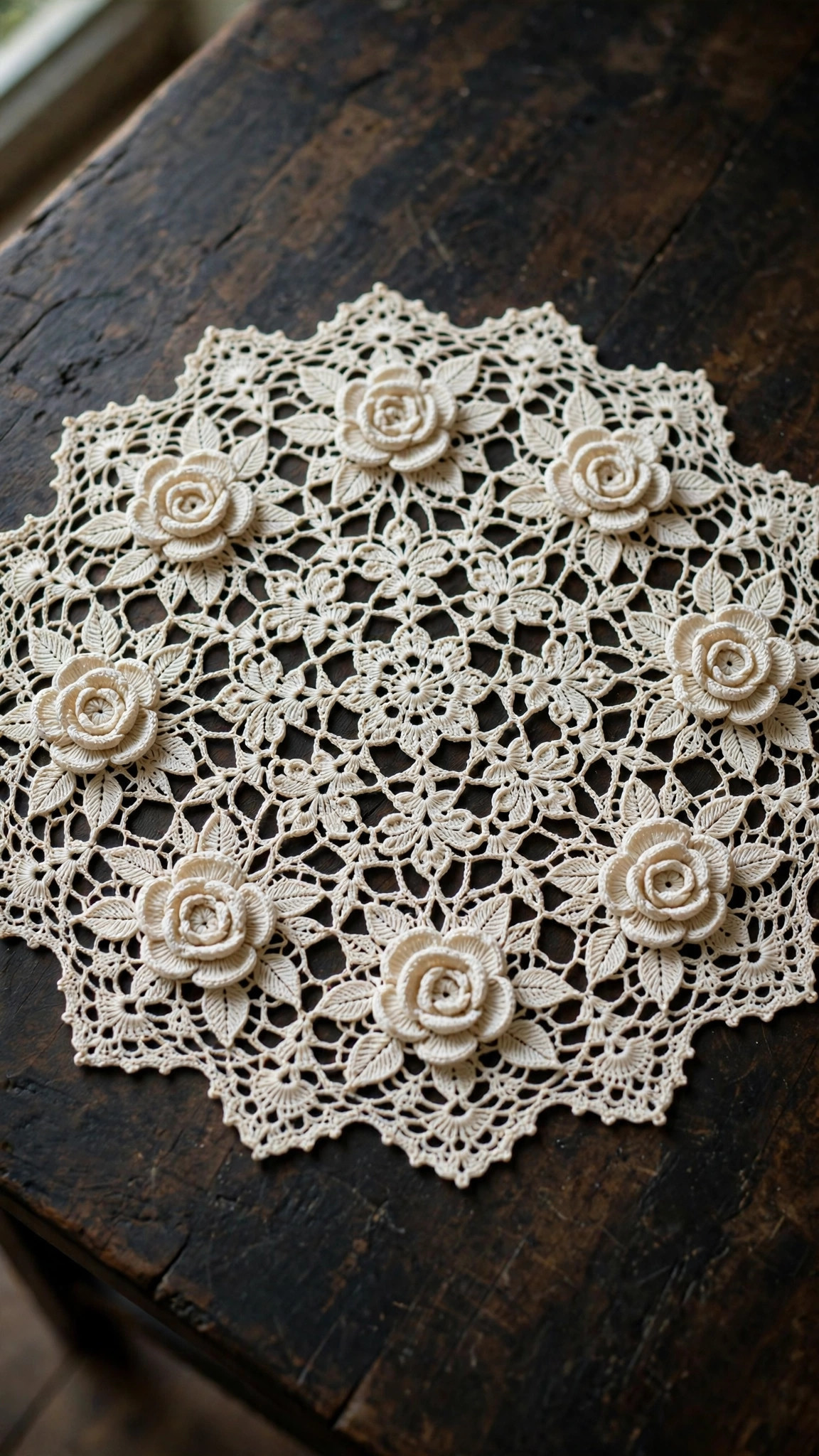
A beginner-friendly introduction to Irish crochet lace: a raised rose motif, shamrock and leaf sprays, a simple chain-mesh background and a scalloped edging, worked in size 10 thread into a 20 cm doily with full stitch counts for every round.

Lace · Crochet
- Finished size
- About 20 cm / 8 in across
- Making time
- About 2–3 hours
- Hook
- 1.75 mm steel, size 10 thread
- Pieces
- 5 elements to assemble
- Skill
- Intermediate
In this post
Irish crochet lace looks impossibly fancy — raised roses, delicate leaves and airy netting behind glass. The lovely secret: it is built from ordinary stitches. A rose is single and double crochet in layers. A shamrock is three small fans on a ring. The famous mesh is mostly chain stitches anchored with single crochet. Make those three pieces and you can make Irish lace.
This free pattern is a gentle first Irish project, designed by us at Little Loop Finds with our own stitch counts throughout. You will make one raised rose, shamrocks and a leaf spray, a filet-style mesh worked around the motifs, and a scalloped edging, finishing as a doily about 20 cm (8 in) across. Nothing is copied from a vintage book or another designer.
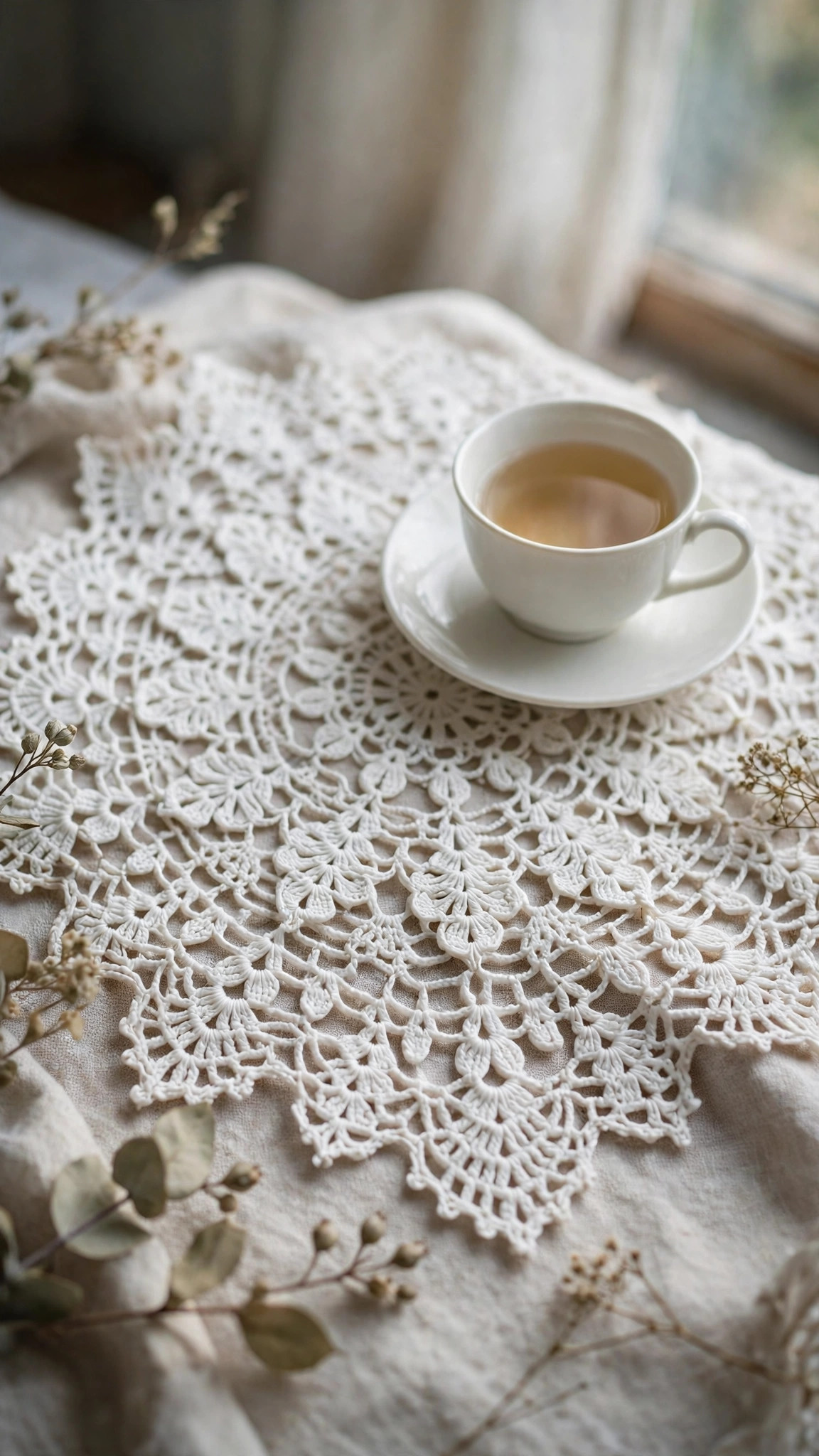
Work it in white or cream size 10 thread, lay it under a teacup or candle, and prepare for people to ask which great-grandmother left it to you. She did not. You made it last weekend.
Contents
- Why you'll love this Irish lace doily
- Materials you'll need
- Size, gauge and skill level
- Abbreviations — US terms
- The pattern (US terms)
- Finishing and assembly
- Tips for lace that lies flat and looks fine
- FAQ
- What to crochet next
Why you'll love this Irish lace doily
First, it teaches the whole Irish lace idea in one small project. Irish crochet is not worked in one piece from the centre out: motifs are made separately, arranged, then joined with a net-like background. That is what you do here — rose, shamrocks, mesh — so once blocked, you understand the construction behind grander pieces like tablecloths and collars.
Second, the motifs are portable and forgiving. A rose takes fifteen minutes and fits in a coat pocket with a ball of thread. If a leaf leans or a petal sits proud, that is charm, not a mistake — and blocking settles most of it.
Third, the mesh is wonderfully relaxing: chain five, single crochet in the next loop, repeated around, growing gently on increase rounds. No charts — just a calm rhythm that makes the motifs look as if they are floating.
Finally, it is a giftable make that costs very little: one ball of thread makes several doilies, and a finished piece folds flat into a card. For more thread projects, see our crochet doily patterns free collection.
Materials you'll need
Size 10 cotton thread is the friendliest place to start — fine enough to look delicate, thick enough to see and frog without tears. Choose white, cream or ecru; pale thread shows the raised motifs beautifully and hides uneven tension better than dark colours.
Steel hook sizes run backwards compared with yarn hooks — a higher number means a smaller hook — so check the millimetre size on the handle rather than guessing.
| Supply | What to get |
|---|---|
| Thread | Size 10 crochet cotton, white or cream, about 45 g / 200 yards |
| Alternative yarn | Light fingering cotton (category 1) |
| Hook | 1.75 mm steel hook (about US 4 steel); 2.0 mm for fingering cotton |
| Needle | Fine tapestry needle that fits size 10 thread |
| Pins | Rustproof pins, about 40, for motifs and blocking |
| Blocking surface | Foam board, folded towel or cork board |
| Notions | Small sharp scissors, stitch markers |
| Optional | Spray bottle, fabric starch for a crisper finish |
Choose mercerised cotton: its sheen and firm twist keep tiny stitches neat, and it blocks crisply. Loosely twisted thread looks fuzzy at this scale.
Size, gauge and skill level
Skill level: Intermediate as a label, beginner-friendly in practice. The stitches are basic — chain, slip stitch, single, half double and double crochet. The intermediate part is working small, keeping count on motif rounds, and joining pieces in order. New to thread? Make one practice rose in thicker yarn first.
Finished size: About 20 cm (8 in) across after blocking, in size 10 thread with a 1.75 mm hook. In light fingering cotton with a 2.0 mm hook, expect about 24 cm (9.5 in).
Gauge: Motif size matters because the mesh counts assume it. After Round 7, the rose should measure about 5.5 cm (2.25 in) across. Much bigger? Drop to a 1.5 mm hook. Much smaller? Rise to 2.0 mm. Slightly loose lace blocks beautifully; too-tight lace puckers and fights the mesh.
The pieces: Five elements — 1 rose, 3 shamrocks, 1 leaf spray (optional), the mesh background, and 1 scalloped edging. Motifs take about an hour; mesh and edging another hour or so.
Abbreviations — US terms
US terms throughout. (UK note: a US single crochet is a UK double crochet, and a US double crochet is a UK treble.)
| Abbreviation | Meaning |
|---|---|
| ch | chain |
| sl st | slip stitch |
| sc | single crochet |
| hdc | half double crochet |
| dc | double crochet |
| tr | treble crochet |
| st(s) | stitch(es) |
| rnd(s) | round(s) |
| sp | space |
| FO | fasten off |
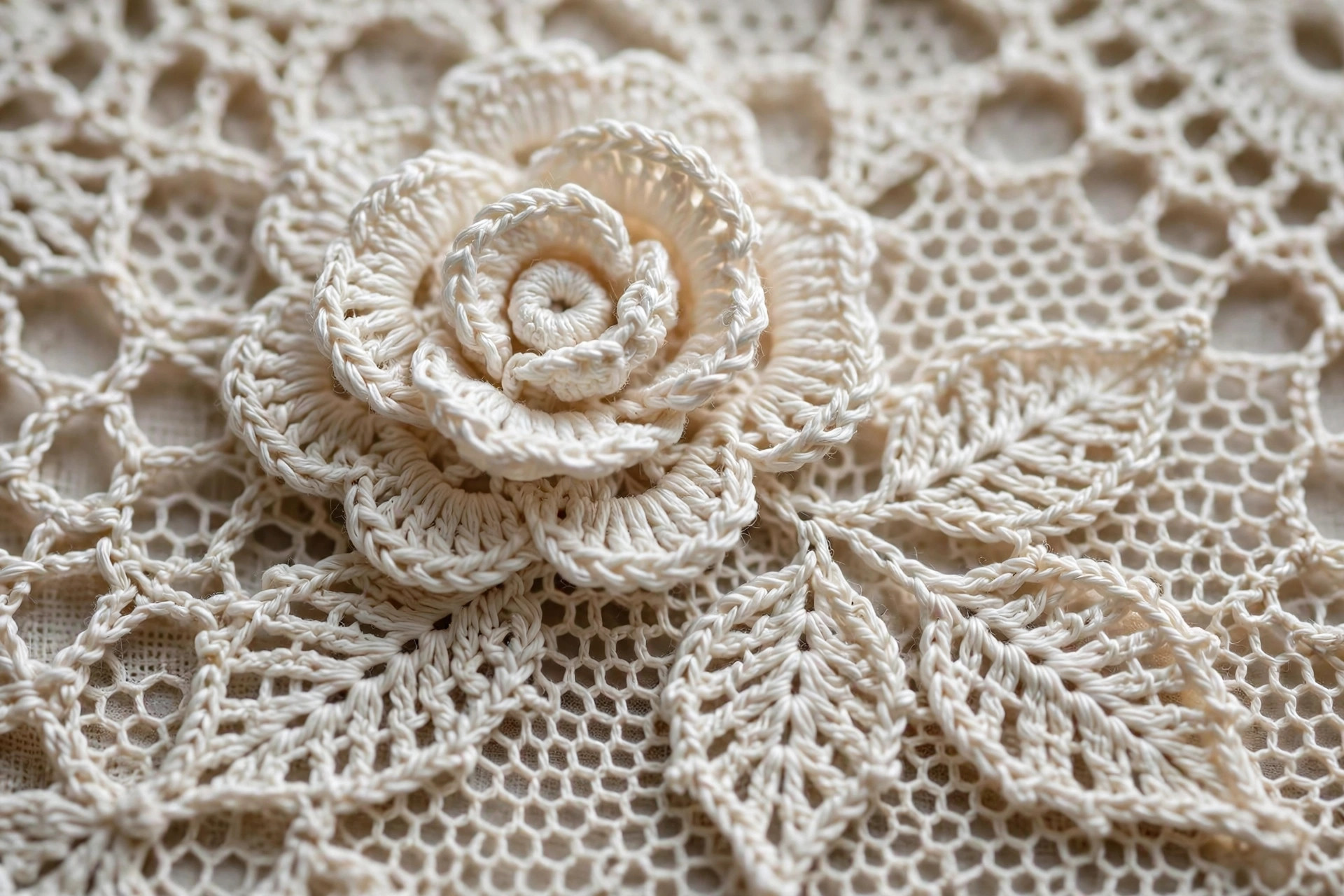
Raised petals without a padding cord: Traditional Irish roses are padded by crocheting over strands of thicker thread. We cheat kindly: a back-loop round and two petal layers build the height instead — same raised effect, no cord to manage, far calmer making.
A note on counts: The bold number ends each round with your stitch or loop count. Count motif rounds carefully — the mesh builds on those numbers. On mesh rounds, count loops, not chains.
The pattern (US terms)
Make the rose first, then the shamrocks and leaf spray. Weave in starting tails as you go — ends hide far more easily inside a motif than after the mesh joins everything.
The classic rose motif — make 1
Worked from the centre out in two petal layers: eight small petals first, then eight larger petals behind them, worked into a chain ring.
- R1: Ch 4, sl st into first ch to form a ring. Ch 1, 8 sc into ring, sl st to join (8 sc)
- R2: Ch 3 (counts as dc), dc in same st, 2 dc in each st around, sl st into ch-3 to join (16 dc)
- R3: Back loop only: sc in each st around, sl st to join (16 sc) — this ridge lifts the petals
- R4 — first petal layer: Sl st into front loop of next st, ch 3, skip 1 st × 8 (8 ch-3 loops)
- R5 — first petals: In each ch-3 loop around, work (sc, ch 1, 3 dc, ch 1, sc), sl st into the first sc to join (8 petals, 40 sts plus chains)
- R6 — back chain ring: Working behind the petals, ch 5, sc into the base between the next two petals — repeat from * 7 more times (8 ch-5 loops)
- R7 — second petals: In each ch-5 loop around, work (sc, ch 1, 5 dc, ch 1, sc), sl st into the first sc to join (8 petals, 56 sts plus chains)
FO, leaving a 15 cm (6 in) tail; weave it through the back of two or three petals before trimming. Cup the rose and coax the outer petals forward — a small, plump garden rose, about 5.5 cm (2.25 in) across.
The shamrock motif — make 3
Three plump leaves fanned around a tiny ring, with a short chain stem. They tuck into the gaps around the rose and give the doily its Irish character.
- R1: Ch 4, sl st into the first ch to form a ring.
- Leaves: Into the ring, work ch 3 (counts as first dc), 2 dc, ch 3, sl st — repeat from * 2 more times into the same ring (3 leaves, 9 dc in total)
- Stem: Ch 7, sl st into the 2nd ch from the hook and into each ch back towards the ring (6 sl st), sl st into the ring once more to anchor.
FO, leaving a 15 cm (6 in) tail for tacking down later. Flatten each leaf so the three fan out evenly, like a tiny cream clover.
For the same leafy shapes at a bigger scale, try our maple leaves crochet pattern in yarn.
The leaf spray — make 1 (optional)
This spray fills the wider gap three shamrocks sometimes leave, and teaches the classic pointed Irish leaf. Work along a chain, then back down the other side.
- Foundation: Ch 9.
- Side 1: Sc in the 2nd ch from hook, hdc in next ch, dc in next 3 ch, tr in next ch, dc in next ch, hdc in last ch (8 sts). Ch 2, sl st into the same ch for the pointed tip.
- Side 2: Into the other side of the chain: hdc, dc, tr, dc in next 3 ch, hdc, sc (8 sts). Sl st into the first sc.
- Stem: Ch 5, sl st into the 2nd ch from the hook and into each ch back to the leaf (4 sl st).
FO, leaving a tail for tacking. The leaf measures about 4 cm (1.5 in). Pinch a gentle lengthwise fold along the centre for a raised midrib.
Arranging the motifs
Lay the rose flat, right side up. Place the shamrocks at roughly 12, 4 and 8 o'clock, stems inwards, tips about 1 cm (0.4 in) from the rose's petals. Tuck the leaf spray into the emptiest gap, tip outwards. Pin each motif at two or three points — the mesh is worked with motifs in place.
The mesh background — filet-style net
A simple chain net: chain-5 loops anchored with single crochet, worked in joined rounds around the rose, catching the shamrocks and leaf spray on Round 2, then grown with two increase rounds so the doily lies flat. Join thread with a sl st into the tip of any outer rose petal.
- Mesh R1: Ch 5, sc into the tip of the next rose petal — repeat from * 7 more times, sl st into the first sc to join (8 ch-5 loops)
- Mesh R2: Sl st into the first loop, ch 1, sc in the same loop. Work ch 5, sc in the next loop around, but on every second or third loop, pause mid-chain and sl st into the nearest shamrock or leaf-spray tip to catch it, then complete the chain. All four small motifs should be anchored by round's end. Sl st into the first sc to join (8 ch-5 loops)
- Mesh R3 — increase: Sl st into first loop, ch 1, sc in same loop. Ch 5, sc in next loop, ch 5, sc in same loop × 4, then ch 5, sc in next loop twice, sl st to join (12 ch-5 loops)
- Mesh R4: Sl st into first loop, ch 1, sc in same loop, ch 5, sc in next loop × 11, sl st to join (12 ch-5 loops)
- Mesh R5 — increase: Sl st into first loop, ch 1, sc in same loop. [Ch 5, sc in next loop × 3, then ch 5, sc in same loop once] × 4, sl st to join (16 ch-5 loops)
- Mesh R6: Sl st into first loop, ch 1, sc in same loop, ch 5, sc in next loop × 15, sl st to join (16 ch-5 loops)
If a motif catch sits one chain early or late, do not worry — the net is organic by design and variations vanish at blocking. The net should cup slightly, like a shallow saucer; edging and blocking open it flat. Ruffling like lettuce means chains too loose; a firm bowl means too tight.
Love a good edging? Our crochet lace edgings free patterns uses this same mesh-and-shell logic on hems and linens.
The scalloped edging
A round of single crochet first gives the shells a solid base; the shells and picots give the doily its finished, wavy edge.
- Edging R1: Ch 1, work 5 sc into each ch-5 loop around, sl st into the first sc to join (80 sc)
- Edging R2 — shells: Ch 1, sc in the first st. Skip 2 sts, work 5 dc in the next st (one shell made), skip 2 sts, sc in the next st — repeat from * 15 more times, joining the final sc with a sl st (16 shells, 16 sc)
- Edging R3 — picot finish: Sl st into the next 2 dc to reach the first shell's centre dc. Ch 3, sl st into that centre dc (picot), sl st into next 2 dc, sl st into the sc between shells, sl st into next 2 dc of the following shell — repeat around (16 picots)
FO, leaving a 15 cm (6 in) tail. Weave it along the back of the edging for 3 cm (1.25 in), change direction once, then trim — the direction change locks thread ends.
Finishing and assembly
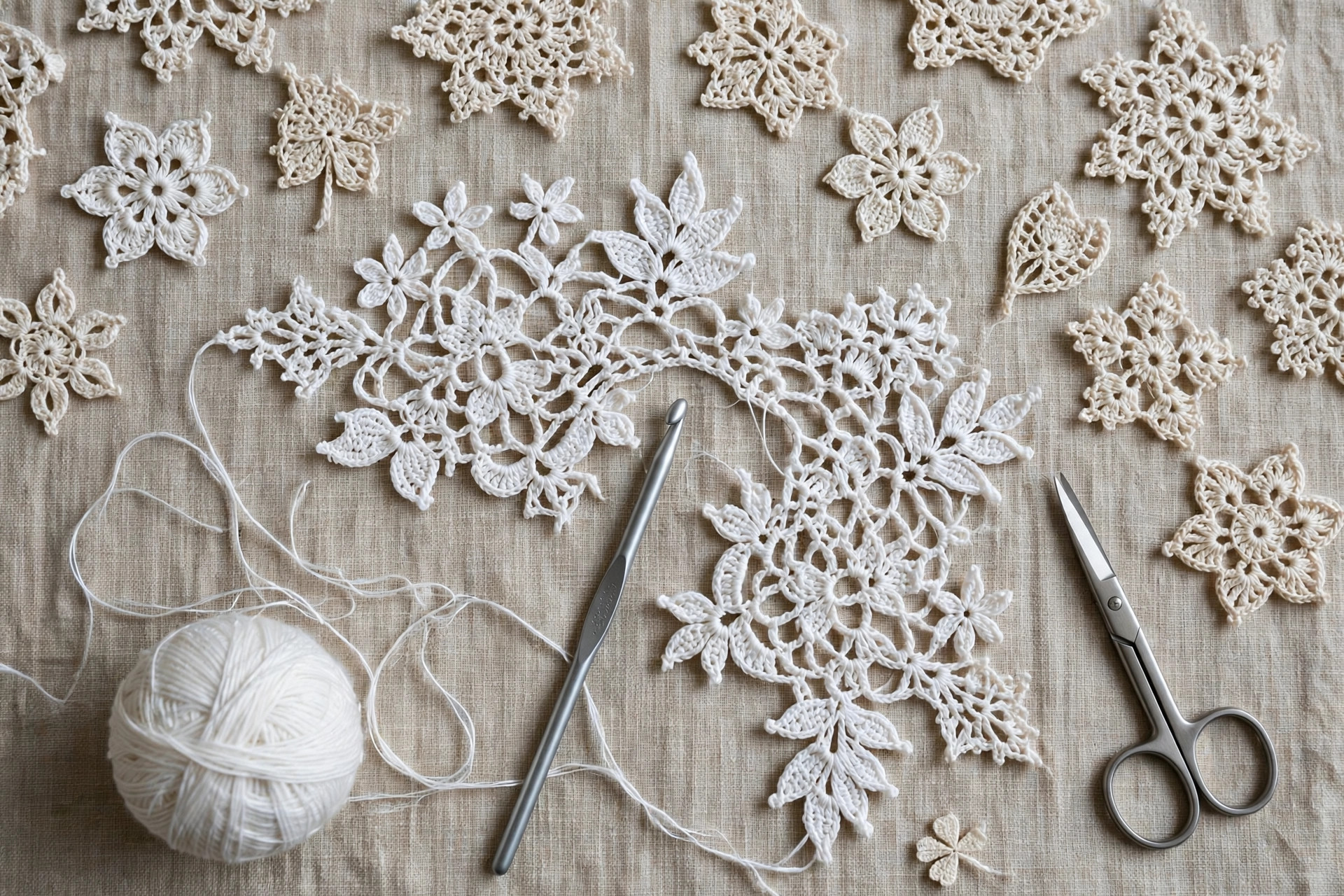
1. Tack any loose motif edges. Turn the doily over. If a shamrock leaf or the leaf spray lifts from the mesh, use its tail and your fine needle to add two or three tiny back-only stitches catching it to the nearest mesh loop.
2. Weave in every remaining end. Weave each end along the back of a motif edge for 2 cm, then back on itself for 1 cm, before trimming. Check the rose centre and shamrock stems twice — those tails hide well.
3. Wet block. Soak in cool water for ten minutes, or spray thoroughly. Lift it supporting its whole weight — wet lace stretches if it dangles — press in a towel, lay right side up on your board.
4. Pin it into shape. Pin the rose flat first, then each picot point, easing the mesh until the piece measures about 20 cm (8 in) across — check in two directions. Pin shamrock leaves open.
5. Optional starch. For a crisp doily under an ornament, mist lightly with spray starch while pinned. For a soft, drapey piece, skip it — our crochet table runners free patterns show how prettily unstarched lace falls.
6. Dry and unpin. Leave pinned until completely dry — overnight is best. Unpin from the outside in and give the rose petals a fingertip fluff to restore their lift.
Tips for lace that lies flat and looks fine
Tension lives in the chains. Your chain-5 does all the mesh sizing. Keep your yarn hold and hook angle steady, and resist speeding up mid-round — distracted loops always show.
Count loops, not stitches. Mark the first loop of each mesh round, and at the join count loops only: 8, 8, 12, 12, 16, 16. A wrong count is quick to pull back — thread forgives.
Catch motifs loosely. Let each connecting chain sit relaxed. A tight catch pulls a dimple into the net that blocking cannot fully remove.
Block every single time. Unblocked Irish lace looks like a small white jellyfish; blocked, like an heirloom. The transformation really is that dramatic, in ten active minutes.
Scale the idea. The same rose sits beautifully on a bookmark — pair it with our crochet cross bookmark pattern free — or as a yarn applique on a cushion or bag.
FAQ
Is this Irish lace pattern really free and original?
Yes. The rose, shamrock, leaf spray, mesh counts and edging are an original Little Loop Finds design, published in full here. Make doilies for yourself and gifts, and sell finished pieces in small quantities with credit to Little Loop Finds as designer.
What is the difference between Irish crochet and regular lace crochet?
Regular lace is usually one continuous fabric of repeating stitch patterns. Irish crochet is assembled: motifs are crocheted separately, arranged, then joined with a chain-mesh background. That is why Irish flowers seem to float on netting — because they do.
Can a beginner really make Irish lace?
Yes, with this project. Every stitch is basic; the fine thread is the only real challenge. Practise the rose once in DK yarn with a 4.0 mm hook to learn the petal layers, then work the real thing in thread. Keep the practice rose — it makes a sweet applique.
Why does my mesh pucker or ruffle?
Puckering means chains too short for the motifs — try chaining 6 instead of 5 on plain rounds, or check your rose measures close to 5.5 cm. Ruffling is the opposite: chains too long, or too many increases. Pulling back one mesh round and adjusting fixes almost every case.
Can I use yarn instead of size 10 thread?
You can. Light fingering cotton with a 2.0 mm hook gives a softer doily of about 24 cm, lovely as a table mat. DK yarn with a 4.0 mm hook makes chunky motifs, charming as coasters or appliques, though you lose the fine floating effect.
How do I join more motifs for a bigger piece?
Make more roses, shamrocks and leaves, pin them all out at once, and work the same chain-5 mesh around and between them, catching every motif edge as you pass. Grow the loop count gently to keep the piece flat, and finish any shape with the same scalloped edging.
What to crochet next
Your first piece of Irish lace deserves company — here are gentle next steps in thread and yarn:
- Browse more thread classics in our crochet doily patterns free round-up for a larger centrepiece.
- Practise the finishing touch elsewhere with crochet lace edgings free patterns — shells and picots for hems and linens.
- Take a break from thread with the crochet flower pattern free — the same layered-petal idea at a relaxing yarn scale.
Happy crocheting — may your mesh lie flat, your roses stand proud, and your doily fool at least one person into thinking it has been in the family for a hundred years.
The box below contains an Etsy link. If you buy through it, we may earn a small commission at no extra cost to you. Learn more.
No time to make one?
Short on time? Find handmade Irish crochet lace from independent makers on Etsy.
Browse on Etsy (opens Etsy in a new tab)