Crochet table runners: 3 free patterns for every table
Three original table runner patterns — a classic striped runner, a lacy openwork runner, and a chunky textured runner — all worked flat in rows with full stitch counts in US terms. Dress your table for every season with beginner-friendly crochet.

Home Decor · Crochet
- Finished size
- Striped 35×154 cm · Lacy 38×139 cm · Chunky 31×117 cm
- Making time
- 6–12 hours per runner
- Hook & yarn
- 5.0–8.0 mm hooks, worsted & bulky yarn
- Skill level
- Beginner — sc, dc, fpdc
- Skill
- Beginner
In this post
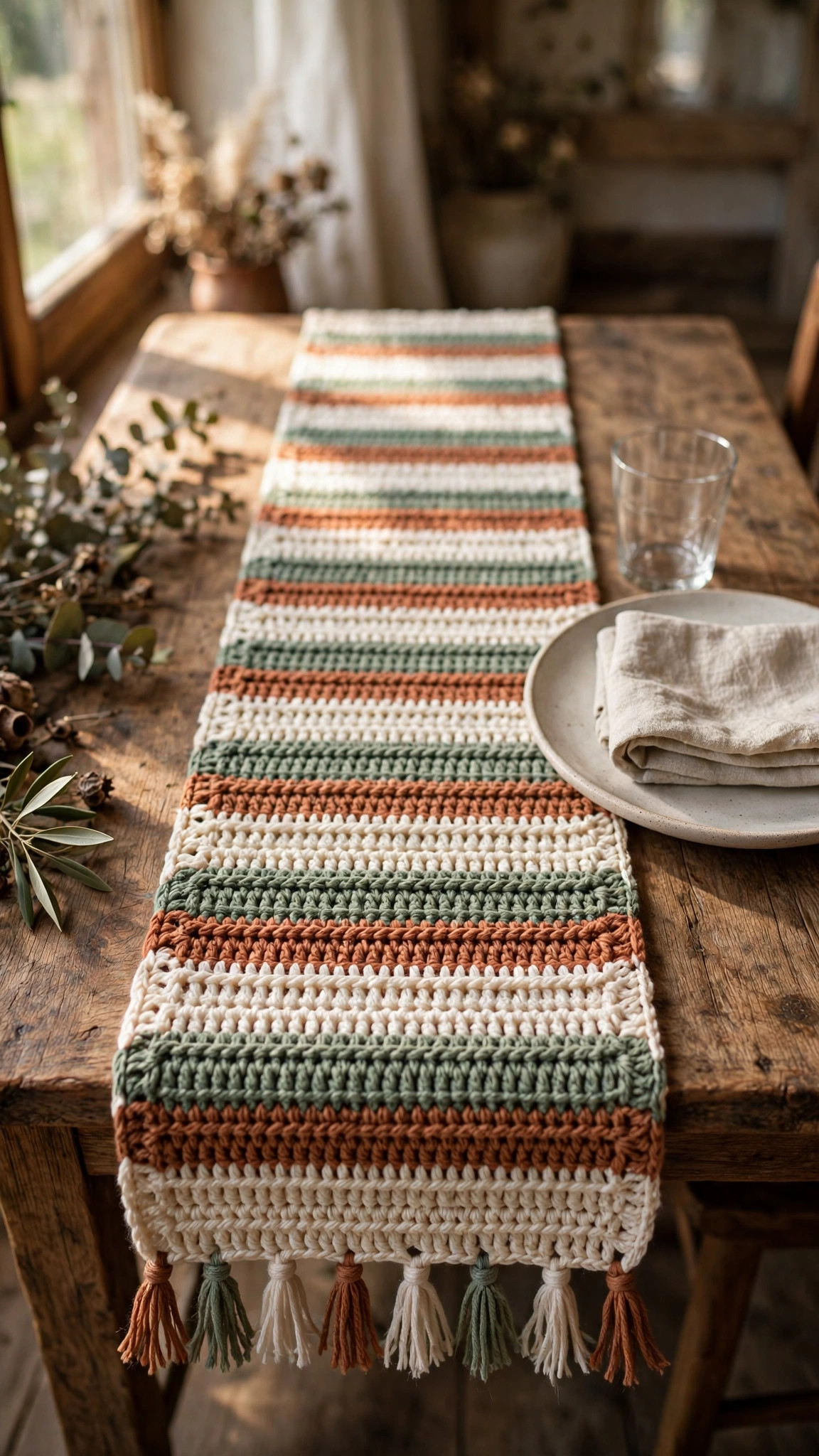
A table runner is the fastest way to make a whole room feel finished — one long strip of handmade texture down the center of the table, and suddenly Tuesday dinner looks like a dinner party. These three original crochet table runner patterns give you a complete wardrobe for your table: a classic striped runner in warm earthy colors, a lacy openwork runner that glows with candlelight, and a chunky textured runner made for cozy winter tables. Every pattern is written in US terms with full stitch counts and stitch math I've checked row by row, so your counts always land exactly where they should.
Table of contents
- Why you'll love these crochet table runner patterns
- Materials you'll need
- Size, gauge and skill level
- Abbreviations — US terms
- The patterns (US terms)
- Runner A: Classic striped runner - Runner B: Lacy openwork runner - Runner C: Chunky textured runner
- Finishing touches
- Variations to try next
- Troubleshooting tips
- Frequently asked questions
- More free patterns to try
Why you'll love these crochet table runner patterns
Most crochet table runner patterns online fall into one of two camps: a single lacy doily-style runner in thread that takes a month and a magnifying glass, or a pattern with "ch a lot, work even" instructions and no actual stitch counts. These three live in the sweet middle — substantial worsted and bulky yarns, real row-by-row instructions, and finished pieces sized for actual tables.
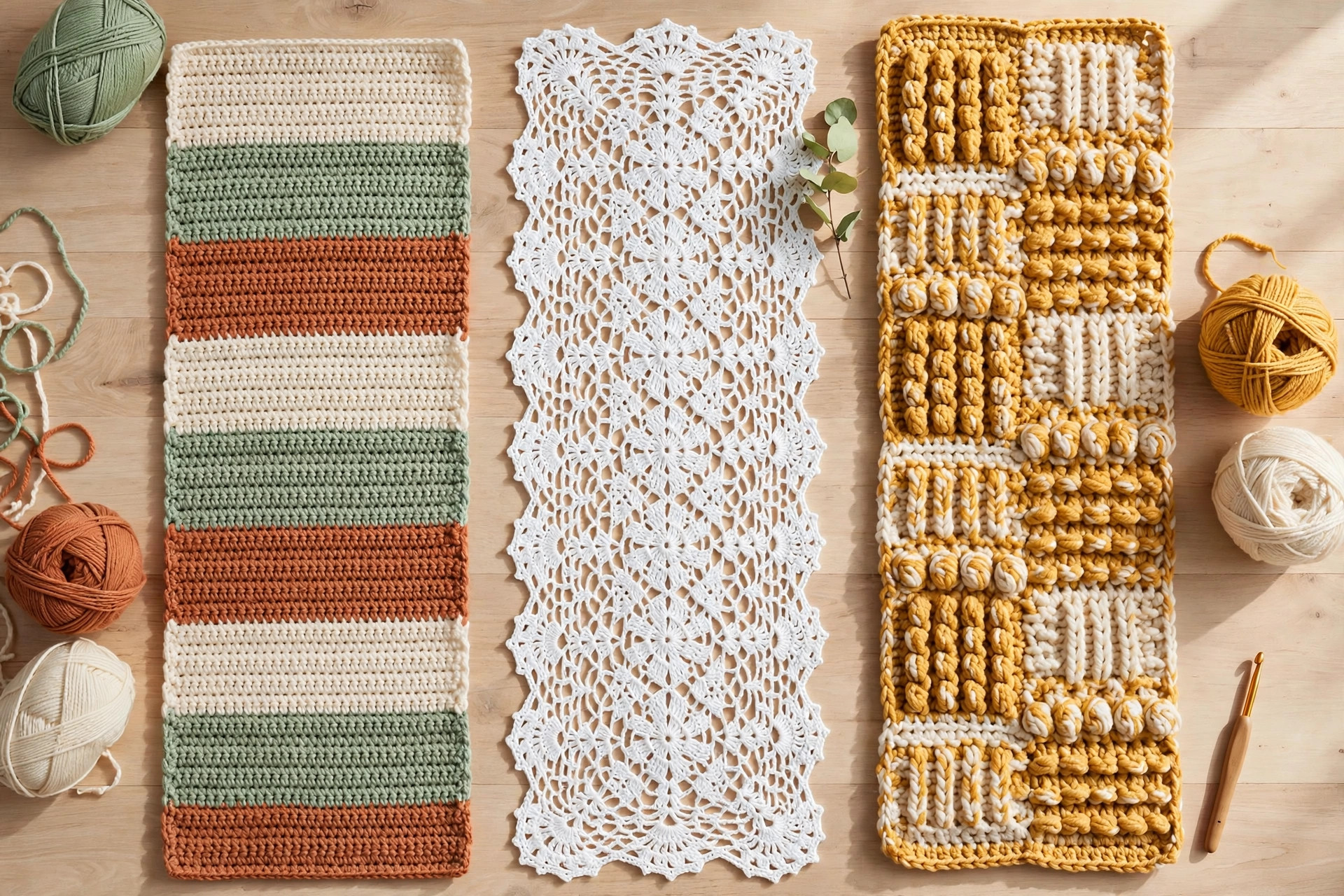
The striped runner is pure rhythmic comfort crochet — long runs of double crochet in three colors, the kind of project you pick up during a movie and put down with twenty new rows done. The lacy runner looks delicate but is secretly sturdy: the openwork mesh alternates with solid rows, so it drapes beautifully without stretching out of shape the way all-mesh runners do. And the chunky runner is the speed demon — front-post ribs in bulky yarn, finished in just a few evenings.
Make one for your own table, or make all three and rotate them with the seasons.
Materials you'll need
| Supply | Runner A: Striped | Runner B: Lacy | Runner C: Chunky |
|---|---|---|---|
| Yarn | Worsted-weight (#4) cotton or acrylic: cream ~200 g, sage green ~80 g, terracotta ~120 g | Worsted-weight (#4) cotton, white or cream, ~300 g | Bulky-weight (#5) acrylic or wool blend: mustard ~150 g, cream ~100 g |
| Crochet hook | 5.0 mm (H-8) | 5.5 mm (I-9) | 8.0 mm (L-11) |
| Notions | Tapestry needle, scissors, stitch markers | Tapestry needle, scissors, stitch markers | Tapestry needle, scissors |
A note on yarn choice: cotton or a cotton blend gives the best drape and washability — runners lie flat and survive spaghetti night. Avoid slippery or novelty yarns for the lacy runner; you want stitch definition in the mesh. For the chunky runner, check the label really says #5, since some "chunky" yarns are #6 and will throw off your width.
Size, gauge and skill level
- Finished sizes: Striped runner — about 35 × 154 cm (14 × 60 in). Lacy runner — about 38 × 139 cm (15 × 55 in). Chunky runner — about 31 × 117 cm (12 × 46 in). All three are sized to overhang a standard dining table by about 25–30 cm (10–12 in) on each end.
- Gauge: Striped: 12 dc = 10 cm (4 in) wide, 7 rows = 10 cm. Lacy: 12.5 sc = 10 cm wide; one 4-row repeat ≈ 6 cm long. Chunky: 9 dc = 10 cm wide, 6.5 rows = 10 cm. Runners are forgiving — a centimeter either way just changes the drape — but check your width after the first few rows and adjust your hook if you're off by more than 2 cm.
- Skill level: beginner. You need chain, single crochet, double crochet, and (chunky runner only) front-post double crochet, explained below. Everything is worked flat in rows with no shaping and no sewing, and the stitch count is given at the end of every row.
New to large flat projects? The easy crochet blanket patterns use the same flat-row skills, just bigger.
Abbreviations — US terms
| Abbreviation | Meaning |
|---|---|
| ch | chain |
| sc | single crochet |
| dc | double crochet |
| fpdc | front-post double crochet (work around the post of the stitch below) |
| sk | skip |
| sp(s) | space(s) |
| st(s) | stitch(es) |
| RS / WS | right side / wrong side |
| rep | repeat |
| FO | fasten off |
Front-post double crochet refresher: yarn over, insert your hook from front to back to front around the post (the vertical bar) of the indicated stitch in the row below, yarn over and pull up a loop, then finish like a normal double crochet (yarn over, pull through 2, yarn over, pull through 2). The stitch pops forward toward you, creating the ribbed texture in the chunky runner.
The patterns (US terms)
All three runners are worked flat in rows, turning at the end of each row. The stitch count in parentheses at the end of each row should match your work — count the first few rows, then spot-check every 5–10 rows. Ch 3 counts as a dc throughout; ch 2 turning chains in the chunky runner do NOT count as a stitch.
Runner A: Classic striped runner
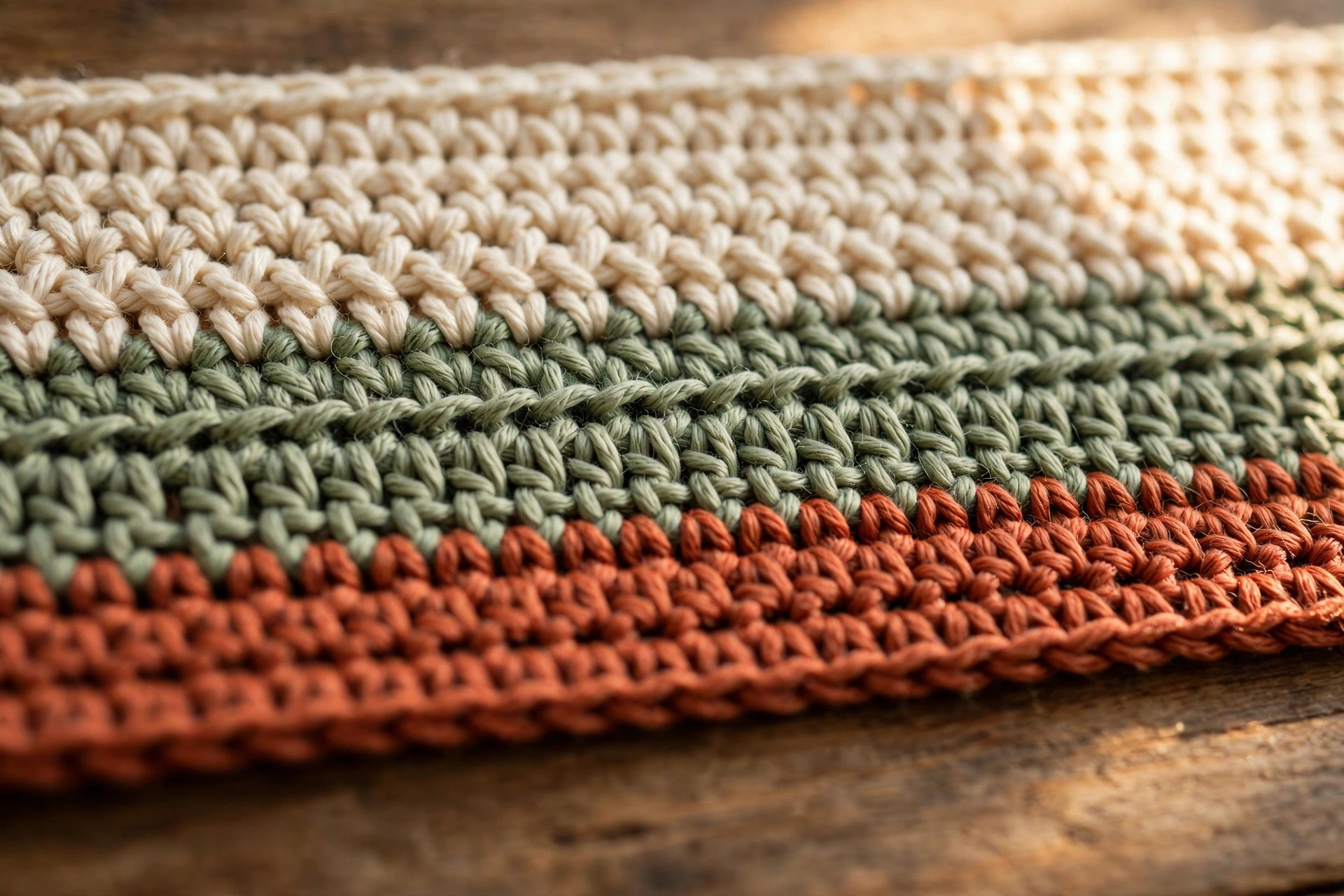
The workhorse. Double crochet stripes in cream, sage, and terracotta, worked lengthwise so the stripes run across the runner. The stripe sequence is a 36-row block repeated 3 times — rhythmic enough to memorize.
Color key: A = cream, B = sage green, C = terracotta.
With A, ch 45.
- Row 1 (RS): With A, dc in 4th ch from hook and in each ch across (42 dc). Turn.
- Rows 2–12: With A, ch 3 (counts as dc), dc in each st across (42 dc). Turn. — 12 rows of A total.
- Rows 13–16: With B, ch 3, dc in each st across (42 dc). Turn. — 4 rows of B.
- Rows 17–24: With C, ch 3, dc in each st across (42 dc). Turn. — 8 rows of C.
- Rows 25–28: With B, ch 3, dc in each st across (42 dc). Turn. — 4 rows of B.
- Rows 29–36: With A, ch 3, dc in each st across (42 dc). Turn. — 8 rows of A.
That's the 36-row stripe block: A×12, B×4, C×8, B×4, A×8. Repeat this block 2 more times (Rows 37–72 and Rows 73–108), changing colors the same way. FO after Row 108 and weave in all ends.
Stitch math check: every row is 42 dc — 42 foundation stitches, 42 stitches worked, no increases or decreases anywhere. Total: 36 × 3 = 108 rows, about 154 cm long and 35 cm wide.
Color changes: work the last dc of the old color until two loops remain on the hook, then yarn over with the new color and pull through. Fasten off the old color and weave in ends as you go — with this many stripes, weaving in at the end is a special kind of misery.
Runner B: Lacy openwork runner
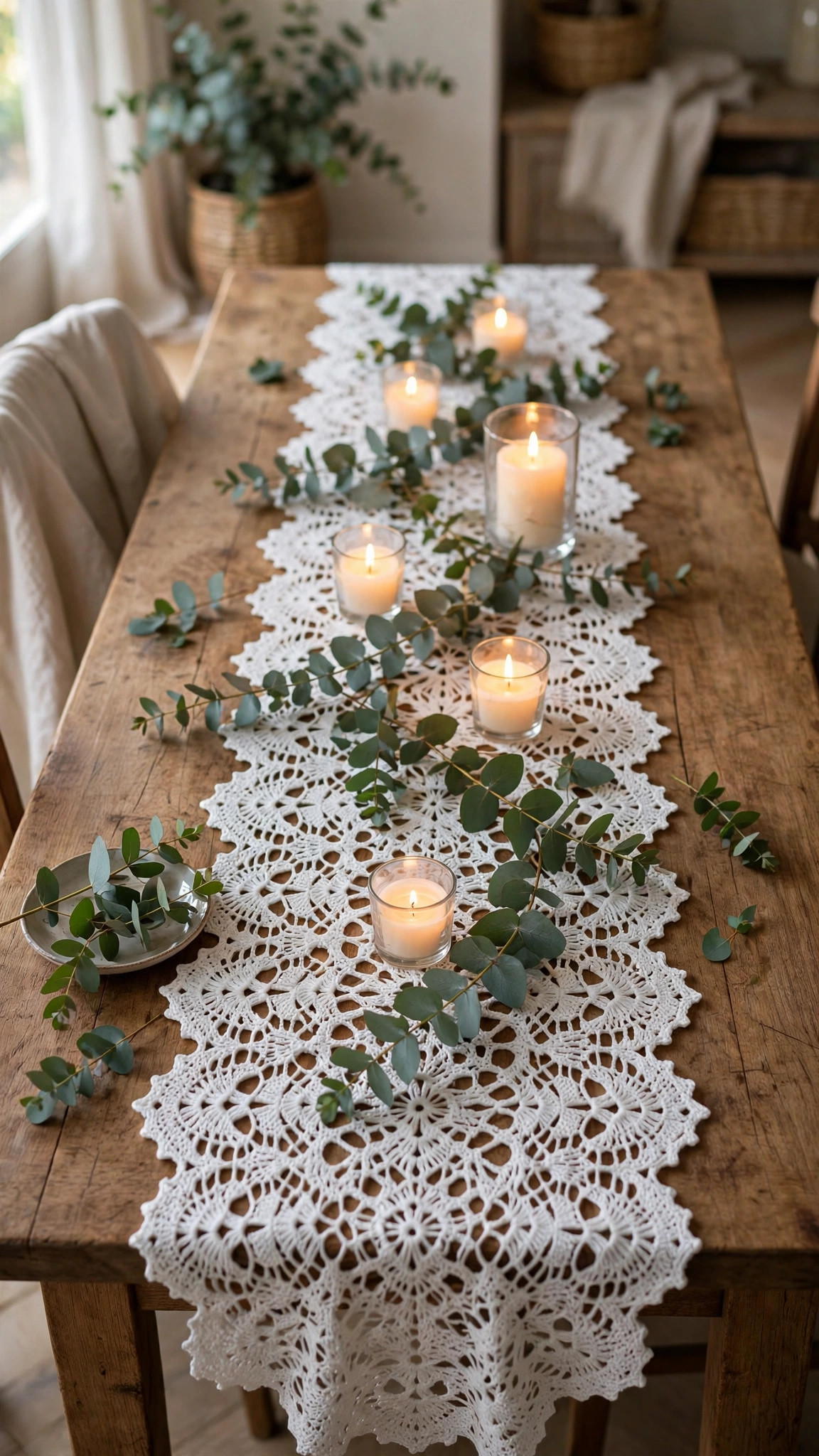
Elegant without being fussy. A 4-row repeat — single crochet, openwork mesh, single crochet, double crochet — creates airy windows framed by solid rows, so the runner drapes like fabric but keeps its shape. The count never changes, which keeps the edges perfectly straight.
With 5.5 mm hook, ch 49.
- Row 1 (RS): Sc in 2nd ch from hook and in each ch across (48 sc). Turn.
- Row 2 (mesh, WS): Ch 4 (counts as dc + ch-1), sk first sc, dc in next sc, ch 1, sk 1 sc, dc in next sc across (24 dc, 24 ch-1 sps). Turn.
- Row 3: Ch 1, sc in first dc and in each ch-1 sp and each dc across (48 sc). Turn.
- Row 4: Ch 3 (counts as dc), dc in each sc across (48 dc). Turn.
- Row 5: Ch 1, sc in each st across (48 sc). Turn.
Rows 2–5 are the pattern repeat: mesh, sc, dc, sc. Repeat Rows 2–5 twenty-two more times (23 repeats total, ending with a Row 5 sc row). Your piece should measure about 139 cm. Do not fasten off — continue to the edging.
Stitch math check: Row 2 starts from 48 sc — skip 1, dc in the 2nd, then 23 repeats of (ch 1, sk 1, dc) across the remaining 46 sc gives 24 dc and 24 chain spaces. Row 3: 24 dc + 24 spaces = 48 sc. The count never changes, so a wrong row means the error is in that row.
Edging: Ch 1 (do not turn), sc evenly around all four edges — 1 sc in each row-end along the long sides and 1 sc in each stitch along the short ends, with 3 sc in each corner. Join with a slip stitch to the first sc. FO and weave in ends. This simple frame stops the mesh edges from curling.
Runner C: Chunky textured runner
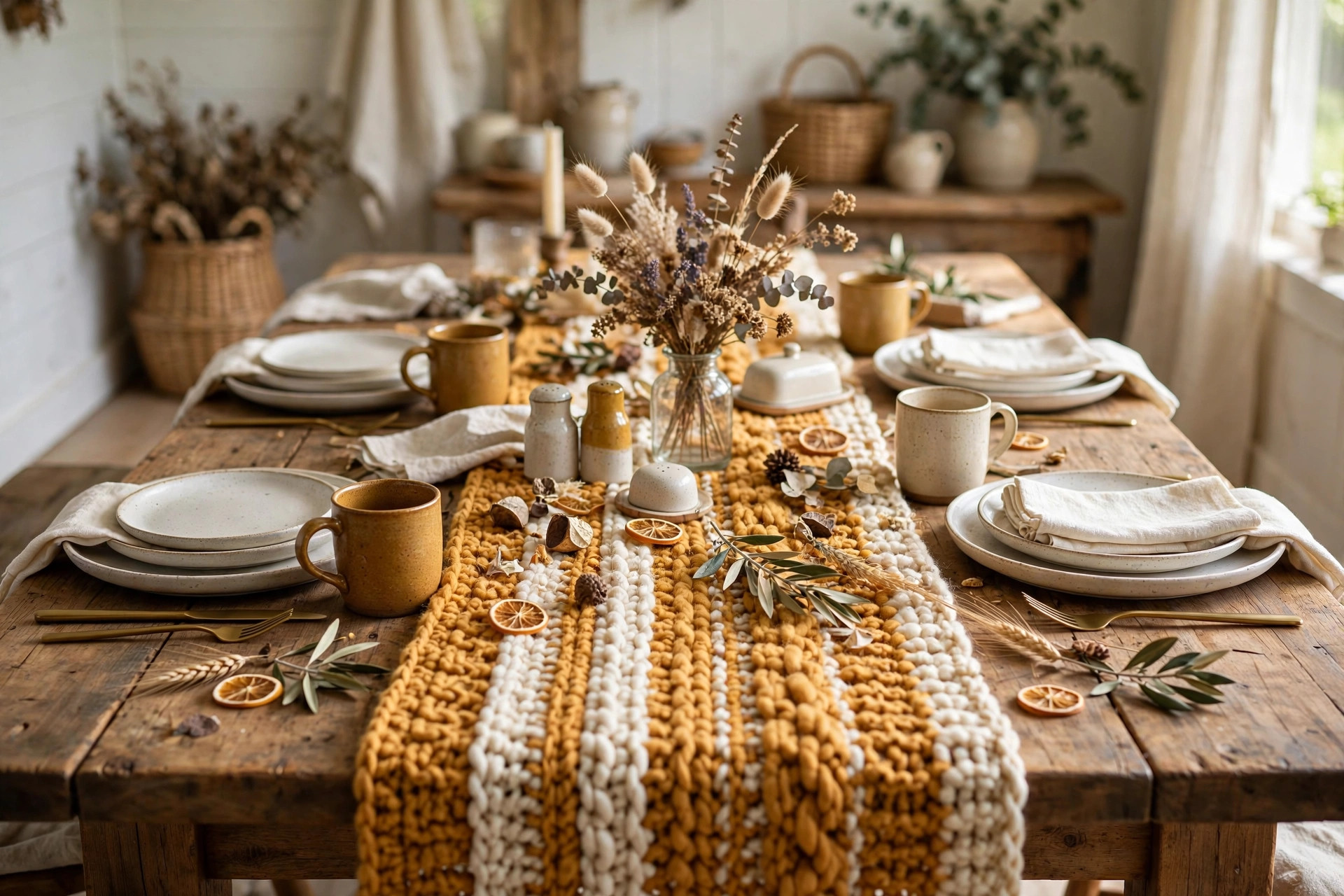
The fast one. Bulky yarn and an 8 mm hook mean this runner grows visibly every evening, and alternating bands of front-post rib and plain double crochet give it a plush, woven look far fancier than the effort involved.
With mustard (or your main color), ch 30.
- Row 1 (RS): Dc in 4th ch from hook and in each ch across (28 dc). Turn.
- Row 2: Ch 2 (turning chain, does NOT count as a stitch), dc in each st across (28 dc). Turn.
- Rows 3–6 (rib band): Ch 2 (does not count), fpdc around next st, dc in next st across (14 fpdc, 14 dc = 28 sts). Turn. Work the first fpdc around the first dc of the row below, skipping the turning chain.
- Rows 7–8: Ch 2 (does not count), dc in each st across (28 dc). Turn.
- Repeat Rows 3–8 until the runner measures about 112 cm from the start, ending after a rib band (a Row 6).
- Final 2 rows: Ch 2 (does not count), dc in each st across (28 dc). Turn. Repeat once more. FO and weave in ends.
Stitch math check: 28 stitches every row. The rib rows alternate fpdc/dc across 28 stitches — 14 of each — starting with fpdc and ending with dc. Because the ch-2 never counts as a stitch, your count stays at 28; if you work into the turning chain by accident you'll get 29 and the ribs will drift.
Two-color option: work the rib bands (Rows 3–6 of each repeat) in cream and the plain dc rows in mustard for a bold ribbed stripe effect. Change colors the same way as Runner A — finish the last stitch of the old color with the new color.
Finishing touches
A table runner lives flat in the open, so fifteen minutes of finishing makes all the difference.
Block every runner. Wet-blocking is non-negotiable for the lacy runner and worth doing for the other two. Soak in lukewarm water with a drop of mild soap for 15 minutes, gently squeeze (never wring), roll in a towel, then pin flat to the finished measurements. For the lacy runner, pin each mesh window open — this is what transforms it from "crumpled" to "elegant." Dry completely, at least 24 hours.
Tame the ends. Weave every tail through the backs of stitches for at least 5 cm, changing direction once. Runners get laundered; a 2 cm weave-in will pop out by the third wash.
Optional fringe for the striped runner. Cut 3 strands of yarn 30 cm long per bundle. Fold a bundle in half, pull the loop through an end stitch with your hook, then pull the strand ends through the loop and tighten. Attach one bundle to every other stitch across both short ends — 21 bundles per end — then trim all to an even 10 cm.
Variations to try next
Once you've made one runner, the formula is endlessly remixable.
- Holiday striped runner. Work Runner A in deep red, forest green, and cream with the optional fringe in gold — same 10–12 hours, boutique-Christmas look. Pair it with the crochet Christmas stocking for a coordinated table.
- Narrower lacy runner for a sideboard. Work Runner B over 32 sc instead of 48 (ch 33 to start; the mesh math still works: skip 1, dc, then 15 mesh repeats = 16 dc and 16 spaces, 32 sc on the return row).
- Single-color chunky runner. Work all of Runner C in one cream or oatmeal bulky yarn. The front-post ribs create all the visual interest, and monochrome goes with everything.
- Extra-long banquet runner. Add one more 36-row stripe block to Runner A (144 rows ≈ 205 cm) for a long farmhouse table — just buy an extra ball of each color.
And if table dressing has you hooked, the flower coaster pattern makes matching coasters for each runner, while the crochet doily patterns collection teaches the lacy techniques behind Runner B at a smaller, quicker scale.
Troubleshooting tips
- Your runner is getting wider or narrower. The usual suspect is the turning chain. In Runners A and B the ch-3 counts as a stitch — so the first real stitch goes into the second stitch. In Runner C the ch-2 does not count — so the first stitch goes into the first stitch. Count your stitches; the fix is always at the row edge.
- The lacy runner's edges are wavy. Work exactly one sc per dc and one sc per ch-1 space on Row 3 — and don't panic mid-project; the final edging round straightens mild waviness.
- The striped runner is curling. Double crochet fabric almost always relaxes with blocking. If it's still curling after blocking, your foundation chain was too tight — next time, chain with a hook one size larger, then switch to the pattern hook for Row 1.
- Front-post stitches feel impossibly tight. You're probably inserting the hook around the post too low. Go around the post just under the top loops of the stitch, and consciously loosen your tension for the fpdc rows.
- Color-change stripes look messy at the edges. Finish the last stitch of the old color with the new color (two loops on hook, yarn over with new color, pull through). This puts the color change at the very top of the stitch — crisp stripes, no dots of old color peeking through.
- The chunky runner is stiff as a board. Bulky yarn plus tight tension equals armor. Go up to a 9 mm hook if your fabric won't drape — runners need to lie flat and flow slightly over the table edge.
- Mesh windows are different sizes. Inconsistent chain-1 tension — try chaining the spaces a touch loosely and evenly. Blocking evens out small differences, but wild variation won't block out.
Frequently asked questions
Are these crochet table runner patterns really free?
Yes — all three complete patterns above are free, no email signup and no purchase required. If they brighten your table, saving this post on Pinterest is the kindest thank-you.
What skill level are these patterns?
Beginner. The striped and lacy runners use only chain, single crochet, and double crochet. The chunky runner adds front-post double crochet (a double crochet worked around the post below).
How long does each runner take to make?
About 10–12 hours for the striped runner (the longest at 154 cm), 8–10 for the lacy, and 6–8 for the chunky thanks to bulky yarn — all pure row-repetition past the first few rows.
How do I wash a crocheted table runner?
Machine wash cold on gentle in a mesh laundry bag, reshape, and dry flat — never hang a wet runner, gravity will stretch it. Re-block the lacy runner after washing to reopen the mesh.
Can I make these runners in different sizes?
Absolutely. For width, adjust the foundation chain (any even stitch count works for all three runners). For length, work more or fewer repeats. Measure against your own table, aiming for 25–30 cm of overhang at each end.
Can I sell finished runners made from these patterns?
Yes — sell finished runners in small batches (craft fairs, Etsy, gifts), crediting Little Loop Finds with a link back. The pattern text and photos may not be redistributed or sold.
Which runner should a total beginner start with?
Start with the striped runner (Runner A): nothing but double crochet — the stripes keep it interesting while your hands learn the rhythm. Save the lacy runner for your second project.
More free patterns to try
Once your table is dressed, keep the hook moving. The flower coaster pattern makes matching coasters for any of these runners, and the crochet doily patterns build on Runner B's lacy techniques. For more home decor, the dishcloth patterns use the same sturdy cotton, the easy blanket patterns scale these flat-row skills up to full throws, and the crochet shawl pattern turns the same stitches into something wearable.
The box below contains an Etsy link. If you buy through it, we may earn a small commission at no extra cost to you. Learn more.
No time to make one?
Short on time? Find handmade crochet table runners from independent makers on Etsy.
Browse on Etsy (opens Etsy in a new tab)