Free Crochet Scrubby Patterns: 3 Easy Kitchen Scrubbers
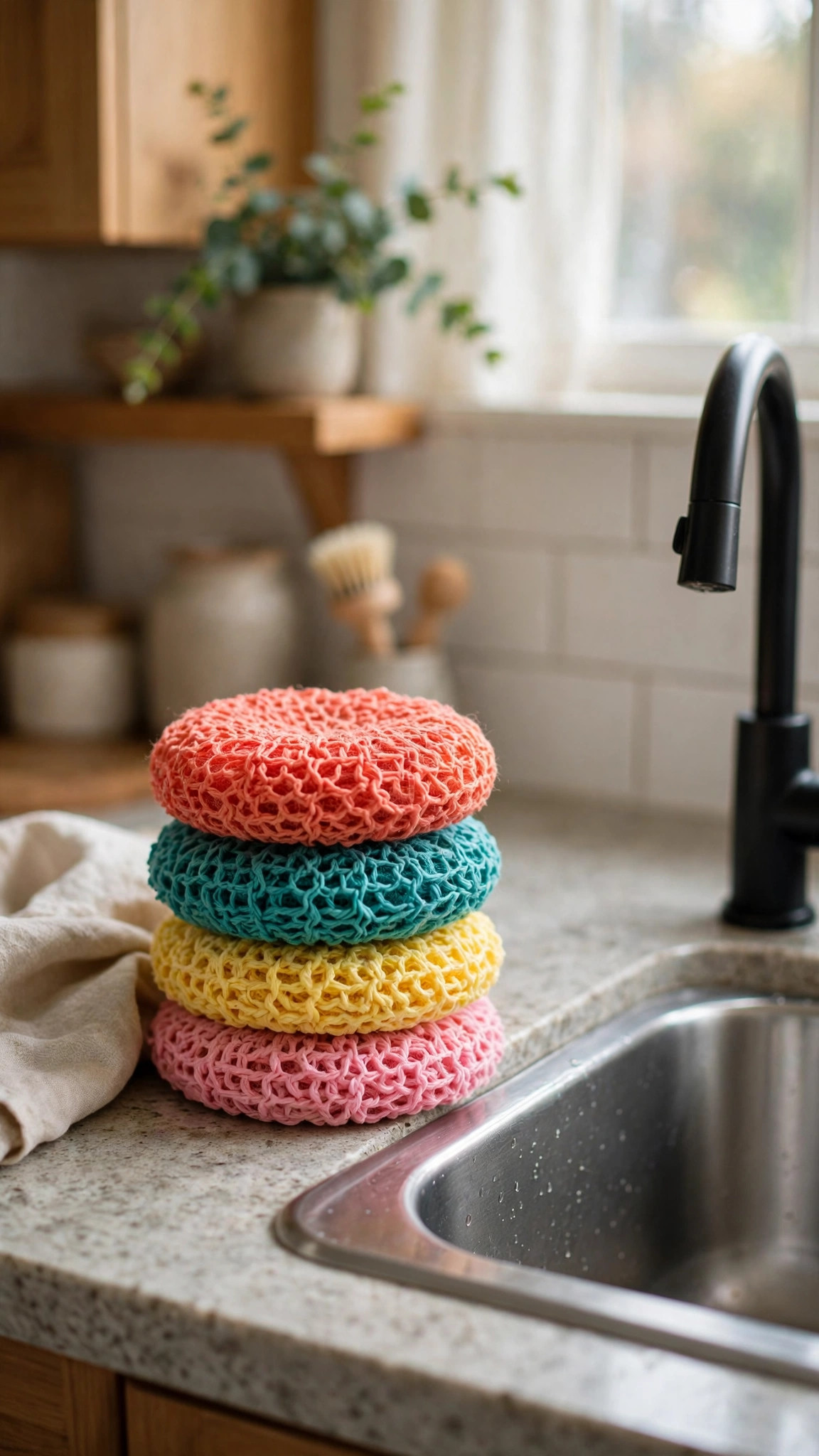
Three original kitchen scrubbies in one free post — a double-layer gathered tulle classic, a one-piece spiral in textured scrubby yarn with a hanging loop, and a two-sided cotton-and-tulle scrubby for wiping and scouring, all in US terms with full stitch counts.

Kitchen · Crochet
- Finished size
- About 10 cm / 4 in across
- Making time
- About 30–45 minutes each
- Hook
- 5.0–6.0 mm, tulle, cotton, scrubby yarn
- Pieces
- 3 scrubby patterns in one post
- Skill
- Beginner
In this post
If your kitchen sink still relies on a sad, flat sponge that gave up weeks ago, these free crochet scrubby patterns are about to change your washing-up life. A good scrubby is small and mighty: it lifts baked-on porridge, scrubs a roasting tray, wipes a counter, then rinses clean and dries fast instead of sitting in a puddle. Better still, a scrubby takes under an hour, uses scraps you probably already own, and lasts for months.
This post gives you three complete, original patterns: the classic round tulle scrubby — double-layer, gathered centre, nylon netting strips; a spiral scrubby in textured scrubby yarn with a hanging loop; and a two-sided scrubby with a cotton back for wiping and a tulle front for scouring. All three are in US terms with full stitch counts, our own stitch math, and honest notes on where each material should never be used.
Contents
- Why you'll love these crochet scrubbies
- Materials you'll need
- Size, gauge and skill level
- Abbreviations — US terms
- The pattern (US terms)
- Finishing and assembly
- Tips for scrubbies that last
- FAQ
- What to crochet next
Why you'll love these crochet scrubbies
First, they actually work. Tulle and netting have a springy roughness that shifts dried food without pressing like you are arguing with a casserole dish. Scrubby yarn builds that texture into the strand, so every stitch is a scouring ridge. Cotton is the opposite — soft, absorbent, perfect for wiping. Right material, right job, quicker washing up.
Second, they are fast and forgiving. Every pattern is a simple circle of single crochet increases — the same six-increase rhythm, round after round. No charts, no lace. If you can make a magic ring and a single crochet, you can make all three, and tension wobbles do not show in netting or textured yarn. Good practice, too, before a bigger make like our crochet dishcloths free patterns.
Third, they are thrifty, and they make useful gifts. One roll of netting makes a drawer of scrubbies; one ball of scrubby yarn makes several spirals. Wash, sanitise and keep going — most makers get three to six months from one. A stack tied with twine, in the colours of the recipient's kitchen, is a present people actually use every day.
Materials you'll need
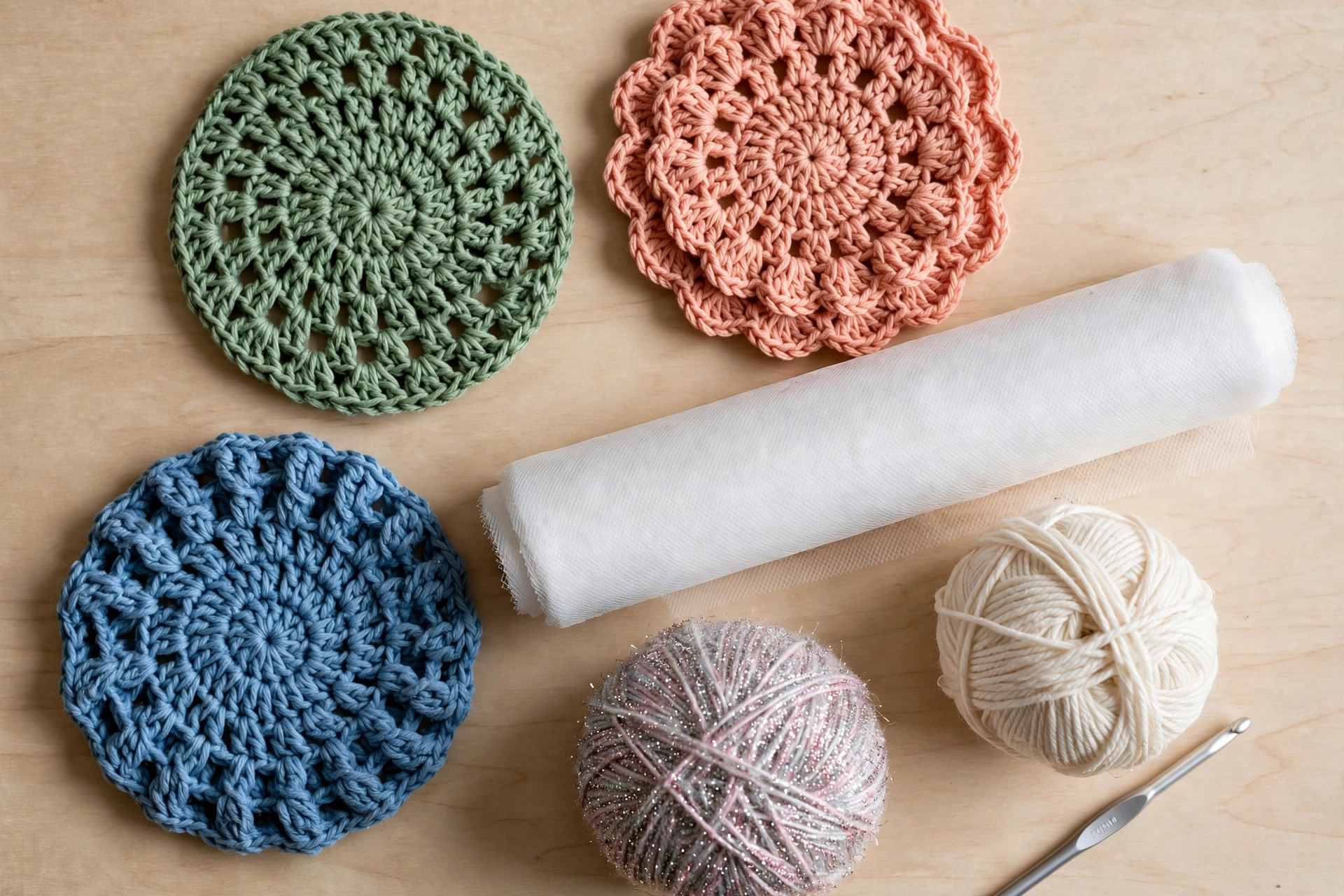
You do not need everything here for every scrubby — each pattern tells you exactly what it uses. With scrubbies, the material is the whole point: a soft acrylic circle will look pretty and scrub nothing, which is a coaster in costume. If coasters are what you are after, try our flower coaster crochet pattern — for scrubbies, stick to netting, scrubby yarn or cotton as written.
Tulle and nylon netting: Craft tulle on a roll, usually 15 cm (6 in) wide, works beautifully, and stiffer nylon netting works even better. Cut strips about 4 cm (1.5 in) wide along the length of the roll. Join strips as you work by overlapping the ends by about 5 cm (2 in) and crocheting through both layers for a few stitches — no knots.
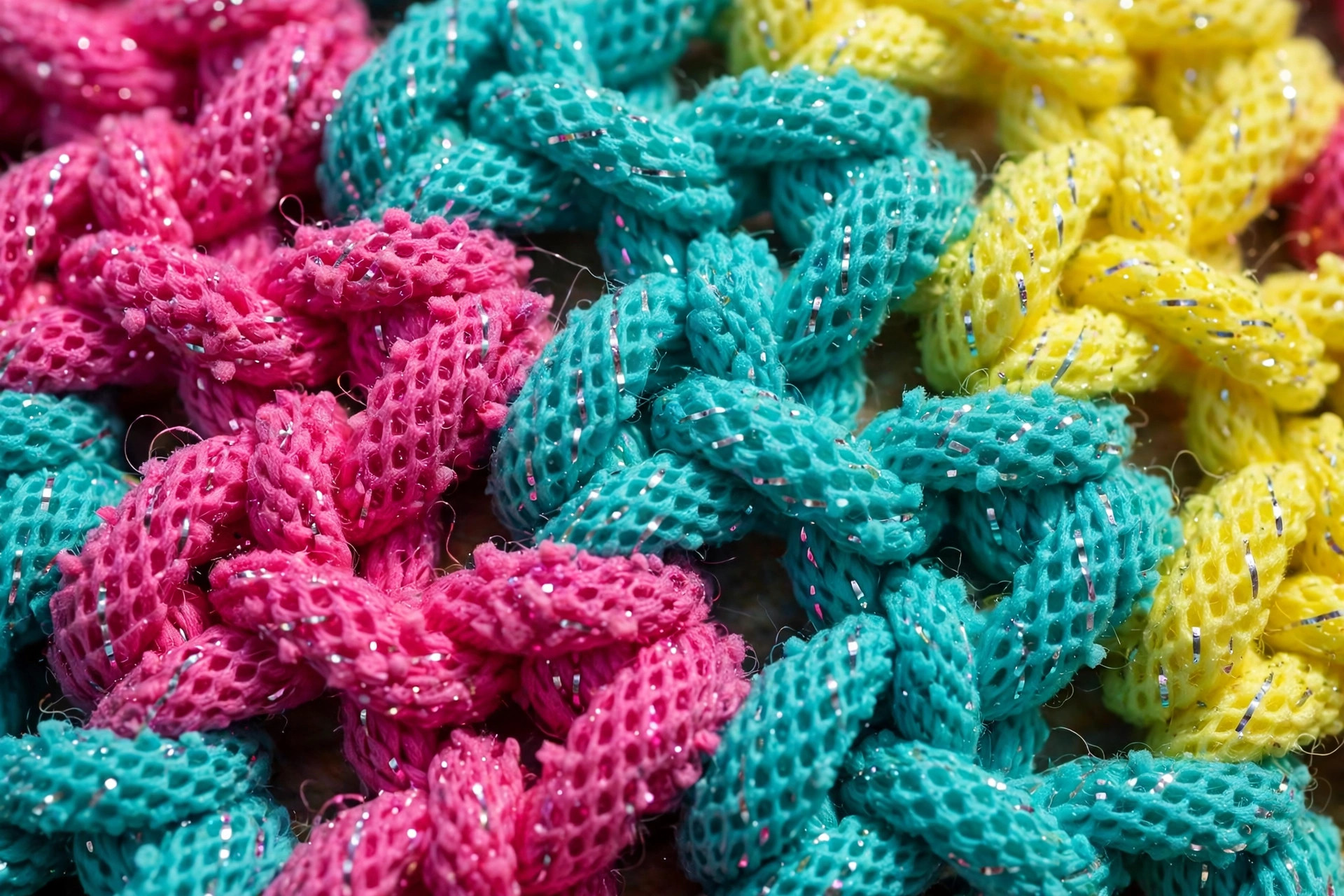
Scrubby yarn: Textured polyester scrubby yarns come in small balls, often with a sparkly strand. They dry fast, resist odours, and the texture does the scouring. One ball makes two to three spirals.
Cotton: For the two-sided scrubby, choose worsted-weight 100 percent cotton — dishcloth cotton is perfect. Avoid shiny mercerised cotton here; you want absorbency, not gloss.
| Supply | What to get |
|---|---|
| Nylon tulle or netting | One roll 15 cm (6 in) wide, or about 0.5 m netting fabric, cut into 4 cm (1.5 in) strips |
| Scrubby yarn | Textured polyester scrubby yarn, 1 ball about 50 g, for 2–3 spiral scrubbies |
| Cotton yarn | Worsted weight (category 4) 100% cotton, about 25 g per two-sided scrubby |
| Hooks | 5.0 mm (US H-8), 5.5 mm (US I-9) and 6.0 mm (US J-10) — see each pattern |
| Notions | Yarn needle with a large eye, stitch marker, sharp scissors, ruler for cutting strips |
| Optional | Rotary cutter and mat for even netting strips; a mesh laundry bag for washing |
A note on hooks: netting and scrubby yarn create friction, so a smooth metal hook slides far better than a wooden one. Keep tension relaxed — and moisturise afterwards, because netting is rough on fingers.
Size, gauge and skill level
Skill level: Beginner. You need a magic ring, single crochet, an increase, and a slip stitch. If you have never crocheted a flat circle, make the spiral scrubby first — scrubby yarn hides everything, which is very encouraging.
Finished size: Each scrubby measures roughly 10 to 11 cm (4 to 4.25 in) across. The tulle scrubby puffs to about 3 cm (1.25 in) thick after gathering; the spiral lies flatter; the two-sided sits in between. Size is not critical — a centimetre either way still scrubs perfectly well.
Gauge: Not critical, and a gauge swatch in netting is a special kind of misery. As a guide, the first three rounds should measure about 5 cm (2 in) across. Much smaller feels stiff; much larger feels floppy. Adjust your hook by half a size if needed.
Making time: About 30 minutes for the spiral, 40 for the two-sided, 45 for the tulle scrubby once strips are cut. Cut a whole roll in one sitting and wind strips into loose balls, and the next five are grab-and-go.
Abbreviations — US terms
US terms throughout. (UK note: a US single crochet is a UK double crochet.)
| Abbreviation | Meaning |
|---|---|
| MR | magic ring |
| sc | single crochet |
| inc | increase — 2 sc in the same stitch |
| sl st | slip stitch |
| st(s) | stitch(es) |
| rnd(s) | round(s) |
| BLO | back loop only |
| FO | fasten off |
A note on rounds: Follow the instruction at the start of each pattern — tulle behaves best in joined work and scrubby yarn in a continuous spiral. Mark the first stitch of each round and move the marker up as you go. The bold number is your stitch count for that round; count at every increase round, because one missed increase shows quickly in a small circle.
Crocheting with netting strips: Treat each strip like thick, springy yarn. Keep it untwisted where you can, pull loops up a little taller, and do not panic about seeing through the fabric — netting looks holey on the hook and scrubs beautifully.
The pattern (US terms)
Make one, make all three — each pattern is complete on its own. Read the safety notes in Finishing before gifting a scrubby, especially about non-stick pans and glass.
Pattern 1 — Classic round tulle scrubby
The traditional favourite: two identical netting circles, joined around the edge, then gathered through the centre so the pad puffs into a dimpled scrubby with real body. The double layer matters — a single circle is too flimsy to grip. Use a 6.0 mm hook and strips about 4 cm (1.5 in) wide.
Make the first layer:
- R1: MR, 6 sc (6)
- R2: inc in each st around (12)
- R3: [sc, inc] × 6 (18)
- R4: [2 sc, inc] × 6 (24)
- R5: [3 sc, inc] × 6 (30)
- R6: [4 sc, inc] × 6 (36)
- R7: sc in each st around (36)
FO, leaving a tail of about 20 cm (8 in). A gentle curl at the edge is normal for netting.
Make the second layer: Work exactly as the first, Rounds 1 to 7 (36), but do not fasten off — you will join the layers with this working strip.
Join the layers: Hold the circles together, neater sides out, stitches aligned. Working through both layers at once, sc in each st around (36), staggering the strip joins so they do not sit in the same spot. Join with a sl st to the first sc and FO, leaving a long tail of netting, about 40 cm (16 in), for gathering in Finishing. The pad will look flat and slightly frilly — exactly right for now.
Pattern 2 — Spiral scrubby in scrubby yarn
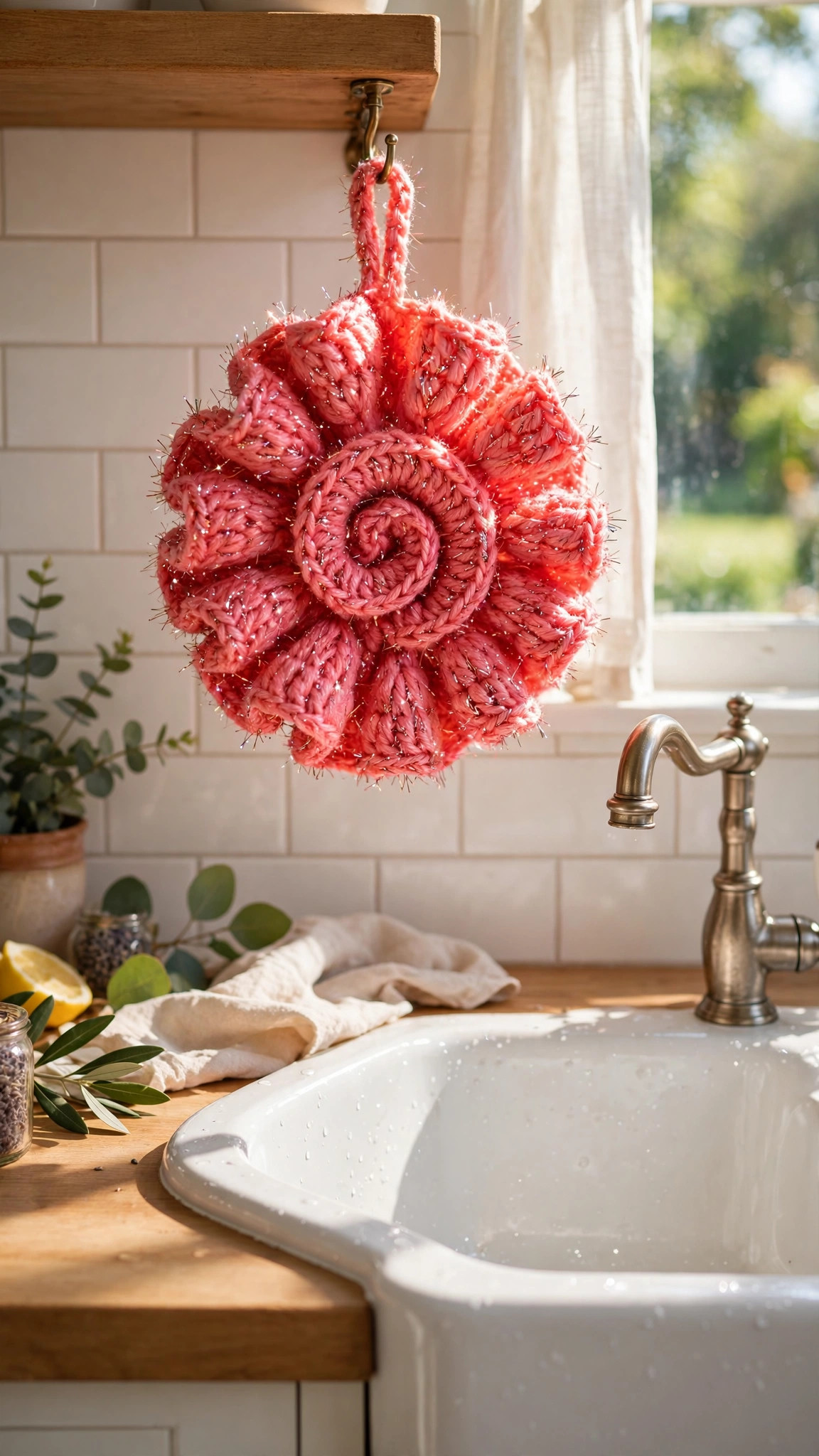
Worked in one continuous spiral in textured scrubby yarn — no joins, no assembly — and each diagonal ridge is a scouring edge. It finishes with a hanging loop, because a scrubby that hangs up dries fast and never gets that swampy sponge smell. Use a 5.5 mm hook.
Work in a continuous spiral — do not join or turn. Mark the first stitch of each round.
- R1: MR, 6 sc (6)
- R2: inc in each st around (12)
- R3: [sc, inc] × 6 (18)
- R4: [2 sc, inc] × 6 (24)
- R5: [3 sc, inc] × 6 (30)
- R6: [4 sc, inc] × 6 (36)
- R7: sc in BLO of each st around (36) — this back-loop round makes the neat edge ridge
- R8: sc in each st around (36)
Hanging loop: Ch 14, keeping the chain loose, then sl st into the same stitch at the base of the chain. FO and weave the tail through three or four stitches on the wrong side before trimming — scrubby yarn tails wriggle free, so travel further than you think.
For a thicker version, make a second spiral, place the two wrong sides together, and work one round of sc through both layers (36) before adding the loop.
Pattern 3 — Two-sided cotton and tulle scrubby
The diplomat of the sink: one face for wiping, one for scouring, no changing tools mid-wash. The cotton back wipes counters and mops up sauces; the tulle front does the scrubbing, and the joined layers feel pleasantly spongy in your hand. Use cotton with a 5.0 mm hook for the back, netting strips with a 6.0 mm hook for the front.
Make the cotton back — cotton yarn, 5.0 mm hook:
- R1: MR, 6 sc (6)
- R2: inc in each st around (12)
- R3: [sc, inc] × 6 (18)
- R4: [2 sc, inc] × 6 (24)
- R5: [3 sc, inc] × 6 (30)
- R6: [4 sc, inc] × 6 (36)
- R7: sc in each st around (36)
FO, leaving a tail of about 20 cm (8 in). The cotton disc should lie flat; a slight ruffle smooths out with a stretch and a press of your palm.
Make the tulle front — netting strips, 6.0 mm hook:
- R1: MR, 6 sc (6)
- R2: inc in each st around (12)
- R3: [sc, inc] × 6 (18)
- R4: [2 sc, inc] × 6 (24)
- R5: [3 sc, inc] × 6 (30)
- R6: [4 sc, inc] × 6 (36)
- R7: sc in each st around (36)
FO. Both discs now share the same stitch count — that is what makes the joining round calm and even.
Join the two sides: Hold the discs together, cotton side out on one face, tulle out on the other, wrong sides touching. Using a fresh length of netting strip and the 6.0 mm hook, sc in each st around through corresponding stitches of both discs (36). Join with a sl st to the first sc, FO, and weave ends between the layers. Use the cotton side for the general wash, flip to tulle for anything stubborn, and hang this one somewhere airy — the cotton side dries a little slower than pure tulle.
Finishing and assembly
Gather the tulle scrubby's centre. Thread Pattern 1's long tail onto your needle, push it through the centre of the pad and back a few millimetres away, and repeat three or four times, crossing like wheel spokes. Pull firmly each time — the pad puckers into a plump, dimpled round. Knot between the layers, trim, and poke the end inside. The gathering holds the layers together and gives your fingers a dimple to grip.
First wash. Before first use, wash each scrubby in warm soapy water, rinse well and dry flat or hanging. This removes factory finish, softens the cotton, and reveals any loose strip ends to trim flush.
Care — washing and sanitising. Rinse after each use, squeeze out, and hang to dry — dry storage matters more than any product. Once a week, machine wash with towels, ideally in a mesh bag; a hot 60°C wash suits tulle, polyester and cotton alike. To sanitise, soak ten minutes in hot water with a splash of white vinegar, or put tulle and scrubby-yarn versions on the dishwasher's top rack. Replace a scrubby when it loses its spring, tears, or stays smelly after a hot wash. Netting and polyester are not compostable, so retire old ones to a last grim job — a barbecue grill, muddy boots — then household waste.
Safety notes. Scouring materials can scratch. Never use these scrubbies on non-stick or coated pans — the coating always loses. Avoid delicate glass, crystal, polished marble, high-gloss finishes and car paintwork, and test first on a hidden corner of stainless steel, enamel and plastic. For anything precious, use Pattern 3's cotton face or a soft cloth. Keep scrubbies for the sink, not skin.
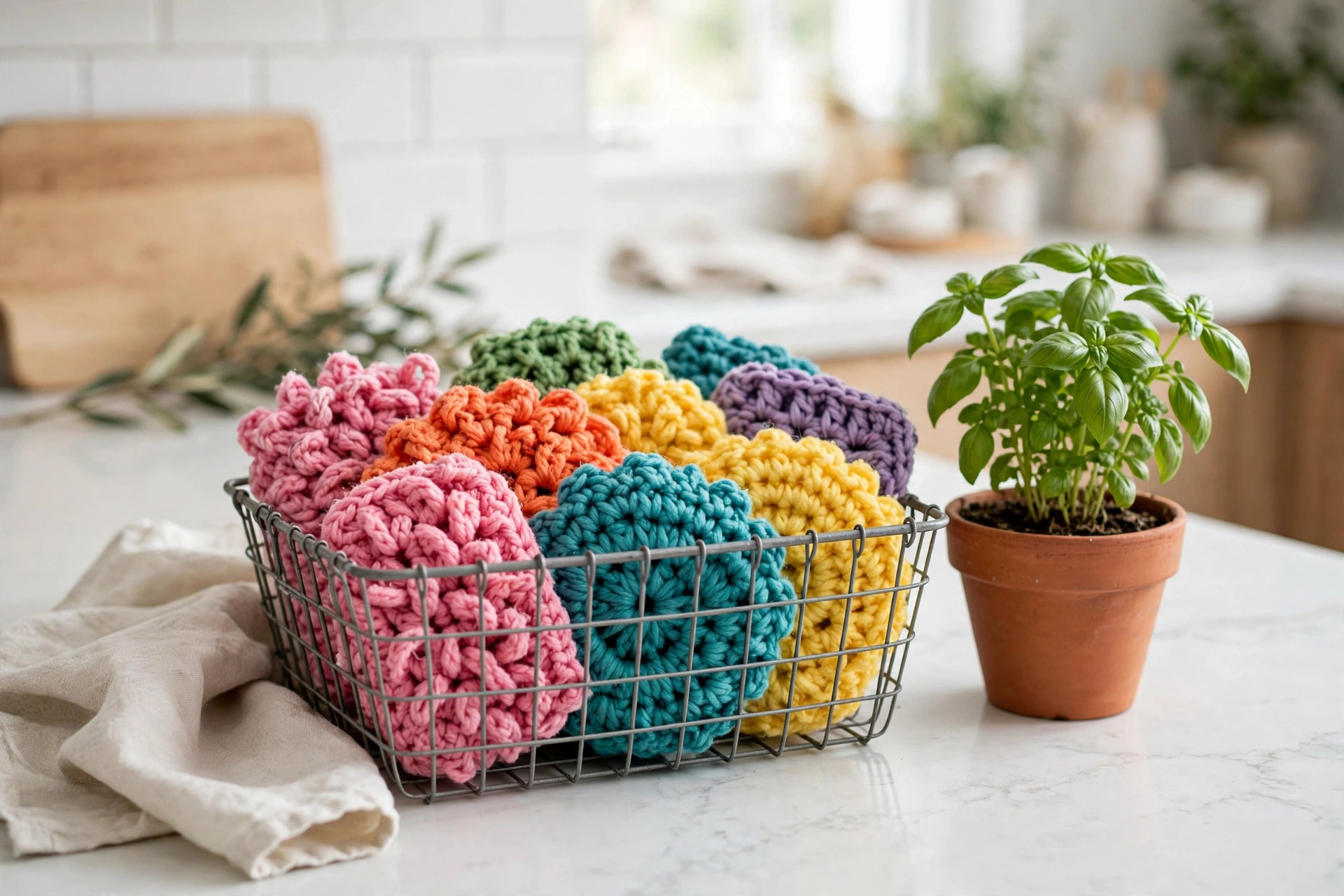
Roll each scrubby between your palms, trim any poking strip ends flush, and line the three up by the sink. They will look almost too cheerful to use. Use them anyway — you can make a replacement in half an hour.
Tips for scrubbies that last
Cut strips evenly, forgive yourself anyway. Even strips make even fabric, but a strip wandering between 3 cm and 5 cm wide still scrubs perfectly. Consistency matters far less than keeping going.
Join by overlapping, never knotting. Knots make hard lumps that can scratch and work loose in the wash. An overlap crocheted through for three or four stitches disappears into the fabric.
Rotate two or three scrubbies. One in use, one drying, one in the wash. A scrubby that dries fully between uses stays fresh far longer — rotation is the real secret.
Colour-code by job. Bathroom scrubbies in one colour, kitchen in another, never the twain. Netting is cheap and colours are joyful, so lean into the system.
Rest your hands. Netting and scrubby yarn are rougher than ordinary yarn — work in shorter bursts and keep hand cream by your project bag.
Gift a sink-side set. Three scrubbies, a dishcloth and a care note, tied in a bundle, is a housewarming present used the same evening.
FAQ
Are these crochet scrubby patterns really free?
Yes. All three patterns are complete on this page, with every round and stitch count included. Make as many as you like for your own sink and for gifts.
What is the best material for a crochet scrubby?
It depends on the job. Nylon tulle and netting scrub strongest and dry fastest. Textured scrubby yarn is easiest to crochet with and nearly as effective. Cotton alone does not scour — it wipes and absorbs — so here it is one face of a two-sided scrubby, not a scrubby on its own.
Can I use a crochet scrubby on non-stick pans?
No. Tulle, netting and scrubby yarn can damage non-stick and coated surfaces. Keep them for uncoated stainless steel, cast iron, enamel, ceramic dishes, trays and worktops, and test any new material on a hidden corner first. For non-stick, use the cotton side of Pattern 3, with a good soak doing the hard work.
How do I wash and sanitise a crochet scrubby?
Rinse, squeeze and hang it somewhere airy after each use. Machine wash weekly with towels in a mesh bag — 60°C is fine for tulle, polyester and cotton — or soak in hot water with a splash of white vinegar for ten minutes. Tulle and scrubby-yarn versions can also go on the dishwasher's top rack.
How long does a crochet scrubby last?
Typically three to six months of daily use, often longer with rotation and proper drying. The gathered tulle scrubby lasts longest — its double layer holds its shape.
My tulle circle keeps curling into a bowl — is that wrong?
A gentle curl is normal and disappears once the layers are joined and the centre is gathered. If it is extreme, your tension is tightening or a strip has twisted into a cord — relax your grip, flatten the strip as you feed it, and pull loops up a little taller. Count each increase round too; a missed increase curls any circle.
Can I sell scrubbies I make from these patterns?
Yes — you may sell finished scrubbies made by hand from these patterns in small quantities, crediting Little Loop Finds as the designer. Bundles of three sell brilliantly at craft fairs. Please do not copy or republish the pattern text and photos themselves.
What to crochet next
Your sink is sorted — keep the kitchen momentum going:
- Build the full set with our crochet basket pattern free — a sturdy little basket is the perfect home for your scrubby rotation.
- Move to the table with the crochet table runners free patterns and give the dining end of the kitchen the same handmade treatment.
- Add a seasonal touch with the easy crochet pumpkin pattern — a quick, cheerful make for the counter.
Happy crocheting — may your trays come clean, your scrubbies stay fresh, and your sink be the brightest corner of the kitchen.
The box below contains an Etsy link. If you buy through it, we may earn a small commission at no extra cost to you. Learn more.
No time to make one?
Short on time? Find handmade crochet scrubbies from independent makers on Etsy.
Browse on Etsy (opens Etsy in a new tab)