Free flower coaster crochet pattern: blossom coaster
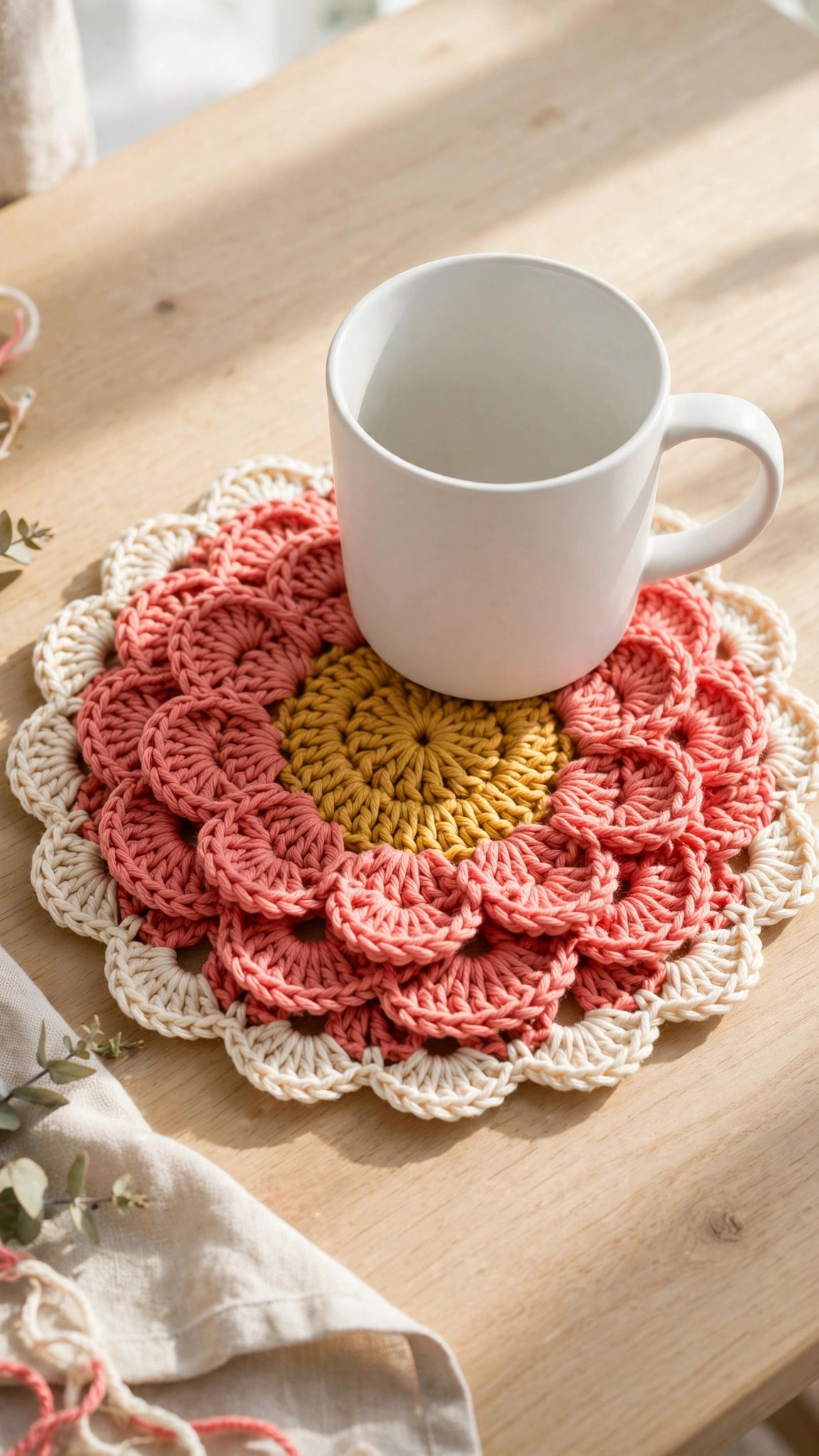
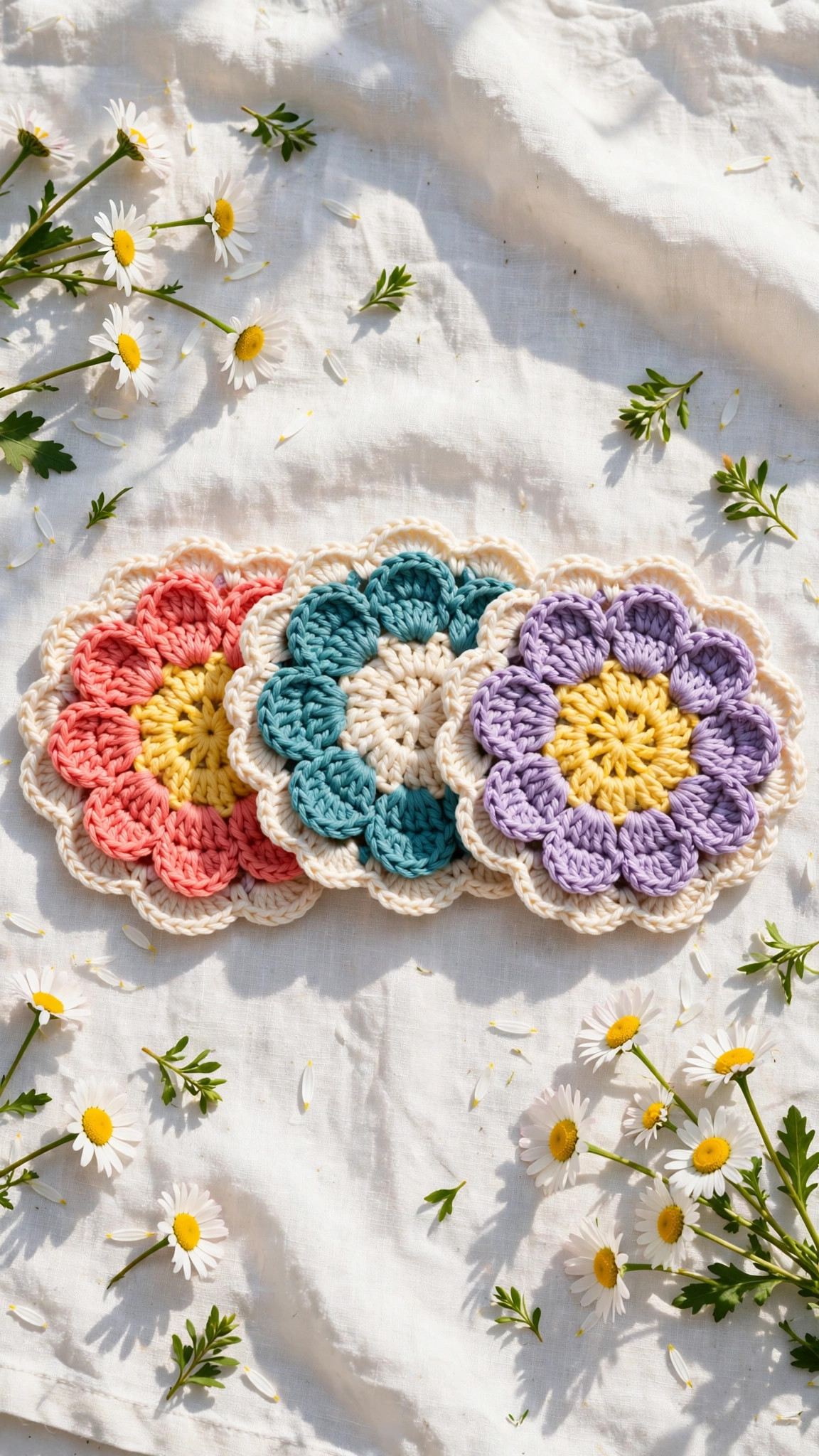
A golden-yellow center, two layers of dimensional coral petals, and a cream scalloped edge — this blossom coaster works up in about 30 minutes from yarn scraps and looks far fancier than its 8 rounds suggest.

Home decor · Crochet
- Finished size
- About 13 cm / 5 in across
- Making time
- About 30–40 minutes
- Hook
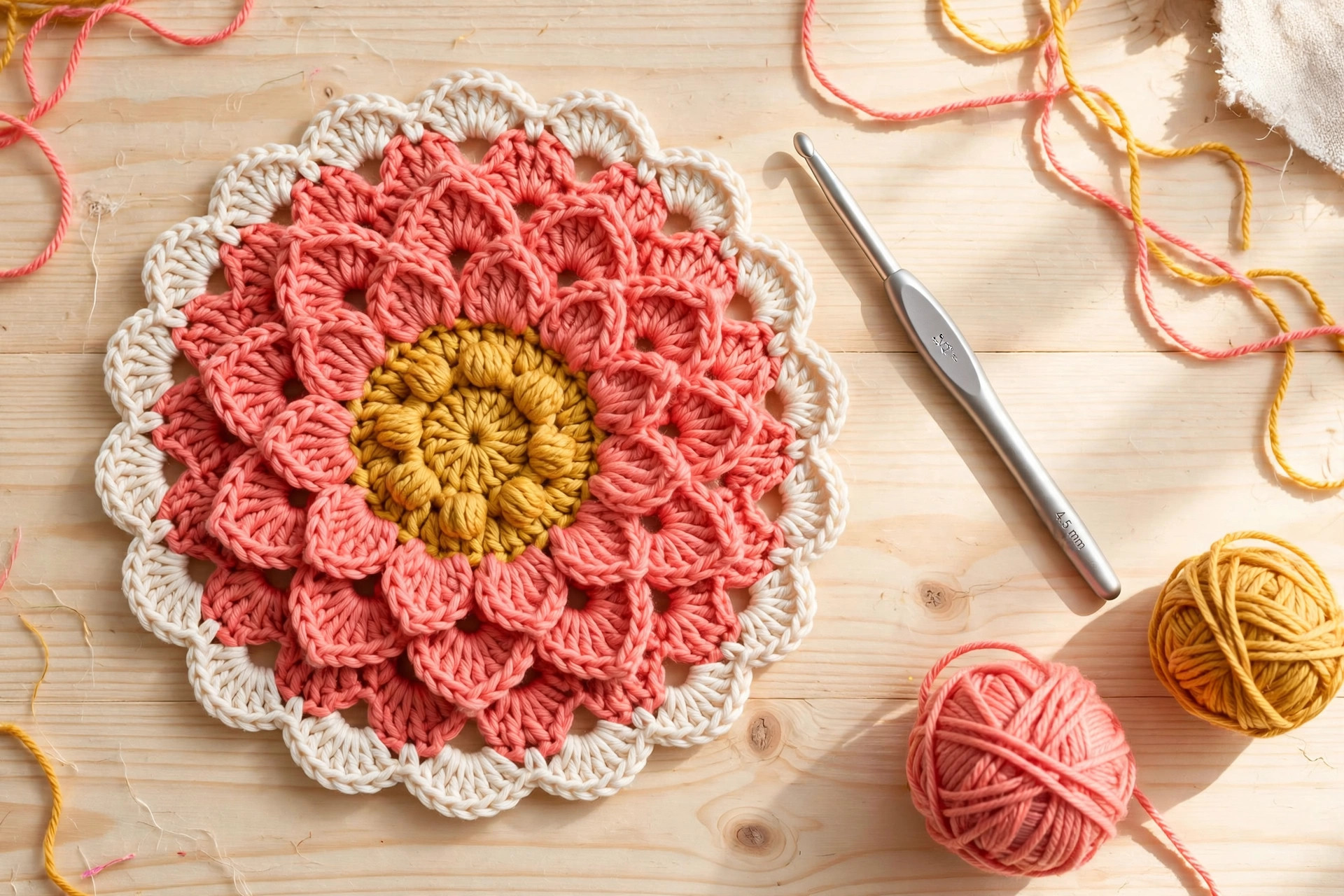
- 4.5 mm, worsted-weight cotton
- Rounds
- 8 joined rounds, 3 colors
- Skill
- Beginner
In this post
If your coffee table could use a little springtime, this free flower coaster crochet pattern is the quickest way to get there. Each blossom coaster works up in about half an hour from yarn scraps — a golden-yellow center, two layers of dimensional petals, and a cream scalloped edge that looks far fancier than the stitch count suggests. Make one for your morning mug, or make a set of six for a gift that looks like it came from a boutique.
Why you'll love this flower coaster crochet pattern
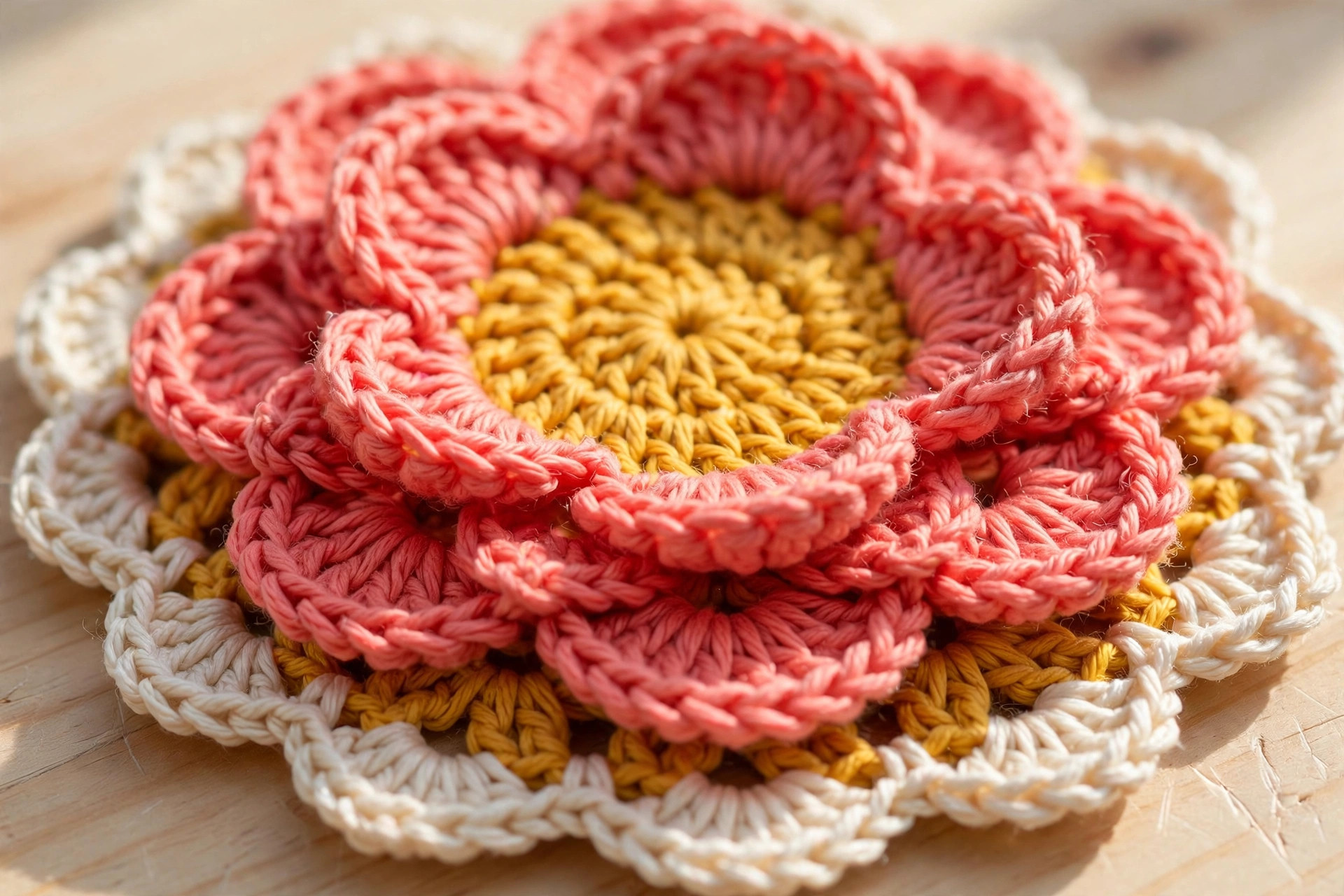
Most crochet coasters are plain circles with a pretty border. This one is the flower itself. The trick is in the petal construction: a base round of small double-crochet clusters creates the inner petal layer, and a second round of wider fans worked into those clusters builds the outer layer. The two layers overlap like real petals, so the coaster has genuine dimension instead of looking printed-on.
It's also the rare pattern that uses genuinely tiny amounts of yarn — about 10 g for the center, 20 g for the petals, 10 g for the edge. That's the bottom-of-the-bag territory where single skeins go to die, and it's exactly why this pattern earns its place: a set of six coasters will barely dent three half-used balls. The whole thing is worked in joined rounds (no spirals to track, no stitch marker needed), so it's a perfect first "round" project if you've only ever crocheted rows.
Materials you'll need
| Supply | What to get |
|---|---|
| Center yarn | Worsted-weight (#4) cotton in mustard yellow, about 10 g |
| Petal yarn | Worsted-weight (#4) cotton in coral pink (or any color), about 20 g |
| Edge yarn | Worsted-weight (#4) cotton in cream or white, about 10 g |
| Crochet hook | 4.5 mm |
| Notions | Tapestry needle, scissors |
Cotton is the right call for coasters. It absorbs condensation instead of sliding around on it, and it survives the washing machine when coffee rings happen. Acrylic works in a pinch, but it melts under very hot mugs and pills faster — save it for decor. If you've made our crochet dishcloths, you already know how cotton behaves, and you probably have the scraps this project needs.
Size, gauge and skill level
- Finished size: about 13 cm (5 in) across, petal tip to petal tip. Big enough for an oversized mug, small enough to stack neatly.
- Gauge: not fussy. Worked as written with worsted cotton and a 4.5 mm hook, Rounds 1–4 should measure about 7 cm (2.75 in) across. If yours is much smaller, your tension is tight — go up to a 5.0 mm hook. If it's floppy and larger, drop to 4.0 mm.
- Skill level: confident beginner. You should know the magic ring (or chain-4 ring), single crochet, double crochet, and slip stitch. The only "new" move is working a fan of stitches into a single stitch, and the pattern walks you through it.
Flat-circle skills transfer directly here: if you've worked our crochet doily patterns, the joined-round rhythm and the increase logic in the center will feel instantly familiar.
Abbreviations — US terms
| Abbreviation | Meaning |
|---|---|
| MR | magic ring |
| ch | chain |
| sl st | slip stitch |
| sc | single crochet |
| dc | double crochet |
| st(s) | stitch(es) |
| R | round |
| FO | fasten off |
Reading the petal rounds: a "3-dc cluster" below means three double crochets all worked into the same stitch — that's what makes each stitch fan out into a petal. When the pattern says "center dc of the cluster," count to the middle stitch of those three and work there. The stitch count in parentheses at the end of each round is your checkpoint — count before moving on.
The pattern (US terms)
All rounds are joined: finish each round with a slip stitch to the first stitch, then chain up for the next round. The chain at the start of a round never counts as a stitch unless the pattern says so. Work with a relaxed hand — tight tension makes the petals curl inward instead of lying flat.
Changing colors: finish the last slip stitch of the old color, cut the yarn leaving a 10 cm (4 in) tail, and join the new color with a slip stitch in any stitch. Join in a valley — a slip stitch or single crochet between petals — never in the middle of a petal, where the knot would show on the finished face. There's no need to carry yarn up the side; with only three colors and clean fasten-offs, the back stays tidy.
Flower center — yellow
- R1: MR, 6 sc (6). Pull the ring closed and sl st to the first sc to join.
- R2: Ch 1, inc in each st around (12). Sl st to join.
- R3: Ch 1, [sc, inc] × 6 (18). Sl st to join.
- R4: Ch 1, [2 sc, inc] × 6 (24). Sl st to join. FO yellow, leaving a 10 cm (4 in) tail to weave in later.
Check your work here: the circle should lie perfectly flat. If the edge ripples, your tension is loose — frog back and work tighter, or drop a hook size for the remaining rounds.
Petal base — petal color
- R5: Join petal color with a sl st in any stitch of R4. (3 dc in the next st, skip 2 sts, sl st in the next st) × 6. Sl st to the first sl st to join.
Stitch check: each repeat uses 4 stitches of R4 — one as the base for the 3-dc cluster, two skipped, one for the slip stitch. Six repeats × 4 = 24, which is exactly your R4 count, so you should end flush with no stitches left over. You now have 6 little clusters (the inner petal layer) with 6 slip stitches sitting between them.
Tip: those 2 skipped stitches are doing structural work — they pull the clusters into rounded petal shapes. Don't be tempted to skip only 1; the petals will come out pointy instead of round.
Layered petals — petal color
- R6: Sl st into the center dc of the first 3-dc cluster to position your hook. Ch 2 (does not count as a stitch). 5 dc in the same stitch, sc in the next sl st. 5 dc in the center dc of the next 3-dc cluster, sc in the next sl st × 5. Sl st to the first dc to join (36: 30 dc + 6 sc).
Each fan of 5 dc blooms over the top of a base cluster, and the single crochet between fans pins the layer down at the valleys — that's what creates the layered, real-flower look. The round should still lie flat; the fans will puff up slightly, which is exactly right.
Flattening round — petal color
- R7: Ch 1, sc in each st around (36). Sl st to join. FO petal color if you're switching to a separate edge color.
This plain round is the unsung hero of the pattern: it evens out the bumpy top of the petal fans and gives the scalloped edge a clean, consistent foundation. Skip it and your shells will wobble.
Scalloped edge — cream
- R8: Join cream with a sl st in any stitch of R7. (Skip 2 sts, 5 dc in the next st, skip 2 sts, sc in the next st) × 6. Sl st to the first sc to join. FO, leaving a 10 cm tail.
Stitch check: each repeat consumes 6 stitches (2 skipped + 1 shell base + 2 skipped + 1 sc base). Six repeats × 6 = 36 — your full R7 count. You'll finish with 6 even shells, one sitting over each petal, like a picot-trimmed doily edge.
Blocking and finishing touches
Weave in all three tails with a tapestry needle, working each one through the backs of nearby stitches for at least 5 cm (2 in) before trimming — coasters get yanked around, and short tails work themselves free.
Now the step most people skip and shouldn't: block it. The layered petals can cup slightly after R6, especially in cotton. Dampen the coaster (a spray bottle is perfect — don't soak it), pin it flat to a towel or blocking mat with the petals spread evenly, and let it dry completely. Ten minutes of active effort, and the difference between "handmade" and "hand-finished" is visible from across the room.
Heat-proofing note: cotton handles hot mugs beautifully, but very dark dyes can transfer onto light-colored mug bases when wet with condensation. If you're gifting a set in deep reds or navy, wash the coasters once first — it's a small step that saves an awkward conversation.
Four pretty colorways to try next
The pattern is a template — the flower reads clearly in almost any palette. Once you've made the coral version, try:
- Daisy. White petals, yellow center, white edge. The classic, and the fastest seller at craft fairs. If you love floral motifs, our free crochet flower pattern builds standalone blooms you can sew onto hats, bags, and blankets with the same petal technique.
- Sunflower. Yellow petals, brown center, cream edge. Swap the petal base to 4-dc clusters instead of 3 for slightly fuller petals — the math still works because the outer fan round anchors to cluster centers either way.
- Monochrome. All three rounds in the same color (try sage green or dusty blue). The texture does all the talking, and it looks strikingly modern on a dark wood table.
- Rainbow set. Six coasters, six petal colors, one shared cream edge. Tie the stack with twine and you have a hostess gift that takes an afternoon and costs almost nothing in yarn.
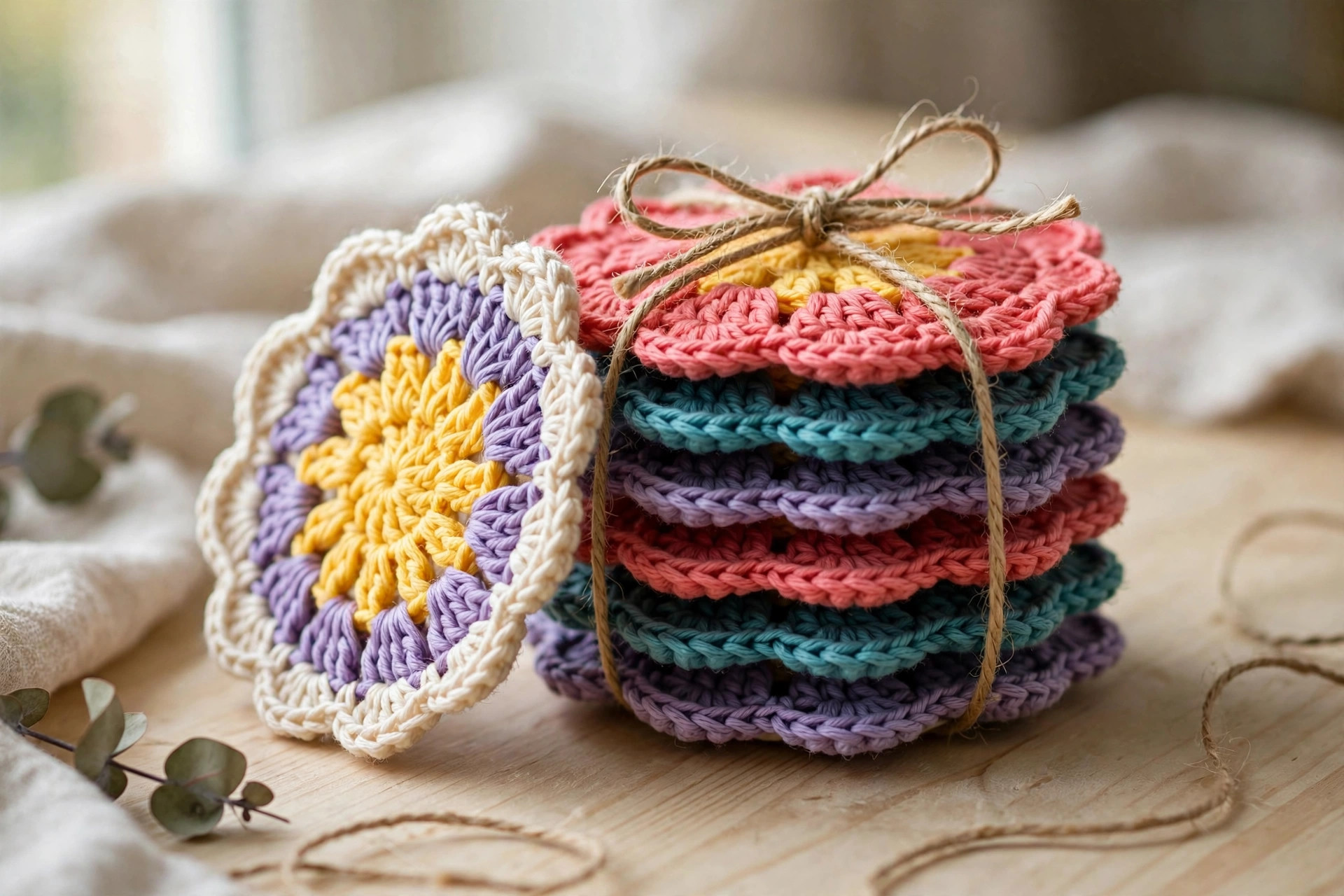
Pair a set with something small and sweet: a free crochet heart tucked into the twine bow turns the stack into a Valentine's or Mother's Day gift with zero extra shopping.
Troubleshooting tips
- The center ripples or won't lie flat. Too many stitches for the round — almost always loose tension on the increase rounds. Frog back to R2 and work tighter, or drop to a 4.0 mm hook for R1–R4 only.
- The petals curl inward like a cup. Your petal-round tension is too tight relative to the center, or you skipped the blocking step. Block it damp and pinned flat; if it still cups, rework R6 with a 5.0 mm hook.
- You have stitches left over at the end of R5. Count R4 — you need exactly 24. The usual culprit is a missed increase in R3 or R4. Each repeat of R5 needs 4 stitches; if you have 25, you added an increase somewhere.
- The shell edge is uneven — some shells bigger than others. You're probably working the 5-dc shells into the wrong stitch (easy to do after the bumpy R6). Count the 2 skipped stitches on each side of every shell base; the shell always lands in the middle stitch of each 6-stitch repeat.
- The join between rounds shows as a visible seam. Pull the slip stitch join snug and start each round's chain in the same stitch — and when you join a new color, join it in a valley (a slip stitch or single crochet), never in the middle of a petal, where the knot would show.
- The coaster slides on the table. Cotton grips better than acrylic, but on very slick surfaces add three tiny dots of fabric-safe silicone glue on the underside. Let cure 24 hours before use.
Frequently asked questions
Is this flower coaster crochet pattern really free?
Yes — the complete pattern above is free, no email signup or purchase required. If it saved you a trip to the home-goods store, saving the post on Pinterest is the kindest thank-you.
What skill level is this pattern?
Confident beginner. If you can single crochet and double crochet in the round and join rounds with a slip stitch, you have every skill needed. The petal fans look advanced but they're just "many stitches in one stitch" — the pattern tells you exactly where.
How long does one coaster take?
About 30–40 minutes once you've made your first: 10 minutes for the center, 15 for the two petal rounds, 5 for the edge, plus weaving in ends. A set of six is a comfortable weekend-afternoon project.
Can I sell the finished coasters I make?
Yes! You may sell finished coasters made from this pattern in small batches (craft fairs, Etsy, gifts). Please credit Little Loop Finds as the pattern designer with a link back to this page. The pattern text and photos themselves may not be redistributed, republished, or sold.
What yarn works best for coasters?
Worsted-weight (#4) 100% cotton is the gold standard — absorbent, heat-tolerant, and machine washable. Avoid novelty or eyelash yarns (the petal texture disappears) and be cautious with very dark dyes on first wash, as noted in the finishing section.
Can I make this coaster bigger, like a doily or trivet?
Absolutely — the petal math scales cleanly. After R4 (24 sts), add two more increase rounds: [3 sc, inc] × 6 (30), then [4 sc, inc] × 6 (36). Work the petal base as (3 dc in next st, skip 2 sts, sl st in next st) × 9 (36 ÷ 4 = 9 petals), the fan round as 9 petals with a sc between each (54 sts total), one plain sc round (54), and the shell edge as (skip 2, 5-dc shell, skip 2, sc) × 9. You'll get a 9-petal trivet about 18 cm (7 in) across.
More free patterns to try
If you enjoyed the quick-satisfaction rhythm of this coaster, keep the hook moving. The crochet doily patterns use the same joined-round skills at a lacier scale, the autumn acorn granny square is another brilliant scrap-buster with seasonal charm, the free crochet heart pattern pairs perfectly with a coaster set as a gift topper, and the crochet shawl pattern is the natural next step when you're ready for a bigger project in the same relaxing stitch rhythms.
The box below contains an Etsy link. If you buy through it, we may earn a small commission at no extra cost to you. Learn more.
No time to make one?
Short on time? Find handmade crochet flower coasters from independent makers on Etsy.
Browse on Etsy (opens Etsy in a new tab)