Free Bolero Jacket Crochet Pattern: Easy Lace Shrug
A lacy open-front bolero shrug in shell stitch: original design, US terms, three sizes, and easy enough for a first garment.

Wearables · Crochet
- Finished size
- 3 sizes, S to L
- Making time
- About 10 hours (M)
- Hook
- 4.5 mm, DK yarn
- Construction
- 1 rectangle, seamed sleeves
- Skill
- Easy
In this post
- Table of contents
- Why you'll love this bolero jacket crochet pattern
- Materials you'll need
- Size, gauge and skill level
- Abbreviations, US terms
- The bolero jacket crochet pattern (US terms)
- Finishing touches and assembly
- Tips and tricks
- Variations to try next
- Troubleshooting tips
- Frequently asked questions
- More free patterns to try
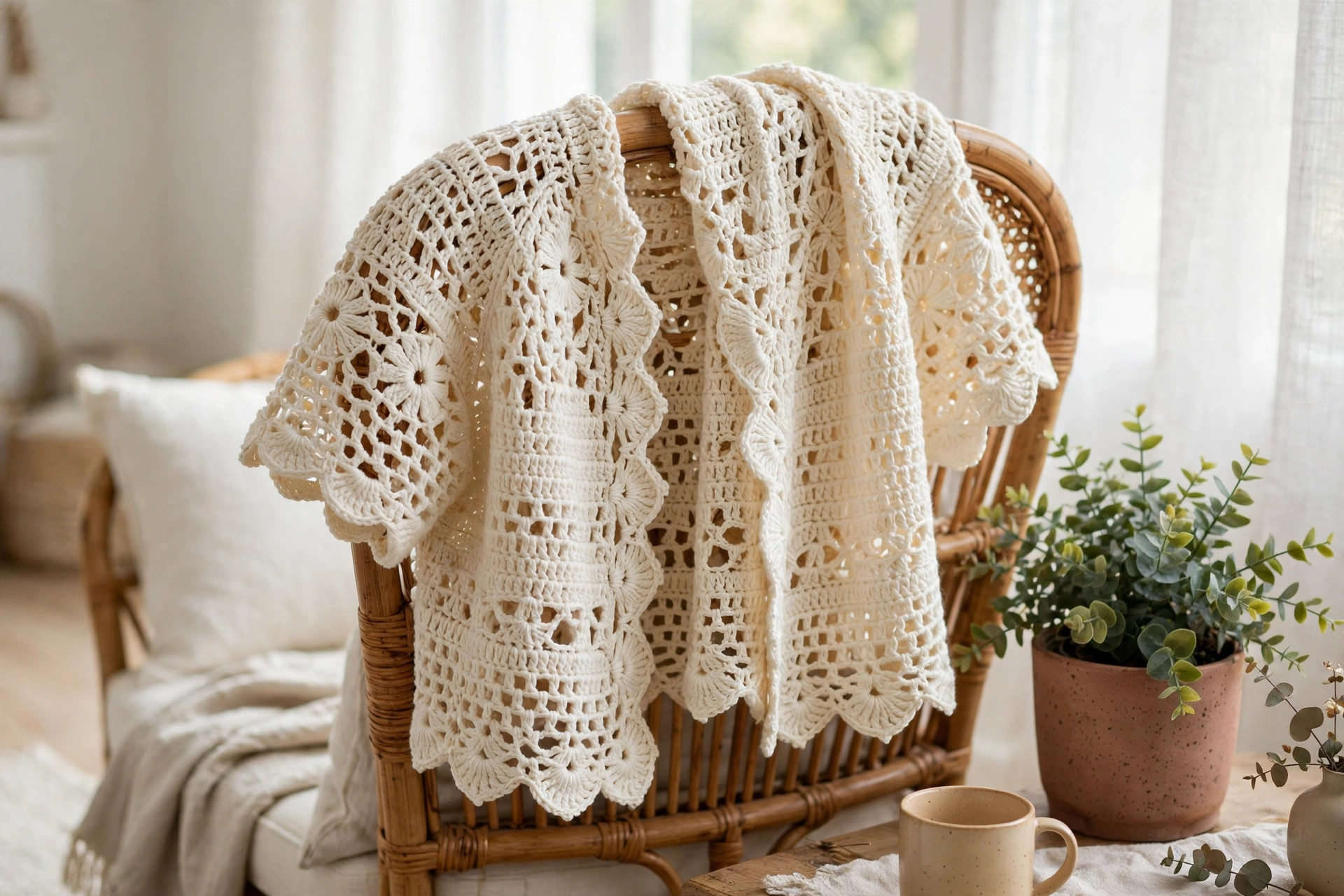
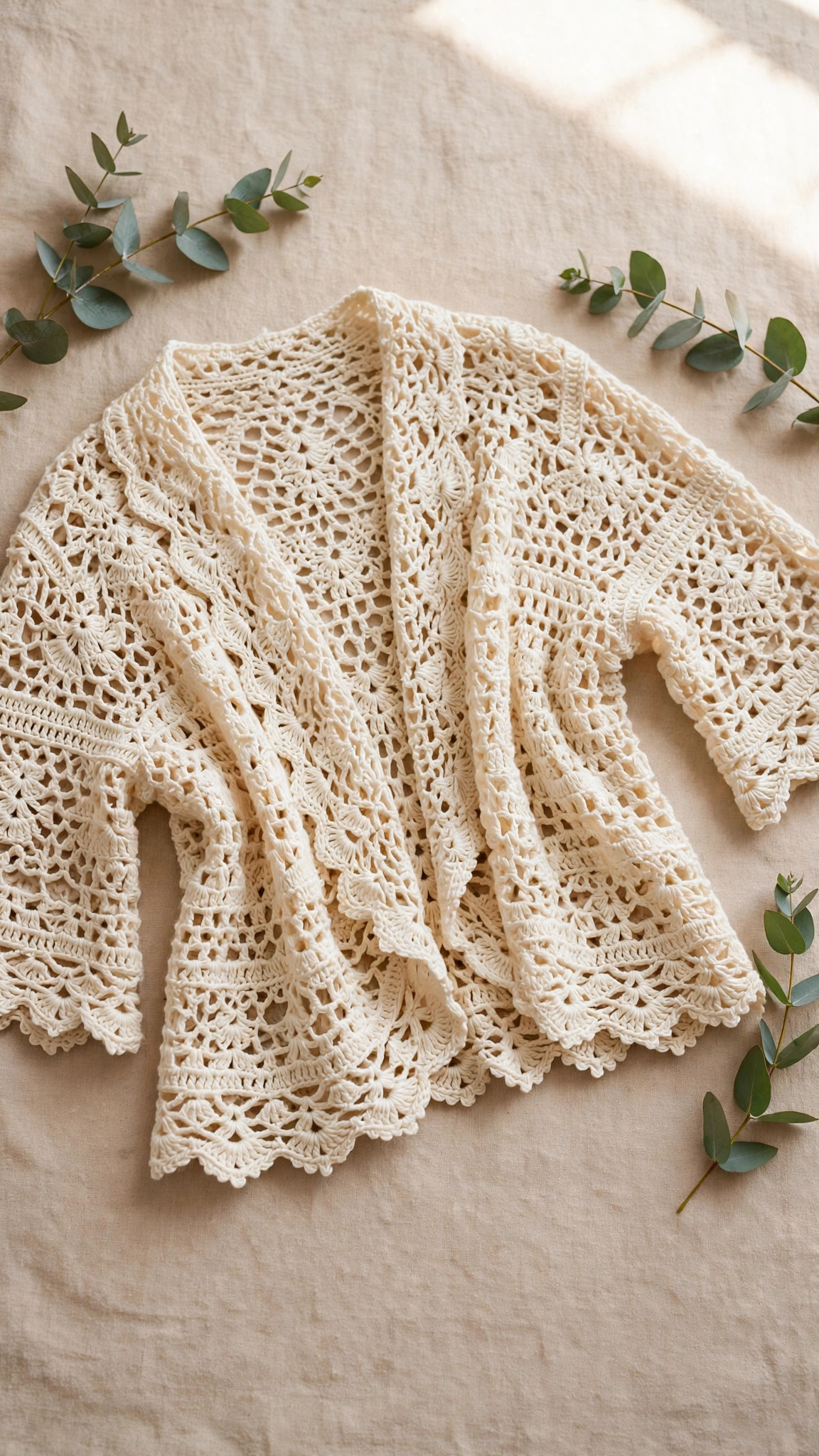
A bolero jacket is the hardest working little garment in a handmade wardrobe: it dresses up a plain top, warms a summer dress on a cool evening, and finishes any outfit. This free bolero jacket crochet pattern makes a lacy, open-front shrug from a single rectangle of shell stitch: no complicated shaping, no set-in sleeves, just fold, seam, and wear.
The construction is almost suspiciously simple. You crochet one rectangle in an airy shell pattern, fold it in half, and seam two short sections to form the sleeves. The scalloped edging gives it a boutique look, and the open front makes the fit forgiving: a little extra room just drapes more beautifully.
This is an original Little Loop Finds design, written in US terms, with three sizes from S to L. If you can double crochet and single crochet, you already know every stitch in this pattern.
Table of contents
- Why you'll love this bolero jacket crochet pattern
- Materials you'll need
- Size, gauge and skill level
- Abbreviations, US terms
- The bolero jacket crochet pattern (US terms)
- Finishing touches and assembly
- Tips and tricks
- Variations to try next
- Troubleshooting tips
- Frequently asked questions
- More free patterns to try
Why you'll love this bolero jacket crochet pattern
Most crochet garments ask you to shape armholes, set sleeves, and match gauge across five pieces. This bolero asks none of that. One rectangle, two short seams, and a pretty edging: that is the entire garment. It is the rare wearable that an advanced beginner can finish in a long weekend and actually wear on Monday.
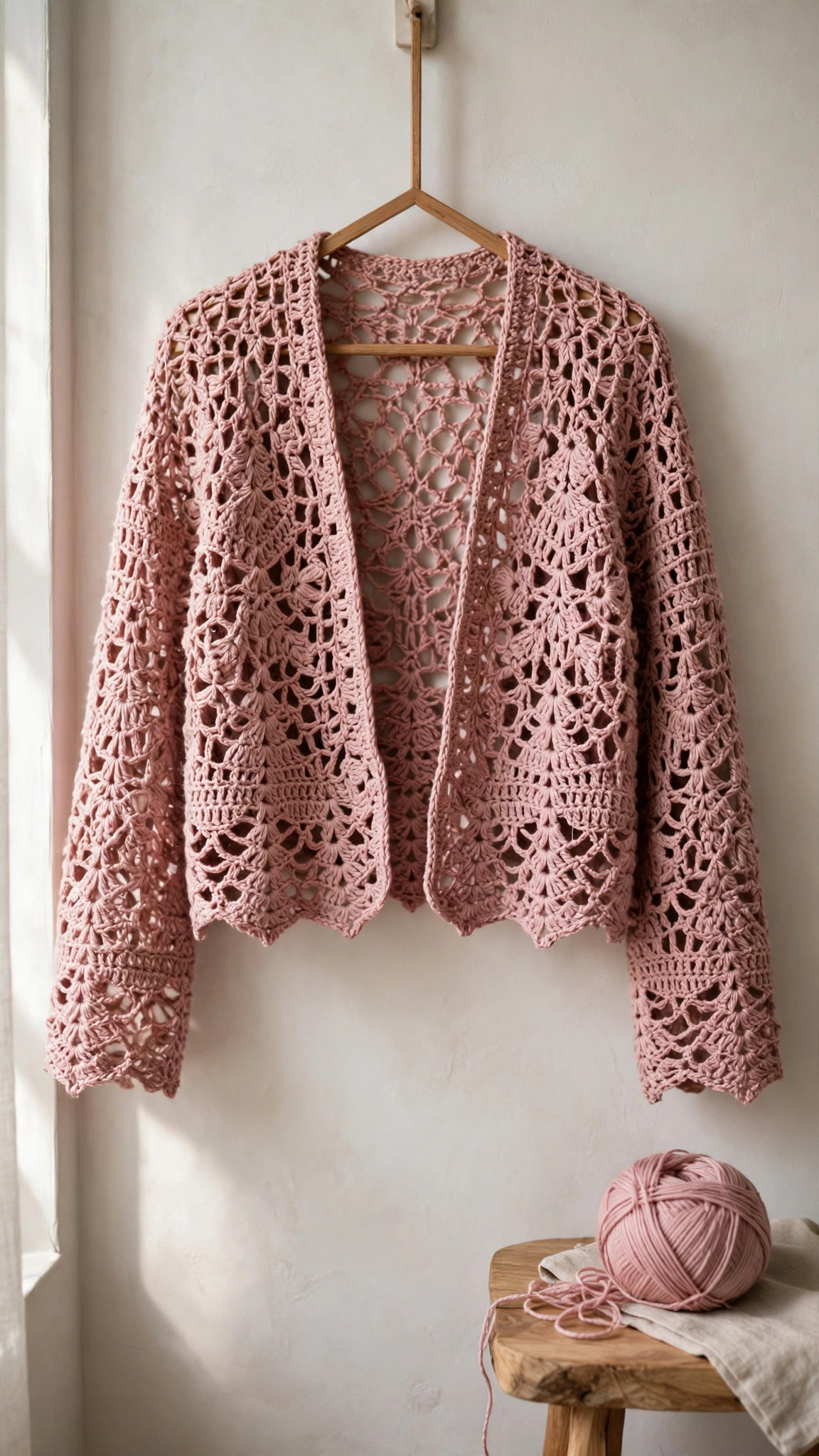
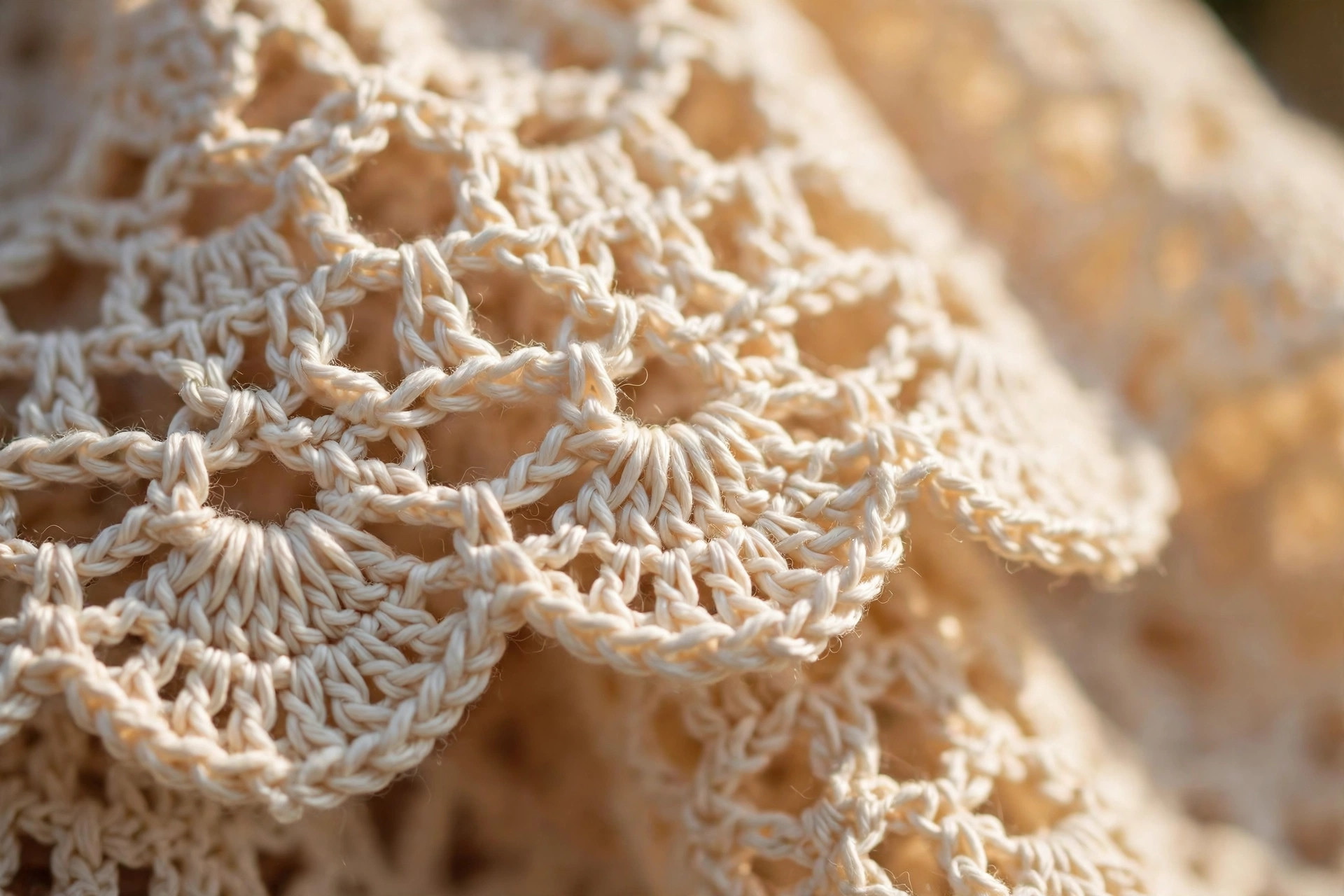
The shell stitch does most of the visual work. Those little fans of double crochet read as delicate lace, but they are just double crochets grouped together, worked into the same stitch over and over. The openwork keeps the fabric light and drapey, which is exactly what a bolero needs: it should float over your shoulders, not sit there like armor. A cotton or cotton-blend DK yarn gives the shells beautiful definition and enough body to hold the shrug's shape.
Fit is wonderfully forgiving. The front is completely open and the sleeves are formed by the fold, so size down for a neat cropped look or up for extra drape. The pattern includes guidance for lengthening the sleeves or deepening the body.
It is also a brilliant stash buster. The rectangle is one continuous piece, so join a new ball at the end of any row and the join disappears into the shells. Once you have the rectangle method down, try our simple crochet sweater pattern for the same logic scaled up to a full sweater, or the free crochet shrug pattern, its cosier long-sleeved cousin.
Materials you'll need
| Supply | What to get |
|---|---|
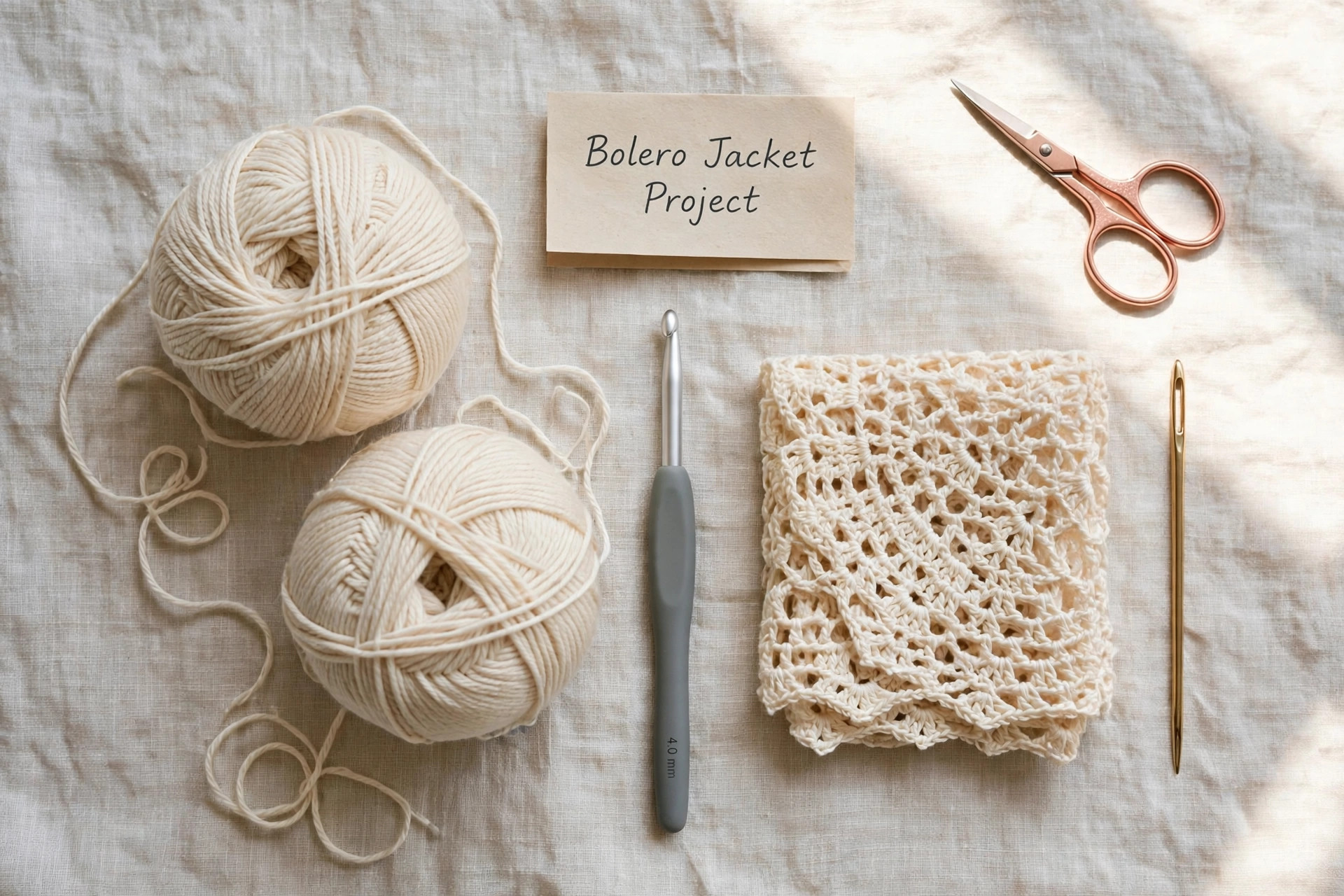
| Yarn | DK-weight (#3) yarn, cotton or cotton blend: about 750 yds / 686 m (S), 900 yds / 823 m (M), 1,050 yds / 960 m (L) |
| Crochet hook | 4.5 mm |
| Tapestry needle | For seaming the sleeves and weaving in ends |
| Notions | Scissors, stitch markers, measuring tape |
Choose a smooth DK with good stitch definition: cotton, cotton-acrylic blend, or a soft acrylic. Fuzzy or novelty yarns will swallow the shell texture, which is the whole point of the design. Solid and gently variegated colourways both work beautifully; busy multi-colours can fight with the lace, so save those for a plainer stitch pattern.
A note on yardage: shell stitch is a yarn-hungry stitch. The estimates above include a comfortable margin, but if you plan to lengthen the body or sleeves, buy one extra ball. Running out mid-edging is the only real tragedy this pattern can produce.
Size, gauge and skill level
The bolero is worked as one rectangle, then folded with the long edges together and seamed at the sides to form the sleeves. Sizes are given as S (M, L) throughout. The finished rectangle measures 38 (42, 46) in / 96.5 (106.5, 117) cm long and 18 (19, 20) in / 46 (48, 51) cm tall before folding.
| Size | To fit bust | Rectangle | Approx. time |
|---|---|---|---|
| S | 32-36 in / 81-91 cm | 38 x 18 in | About 8 hours |
| M | 36-40 in / 91-102 cm | 42 x 19 in | About 10 hours |
| L | 40-44 in / 102-112 cm | 46 x 20 in | About 12 hours |
- Finished size: after folding and seaming, the shrug spans the back with 9 (10, 11) in sleeves and an open front about 20 (22, 24) in wide. The doubled depth (shoulder to hem) is 9 (9.5, 10) in.
- Gauge: 12 stitches and 8 rows = 4 in (10 cm) in the shell pattern with a 4.5 mm hook, after light blocking. Count your shells, not just your stitches: you should have 19 (21, 23) shells across Row 2. If you have more shells per 4 inches, go up a hook size; fewer, go down.
- Skill level: easy. You should be comfortable with chains, single crochet, double crochet, and slip stitch. The only new skill is whipstitching a seam, and the pattern walks you through it.
Choosing your size: pick the size matching your bust for a neat cropped bolero, or go up a size for a drapier shrug. Between sizes and prefer a closer fit? Size down: the shells have natural stretch.
Abbreviations, US terms
| Abbreviation | Meaning |
|---|---|
| ch | chain |
| sc | single crochet |
| dc | double crochet |
| sl st | slip stitch |
| sk | skip |
| st(s) | stitch(es) |
| RS | right side |
| WS | wrong side |
| FO | fasten off |
| [ ] | total stitch count at the end of the row |
Reading the sizes: instructions give the S size first, with M and L in parentheses, like this: ch 116 (128, 140). Where only one number appears, it applies to all three sizes.
The bolero jacket crochet pattern (US terms)
Work the rectangle first, then fold and seam it in the finishing section. The shell pattern is a two-row repeat: Row 2 places the shells, Row 3 staggers them. Mark the right side of Row 2 with a stitch marker so you always know which row comes next.
The rectangle
Ch 116 (128, 140).
- Row 1 (WS): sc in 2nd ch from hook and in each ch across. [115 (127, 139) sc]
- Row 2 (RS): ch 1, sc in first st, *sk 2 sts, 5 dc in next st, sk 2 sts, sc in next st; rep from * across. [19 (21, 23) shells]
- Row 3: ch 3 (counts as dc), 2 dc in first st, *sc in 3rd dc of next shell (the centre dc), 5 dc in next sc; rep from * 17 (19, 21) more times, sc in 3rd dc of last shell, 3 dc in last st.
- Row 4: ch 1, sc in first st, *sk 2 sts, 5 dc in next st, sk 2 sts, sc in next st; rep from * 18 (20, 22) more times, sc in last st. [19 (21, 23) shells]
Repeat Rows 3 and 4 until the rectangle measures 18 (19, 20) in / 46 (48, 51) cm from the foundation chain, ending with a Row 3. Do not fasten off yet: you will use the working loop for the first part of the edging later, so place a stitch marker in it and set the rectangle aside.
Counting check: after any shell row, count 19 (21, 23) shells across. If your edges wander, you are skipping the wrong number of stitches: each shell or gap always spans exactly 2 skipped stitches.
Keep the foundation edge loose. Chain with a hook one size larger, or work the chain very loosely. A tight foundation pulls the bottom edge in and the rectangle flares into a trapezoid. If Row 1 already looks narrower than your chain, restart with a looser chain: ten minutes now saves a wonky bolero later.
Count shells every four rows. Lace drifts easily and the mistake compounds. A quick shell count at the end of each Row 4 takes twenty seconds and catches every error while it is still a one-row fix.
Finishing touches and assembly
Fold the rectangle. Lay the rectangle flat with the right side facing up. Bring the top long edge down to meet the bottom long edge, so the piece is folded in half lengthwise. The fold is the top of the shrug (it will sit across your shoulders); the two loose long edges at the bottom are what you seam.
Seam the sleeves. Thread the tapestry needle with a long piece of matching yarn. Starting at one short end, whipstitch the two bottom edges together for 9 (10, 11) in, working through both layers. Repeat from the other short end. You now have two sleeve tubes with open cuffs at the short ends, and an open section in the middle (about 20 (22, 24) in) which is the front opening of the bolero. Try it on: your arms go through the tubes, the fold sits across your upper back, and the front hangs open.
A note on the whipstitch: bring the needle up through both layers, then over the edge and up again about a quarter inch along. Keep stitches even and relaxed so the seam lies flat instead of puckering.
Work the front edging. Pick up the working loop you marked earlier, or join yarn with a slip stitch at one end of the front opening (right where a sleeve seam ends). Round 1: ch 1, work sc evenly through BOTH layers along the entire open front edge, placing about 3 sc per inch and adjusting your count to a multiple of 6. Round 2 (scallops): ch 1, *sk 2 sc, 5 dc in next sc, sk 2 sc, sl st in next sc; rep from * around the opening, join with a sl st to the first sc. FO.
Work the cuff edgings. Join yarn with a slip stitch at the underarm (where the sleeve seam meets the cuff). Round 1: ch 1, sc evenly around the cuff opening: work 1 sc in each stitch across the folded top edge and 2 sc in each row end along the open bottom edge, adjusting to a multiple of 6. Round 2: scallops exactly as for the front edge. Repeat for the second cuff.
Weave every end. Thread each tail onto the tapestry needle and run it through nearby stitches for at least 2 inches, changing direction once. Work the edging joins on the wrong side so they never show.
Block lightly (recommended). Soak 15 minutes in lukewarm water, squeeze out the water in a towel (never wring), and lay flat to dry, patting the shells open and the scallops into points. Blocking transforms shell stitch: the lace looks twice as delicate.
Tips and tricks
Swatch the shells, not just the stitches. Work a swatch at least 3 shells wide and 8 rows tall, block it as you will block the garment, then measure. Shell lace grows more in blocking than plain stitches do.
Join new balls at row ends only. A join in the middle of a shell row leaves a tail in the most visible part of the lace. Plan ball changes for the end of a row, and weave the tails vertically along the edge where the edging will cover them.
Try it on before the edging. Once the sleeves are seamed, try the shrug on and check the sleeve length and front opening. It is easy to adjust a seam now; after the scalloped edging goes on, changes mean unpicking lace.
Keep the fold soft. The folded top edge sits across your shoulders, so avoid working into it tightly during the cuff edging. If the fold feels stiff, steam it lightly (iron held above the fabric, never touching) and let it relax.
Variations to try next
One rectangle, endless boleros:
- Evening bolero. Work the pattern in a DK with a touch of metallic thread and shorten the rectangle by 2 inches for a cropped, dressy shrug that sits perfectly over a cocktail dress.
- Long-sleeved version. Seam 12 (13, 14) in for the sleeves instead of 9 (10, 11) in, and work two extra scallop rounds on the cuffs. The result wears like a proper lacy jacket. Our crochet cardigan sweater pattern takes this idea all the way to a full buttoned cardigan if you fall in love with the silhouette.
- Oversized drape shrug. Go up one full size and work the rectangle 2 inches taller. Worn open, it drapes like a waterfall front: less bolero, more statement layer.
- Two-tone shells. Change colour every two rows so the shell rows alternate. The staggered shells in two colours look like overlapping petals. Our crochet poncho free pattern uses a similar two-row colour rhythm if you want to practice the technique on a quicker project.
- Bridal bolero. Work the S size in white or ivory DK and weave a narrow satin ribbon through the front edging as a tie: a classic cover-up for sleeveless wedding dresses.
Troubleshooting tips
- The rectangle is wider at one end than the other. Your foundation chain was tighter than your working tension, or your stitch count drifted. Count your shells: if the count is right, blocking will even out up to an inch of difference. If the count is wrong, find the row where it changed and fix it there.
- The shells look cramped and the lace will not open up. Your hook is too small for the yarn, or the shells are worked too tightly. Go up half a hook size, or consciously relax your grip on the shell stitches. Judge the lace after blocking, not before.
- The sleeve seam puckers. The whipstitches are too tight or too far apart. Aim for small, even stitches about a quarter inch apart, easing the fabric as you go rather than pulling each stitch snug.
- The front opening gapes or pulls. If it gapes, size down next time, or add a small ribbon tie at the front. If it pulls across the back, the rectangle is too narrow: go up a size, since the open front cannot be eased like a seamed garment.
- The scalloped edging ripples. Your edging stitch count is too high: more than a multiple of 6, or more than 3 sc per inch. Remove the edging round and rework with fewer stitches. A rippling edge will not block flat.
- The cuffs flare out. Too many stitches in the cuff round. Rework Round 1 with about 2 sc per inch of cuff edge, and check it against your wrist before adding the scallops.
Frequently asked questions
Is this free bolero jacket crochet pattern really free?
Yes, the complete pattern above is free, with no email signup and no PDF purchase required.
What skill level is this bolero pattern?
Easy. If you can chain, single crochet, double crochet, and sew a simple whipstitch seam, you have every skill this pattern needs. There is no shaping and no picking up stitches.
How long does it take to crochet the bolero jacket?
About 10 hours for the medium size: roughly 8 hours for the rectangle, 30 minutes for seaming, and the rest for the edgings and finishing. The small size takes about 8 hours, the large about 12.
How much yarn do I need?
About 750 yds for S, 900 yds for M, and 1,050 yds for L of DK-weight yarn. That is roughly 4, 5, and 6 balls of a typical 200-yard DK skein. Buy one extra ball if you plan to lengthen the body or sleeves.
Can I make the sleeves longer?
Yes. Seam further in from each short end: 12 inches of seaming gives a bracelet-length sleeve on most wearers. Just keep both sides equal, and remember that longer sleeves eat into the front opening width.
Will this fit if I am between sizes?
Very likely yes. The open front is forgiving: size down for a neat cropped fit or up for more drape. The shells also have natural horizontal stretch, about 10 percent, which covers most in-between measurements.
Can I sell the finished boleros I make?
Yes! You may sell finished boleros made from this pattern in small batches (craft fairs, markets, gifts). Please credit Little Loop Finds as the pattern designer.
More free patterns to try
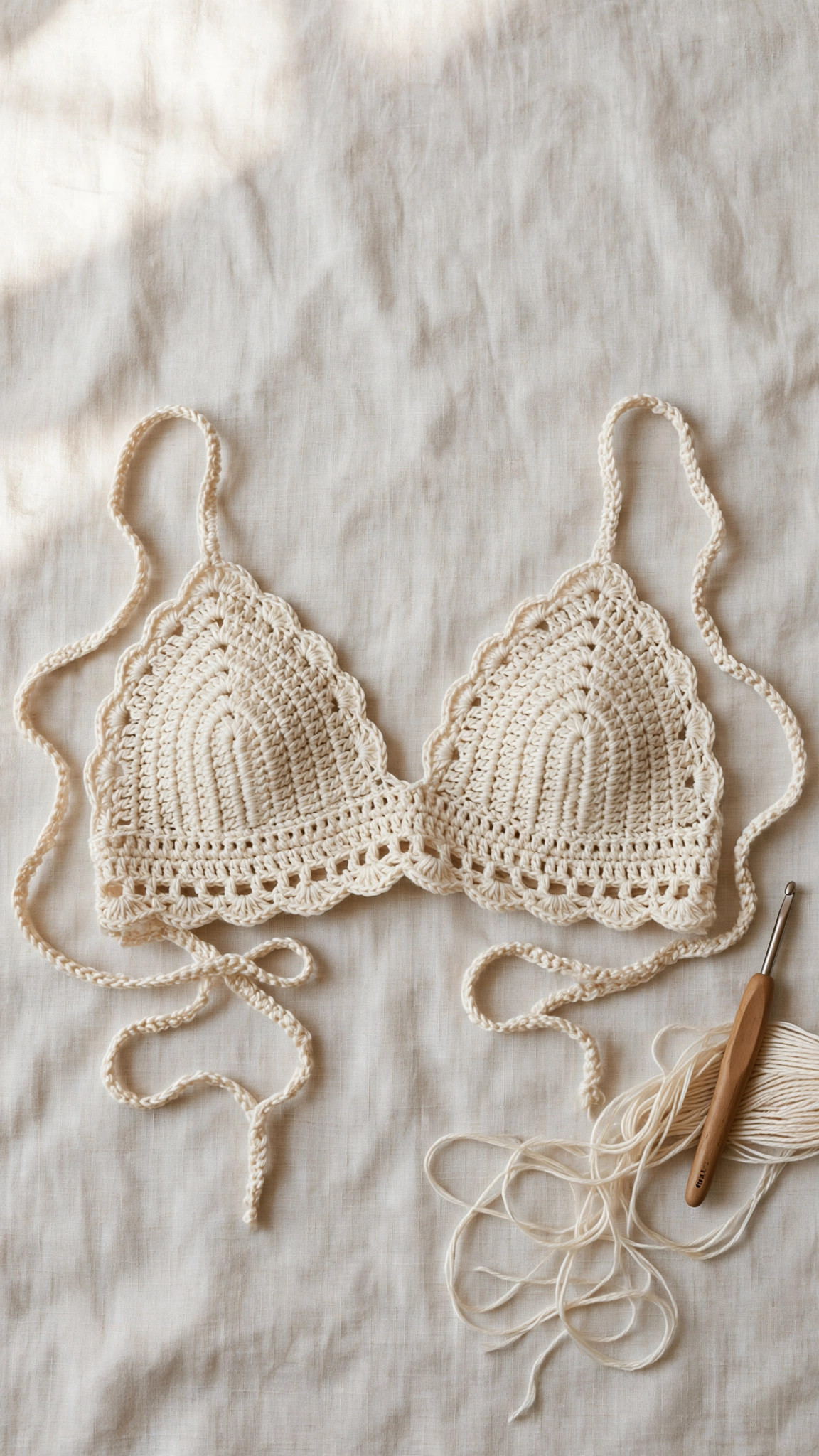
If this one-rectangle magic was fun, the wearable parade continues. The hexagon sweater crochet pattern uses the same fold-and-seam logic in a bolder geometric stitch, and our batch-mate the crochet bralette pattern is another quick, confidence-boosting garment in the same DK weight. For layering season, keep both on your hook.