Zig Zag Crochet Pattern (Free Scarf)
Crochet a striped zigzag stitch scarf with peaked rows and a simple fringe, then loop it around your neck or give it as a gift.

Patterns · Crochet
- Finished size
- 60 x 8 in
- Making time
- 6 hours per scarf
- Hook
- US H-8 (5.0 mm)
- Set
- Scarf, fringe
- Skill
- Easy
In this post
- Key Takeaways
- Table of Contents
- Why You Will Love This Zig Zag Crochet
- Finished Size, Skill Level, and Time
- Materials You Need
- Abbreviations (US Terms)
- Gauge and Sizing Notes
- Part 1: The Zigzag Stitch, Step by Step
- Part 2: The Scarf Body
- Part 3: Fringe and Finishing
- Variations: Colors, Widths, and Uses
- Troubleshooting Peaks and Valleys
- Care Instructions
- Frequently Asked Questions
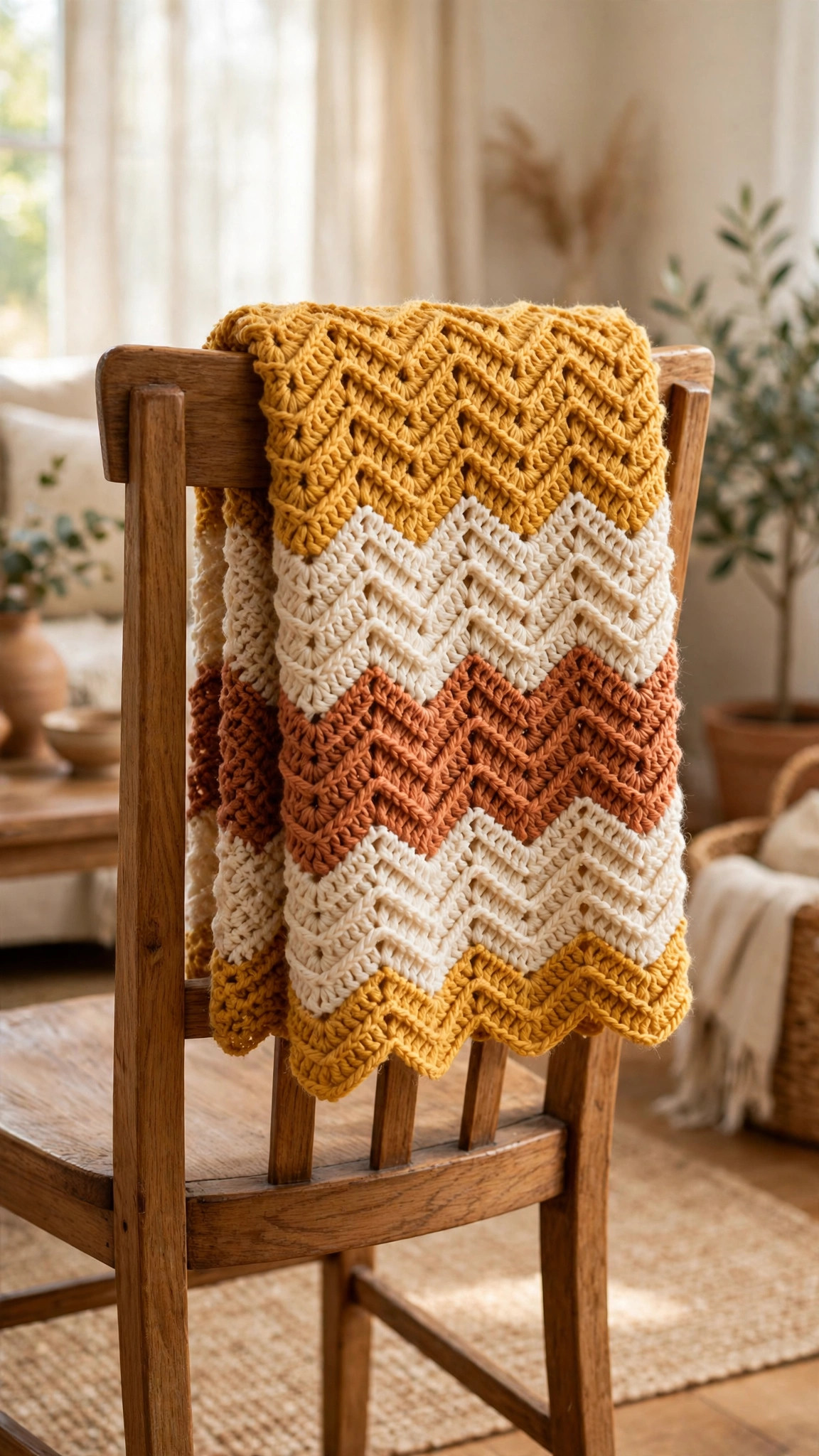
A zig zag crochet pattern is one of the happiest stitches you can learn. Sharp peaks and valleys ripple across the fabric in bands of color, and the rhythm of the increases and decreases is easy to memorize after the first few rows. This free zig zag crochet pattern teaches you the stitch from scratch and turns it into a warm, cheerful scarf you can finish in a weekend.
A quick note on scope: this post is about the zigzag stitch worked into a scarf, a long narrow strip of peaked rows with a simple fringe. It is not a zigzag blanket. If you want a wide zigzag throw, our chevron crochet pattern is the blanket version, worked in the same family of stitches at a much larger scale.
Key Takeaways
- Free original pattern: this zig zag crochet pattern is a Little Loop Finds original design, written in US terms, and completely free.
- A stitch tutorial and a scarf: learn the zigzag stitch step by step, then work it into a finished scarf.
- Beginner friendly: double crochet rows only, with the peaks and valleys explained stitch by stitch.
- A quick weekend project: one scarf takes about 6 hours, spread over two or three relaxed evenings.
- Three ways to wear it: loop it once around your neck, drape it long over a coat, or fold it in half for extra warmth.
Table of Contents
- Why You Will Love This Zig Zag Crochet
- Finished Size, Skill Level, and Time
- Materials You Need
- Abbreviations (US Terms)
- Gauge and Sizing Notes
- Part 1: The Zigzag Stitch, Step by Step
- Part 2: The Scarf Body
- Part 3: Fringe and Finishing
- Variations: Colors, Widths, and Uses
- Troubleshooting Peaks and Valleys
- Care Instructions
- Frequently Asked Questions
Why You Will Love This Zig Zag Crochet
There is something joyful about a zigzag. The peaks point up, the valleys dip down, and the whole scarf looks like a row of little mountains in yarn. A zig zag crochet scarf is cheerful without being loud, especially in warm colors like mustard yellow, cream, and terracotta.
Finished Size, Skill Level, and Time
- Finished size: about 60 inches long and 8 inches wide, not counting the fringe. Each zigzag repeat is about 4 inches wide, and the scarf has 2 repeats across.
- Skill level: Easy. You need chains, double crochet, and the increases and decreases explained in Part 1.
- Time: about 6 hours per scarf: 1 hour to learn the stitch and swatch, 4 hours for the body, and 1 hour for the fringe and finishing.
Materials You Need
| Item | What to get |
|---|---|
| Yarn, color A | Worsted weight (size 4) yarn in mustard yellow, 200 yards |
| Yarn, color B | Worsted weight (size 4) yarn in cream, 150 yards |
| Yarn, color C | Worsted weight (size 4) yarn in terracotta, 150 yards |
| Hook | US H-8 (5.0 mm), or the size that gives you the gauge below |
| Notions | Tapestry needle, scissors, stitch markers, a row counter (optional) |
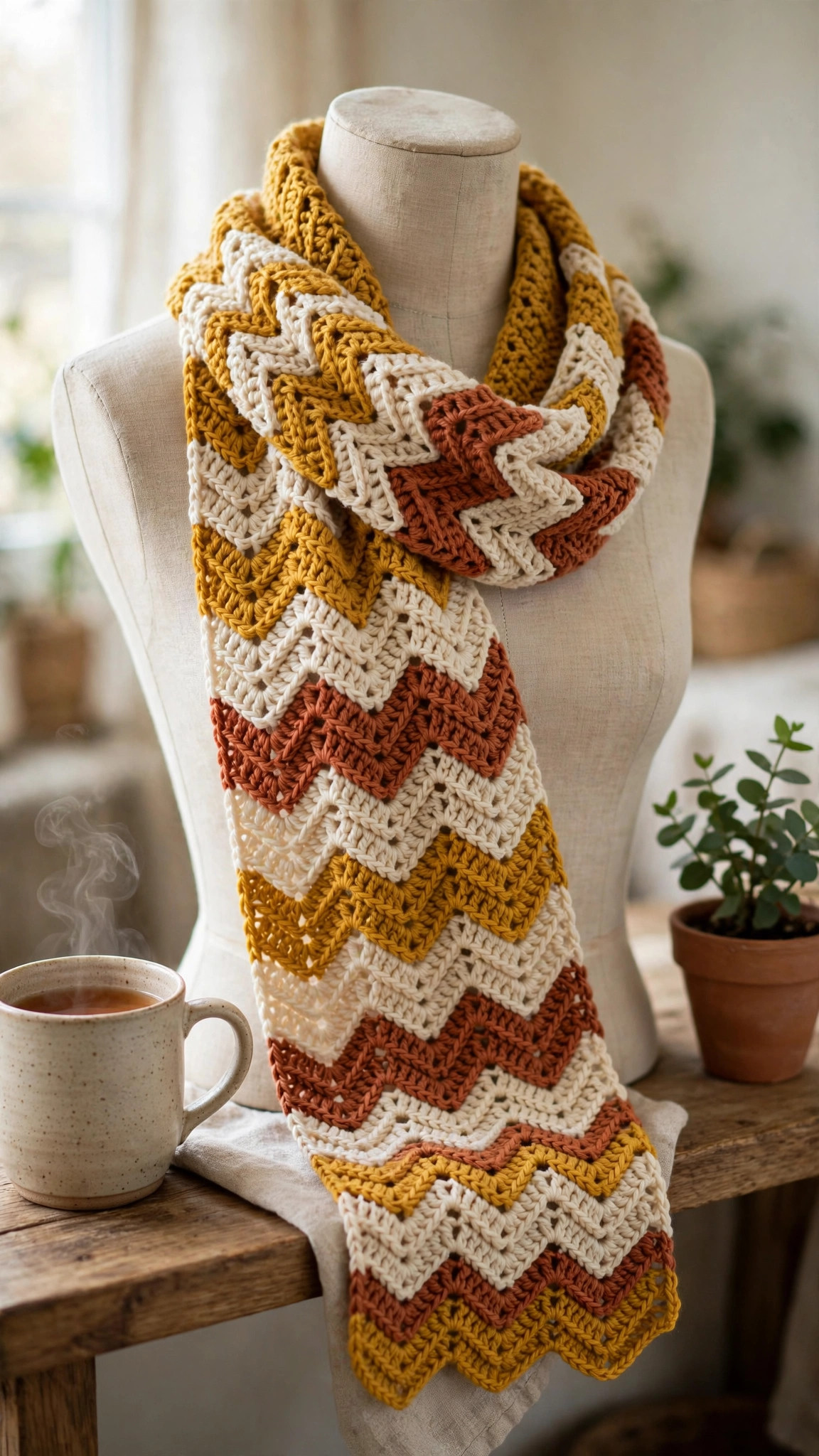
Worsted weight yarn is the best choice for a zigzag scarf because it works up quickly, the peaks hold their shape, and the finished scarf is warm but not bulky. A smooth acrylic or wool blend works well, because it shows clean stitch definition and drapes nicely around the neck. Choose three colors with good contrast so the zigzag stripes read clearly. Mustard yellow, cream, and terracotta are the colors in the photos.
Abbreviations (US Terms)
- ch = chain
- sl st = slip stitch
- sc = single crochet
- dc = double crochet
- dc2tog = double crochet two together (a decrease)
- st(s) = stitch(es)
- rep = repeat
- RS = right side
- WS = wrong side
Gauge and Sizing Notes
Gauge for a zigzag scarf matters less than it does for a garment, but it still decides how wide your scarf turns out. Work a swatch of 25 dc stitches and 8 rows in color A, and measure it. It should be about 7 inches wide and 4 inches tall. If your swatch is wider than 7 inches, go down a hook size. If it is narrower, go up a hook size.
One zigzag repeat in this pattern is 24 stitches wide, which makes a repeat about 4 inches wide at the gauge above. The scarf is worked over 2 repeats, so it is about 8 inches wide.
To make a narrower scarf, work 1 repeat instead of 2, for a scarf about 4 inches wide. To make a wider scarf, work 3 repeats, for a scarf about 12 inches wide. To make a longer scarf, keep working the stripe sequence until it measures the length you want, then add the fringe.
Part 1: The Zigzag Stitch, Step by Step
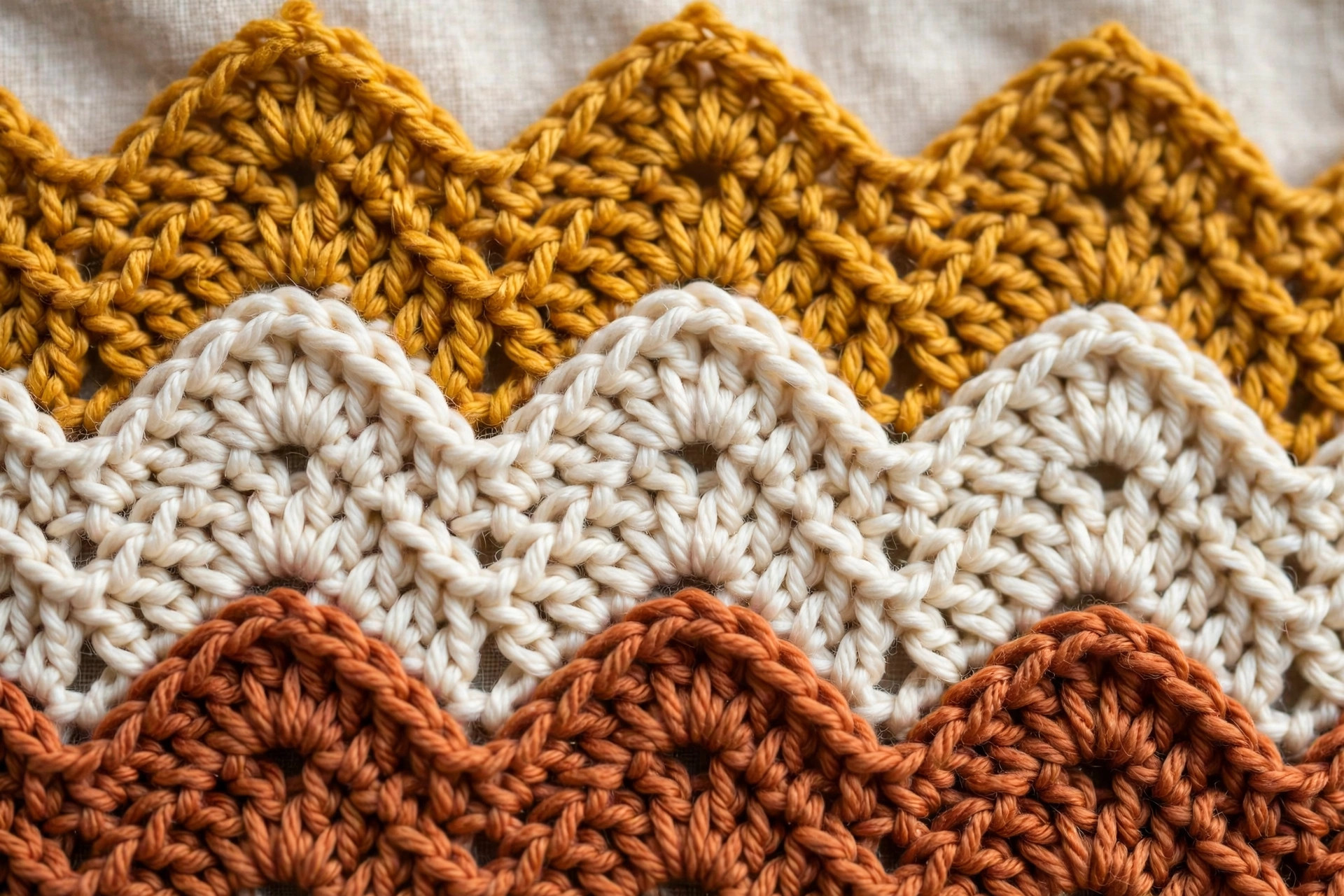
The zigzag stitch is built from one repeat of 24 stitches, worked in double crochet. Each repeat has a peak in the middle, where increases push the fabric up, and a valley at each end, where decreases pull the fabric down. The peaks and valleys line up from row to row, so the zigzag grows taller as you work.
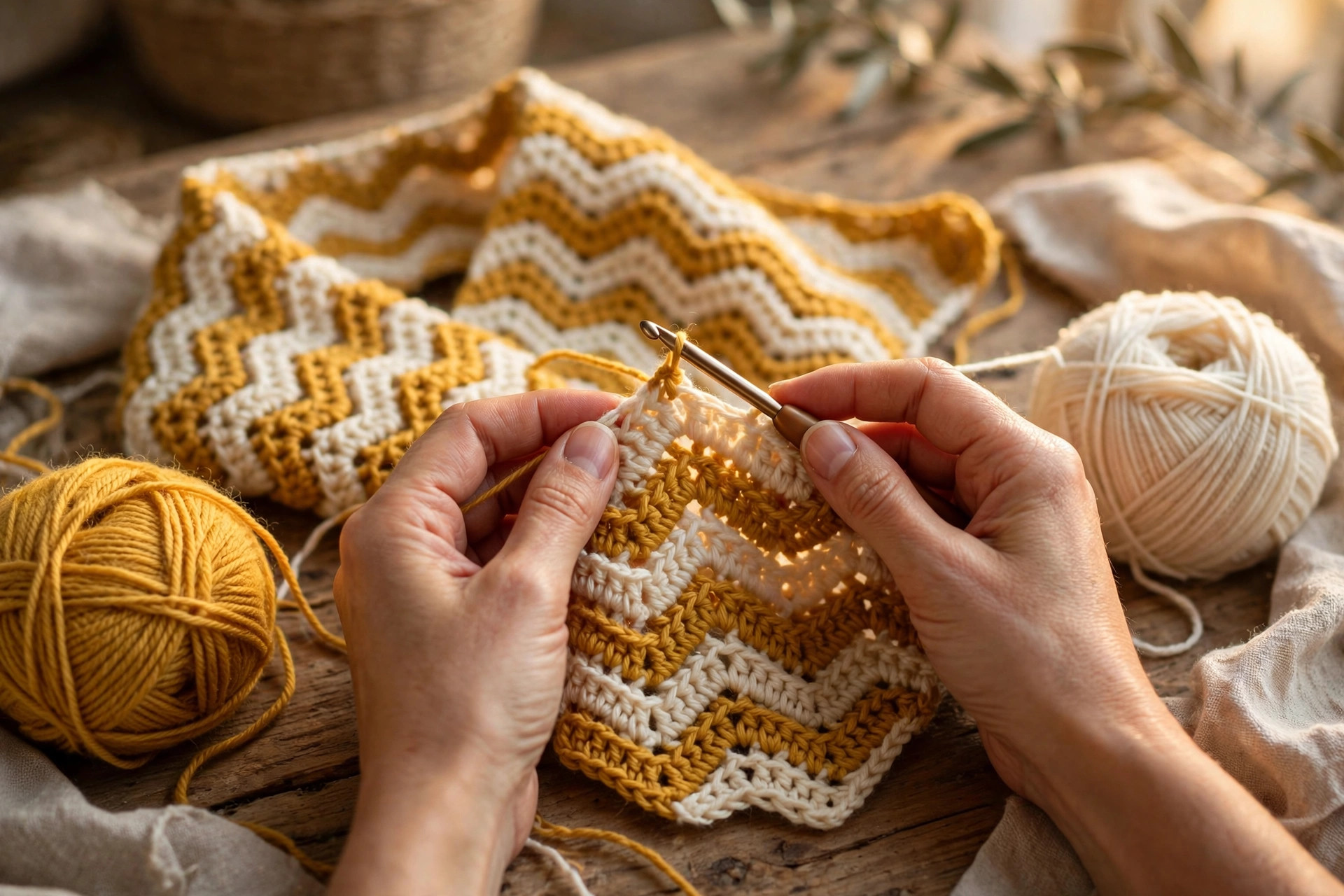
Before you start the scarf, practice one repeat on a small swatch. Chain 25, work the repeat below for 6 rows, and watch the peaks form.
The Repeat
Worked over a multiple of 24 stitches, plus 3 for the turning chain. One repeat reads like this:
- Work 11 dc, then work 3 dc in the next stitch (this is the peak), then work 11 dc, then work dc2tog over the next 2 stitches, then work dc2tog over the following 2 stitches (this pair of decreases is the valley, shared with the next repeat).
Read that slowly, because the whole stitch lives in those two moves. The 3 dc in one stitch fans the fabric out and up into a peak. The two dc2tog decreases in a row pinch the fabric in and down into a valley.
Foundation
With color A, ch 51.
- Row 1 (RS): dc in the 4th ch from the hook and in each ch across. (48 dc, counting the turning chain as the first stitch)
This first row is a plain row of double crochet, and it forms the straight bottom edge of the scarf. The zigzag starts in row 2, so keep your stitch markers handy.
Row 2: The First Zigzag Row
- Row 2 (WS): ch 3, turn, dc in each of the next 10 sts, 3 dc in the next st, dc in each of the next 11 sts, dc2tog over the next 2 sts, dc2tog over the next 2 sts, dc in each of the next 11 sts, 3 dc in the next st, dc in each of the next 10 sts, dc in the top of the turning ch. (50 dc, counting the increases and decreases)
Count your stitches at the end of row 2. You should have 50 stitches: the two peaks each added 2 stitches, and the valley in the middle took away 2 stitches. The stitch count will stay at 50 for the rest of the scarf.
Rows 3 and Beyond
- Row 3 (RS): ch 3, turn, dc in each of the next 10 sts, 3 dc in the next st (the center stitch of the peak below), dc in each of the next 11 sts, dc2tog over the next 2 sts, dc2tog over the next 2 sts (the valley), dc in each of the next 11 sts, 3 dc in the next st (the second peak), dc in each of the next 10 sts, dc in the top of the turning ch. (50 dc)
Repeat row 3 for every zigzag row. The only thing you need to find in each row is the center stitch of each peak and the center of each valley. Place a stitch marker in the middle stitch of each 3 dc peak when you work it, and the next row becomes easy to read, because the marker tells you exactly where the next peak goes.
Part 2: The Scarf Body
The scarf body is 96 rows of zigzag, worked in a stripe sequence of three colors. The stripes are wide enough to show off the zigzag, and the color changes happen at the end of a row, so they never interrupt a peak or a valley.
The Stripe Sequence
Work the rows in this order, changing color at the end of the last row of each stripe:
| Rows | Color | Number of rows |
|---|---|---|
| 1-8 | A, mustard yellow | 8 |
| 9-16 | B, cream | 8 |
| 17-24 | C, terracotta | 8 |
| 25-32 | A, mustard yellow | 8 |
| 33-40 | B, cream | 8 |
| 41-48 | C, terracotta | 8 |
| 49-56 | A, mustard yellow | 8 |
| 57-64 | B, cream | 8 |
| 65-72 | C, terracotta | 8 |
| 73-80 | A, mustard yellow | 8 |
| 81-88 | B, cream | 8 |
| 89-96 | C, terracotta | 8 |
That is 12 stripes of 8 rows each, 96 rows in total. At the gauge above, 96 rows measure about 60 inches long. Measure your scarf after stripe 6, at row 48, and it should be about 30 inches long.
How to Change Colors
Work the last stitch of the old color until you have two loops left on the hook, then yarn over with the new color and pull it through both loops. Chain 3 with the new color, turn, and work the first stitch of the next row in the new color. The chain 3 counts as the first double crochet of the row, so your stitch count stays at 50.
At the edges of the scarf, the unused colors wait for their turn. Because each color returns after two stripes, cut the old color at each change, leaving a 6 inch tail to weave in later. Long floats of yarn along the edge can snag, and the fringe will cover the ends anyway. Our corner to corner crochet patterns collection uses the same cut and weave logic for its stripes.
Keep a small notebook or a row counter beside you, and tick off each stripe as you finish it. The stripe sequence repeats every 3 stripes, so it is easy to lose track of which color comes next after a break.
Keeping the Edges Straight
The edges of a zigzag scarf can wobble if the turning chain is worked inconsistently. Always work the last stitch of the row into the top of the turning chain from the row below, and always count the turning chain as the first stitch. Place a stitch marker in the top of the turning chain at the start of every row for the first few stripes, until the edge feels automatic.
If one edge looks tighter than the other, check your turning chains. A chain that is pulled too tight at the start of the row will pinch the edge in, and a chain that is too loose will flare it out. Aim for a turning chain that matches the height of a double crochet. Our basic crochet scarf patterns guide covers the same edge technique in detail.
Part 3: Fringe and Finishing
The fringe is the finishing touch that makes the scarf look handmade and complete. It is made from short strands of yarn in all three colors, knotted through the stitches at each end of the scarf. The whole fringe takes about 30 minutes.
Adding the Fringe
Cut 24 strands of yarn, 8 in each color, each strand 12 inches long. Fold one strand in half to make a loop, push the crochet hook through a stitch at the end of the scarf, catch the loop, and pull it partway through. Then pull the two loose ends through the loop and tug gently to tighten the knot.
Space the fringe evenly across each end of the scarf. Place one tassel in each peak, one in each valley, and the rest spaced evenly between them, about 6 tassels per end in a mix of the three colors. Alternate the colors across the end so the fringe echoes the stripes: mustard, cream, terracotta, mustard, cream, terracotta.
Trim the fringe so all the strands hang to the same length, about 4 inches. Lay the scarf flat, comb the fringe straight with your fingers, and trim the ends with sharp scissors.
Finishing
Weave in every yarn end with a tapestry needle, working the tail through the back of several stitches in the same color, then trimming it close. Take care around the peaks, because a tail woven through a peak stitch can flatten the point, so weave tails through the slopes instead.
Block the scarf by laying it flat on a clean towel, misting it lightly with water, and gently shaping the peaks into even points. Let it dry flat. Do not stretch the scarf hard, because the valleys can pull out of shape.
To wear your scarf, loop it once around your neck with the ends hanging in front, and let the fringe show. Our crochet scarf patterns for beginners collection has more ways to style a handmade scarf. To give your scarf as a gift, fold it in thirds, tie it with a ribbon, and tuck a small card inside.
Variations: Colors, Widths, and Uses
- Classic mustard and cream: work the scarf in mustard yellow and cream only, alternating 8 row stripes, for a softer two color zigzag. Our mosaic crochet pattern makes a matching throw in warm colors.
- Bold rainbow zigzag: work each 8 row stripe in a different bright color, for a cheerful rainbow scarf that uses up leftover yarn.
- Narrow neck warmer: work 1 repeat instead of 2, for a scarf about 4 inches wide, and work 48 rows instead of 96, then sew the short ends together for a cozy cowl.
- Wide wrap: work 3 repeats, for a scarf about 12 inches wide, and work the same 96 rows for a wrap you can drape over your shoulders.
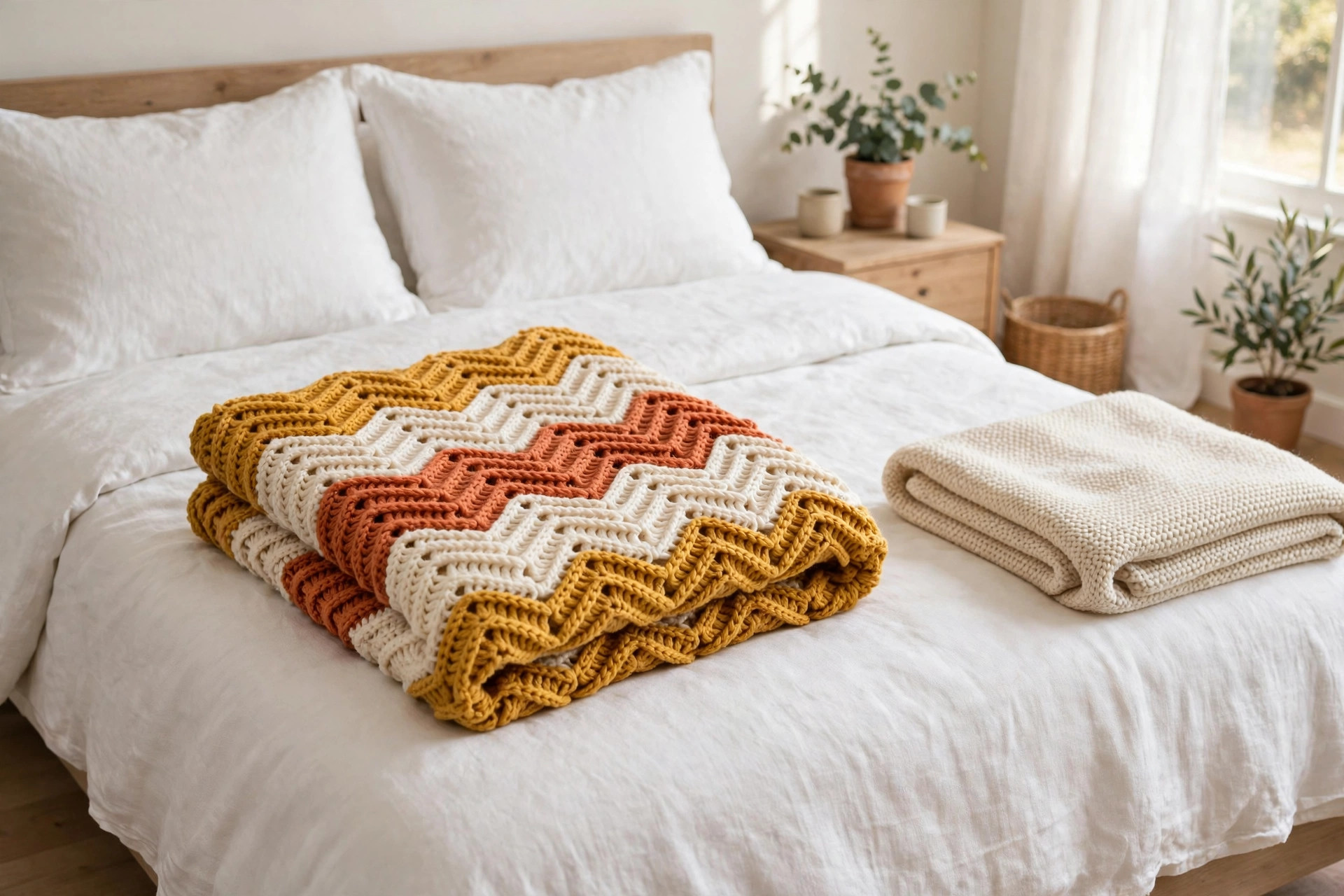
- Baby zigzag blanket: work 6 repeats, for a piece about 24 inches wide, and work 96 rows for a small baby blanket, then add a simple single crochet border instead of fringe.
Troubleshooting Peaks and Valleys
- My peaks lean to one side. The increase is landing in a different stitch each row. Place a stitch marker in the center stitch of each peak, and work the 3 dc into the marked stitch every row.
- My valleys look loose and holey. The decreases are being worked too loosely. Pull the yarn snug after each dc2tog, and make sure both decreases of the pair sit side by side with no plain stitch between them.
- My scarf gets wider as I work. An extra stitch is being added at the edge, probably by working into the turning chain twice. Count at the end of every row, and the count should stay at 50 after row 2.
- My scarf gets narrower as I work. A stitch is being missed at the edge, probably the last stitch into the top of the turning chain. Place a marker in the turning chain so you can find it.
- My stripes look uneven. The tension changed between stripes, or the row counts drifted. Count the rows in each stripe, and keep the count at 8.
Care Instructions
Machine wash a zigzag scarf on a gentle cycle in cool water with a mild detergent, and lay it flat to dry. If the yarn label says hand wash only, wash it gently in cool water with a tiny amount of mild soap, press the water out without wringing, and lay it flat on a clean towel to dry. Do not put a zigzag scarf in the dryer on high heat. Reshape the peaks while the scarf is damp, comb the fringe straight, and keep it out of direct sunlight.
Frequently Asked Questions
Is this zig zag crochet pattern good for beginners?
Yes, it is a great first stitch pattern project. You need chains and double crochet, plus the increases and decreases explained in Part 1, and every row ends with a stitch count. One scarf takes about 6 hours, and the repeat is easy to memorize.
What yarn is best for a zig zag crochet scarf?
Worsted weight yarn is the best choice, because it works up quickly and the peaks hold their shape. Mustard yellow, cream, and terracotta give the warm look in the photos, but any three colors with good contrast will show the zigzag clearly.
How big is the finished scarf?
About 60 inches long and 8 inches wide, not counting the 4 inch fringe at each end. Each zigzag repeat is about 4 inches wide, and the scarf has 2 repeats across.
How many rows are in the scarf?
The body is 96 rows: 1 foundation row of plain double crochet, then 95 zigzag rows in 12 stripes of 8 rows each. The stripe table in Part 2 shows which color to use for each stripe.
Can I make the zigzag scarf wider or longer?
Yes, both are easy. Add one repeat of 24 stitches for every 4 inches of extra width, and keep working the stripe sequence for extra length. Add the fringe last, after the scarf measures the length you want.
Can I sell scarves made from this pattern?
Yes, you may sell finished scarves made from this free pattern, with credit to Little Loop Finds. Please do not sell or republish the pattern text itself. A zigzag scarf in soft colors makes a sweet gift bundle with a matching hat.
Happy stitching, and may your little zigzag bring a bright, cheerful ripple to whoever wears it.