Virus Shawl Crochet Pattern (Free Lace Triangle Shawl)
Crochet a lacy virus stitch shawl with rippling fans and a scalloped border, then wear it as a light wrap for cool evenings.

Patterns · Crochet
- Finished size
- 64 in wingspan, 30 in deep
- Making time
- 12 to 15 hours
- Hook
- US 7 (4.5 mm)
- Set
- Center, fans, border
- Skill
- Intermediate
In this post
- Key Takeaways
- Table of Contents
- Why You Will Love This Virus Shawl
- Finished Size, Skill Level, and Time
- Materials You Need
- Abbreviations (US Terms)
- Gauge and Sizing Notes
- Part 1: The Center Triangle and First Fans
- Part 2: The Virus Stitch Repeat
- Part 3: The Scalloped Border and Finishing
- Variations: Colors, Sizes, and Yarn Choices
- Troubleshooting Virus Shawls That Curl or Ruffle
- Care Instructions
- Frequently Asked Questions
A virus shawl is one of the most satisfying lace projects you can crochet. The virus stitch looks complicated, with its rippling fans and open mesh, but it is really a simple four row repeat that grows into a beautiful triangle. This free virus shawl crochet pattern walks you through every row, from the center triangle to the scalloped border.
This is an original Little Loop Finds design, written in US terms and completely free. The shawl is worked top down in rows, starting at the center of the long top edge and growing outward to a wide wingspan, with a fan on each new repeat and a simple scalloped edge to finish. If you can double crochet, chain, and count to ten, you can crochet this shawl.
A quick note on scope: this post is about one specific project, a triangular lace shawl worked in the virus stitch, with repeating fan rows and a scalloped border. It is not a rectangular scarf or a round mandala. If you want a simpler flat project first, our basic crochet scarf patterns collection is a gentle place to start.
Key Takeaways
- Free original pattern: this virus shawl crochet pattern is a Little Loop Finds original lace design, written in US terms, and completely free.
- The classic virus stitch: a simple four row repeat of fans and open mesh that grows into a rippling triangle.
- Intermediate lace, patient pace: double crochet fans and chain spaces only, with each full repeat adding one more fan on each side.
- A generous wrap: about 64 inches across the wingspan and 30 inches deep, using about 900 yards of DK weight yarn.
- Easy to customize: change the yarn, add or remove repeats for any size, and finish with the scalloped border or a plain edge.
Table of Contents
- Why You Will Love This Virus Shawl
- Finished Size, Skill Level, and Time
- Materials You Need
- Abbreviations (US Terms)
- Gauge and Sizing Notes
- Part 1: The Center Triangle and First Fans
- Part 2: The Virus Stitch Repeat
- Part 3: The Scalloped Border and Finishing
- Variations: Colors, Sizes, and Yarn Choices
- Troubleshooting Virus Shawls That Curl or Ruffle
- Care Instructions
- Frequently Asked Questions
Why You Will Love This Virus Shawl
The virus stitch has a funny name and a devoted following, and once you work the first few repeats you will understand why. The fans ripple out from the center like waves, the open mesh keeps the fabric light and airy, and the shawl grows fast enough that you can see real progress after every evening of stitching.
A virus shawl is also a wonderful way to learn lace without a chart full of symbols. The whole stitch is built from double crochet and chain spaces, in the same four row repeat from the center to the edge. You learn the rhythm once, and then you can crochet while you watch a show or chat with a friend.
Finished Size, Skill Level, and Time
- Finished size: about 64 inches across the wingspan and 30 inches deep from the center top to the bottom point, after light blocking, in DK weight yarn. The pattern also gives notes for a small 48 inch shawlette and a large 76 inch wrap.
- Skill level: Intermediate. You need chains, double crochet, chain spaces, and the ability to count stitches and find the center of a fan. There is nothing harder than a double crochet, but the open lace needs steady counting.
- Time: about 12 to 15 hours total: roughly 1 hour for the center and first fans, 8 to 10 hours for the repeats, and 1 to 2 hours for the border, blocking, and weaving in ends.
Materials You Need
| Item | What to get |
|---|---|
| Yarn | DK weight (size 3) yarn, about 900 yards, in a gradient or solid color |
| Hook | US 7 (4.5 mm), or the size that gives you a soft drape with open lace |
| Notions | Tapestry needle, scissors, stitch markers, blocking pins and a blocking mat |
| Optional | A shawl pin or brooch to hold the wrap closed |
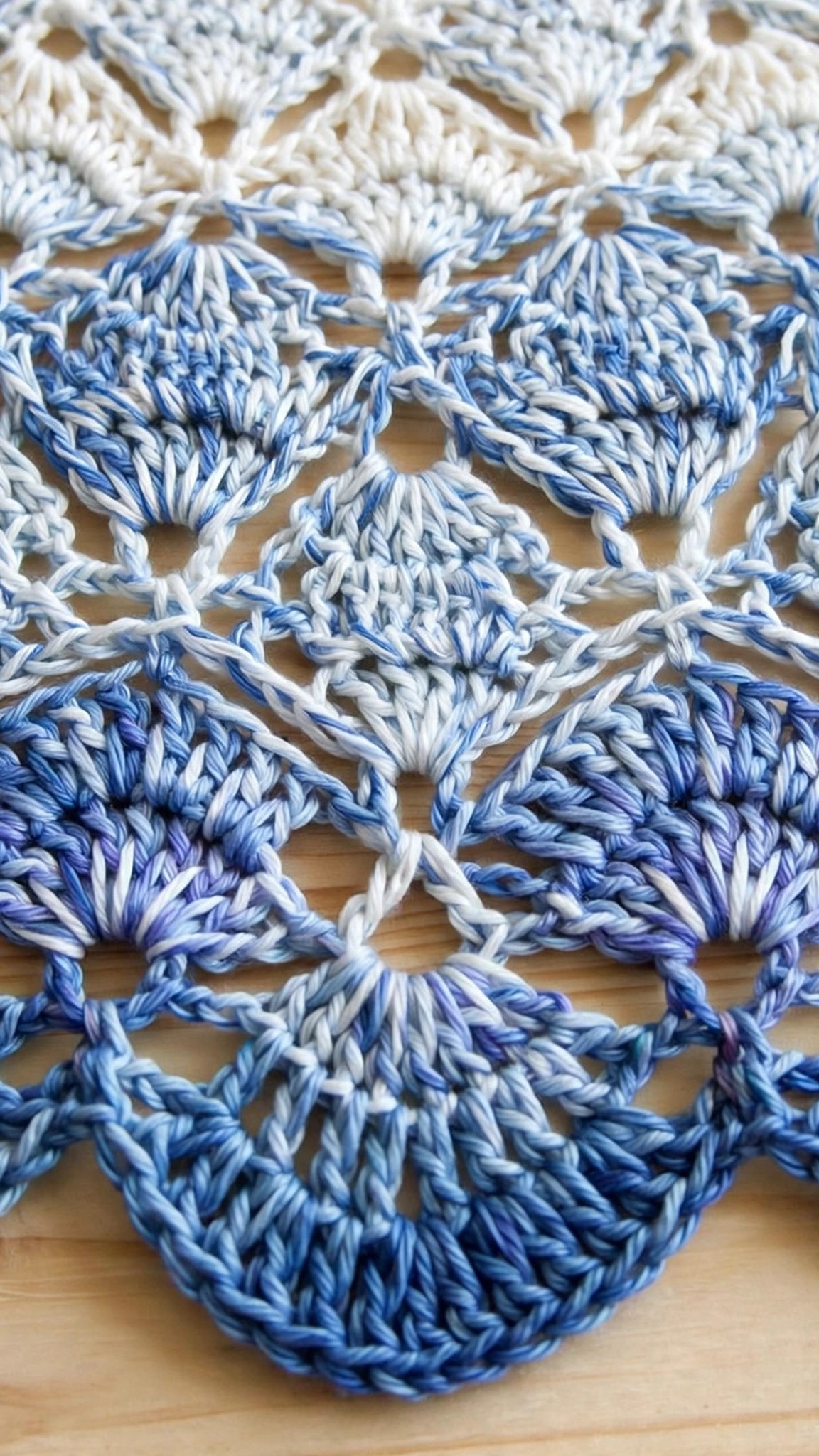
DK weight yarn is the best choice for a virus shawl because it is light enough for lace but thick enough that the fans show clearly, and it drapes well without feeling heavy on the shoulders. A smooth acrylic, cotton blend, or wool blend yarn works well, because it shows clean stitch definition and blocks nicely. A gradient yarn is a lovely pick, because the colors change as the shawl grows. Avoid fuzzy or eyelash yarns, because they hide the fan pattern and make it hard to find the chain spaces.
Abbreviations (US Terms)
- ch = chain
- sl st = slip stitch
- sc = single crochet
- dc = double crochet
- st(s) = stitch(es)
- sp(s) = space(s)
- sk = skip
- rep = repeat
- V-st = V stitch, (dc, ch 1, dc) worked in the same stitch or space
- RS = right side
- WS = wrong side
Gauge and Sizing Notes
Gauge for a lace shawl is about drape, not about hitting an exact number. Work the first four rows of the pattern and look at the fabric. The fans should lie flat, the mesh should look open and even, and the shawl should feel soft when you hold it up, not stiff like a board. If the fabric feels tight and the fans curl under, go up a hook size. If the fabric feels loose and floppy and the chain spaces gape open, go down a hook size.
One full four row repeat adds about 3 inches to the depth of the shawl and one more fan on each side. To make a smaller shawlette, work 5 repeats for a shawl about 48 inches across. To make a large wrap, work 12 repeats for a shawl about 76 inches across. You can stop at any repeat and move on to the border.
Part 1: The Center Triangle and First Fans
The shawl starts with a tiny center triangle and grows outward in rows. Every row begins with a turning chain and ends with a double crochet in the last stitch, and you turn the work at the end of every row. Mark the center V stitch on each row, because that center point is the bottom tip of the triangle.
The center and the first V row
Chain 4. Work 10 dc in the 4th chain from the hook. Turn. (11 stitches, counting the turning chain as a double crochet.)
- Row 1: Ch 4 (counts as a dc and a ch 1). Dc in the first st, ch 1, sk 2 sts, V-st in the next st, ch 1, sk 2 sts, V-st in the next st, ch 1, sk 2 sts, V-st in the next st, ch 1, dc in the last st. Turn. (3 V-sts)
Count your stitches before you go on. Row 1 should have 11 double crochets with chain 1 spaces between them, and the three V stitches sit evenly across the row, with the second V stitch as the center point. If your Vs are not evenly spaced, pull the row out and try again, because every later row builds on these positions.
The first fan row
Row 2 is where the virus stitch first appears. Each fan is a group of 10 double crochets worked into the chain 1 space at the center of a V stitch, and a new V stitch goes into the chain 1 space between each pair of fans.
- Row 2: Ch 3 (counts as a dc), dc in the first st, 10 dc in the ch-1 sp at the center of the next V-st, V-st in the next ch-1 sp, 10 dc in the ch-1 sp at the center of the next V-st, V-st in the next ch-1 sp, 10 dc in the ch-1 sp at the center of the next V-st, 2 dc in the last st. Turn. (3 fans, 38 dc)
Your work should now look like a small triangle with three rippling fans across the bottom edge. The fans may curl a little at this stage, and that is normal. The fabric relaxes as you add more rows, and blocking at the end smooths out any remaining curl.
Part 2: The Virus Stitch Repeat
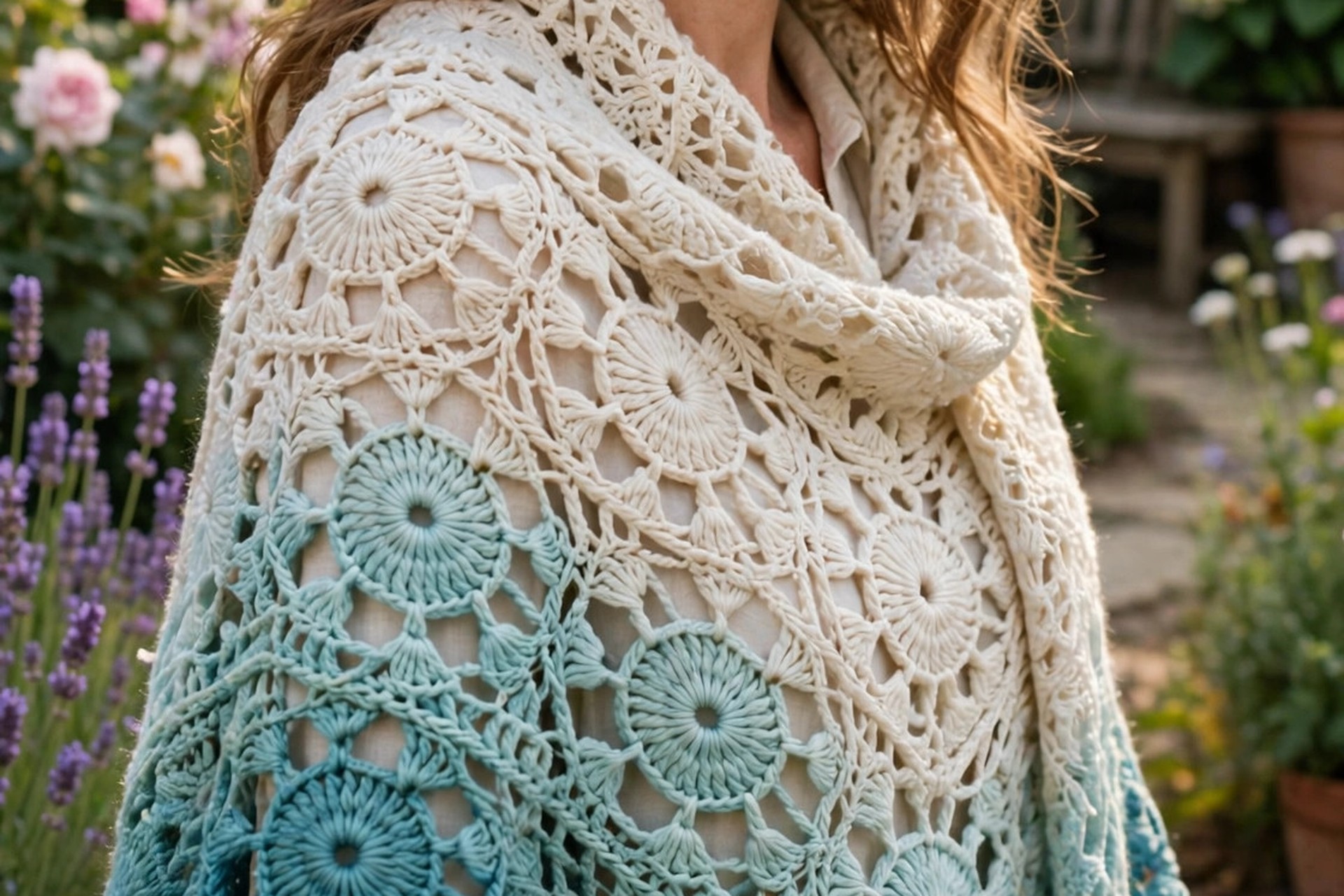
The virus stitch repeat is two rows, a V row and a fan row, worked in turns. Each full repeat adds one more fan on each side of the shawl, and the table below shows how it grows.
The V row
Work a V row after every fan row. On a V row, you place a V stitch at the center of every fan and in every space between the fans, with chain 1 spaces between them.
- V row: Ch 4 (counts as a dc and a ch 1). Dc in the first st, (ch 1, sk 2 sts, V-st in the next st) rep across the row, working the last V-st in the center of the last fan, ch 1, dc in the last st. Turn.
Each V row has two more V stitches than the one before it, one extra on each side. The first V row had 3 V stitches, then 5, then 7, then 9, and so on. Count your Vs at the end of each V row, because a missed V stitch is much easier to fix now than three rows later.
The fan row
Work a fan row after every V row. On a fan row, you work a fan of 10 double crochets into the chain 1 space at the center of every V stitch, and a V stitch into the chain 1 space between each pair of fans.
- Fan row: Ch 3 (counts as a dc), dc in the first st, (10 dc in the ch-1 sp at the center of the next V-st, V-st in the next ch-1 sp) rep across the row, ending with 10 dc in the ch-1 sp at the center of the last V-st, 2 dc in the last st. Turn.
Each fan row has two more fans than the one before it, one extra on each side: 3 fans, then 5, then 7, then 9, and so on. The edge stitches stay the same on every row, 2 double crochets at the start and 2 at the end, and they keep the sides of the triangle straight while the fans grow wider.
How the shawl grows
| Repeats worked | Fans on the last fan row | Approximate wingspan |
|---|---|---|
| 1 (Part 1) | 3 fans | 16 inches |
| 3 | 7 fans | 30 inches |
| 5 | 11 fans | 44 inches |
| 8 | 17 fans | 64 inches |
| 10 | 21 fans | 72 inches |
| 12 | 25 fans | 76 inches |
Work the repeat until your shawl measures about 64 inches across the wingspan, which takes 8 full repeats after Part 1 for most crocheters, or stop earlier for a shawlette and later for a large wrap. End after a fan row, so the border sits on a straight row of fans, and do not stretch the lace while you measure, because it will grow a little more in blocking.
Part 3: The Scalloped Border and Finishing
The scalloped border gives the shawl a soft, finished edge and a gentle wave along the two short sides and the bottom point. Work it on the right side of the shawl, with the top edge facing up. The border row is worked in single crochet and double crochet shells, and the center point gets a small chain space so it stays sharp.
- Border row: Ch 1 (does not count as a st), sc in the first st, (sk 2 sts, 5 dc in the next st, sk 2 sts, sc in the next st) rep across the first short side, working (sc, ch 2, sc) in the ch-1 sp at the center point, then continue the shells along the second short side in the same way, ending with a sc in the last st. Fasten off.
Work the shells loosely so the border ripples gently instead of pulling tight. If the edge curls under, go up a hook size for the border row. If it flares out like a ruffle, go down a hook size. The top edge needs no border, because it sits against the neck, but you can work one row of single crochet along it for a firmer edge.
Weave in all ends with a tapestry needle, working each tail through the back of several stitches and trimming it close. Soak the shawl in cool water with a little wool wash for 15 minutes, press out the water gently in a towel, and pin it out on blocking mats to the finished size, stretching the fans open and pinning each scallop. Let it dry fully before you unpin it, which usually takes a full day. Our crochet mandala pattern uses the same gentle blocking method.
Variations: Colors, Sizes, and Yarn Choices
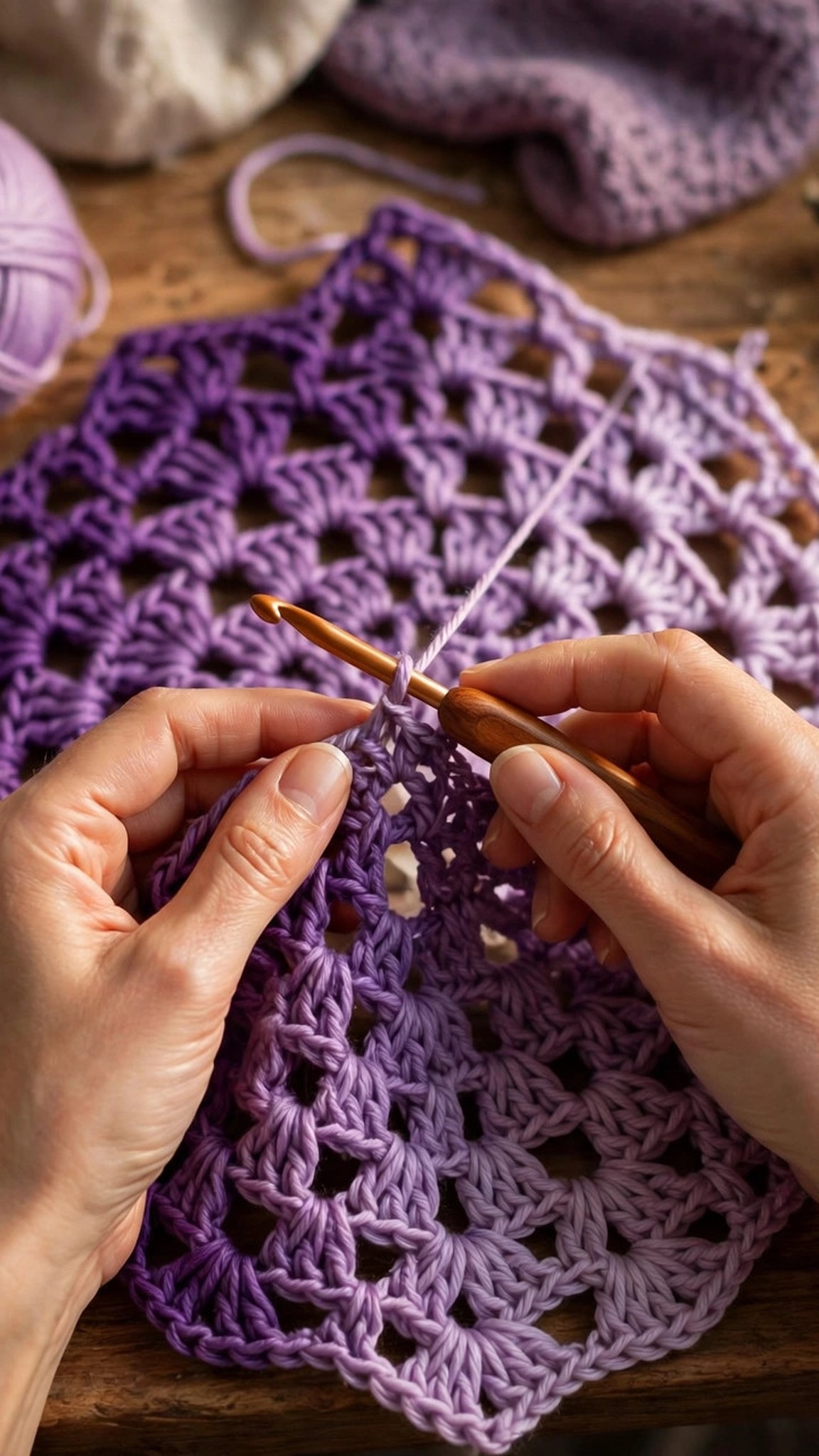
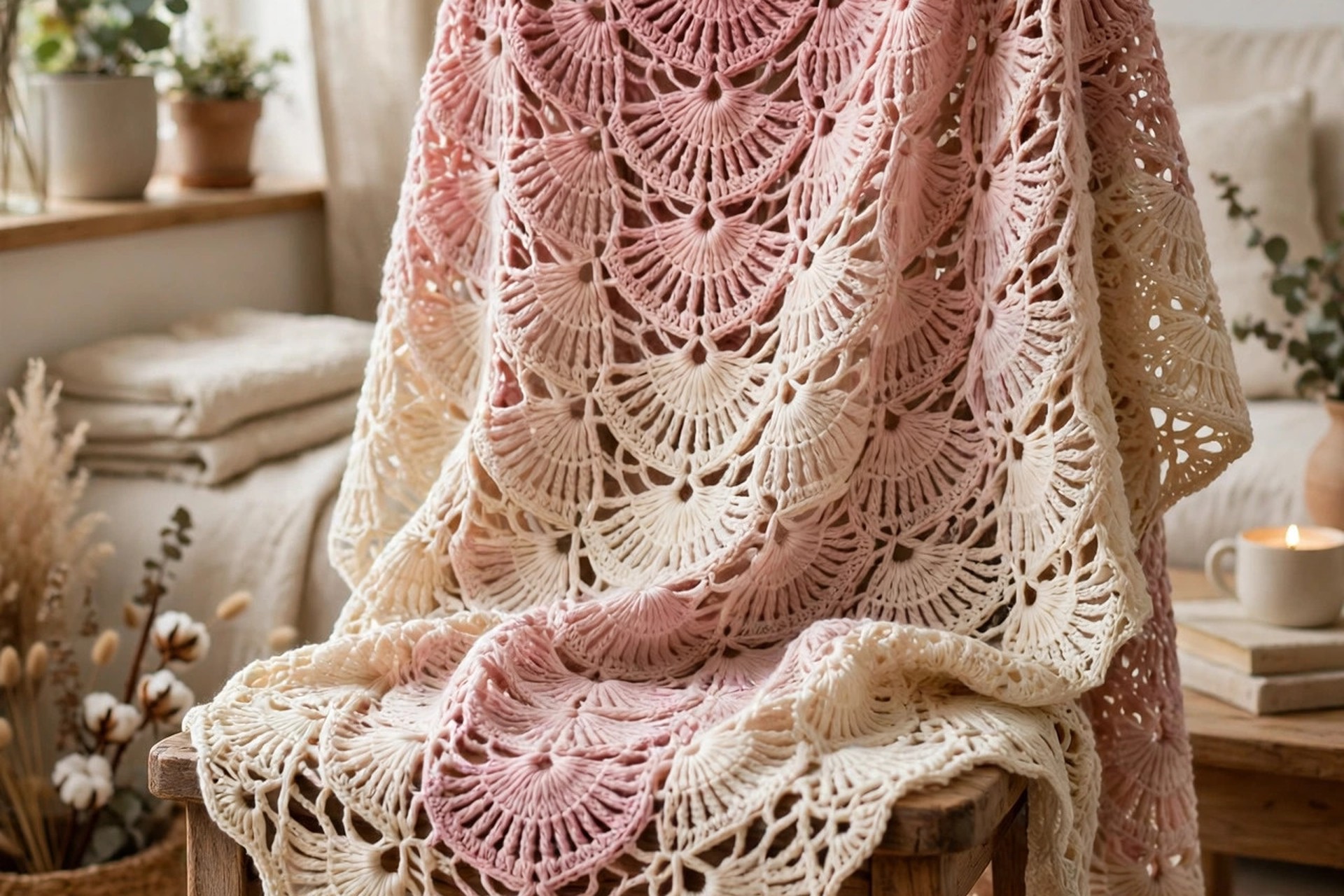
- Classic gradient shawl: work the pattern in a gradient DK yarn, the colorway in the photos, for a shawl that shades from one color to another as the fans grow. Our chevron crochet pattern also looks lovely in a gradient.
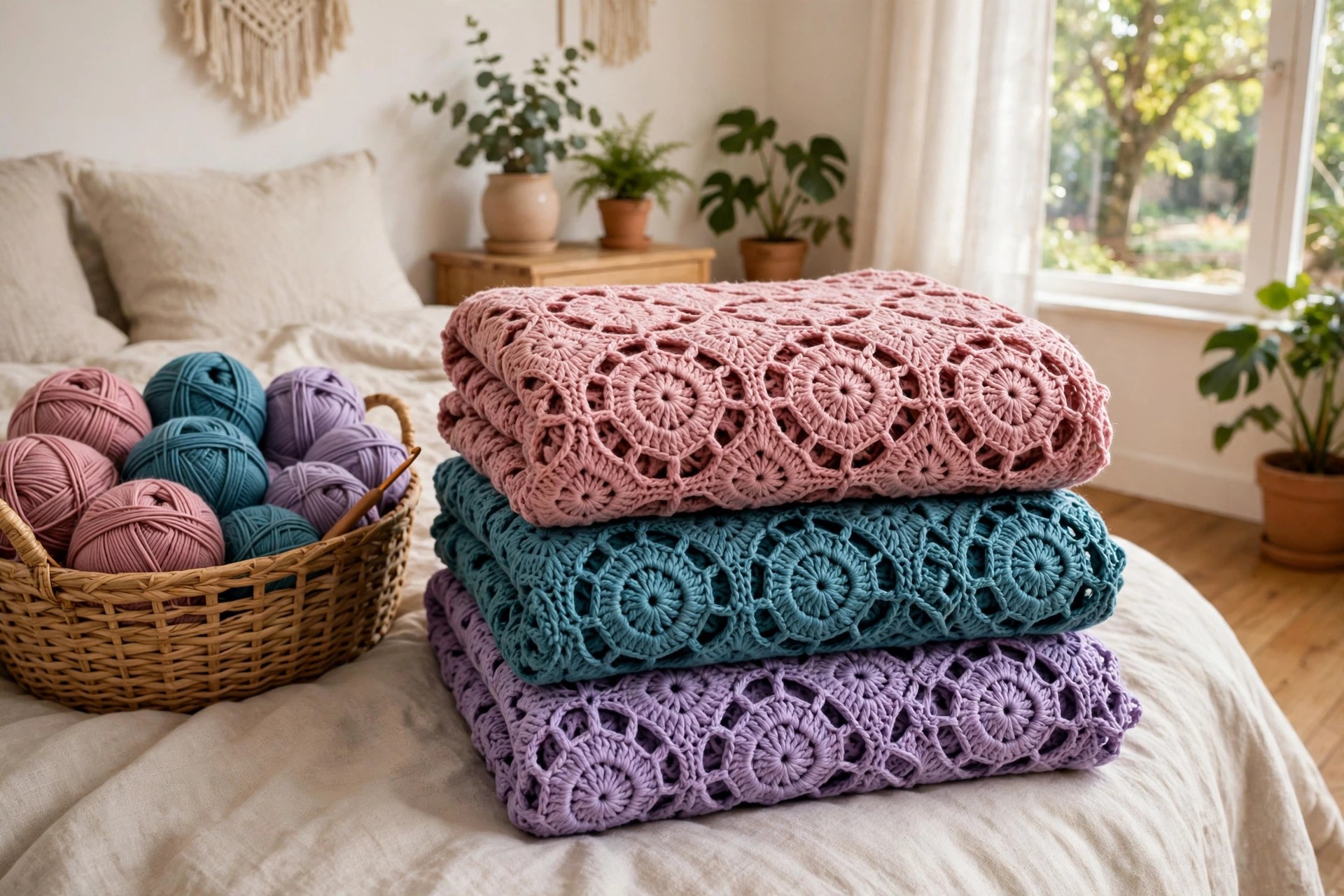
- Solid color lace: make the shawl in a single soft solid, like dusty rose or sage.
- Small shawlette: stop after 5 repeats for a 48 inch shawlette that works as a neck scarf or a light shoulder cover. Our crochet leaf pattern makes a matching pin or brooch for it.
- Large wrap: keep going to 12 repeats for a 76 inch wrap that covers the shoulders fully. Use about 1,300 yards of yarn for this size.
- Fingering weight lace: make the shawl in fingering weight yarn with a 3.5 mm hook for a finer, drapier shawl, working 10 repeats for a similar wingspan.
Troubleshooting Virus Shawls That Curl or Ruffle
- My fans curl under at the edges. The edge stitches are too tight, or the fans need blocking. Work the edge stitches loosely, and pin the shawl out firmly when you block it.
- My shawl ruffles like a lettuce leaf. You have too many stitches, usually from an extra V stitch on a V row. Count your Vs at the end of each V row against the growth table, and pull back to the last correct row.
- My center point is not centered. The center V stitch drifted to one side, usually because a fan was worked in the wrong chain space. Mark the center V stitch on every row, and check that it sits in the middle.
- My shawl is a triangle, but the sides curve inward. The edge stitches are too tight. The start and end of every row should have 2 double crochets, and the turning chain counts as the first of them.
- I keep losing the chain 1 spaces. The spaces are small and easy to miss, especially in a dark yarn. Work in good light, use a lighter yarn for your first virus shawl, and poke your hook into each space before you work the stitch.
Care Instructions
Hand wash a crochet virus shawl gently in cool water with a little mild soap, squeeze gently without wringing, and roll it in a clean towel to press out the water. Lay it flat to dry on a towel or blocking mats, pinning it back to shape if the lace has tightened up. Do not put a lace shawl in the dryer, because the heat can shrink wool and distort the fans. Fold the shawl loosely for storage, and keep it out of direct sunlight. If the shawl is acrylic, machine wash it on a gentle cycle in a mesh bag, but lay it flat to dry.
Frequently Asked Questions
Is the virus stitch hard to learn?
No, the virus stitch looks much harder than it is. The whole stitch is double crochet and chain spaces, in a two row repeat that you learn once and then repeat to the edge. The counting is the tricky part, and marking the center V stitch makes it much easier.
How much yarn do I need for a virus shawl?
About 900 yards of DK weight yarn for the 64 inch shawl in this pattern. A small 48 inch shawlette takes about 550 yards, and a large 76 inch wrap takes about 1,300 yards. Buy one extra ball if you can, because dye lots change between batches.
What is the best yarn for a virus shawl?
DK weight yarn is the best choice, because it is light enough for lace but thick enough that the fans show clearly. A smooth acrylic or wool blend works well. Our waffle stitch crochet pattern also works beautifully in DK weight yarn.
How do I keep the center point straight?
Mark the center V stitch on every row, and check that it sits in the middle before you start the next row. The center point stays straight as long as each side grows by the same number of fans.
Can I make a virus shawl in a different size?
Yes, stop after any fan row and work the border, and the shawl is finished at that size. Five repeats make a small shawlette, 8 repeats make the full size in this pattern, and 12 repeats make a large wrap.
Can I sell shawls made from this pattern?
Yes, you may sell finished shawls made from this free pattern, with credit to Little Loop Finds. Please do not sell or republish the pattern text itself. Gradient shawls sell well at craft markets.
Happy stitching, and may your virus shawl ripple out into the softest wrap you have ever made.