Tunisian Crochet Sweater Pattern (Free Relaxed Fit)
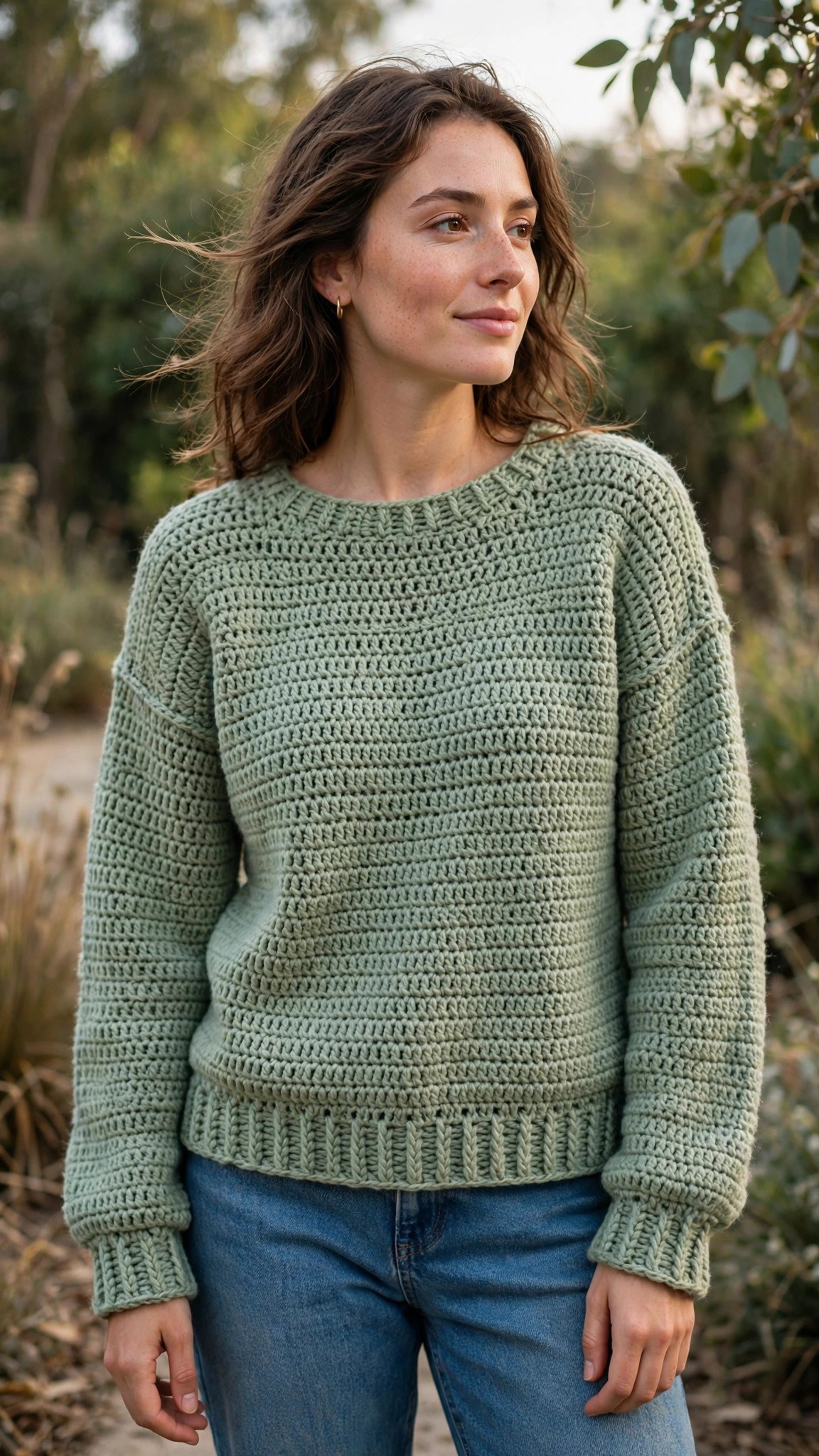
Crochet a relaxed fit Tunisian sweater in sizes S to L with long sleeves and a crew neck in about sixteen hours, then wear it as your favorite everyday layer.

Patterns · Crochet
- Finished size
- 24 in long, S/M/L
- Making time
- 16 hours
- Hook
- US K-10.5 (6.5 mm)
- Set
- Sweater, sleeves
- Skill
- Advanced Beginner
In this post
- Key Takeaways
- Table of Contents
- Why You Will Love This Tunisian Crochet Sweater
- Finished Size, Skill Level, and Time
- Materials You Need
- Abbreviations (US Terms)
- Gauge and Sizing Notes
- Tunisian Simple Stitch Basics
- Part 1: The Back and Front Panels
- Part 2: The Sleeves
- Part 3: Assembly, Neckline, and Ribbing
- Variations: Colors, Sizes, and Uses
- Troubleshooting a Sweater That Does Not Fit
- Care Instructions
- Frequently Asked Questions
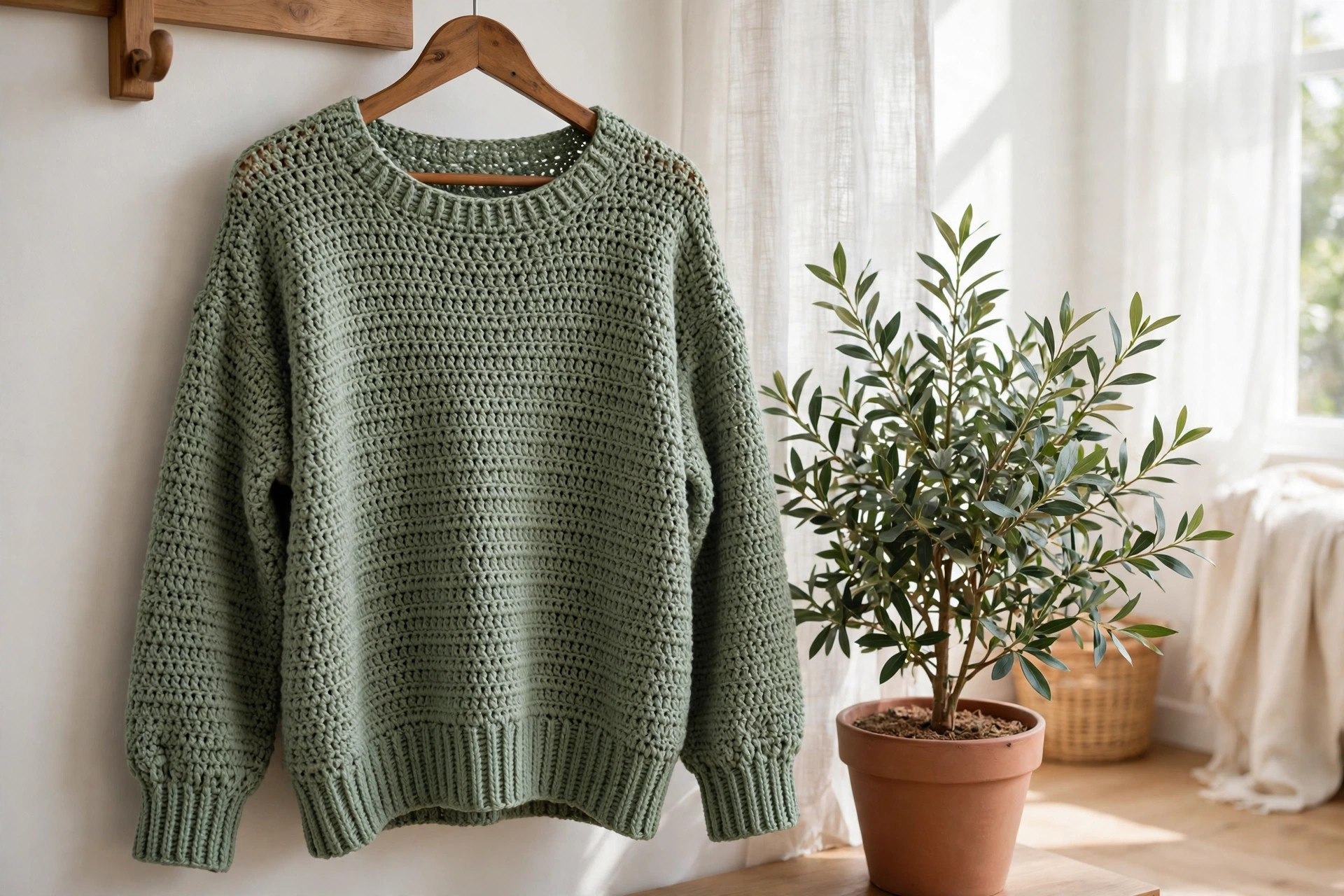
A Tunisian crochet sweater is the coziest garment you can make with a Tunisian hook. This free Tunisian crochet sweater pattern makes a relaxed fit sweater in sizes S to L, worked in Tunisian simple stitch with long sleeves and a simple crew neck. It is warm, comfortable, and made to be worn every day.
This is an original Little Loop Finds design, written in US terms and completely free. The sweater is worked in flat panels of Tunisian simple stitch, with no tricky shaping, and the pieces are sewn together. If you have never tried Tunisian crochet before, this sweater is a wonderful first garment.
A quick note on scope: this post is about one specific garment, a Tunisian crochet sweater in Tunisian simple stitch with a relaxed fit. It is not a blanket. If you want a Tunisian blanket in the same stitch, our Tunisian crochet blanket pattern is the one to make.
Key Takeaways
- Free original pattern: a Little Loop Finds original design, written in US terms, and completely free.
- A relaxed fit sweater: a Tunisian simple stitch garment with a crew neck and long sleeves.
- Sizes S to L: a 40, 44, or 48 inch bust, with a 24 inch length.
- Simple construction: flat Tunisian panels with straight seams, no tricky shaping.
- A 16 hour project: one sweater takes about 16 hours, spread over a couple of weeks.
Table of Contents
- Why You Will Love This Tunisian Crochet Sweater
- Finished Size, Skill Level, and Time
- Materials You Need
- Abbreviations (US Terms)
- Gauge and Sizing Notes
- Tunisian Simple Stitch Basics
- Part 1: The Back and Front Panels
- Part 2: The Sleeves
- Part 3: Assembly, Neckline, and Ribbing
- Variations: Colors, Sizes, and Uses
- Troubleshooting a Sweater That Does Not Fit
- Care Instructions
- Frequently Asked Questions
Why You Will Love This Tunisian Crochet Sweater
A handmade sweater is the most satisfying thing you can crochet, and Tunisian crochet makes the fabric extra special. Tunisian simple stitch creates a dense, woven looking fabric with a lovely drape, and it holds its shape beautifully. The relaxed fit skims the body instead of clinging, and the long sleeves and crew neck make it a true everyday piece.
Tunisian crochet is also wonderfully relaxing once you learn the rhythm. Every row is two passes, a forward pass that picks up loops and a return pass that works them off, and the hook holds all the stitches for you.
Finished Size, Skill Level, and Time
- Finished size: length 24 inches from the shoulder, sleeve 19 inches long. Bust: size S 40 inches, size M 44 inches, size L 48 inches. The sweater is meant to be worn with about 4 inches of ease.
- Skill level: Advanced beginner. You need a foundation chain, Tunisian simple stitch, a Tunisian bind off, and simple seaming.
- Time: about 16 hours per sweater: 5 hours for the back panel, 5 hours for the front panel, 4 hours for the two sleeves, 2 hours for assembly, the neckline, and the ribbing.
Materials You Need
| Item | What to get |
|---|---|
| Yarn, main color | DK weight (size 3) yarn in sage green, size S 1,200 yards, size M 1,350 yards, size L 1,500 yards |
| Yarn, ribbing | DK weight (size 3) yarn in the same color, 100 yards, or use the main color |
| Hook | Tunisian hook US K-10.5 (6.5 mm) with a cable, or the size that gives you the gauge below |
| Hook, ribbing | Regular crochet hook US H-8 (5.0 mm) |
| Notions | Tapestry needle, scissors, tape measure, stitch markers, pins |
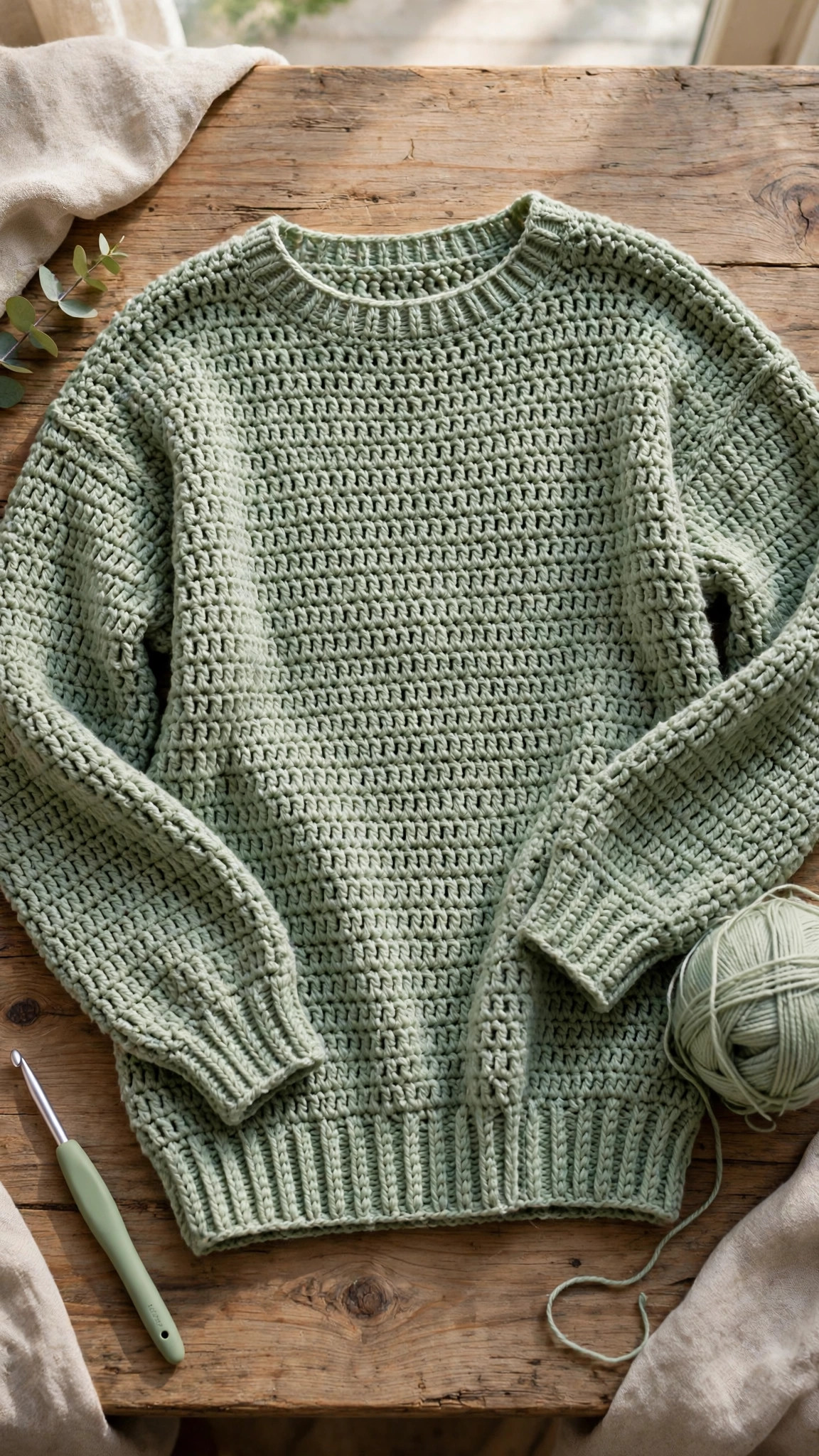
DK weight yarn is the best choice for a Tunisian crochet sweater because it is light enough to drape well, and the fabric is warm without being heavy. A smooth acrylic or wool blend yarn is a good pick, because it is soft against the skin and it shows the Tunisian stitch texture clearly. Choose a calm sage green, dusty blue, or warm cream for a sweater you will wear every day.
Abbreviations (US Terms)
- ch = chain
- TSS = Tunisian simple stitch
- TSS2tog = Tunisian simple stitch 2 together (work 2 stitches as one, decreasing by 1 stitch)
- inc = increase (work 2 TSS in the same stitch)
- sc = single crochet
- sl st = slip stitch
- st(s) = stitch(es)
- rep = repeat
- FP = forward pass
- RP = return pass
Gauge and Sizing Notes
Gauge matters on a sweater, because a small error grows across 70 stitches and 72 rows. Work a swatch of 20 TSS stitches and 16 rows in the main color. It should be about 5.5 inches wide and 5 inches tall, which is 14 stitches and 12 rows to 4 inches.
Measure your bust before you start and pick the size with about 4 inches of ease, because this sweater is meant to be relaxed, not tight. The pattern gives stitch counts for sizes S, M, and L in that order, written as S (M, L) through the pattern. Count your stitches at the end of every forward pass on the back panel, because the back sets the size of the whole sweater. Tunisian fabric can curl at the edges, and that is normal.
Tunisian Simple Stitch Basics
If you are new to Tunisian crochet, here is the whole stitch in two passes, and you never turn the work.
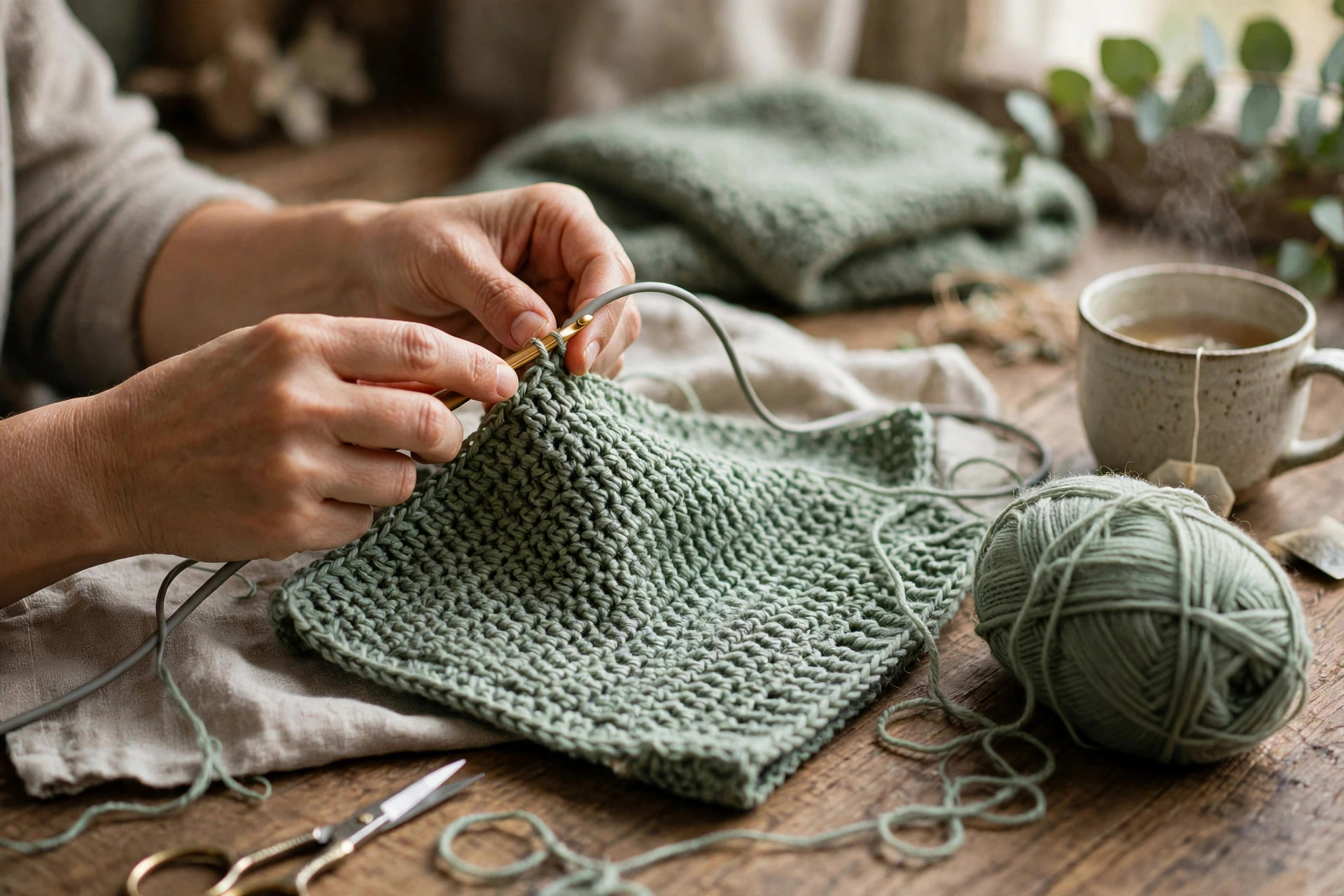
The forward pass picks up loops. Insert the hook under the vertical bar of the next stitch, yarn over, and pull up a loop. Keep the loop on the hook and move to the next stitch.
The return pass works the loops off. Yarn over and pull through one loop, then yarn over and pull through two loops, and repeat until one loop is left on the hook.
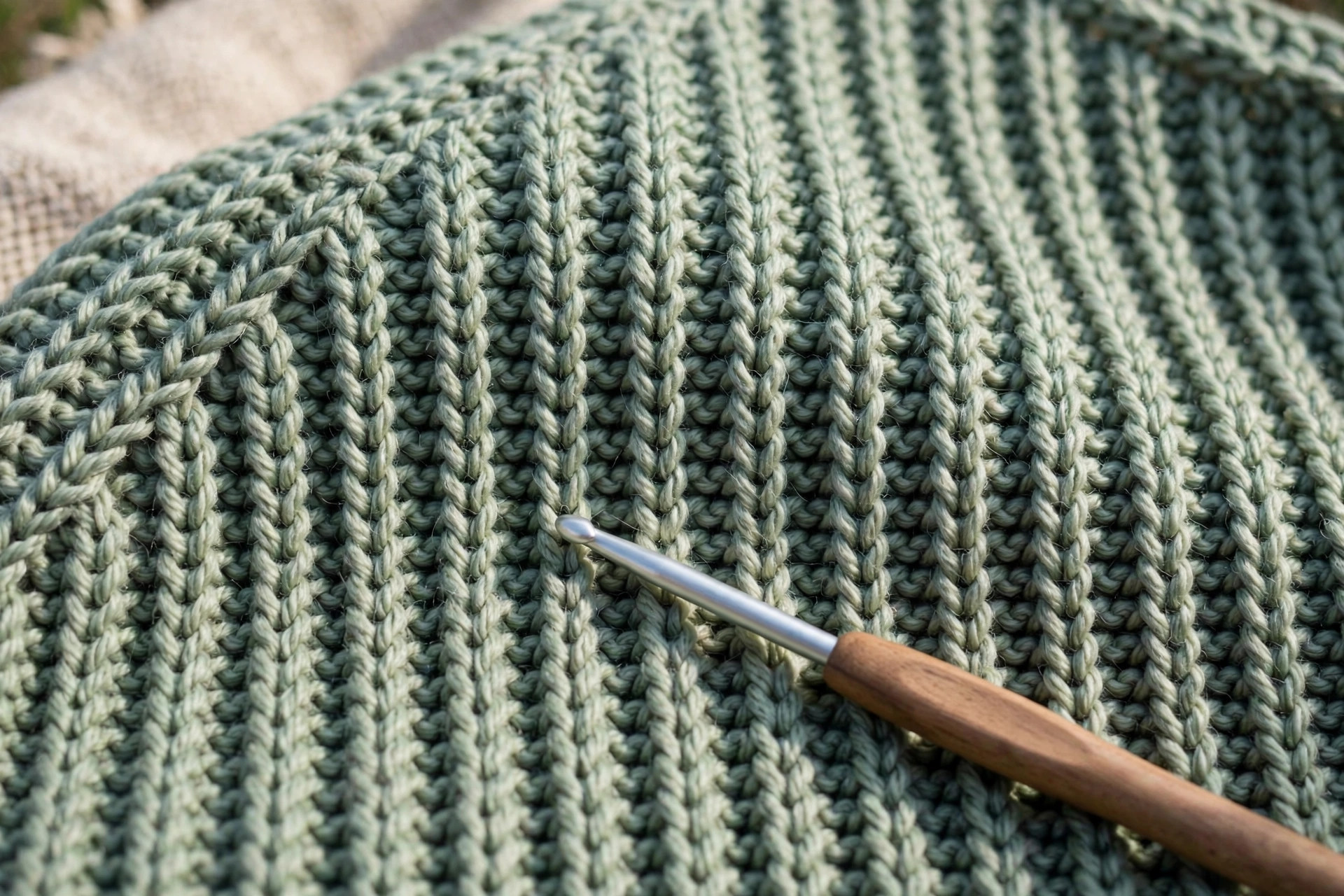
The first stitch of each row is the loop already on your hook, so you skip the first vertical bar and work into the second one. The last stitch of each row is worked under the two strands at the edge, which keeps the edge straight. Work a few practice rows on a swatch before you start the sweater.
Part 1: The Back and Front Panels
The back panel and the front panel are worked the same way for most of their length, and the front panel gets a simple crew neck near the top. Work both panels flat in Tunisian simple stitch.
The Back Panel
With the Tunisian hook and the main color, ch 70 (78, 86).
- Row 1: pick up a loop in the back bump of the 2nd ch from the hook and in each ch across. Work the return pass. (70 (78, 86) sts)
- Rows 2 to 70: work one row of TSS across, picking up a loop in each vertical bar and working the return pass. (70 (78, 86) sts)
- Row 71: work TSS across to the last 2 sts, TSS2tog. Work the return pass. (69 (77, 85) sts)
- Row 72: work TSS across. Work the return pass. (69 (77, 85) sts)
Bind off with a slip stitch bind off, working one sl st in each vertical bar across the row. Fasten off, leaving a long tail for seaming. The back panel should be about 20 (22, 24) inches wide and 24 inches long. Lay it flat and measure the width at the top, the middle, and the hem, because the three numbers should match.
The Front Panel
With the Tunisian hook and the main color, ch 70 (78, 86).
- Row 1: pick up a loop in the back bump of the 2nd ch from the hook and in each ch across. Work the return pass. (70 (78, 86) sts)
- Rows 2 to 58: work one row of TSS across. (70 (78, 86) sts)
- Row 59: work TSS across to the last 2 sts, TSS2tog. Work the return pass. (69 (77, 85) sts)
- Row 60: work TSS across. Work the return pass. (69 (77, 85) sts)
Now shape the crew neck in two halves, finishing one shoulder, then the other.
- Row 61: work TSS across the first 24 (27, 30) sts, then work the return pass across those stitches only, leaving the rest of the row unworked for now. (24 (27, 30) sts)
- Rows 62 to 72: work TSS across the 24 (27, 30) sts on this shoulder, working the return pass after each forward pass. (24 (27, 30) sts)
Bind off the first shoulder and fasten off. Join the yarn at the other side of the neck opening, leaving the center 21 (23, 25) stitches unworked for the neck.
- Rows 61 to 72: work TSS across the remaining 24 (27, 30) sts, working the return pass after each forward pass. (24 (27, 30) sts)
Bind off the second shoulder and fasten off, leaving a long tail for seaming. Each front shoulder should be about 7 (7.5, 8.5) inches wide, and the neck opening should be about 6 (6.5, 7) inches wide. Lay both panels side by side and check that they are the same length. Our crochet cardigan sweater pattern uses the same flat panel shaping if you want an open front layer in the same style.
Part 2: The Sleeves
The sleeves are tapered rectangles with no cap shaping, which is what makes this a drop shoulder sweater. Work both sleeves the same way, and keep your stitch counts the same on each sleeve.
The Sleeves (make 2)
With the Tunisian hook and the main color, ch 49.
- Row 1: pick up a loop in the back bump of the 2nd ch from the hook and in each ch across. Work the return pass. (49 sts)
- Rows 2 to 8: work one row of TSS across. (49 sts)
- Row 9: inc in the first st, work TSS across to the last st, inc in the last st. Work the return pass. (51 sts)
- Rows 10 to 15: work one row of TSS across. (51 sts)
- Row 16: inc in the first st, work TSS across to the last st, inc in the last st. Work the return pass. (53 sts)
- Rows 17 to 22: work one row of TSS across. (53 sts)
- Row 23: inc in the first st, work TSS across to the last st, inc in the last st. Work the return pass. (55 sts)
- Rows 24 to 29: work one row of TSS across. (55 sts)
- Row 30: inc in the first st, work TSS across to the last st, inc in the last st. Work the return pass. (57 sts)
- Rows 31 to 36: work one row of TSS across. (57 sts)
- Row 37: inc in the first st, work TSS across to the last st, inc in the last st. Work the return pass. (59 sts)
- Rows 38 to 43: work one row of TSS across. (59 sts)
- Row 44: inc in the first st, work TSS across to the last st, inc in the last st. Work the return pass. (61 sts)
- Rows 45 to 50: work one row of TSS across. (61 sts)
- Row 51: inc in the first st, work TSS across to the last st, inc in the last st. Work the return pass. (63 sts)
- Rows 52 to 57: work one row of TSS across. (63 sts)
Bind off and fasten off, leaving a long tail for seaming. Each sleeve should be about 14 inches wide at the cuff, 18 inches wide at the top, and 19 inches long. Lay both sleeves side by side and check that the increase rows line up, because the increases are worked on rows 9, 16, 23, 30, 37, 44, and 51.
Part 3: Assembly, Neckline, and Ribbing
This is the part where flat panels become a sweater. Pin everything before you sew, and take your time with the seams, because neat seaming is what makes a handmade sweater look store bought.
Assembly
Lay the back panel flat with the right side facing up. Lay the front panel on top of it, right sides together, with the neck openings lined up at the top. Pin the shoulder seams and sew each front shoulder to the back panel along the top edge. Our simple crochet sweater pattern uses the same sew as you go method if you want another garment to practice on.
Open the sweater flat again. Pin one sleeve to each armhole, matching the center of the sleeve top to the shoulder seam, and easing the sleeve top into the opening. Sew the sleeve tops in place. Then fold the sweater so the front and back meet, and sew the underarm and side seams in one long line, from the sleeve cuff all the way down to the hem, on each side.
The Neckline
With the regular hook and the main color, join the yarn at the right shoulder seam.
- Round 1: ch 1, work 1 sc in each stitch and row end around the neck opening, about 64 sc in total. Join with a sl st to the first sc.
- Rounds 2 to 3: ch 1, sc in each st around. Join with a sl st to the first sc.
Fasten off and weave in the ends. The neckline should lie flat and sit close to the neck without pulling.
The Hem and Cuff Ribbing
With the regular hook and the main color, join the yarn at a side seam.
- Round 1: ch 1, work 1 sc in each stitch around the hem, about 140 (156, 172) sc in total. Join with a sl st to the first sc.
- Rounds 2 to 4: ch 2, work 1 dc in the front post of the next st, 1 dc in the back post of the following st, and repeat around, for a simple post stitch rib. Join with a sl st to the first st.
Fasten off and weave in the ends. Work the same ribbing around each sleeve cuff, with about 49 sc in the first round and 3 rounds of post stitch rib.
Variations: Colors, Sizes, and Uses
- Classic cream sweater: work the whole sweater in cream with a sage green ribbing for a soft two tone look.
- Dusty blue with a deeper neck: make the sweater in dusty blue and work the neck shaping 4 rows earlier for a wider crew neck. Our oversized sweater crochet pattern free makes a matching slouchy layer for cold days.
- Shorter cropped version: stop the panels at row 56 instead of row 72 for a cropped sweater that is about 19 inches long.
Troubleshooting a Sweater That Does Not Fit
- My sweater is too wide. Your gauge is looser than the pattern gauge. Measure your swatch again and go down a hook size before you restart the back panel.
- My sweater is too short. Count the rows on the back panel, because it should have 72 rows.
- My sleeves are different lengths. Count the rows on each sleeve. Both should have 57 rows with increases on rows 9, 16, 23, 30, 37, 44, and 51.
- My edges curl badly. Tunisian fabric curls until it is blocked and seamed. Wet block each panel flat, pin it to size, and let it dry fully before you sew the seams.
- My neck opening is too wide. Work the neck shaping 4 rows later next time, or add one more round of sc around the neckline to pull it in.
- My return pass feels tight. Keep the yarn overs loose and let the hook slide through the loops without tugging.
Care Instructions
Hand wash a Tunisian crochet sweater in cool water with a mild detergent, and press the water out gently without wringing. Reshape the sweater while it is damp, lay it flat on a clean towel, and let it dry fully away from direct heat. Keep the sweater folded on a shelf, because hanging it on a thin hanger will stretch the shoulders out of shape.
Frequently Asked Questions
Is Tunisian crochet hard for a beginner?
Tunisian crochet is easy to learn once you know the two passes. The forward pass picks up loops and the return pass works them off, and that is the whole stitch. This sweater is a good first Tunisian garment, because it uses only Tunisian simple stitch, and you can practice on a swatch before you start.
What is the difference between a Tunisian sweater and a Tunisian blanket?
A Tunisian sweater is a shaped garment with panels, sleeves, a neckline, and seams, while a Tunisian blanket is a flat rectangle with no shaping. If you want a blanket, our Tunisian crochet blanket pattern is the one to make.
What yarn is best for a Tunisian crochet sweater?
DK weight acrylic or wool blend yarn is the best choice, because it is light enough to drape well and it shows the Tunisian stitch texture clearly.
Do I need a special hook for Tunisian crochet?
Yes, you need a Tunisian hook with a cable or a long shaft, because the hook holds all the stitches of a row at once. A US K-10.5 (6.5 mm) Tunisian hook is the size used for this pattern.
How long does this sweater take to make?
One sweater takes about 16 hours: 5 hours for the back panel, 5 hours for the front panel, 4 hours for the two sleeves, and 2 hours for assembly, the neckline, and the ribbing.
Can I make the sweater in a bigger size?
Yes, add 8 stitches to the foundation chain of each panel for each size up, and work 2 more rows before the shoulder shaping for extra length.
Can I sell sweaters made from this pattern?
Yes, you may sell finished sweaters made from this free pattern, with credit to Little Loop Finds. Do not sell or republish the pattern text itself.
Happy stitching, and may your sweater keep you cozy on every cool day ahead.