Tunisian crochet blanket patterns free: easy throw
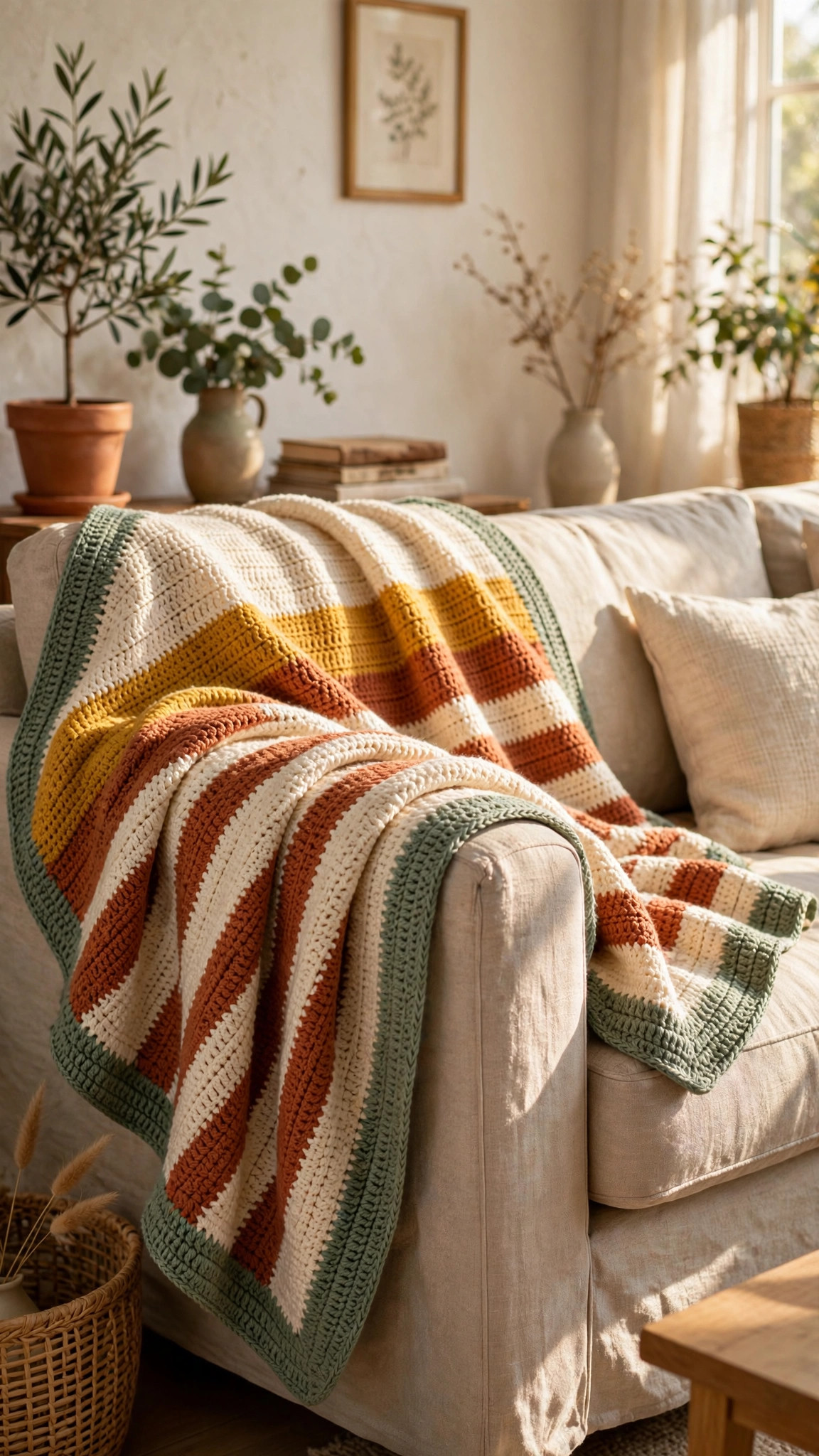
A thick, woven-looking striped throw in Tunisian simple stitch, worked in relaxing forward and return passes on a long hook, with no shaping and stripes that do all the decorating.

Home Decor · Crochet
- Finished size
- 50 x 60 in (Throw)
- Making time
- About 12–28 hours
- Hook
- 6.5 mm Tunisian hook, cable
- Stitch
- Tunisian simple stitch only
- Skill
- Beginner
In this post
If you love the look of knitting but only know how to crochet, Tunisian crochet is your new best friend. This free Tunisian crochet blanket pattern uses just one stitch, the Tunisian simple stitch, to make a thick, woven-looking throw with beautiful drape and a subtle texture that looks far fancier than the effort involved. You work with a long hook, pick up a whole row of loops, then work them off again, and the rhythm becomes meditative within the first ten rows. No shaping: just relaxing rows and pretty stripes.
Why you'll love these free Tunisian crochet blanket patterns
Tunisian crochet sits in the sweet spot between knitting and crochet, and this blanket shows off everything that makes it special. The fabric is denser and warmer than regular crochet, with a neat woven texture that looks like stockinette stitch from across the room. It drapes beautifully over a sofa arm and holds its shape.
The best part is how simple the stitch is. Tunisian simple stitch is just two moves repeated: a forward pass where you pick up a loop in every stitch, and a return pass where you work the loops off two at a time. Once you have done three rows, your hands know the rhythm. The stripes do all the decorating, so you never have to count a complicated stitch pattern.
This is also the perfect first Tunisian project because the blanket is a plain rectangle. There is no shaping to track, and the stitch count never changes after the foundation chain. The striped design means you only ever work with one color at a time, so there are no tangled bobbins and no ends to weave in mid-row.
Materials you'll need
| Supply | What to get |
|---|---|
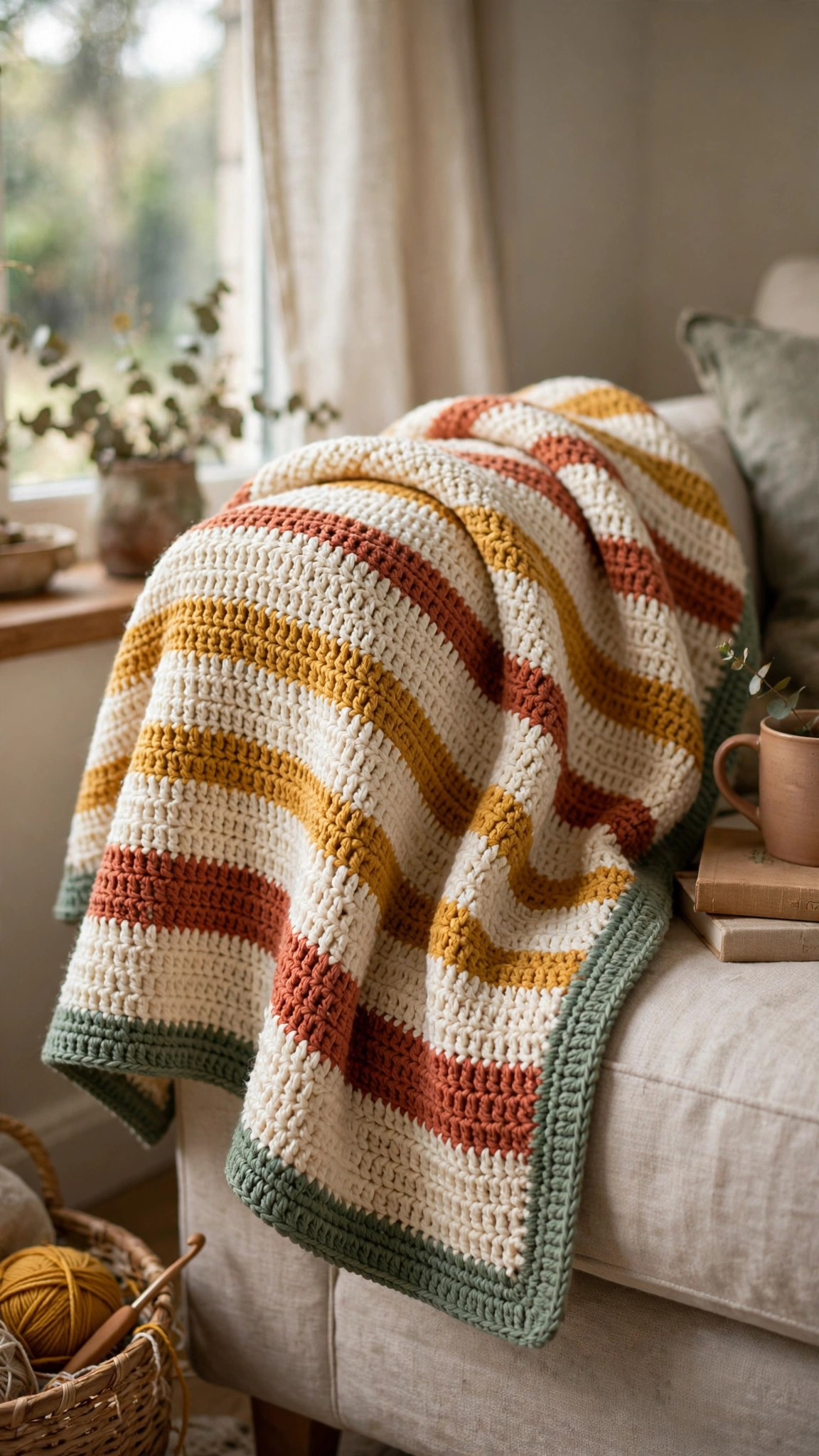
| Main color (A) | Worsted-weight (#4) yarn in cream, about 700 yds / 640 m (4 balls of 200 yds) for Throw |
| Stripe color (B) | Worsted-weight (#4) yarn in mustard, about 200 yds / 185 m (1 ball) for Throw |
| Stripe color (C) | Worsted-weight (#4) yarn in terracotta, about 200 yds / 185 m (1 ball) for Throw |
| Border color (D) | Worsted-weight (#4) yarn in sage, about 250 yds / 230 m (2 balls) for Throw |
| Tunisian hook | 6.5 mm (K-10.5) Tunisian hook with a 24 in / 60 cm cable |
| Tapestry needle | For weaving in ends |
| Notions | Stitch markers, scissors, tape measure |
| Optional | A second cable for very wide blankets |
A smooth worsted-weight acrylic or acrylic-blend yarn is the best pick here: it slides easily on the hook, shows off the woven texture, and survives the washing machine. Avoid fuzzy yarns for your first Tunisian project, because they hide the vertical bars you need to see. The cable hook matters: a regular crochet hook cannot hold a whole row of loops, and the stitches will slide off the end.
Yarn amounts by size (approximate): Lap — A: 500 yds (3 balls), B: 150 yds (1 ball), C: 150 yds (1 ball), D: 200 yds (1 ball). Throw — A: 700 yds (4 balls), B: 200 yds (1 ball), C: 200 yds (1 ball), D: 250 yds (2 balls). Twin — A: 1,100 yds (6 balls), B: 300 yds (2 balls), C: 300 yds (2 balls), D: 400 yds (2 balls).
Size, gauge and skill level
The blanket is a plain rectangle worked in rows from the bottom edge up. Pick your size before you start, because the foundation chain sets the width and cannot be changed later.
| Size | Finished size | Foundation chain | Rows |
|---|---|---|---|
| Lap | 36 x 48 in / 91 x 122 cm | Ch 127 | 144 |
| Throw | 50 x 60 in / 127 x 152 cm | Ch 176 | 180 |
| Twin | 66 x 80 in / 168 x 203 cm | Ch 232 | 240 |
- Finished size (Throw): about 50 in (127 cm) wide and 60 in (152 cm) long, including the border.
- Gauge: 14 Tunisian simple stitches and 12 rows = 4 in (10 cm) with a 6.5 mm Tunisian hook, unblocked. Work a 6-inch swatch first: if your blanket comes out wider than the table, drop to a 6.0 mm hook; if narrower, go up to a 7.0 mm hook.
- Skill level: confident beginner. You should know how to chain and single crochet. Tunisian simple stitch is explained row by row below, and there is no shaping anywhere.
If you have never tried Tunisian crochet, this is the perfect first project: one stitch, straight rows, and stripes that keep it interesting. And if you fall in love with cozy blankets, our easy crochet patterns for blankets collection has more free blanket patterns in regular crochet to try next.
Abbreviations — US terms
| Abbreviation | Meaning |
|---|---|
| ch | chain |
| sc | single crochet |
| sl st | slip stitch |
| st(s) | stitch(es) |
| TSS | Tunisian simple stitch: insert hook under the front vertical bar of the next stitch, yarn over, pull up a loop |
| yo | yarn over |
| RS | right side |
| FO | fasten off |
A note on Tunisian rows: every Tunisian row has two passes. The forward pass picks up one loop per stitch and leaves them all on the hook. The return pass works the loops off two at a time. You never turn the work: the right side always faces you. The chain at the start of a row is the foundation for the forward pass only.
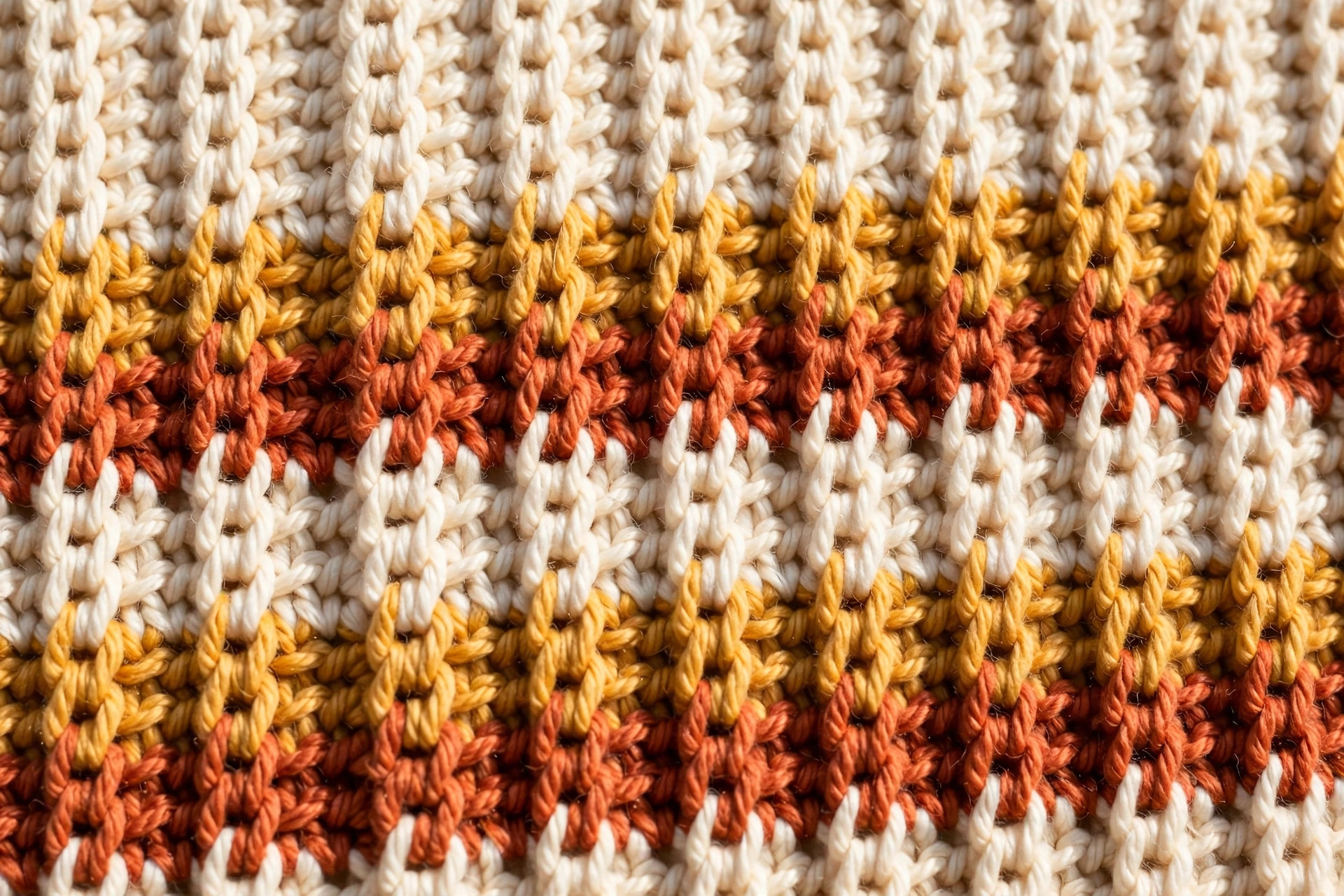
The pattern (US terms)
The blanket is worked bottom to top in Tunisian simple stitch. Every row is a forward pass followed by a return pass. The stripe sequence repeats every 32 rows: 12 rows of cream, 4 rows of mustard, 12 rows of cream, 4 rows of terracotta. Change colors at the start of a forward pass, and carry the unused colors loosely up the side edge, where the border will cover them.
Foundation row
With color A and the 6.5 mm Tunisian hook, chain the foundation chain for your size: Lap ch 127, Throw ch 176, Twin ch 232.
- Forward pass: insert hook in 2nd ch from hook, yo, pull up a loop. *Insert hook in next ch, yo, pull up a loop; rep from * across, leaving every loop on the hook. (Lap 126 loops, Throw 175 loops, Twin 231 loops)
- Return pass: yo, pull through 1 loop (this makes the edge chain). *Yo, pull through 2 loops; rep from * until 1 loop remains on the hook. That last loop counts as the first stitch of the next row.
You now have one row of Tunisian simple stitch. Count the vertical bars across the row: there should be 126, 175, or 231 of them, including the edge stitch on the far right.
Tunisian simple stitch rows
- Forward pass: the loop on your hook is the first stitch. *Insert hook under the front vertical bar of the next stitch, yo, pull up a loop; rep from * across. For the last stitch of the row, insert the hook under both vertical bars at the edge (the front bar and the back bar) and pull up a loop: this keeps the edge straight and firm. (Lap 126 loops, Throw 175 loops, Twin 231 loops)
- Return pass: yo, pull through 1 loop. *Yo, pull through 2 loops; rep from * until 1 loop remains on the hook.
That is the whole stitch. Work it again and again, following the stripe sequence below. Keep your loops loose and even on the forward pass: tight loops are the number one cause of Tunisian blankets that curl and narrow.
Stripe sequence (repeats every 32 rows):
| Rows | Color | Rows worked |
|---|---|---|
| 1–12 | A (cream) | 12 |
| 13–16 | B (mustard) | 4 |
| 17–28 | A (cream) | 12 |
| 29–32 | C (terracotta) | 4 |
Repeat this 32-row sequence until you reach the row count for your size, then work the final rows in color A so the blanket ends with a cream section at the top, matching the bottom. The exact stripe counts by size are:
| Size | Total rows | Full 32-row repeats | Final rows in A |
|---|---|---|---|
| Lap (144 rows) | 144 | 4 repeats (128 rows) | 16 rows |
| Throw (180 rows) | 180 | 5 repeats (160 rows) | 20 rows |
| Twin (240 rows) | 240 | 7 repeats (224 rows) | 16 rows |
Tip: when you change colors, cut the old color leaving a 6-inch tail, and start the new color on the forward pass. Do not change colors on the return pass: the color change will show as a jogged line. Weave the tails in later, or carry the stripe colors up the side if the gap is only a few rows: the border covers the carried strands completely.
Bind-off row
The bind-off row stops the top edge from stretching and gives the border a firm edge to work into. Work it in color A.
- Bind-off: with the loop on your hook, *insert hook under the front vertical bar of the next stitch, yo, pull up a loop, yo, pull through both loops on the hook (like a slip stitch); rep from * across, working the last stitch under both edge bars. Do not work a return pass. Fasten off.
Your blanket should now be a neat rectangle with a firm top edge. If the top edge flares wider than the bottom, your bind-off was too loose; if it pulls in, it was too tight. Either way the border will even it out, so do not unpick it.
Border
Work the border in color D (sage) with the same 6.5 mm Tunisian hook, or switch to a regular 6.0 mm crochet hook if you prefer. Work it in joined rounds with the right side facing you.
- Round 1: join color D at any corner with a sl st. Ch 1, work sc evenly around all four sides: 1 sc in each stitch along the top and bottom edges, and about 1 sc per row along each side edge. Work 3 sc in each corner stitch. Join with a sl st to the first sc.
- Round 2: ch 1, sc in each sc around, working 3 sc in the center sc of each corner. Join with a sl st to the first sc.
- Round 3: ch 1, sc in each sc around, working 3 sc in the center sc of each corner. Join with a sl st to the first sc.
Fasten off and weave in all ends. The three-round border does two jobs: it frames the stripes, and it tames the natural curl of Tunisian fabric.
Finishing touches
Take twenty unhurried minutes here: it is the difference between a blanket that curls into a tube and a blanket that lies flat on the sofa.
Block it. Lay the blanket flat on a clean sheet or blocking mats, pin it to the finished measurements, and mist it lightly with water. Let it dry completely before you use it. Blocking is not optional for Tunisian crochet: it relaxes the curl, evens out the stitches, and sets the stripes straight. For acrylic yarn, gentle steam from an iron held an inch above the fabric (never pressed down) works even better and the shape holds longer.
Weave in ends as you go. A striped blanket has more ends than a solid one, so weave each tail in as soon as you cut it instead of leaving them all for the end. Work each tail into the wrong side for at least 2 inches, changing direction once so it cannot wriggle out in the wash.
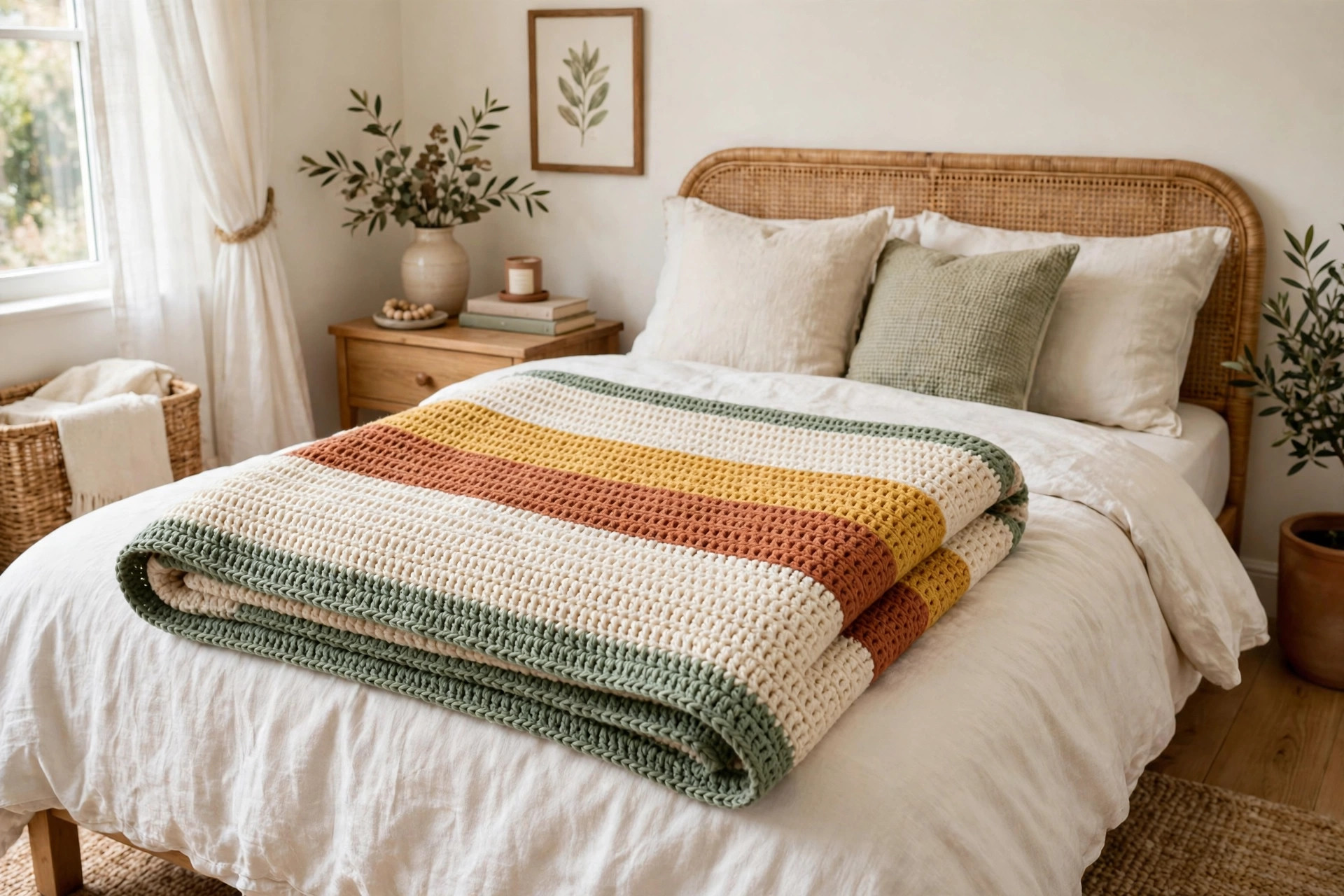
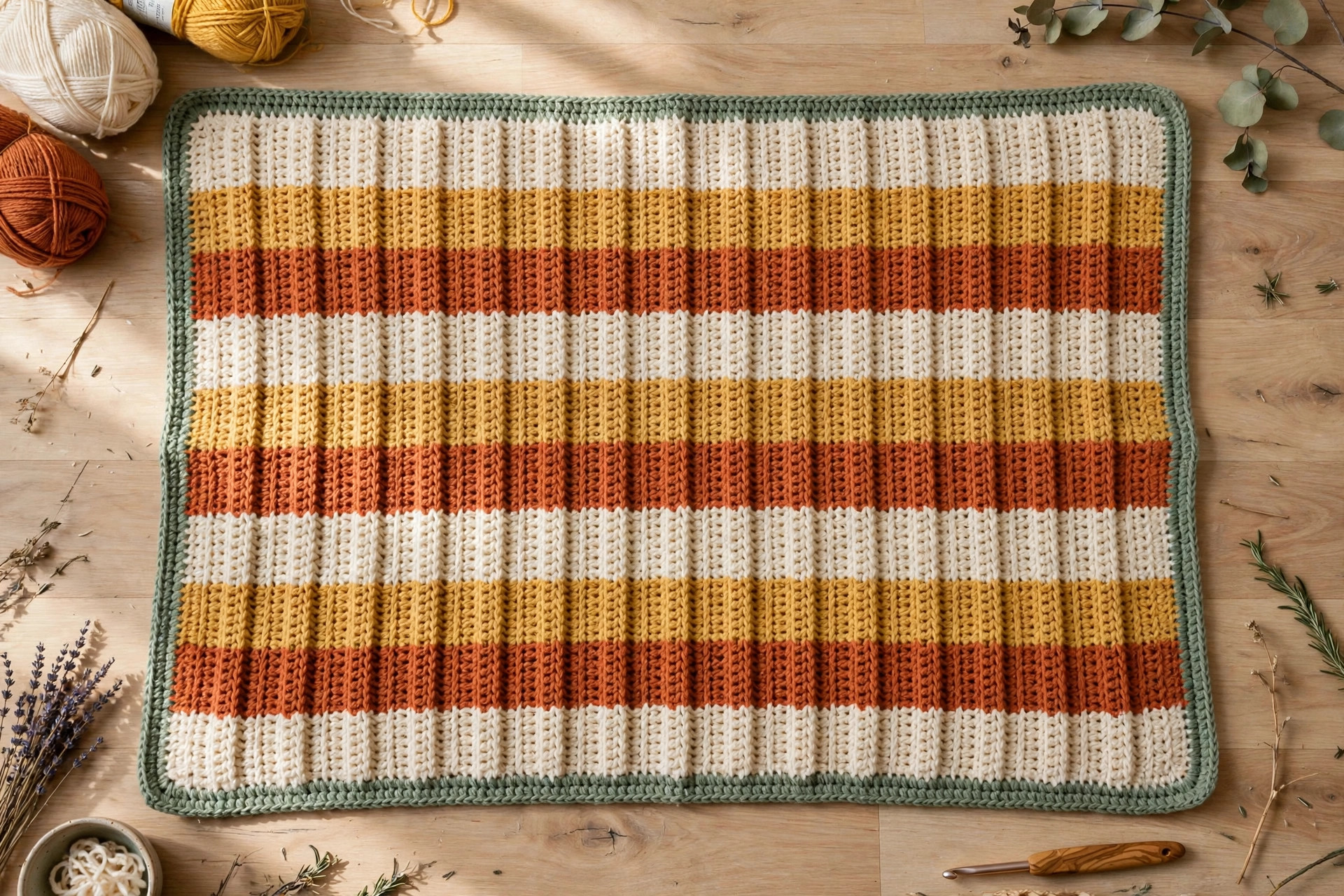
Wash it before the first use. A gentle machine wash and flat dry softens the yarn and relaxes any remaining curl. After that, wash cold on a gentle cycle whenever it needs it.
Three cute variations to try next
Once you have made one Tunisian blanket, the formula is yours to play with. Same stitch, same rectangle, three personalities:
- Ombre stripes. Work the blanket in a single color family, moving from pale cream through soft mustard to deep terracotta, with four rows of each shade. The gradient looks modern and uses up every half ball of one color family. If you like blanket projects, the crochet skull blanket pattern is a bold graphic blanket in regular crochet.
- Two-color classic. Work the whole blanket in cream with a single wide mustard stripe near each end, and a sage border. It is quicker, it uses less yarn, and it suits a minimalist living room. Pair it with our flower bouquet blanket crochet pattern for a matching set of handmade throws.
- Baby Tunisian blanket. Work the Lap size in soft DK-weight (#3) yarn with a 5.0 mm Tunisian hook and a 20-inch cable, and use pastel stripes instead of mustard and terracotta. The dense Tunisian fabric is wonderfully warm for a crib or stroller. If you like small cozy makes, the lovey blanket crochet pattern is a quick companion project for little ones.
And if this project gave you the blanket bug, the star blanket crochet pattern is a fun shaped blanket that starts from the center and grows outward like a star.
Troubleshooting tips
- Your blanket curls up like a scroll. All Tunisian crochet curls: it is the nature of the stitch. The border and blocking fix it. If the curl is severe, block the blanket twice, and work the border with a hook one size smaller so it pulls the edges in.
- Your blanket is narrowing as you go. You are missing the last stitch of the forward pass. Always work the last stitch under both edge bars, and count your loops every ten rows: the count should never change.
- Your blanket is widening as you go. You are picking up an extra loop at the start of the forward pass, probably by working into the chain between the first and second bars. The loop on your hook is the first stitch: your next pick-up goes under the second bar, not the first.
- The stripes have a jogged step where the color changes. You changed color on the return pass instead of the forward pass. Always change color at the start of a forward pass so the new color starts cleanly at the edge.
- Your loops are hard to pick up and your hand aches. Your forward pass is too tight. Consciously pull each loop up a little higher than you think you need, and take a break every twenty rows to stretch your hands.
- The edge stitches look loose and loopy. Work the last stitch of every forward pass under both edge bars, and pull the return pass a touch tighter at the edges. The border will cover minor looseness.
Frequently asked questions
Is this Tunisian crochet blanket pattern really free?
Yes, the complete pattern above is free, no email signup, no PDF purchase required.
What skill level is this Tunisian blanket pattern?
Confident beginner. If you can chain and single crochet, you can learn Tunisian simple stitch from the instructions above. There is no shaping anywhere, and the stitch count never changes.
Do I need a special hook for Tunisian crochet?
Yes, you need a Tunisian hook with a cable long enough to hold a whole row of loops. A regular crochet hook is too short: the loops will slide off the end. A 6.5 mm hook with a 24-inch cable covers all three sizes in this pattern.
How long does it take to make?
About 12 hours for Lap, 18 hours for Throw, and 28 hours for Twin. Tunisian crochet is slower than regular crochet because every row is worked twice, but the rhythm is relaxing and the rows add up quickly.
How much yarn do I need?
For Throw, about 700 yds of the main color, 200 yds each of mustard and terracotta, and 250 yds of sage for the border, all in worsted-weight yarn. Lap needs less, Twin needs more: see the materials table above.
Will the blanket curl?
Tunisian fabric always curls a little, and blocking plus the three-round border relaxes it. Wash and block the blanket before the first use, and it will lie flat on the sofa.
Can I sell the finished blankets I make?
Yes! You may sell finished blankets made from this pattern in small batches (craft fairs, markets, gifts). Please credit Little Loop Finds as the pattern designer with a link back to this page.
More free patterns to try
If this Tunisian blanket was fun, keep the hook moving. The easy crochet patterns for blankets collection has more free blanket patterns in regular crochet, the crochet skull blanket pattern is a bold graphic throw, the flower bouquet blanket crochet pattern is a pretty floral blanket, and the star blanket crochet pattern grows outward from the center like a star.