Stitch Sampler Crochet Pattern (Free Scarf)
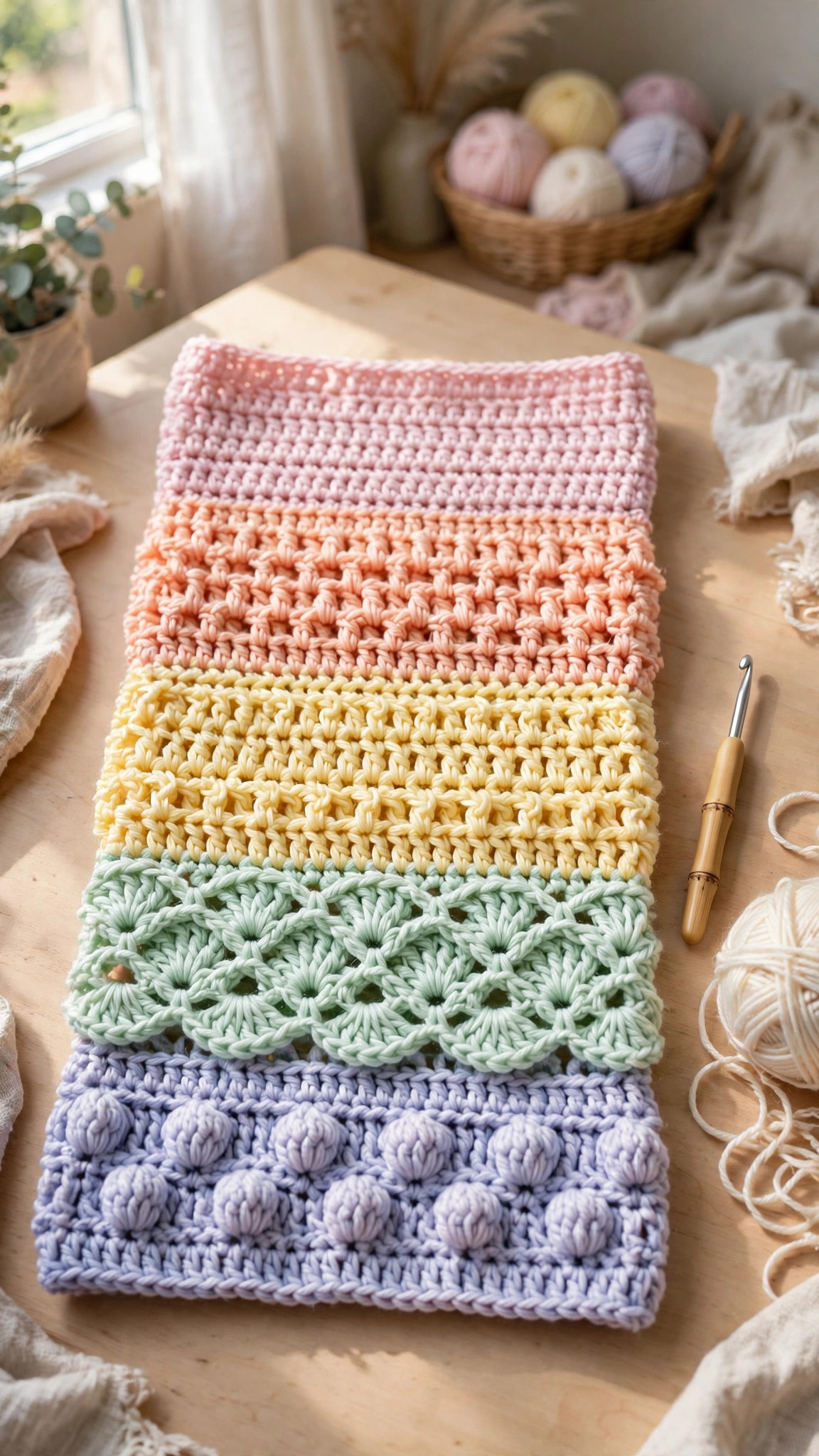
Crochet a pastel stitch sampler scarf that teaches ten stitches, from single crochet to shell and bobble, then wear it or gift it to a fellow beginner.
Patterns · Crochet
- Finished size
- 8 x 60 in
- Making time
- 9 hours per scarf
- Hook
- US J-10 (6.0 mm)
- Set
- Scarf, tassels
- Skill
- Beginner
In this post
- Key Takeaways
- Table of Contents
- Why You Will Love This Stitch Sampler
- Finished Size, Skill Level, and Time
- Materials You Need
- Abbreviations (US Terms)
- Gauge and Sizing Notes
- Part 1: Sections 1 to 3, the Basic Stitches
- Part 2: Sections 4 to 6, Shell, Bobble, and Puff
- Part 3: Sections 7 to 10, Clusters, V Stitch, and the Finish
- Part 4: The Border and Tassels
- Variations: Colors, Sizes, and Uses
- Troubleshooting Wavy Edges and Uneven Sections
- Care Instructions
- Frequently Asked Questions
A stitch sampler scarf is the best way to learn crochet, because every section teaches you a new stitch while you make something you will actually wear. This free stitch sampler crochet pattern walks you through ten stitch sections, from single crochet to shell stitch and bobble stitch, all in one soft pastel scarf.
This is an original Little Loop Finds design, written in US terms and completely free. The scarf is worked flat in rows, and each of the ten sections is six rows tall, so you always know where you are. If you can crochet a chain and a single crochet, you can start this scarf today and learn the rest as you go.
A quick note on scope: this post is about one specific stitch sampler scarf, a long pastel scarf with ten stitch sections and a tassel fringe. It is not a stitch sampler blanket or a wall hanging. If you want another scarf to practice on, our crochet scarf patterns for beginners collection has more easy options.
Key Takeaways
- Free original pattern: this stitch sampler crochet pattern is a Little Loop Finds original design, written in US terms, and completely free.
- Ten stitches in one scarf: single, half double, double, shell, bobble, puff, cluster, V stitch, lemon peel, and a tidy single crochet finish.
- Beginner friendly learning project: each section is six rows tall, with stitch counts at the end of every row.
- A relaxing week of stitching: one scarf takes about 9 hours, spread over several evenings of calm rows.
- Three ways to use it: wear it yourself, gift it to a friend who is learning to crochet, or keep it as a stitch reference.
Table of Contents
- Why You Will Love This Stitch Sampler
- Finished Size, Skill Level, and Time
- Materials You Need
- Abbreviations (US Terms)
- Gauge and Sizing Notes
- Part 1: Sections 1 to 3, the Basic Stitches
- Part 2: Sections 4 to 6, Shell, Bobble, and Puff
- Part 3: Sections 7 to 10, Clusters, V Stitch, and the Finish
- Part 4: The Border and Tassels
- Variations: Colors, Sizes, and Uses
- Troubleshooting Wavy Edges and Uneven Sections
- Care Instructions
- Frequently Asked Questions
Why You Will Love This Stitch Sampler
There is something deeply satisfying about watching a scarf change texture every few rows. One section is smooth and dense, the next is lacy and open, and the one after that pops up in soft bobbles. A stitch sampler keeps your hands interested, so it never feels like a boring long project.
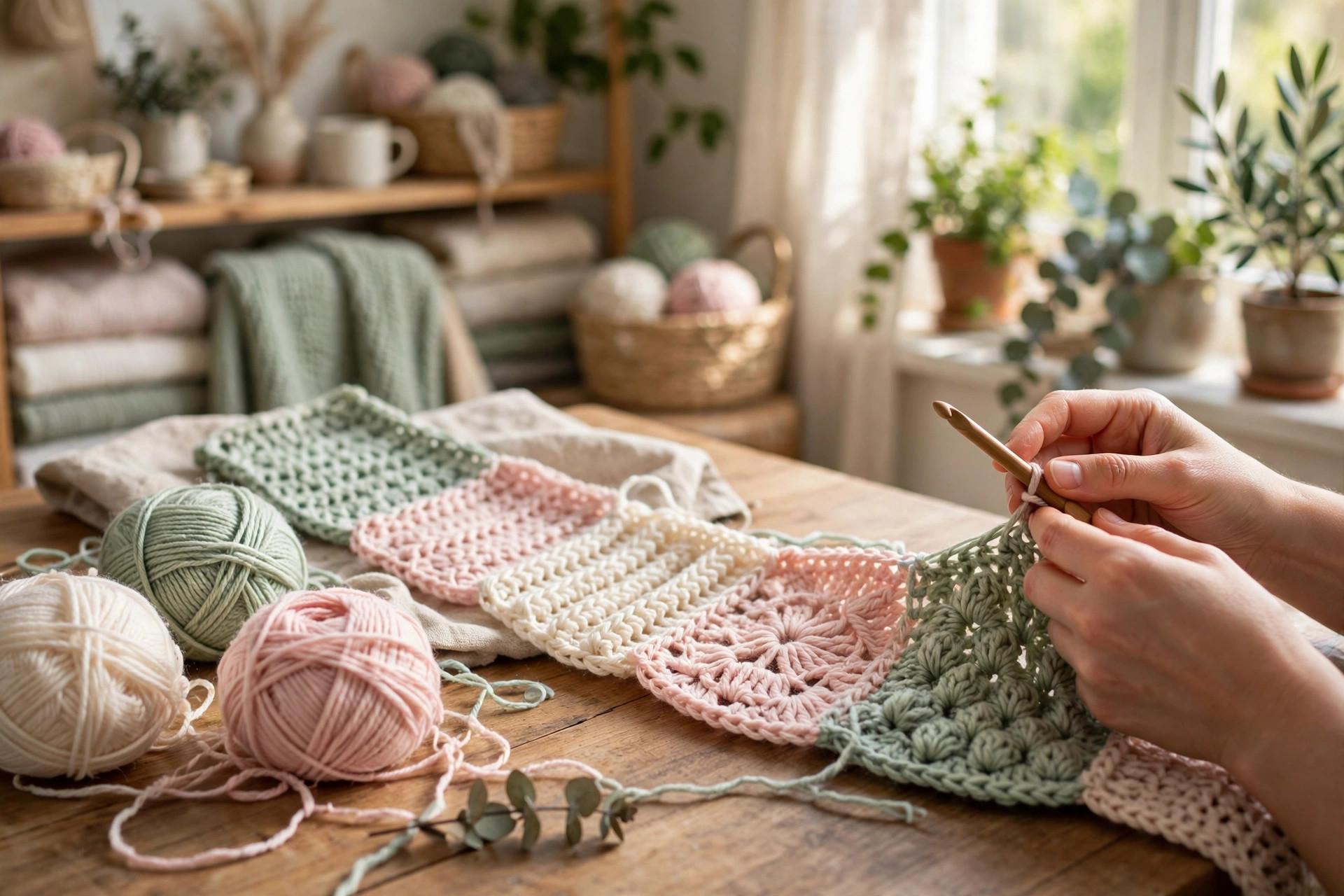
A stitch sampler is also the smartest way to learn crochet. Instead of ten separate swatches that end up in a drawer, you make one useful scarf and learn ten stitches along the way, with each section building on the one before it.
Finished Size, Skill Level, and Time
- Finished size: about 8 inches wide and 60 inches long, not counting the tassels, in worsted weight yarn. Each stitch section is about 6 inches long, and the scarf has 10 sections.
- Skill level: Beginner. You need chains and single crochet to start, and every new stitch is explained in its own section.
- Time: about 9 hours per scarf: 7 hours for the ten sections and 2 hours for the border, tassels, and finishing.
Materials You Need
| Item | What to get |
|---|---|
| Yarn, color A | Worsted weight (size 4) yarn in cream, 200 yards |
| Yarn, color B | Worsted weight (size 4) yarn in blush pink, 200 yards |
| Yarn, color C | Worsted weight (size 4) yarn in sage green, 200 yards |
| Yarn, color D | Worsted weight (size 4) yarn in soft sky blue, 200 yards |
| Hook | US J-10 (6.0 mm), or the size that gives you the gauge below |
| Notions | Tapestry needle, scissors, stitch markers, a row counter (optional) |
Worsted weight yarn is the best choice here because it works up quickly, the stitch textures show clearly, and the finished scarf is warm but not heavy. A smooth acrylic or cotton blend works well, because it shows clean stitch definition and washes easily. Choose four colors that look good together, and avoid fuzzy yarns, because they hide the stitch texture.
Abbreviations (US Terms)
- ch = chain
- sl st = slip stitch
- sc = single crochet
- hdc = half double crochet
- dc = double crochet
- puff = puff stitch (yarn over, pull up a loop 3 times in the same stitch, yarn over and pull through all loops)
- bobble = bobble stitch (5 double crochet worked together)
- st(s) = stitch(es)
- sp = space
- rep = repeat
- RS = right side
- WS = wrong side
Gauge and Sizing Notes
Gauge for a stitch sampler matters less than it does for a fitted garment, because a scarf can be a little wider or narrower and still look lovely. Work a swatch of 15 sc stitches and 16 rows in color A, and measure it. It should be about 4 inches wide and 4 inches tall. If your swatch is wider than 4 inches, go down a hook size. If it is narrower, go up a hook size.
Each section is 6 rows tall, about 6 inches long at the gauge above, for 10 sections and 60 rows in total. For a shorter scarf, work 8 sections instead of 10. For a wider scarf, chain 41 instead of 32, and adjust the stitch counts to match.
Part 1: Sections 1 to 3, the Basic Stitches
The scarf is worked flat in rows, turning at the end of every row. Each section is six rows tall and uses one color. Change color by finishing the last stitch of the old color with the new color on the final yarn over.
Foundation
With color A (cream), ch 32.
- Row 1 (RS): sc in the 2nd ch from the hook and in each ch across. (31 sc)
Count your stitches now, because 31 is the stitch count for the whole scarf.
Section 1: Single Crochet (Rows 2-7)
- Rows 2-7 (WS): with color A, ch 1, turn, sc in each st across. (31 sc)
After row 7 you should have a neat band of tight single crochet. It makes a firm fabric that holds its shape, which is why it suits the ends of the scarf. Our basic crochet scarf patterns use the same single crochet start.
Section 2: Half Double Crochet (Rows 8-13)
- Rows 8-13 (WS): with color B, ch 2, turn, hdc in each st across. (31 hdc, counting the turning chain as the first stitch)
Section 3: Double Crochet (Rows 14-19)
- Rows 14-19 (WS): with color C, ch 3, turn, dc in each st across. (31 dc, counting the turning chain as the first stitch)
Part 2: Sections 4 to 6, Shell, Bobble, and Puff
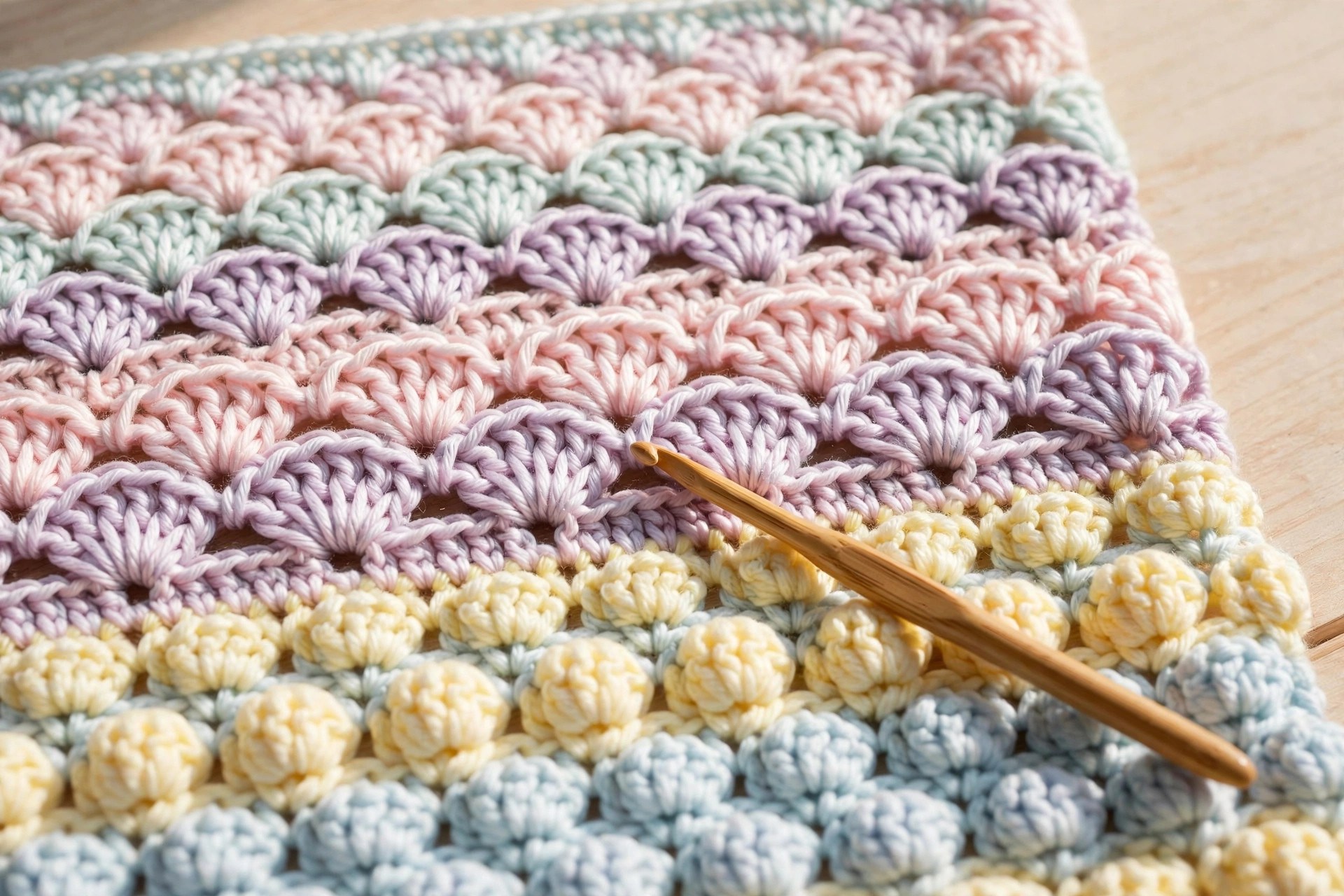
These three sections use the double crochet you just learned, grouped in new ways, to make shells, bobbles, and puffs. Work slowly through the first row of each section.
Section 4: Shell Stitch (Rows 20-25)
- Row 20 (WS): with color D, ch 1, turn, sc in first st, *skip 2 sts, 5 dc in next st, skip 2 sts, sc in next st; rep from * 3 more times, skip 2 sts, 5 dc in next st, skip 2 sts, sc in last st. (31 sts, 5 shells)
- Row 21: ch 3, turn, 2 dc in first sc, *sc in center dc of next shell, 5 dc in next sc; rep from * 3 more times, sc in center dc of next shell, 3 dc in last sc. (31 sts)
- Rows 22-25: rep row 21. (31 sts)
Shell stitch makes a scalloped, lacy band, the prettiest section in the scarf. Count the shells at the end of row 20: you should have 5 shells and 6 single crochet stitches.
Section 5: Bobble Stitch (Rows 26-31)
- Rows 26, 28, 30 (WS): with color A, ch 1, turn, sc in each st across. (31 sc)
- Rows 27, 29, 31: ch 1, turn, sc in each of the first 3 sts, *bobble in the next st, sc in each of the next 3 sts; rep from * across, ending with sc in each of the last 3 sts. (31 sts, 7 bobbles)
Section 6: Puff Stitch (Rows 32-37)
- Rows 32, 34, 36 (WS): with color B, ch 1, turn, sc in each st across. (31 sc)
- Rows 33, 35, 37: ch 1, turn, sc in the first st, *puff in the next st, sc in the next st; rep from * across, ending with sc in the last st. (31 sts, 15 puffs)
Puff stitch is softer than bobble stitch, because the loops are pulled up loosely. Keep your puffs the same height by pulling each loop up to the same length. Our waffle stitch crochet pattern uses the same idea of raised texture on a plain background.
Part 3: Sections 7 to 10, Clusters, V Stitch, and the Finish
The last four sections combine stitches you already know: clusters group double crochet together, V stitch spreads them apart, and lemon peel mixes single and double crochet for a pebbled texture.
Section 7: Granny Clusters (Rows 38-43)
- Row 38 (WS): with color C, ch 3, turn, 2 dc in the first st, *skip 2 sts, 3 dc in the next st; rep from * 8 more times, skip 2 sts, dc in the last st. (31 sts)
- Rows 39-43: ch 3, turn, 2 dc in the first st, 3 dc in the space between each cluster below, ending with dc in the last st. (31 sts)
Granny clusters are fast and rhythmic, the same stitch that builds granny squares. Once you learn them here, you can make granny squares, blankets, and bags with the same stitch. Our mosaic crochet pattern is a good next project if you enjoy working with stitch groups.
Section 8: V Stitch (Rows 44-49)
- Row 44 (WS): with color D, ch 3, turn, dc in the first st, *skip 1 st, (dc, ch 1, dc) in the next st; rep from * 13 more times, dc in the last st. (14 V stitches)
- Rows 45-49: ch 3, turn, dc in the first st, (dc, ch 1, dc) in the chain 1 space of each V below, ending with dc in the last st. (14 V stitches)
Section 9: Lemon Peel (Rows 50-55)
- Row 50 (WS): with color A, ch 1, turn, sc in the first st, *dc in the next st, sc in the next st; rep from * across, ending with sc in the last st. (31 sts)
- Row 51: ch 1, turn, dc in the first st, *sc in the next st, dc in the next st; rep from * across, ending with dc in the last st. (31 sts)
- Rows 52 and 54: rep row 50. (31 sts)
- Rows 53 and 55: rep row 51. (31 sts)
Section 10: Single Crochet Finish (Rows 56-60)
- Rows 56-60 (WS): with color B, ch 1, turn, sc in each st across. (31 sc)
Part 4: The Border and Tassels
The border is worked in rounds around all four sides of the scarf, starting from the top right corner. It tidies the edges and hides the color change tails at the sides.
Border
With color B still attached, do not turn. Work along the top edge first, then down the side, along the bottom, and up the other side.
- Round 1: ch 1, sc across the top edge (31 sc), 3 sc in the corner st, sc evenly down the side edge (about 60 sc), 3 sc in the corner st, sc across the bottom edge (31 sc), 3 sc in the corner st, sc evenly up the other side edge (about 60 sc), 3 sc in the corner st, join with a sl st to the first sc.
- Round 2: ch 1, sc in each st around, working 3 sc in each corner st, join with a sl st to the first sc. Fasten off color B.
The two rounds of single crochet in blush pink give the scarf a clean frame about half an inch wide.
Tassels
Cut 24 strands of yarn, 12 inches long, in a mix of the four colors. Take 3 strands together, fold them in half, pull the loop through a stitch at the short end with your hook, then pull the ends through the loop and tighten gently. Repeat across the short end, with 4 tassel groups on each end, and trim them to about 4 inches.
Finishing
Weave in every yarn end with a tapestry needle, working the tail through the back of several stitches in the same color, then trimming it close. Block the scarf by laying it flat on a clean towel, misting it lightly with water, and gently shaping the edges straight. Let it dry flat, and do not stretch it hard, because the shell and V stitch sections can grow longer than the single crochet sections.
To wear it, fold the scarf in half and pull the ends through the loop, or wrap it once around your neck. Our chevron crochet pattern makes a matching throw in the same pastel colors.
Variations: Colors, Sizes, and Uses
- Classic cream and blush: work the scarf in cream and blush pink only, alternating by section.
- Bold rainbow sampler: use a different bright color for every section, ten colors in all.
- Mens sampler scarf: make the scarf in navy, charcoal, and forest green with no tassels.
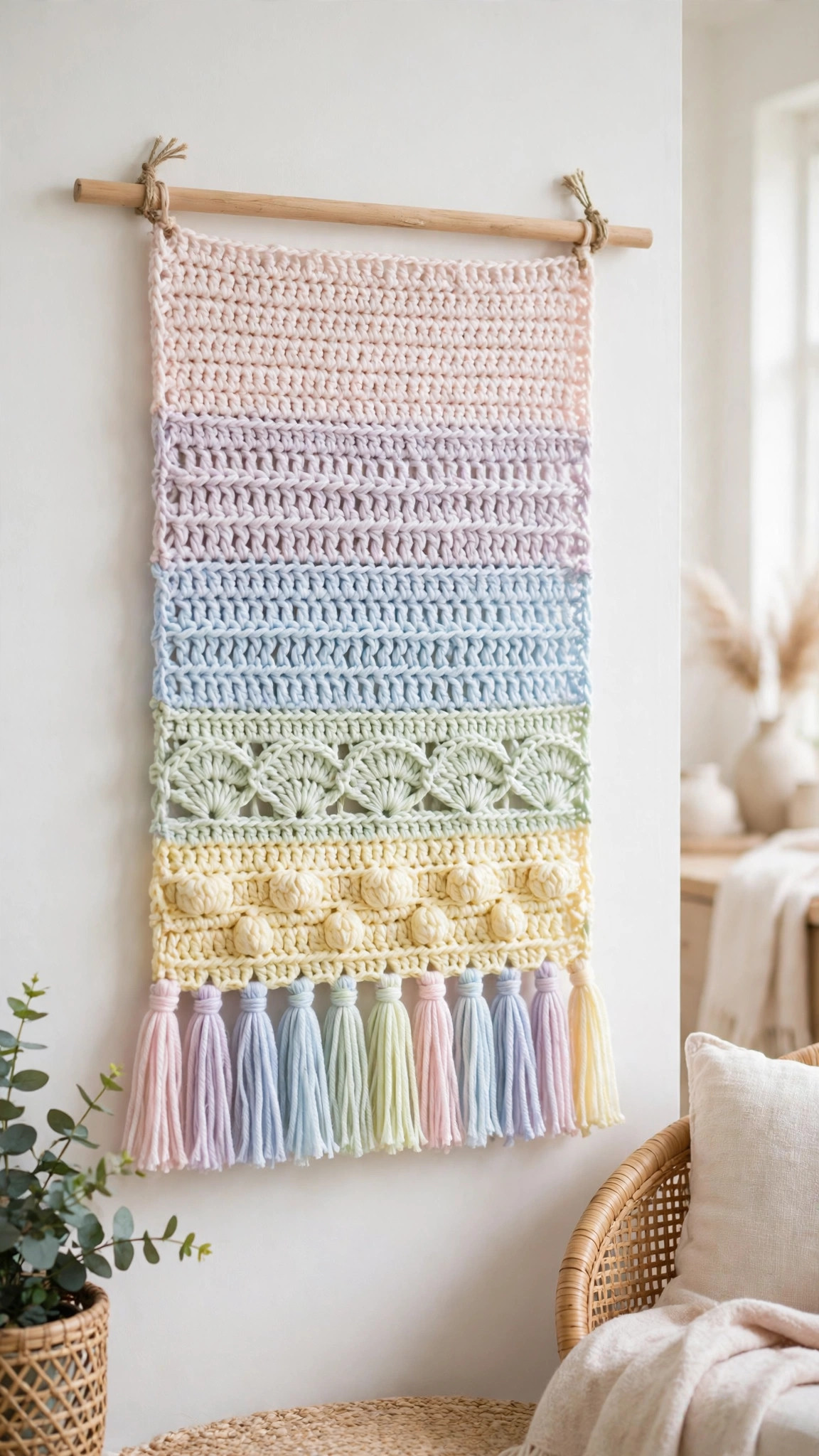
- Sampler wall hanging: stop after section 5, add a wooden dowel rod through the top edge, and hang it on the wall as stitch art.
- Sampler baby blanket: chain 64 instead of 32 and make a soft baby blanket about 16 inches wide, with a simple single crochet border.
Troubleshooting Wavy Edges and Uneven Sections
- My edges wobble from side to side. The turning chain is being worked as a stitch on one side and skipped on the other, so place a stitch marker in the top of the turning chain at the start of every row.
- My sections are different widths. Your tension changed between sections, so measure the width after every section and work a wider section a little tighter.
- My shells lean to one side. Work each new shell into the single crochet between the shells below it.
- My bobbles disappear into the fabric. Check that rows 26, 28, and 30 are plain single crochet, because the bobbles need plain rows on either side to pop.
- My stitch count drifts from 31. A stitch was missed at a color change, or an extra stitch was added at the edge, so count at the end of every row and pull back to the last color change if the count is wrong.
Care Instructions
Machine wash on a gentle cycle in cool water with a mild detergent, and lay flat to dry. If the yarn label says hand wash only, wash gently in cool water with a tiny amount of mild soap, press the water out without wringing, and lay flat on a clean towel to dry. Do not put the scarf in the dryer on high heat. Reshape the tassels while it is damp, and keep it out of direct sunlight.
Frequently Asked Questions
Is this stitch sampler crochet pattern good for beginners?
Yes, it is made for beginners. You only need chains and single crochet to start, and every new stitch is explained in its own section. One scarf takes about 9 hours, and you will know ten stitches by the end of it.
What yarn is best for a stitch sampler scarf?
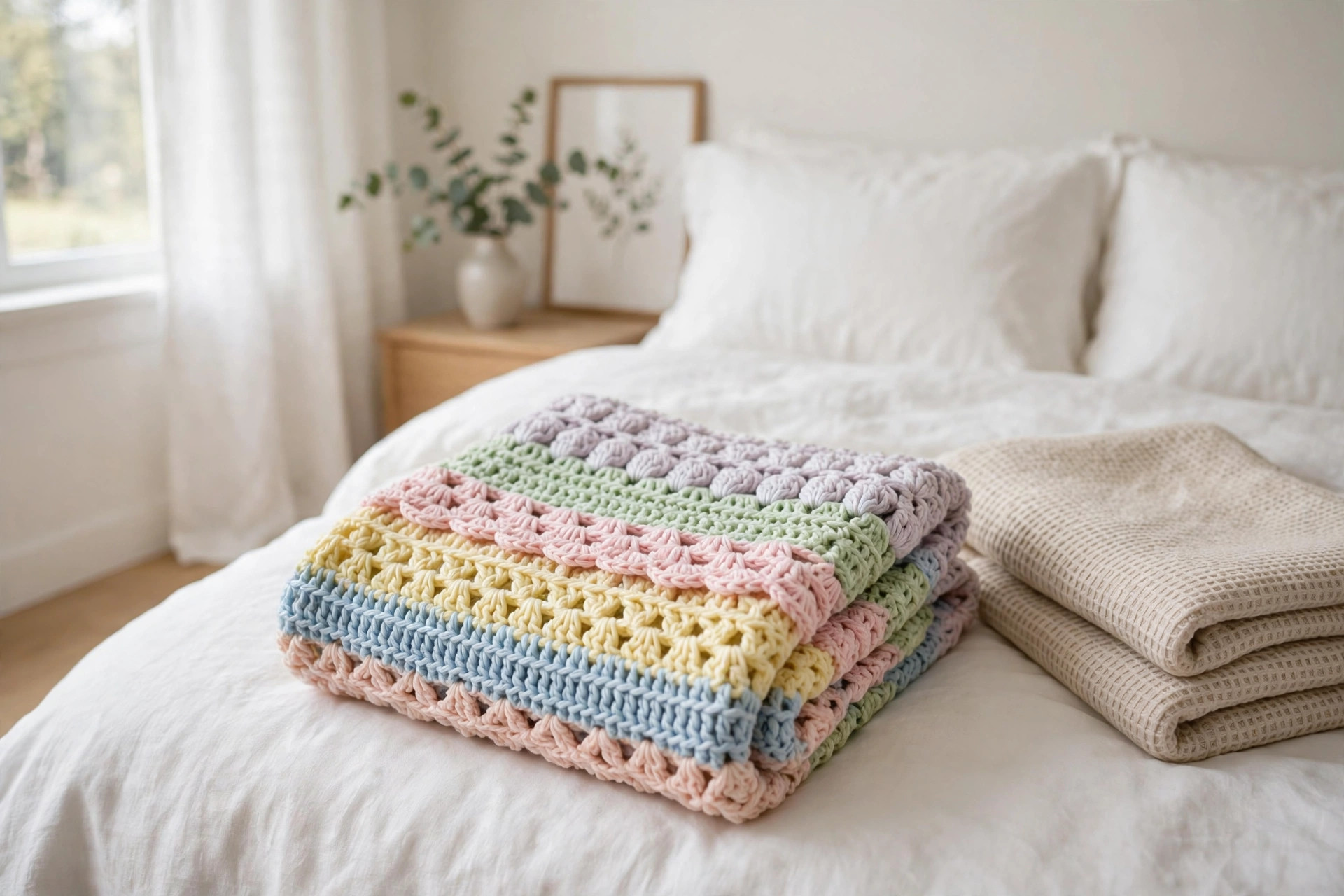
Worsted weight yarn, because it works up quickly and the stitch textures show clearly. Cream, blush pink, sage green, and soft sky blue give the pastel look in the photos, but any four colors that look good together will work.
How big is the finished scarf?
About 8 inches wide and 60 inches long, not counting the tassels, in worsted weight yarn with a 6.0 mm hook. Each of the ten stitch sections is about 6 inches long.
How do I change colors between sections?
Finish the last stitch of the old color with the new color on the final yarn over. Leave a 6 inch tail of each color to weave in later.
Can I make the stitch sampler as a blanket?
Yes, chain 64 instead of 32 for a width of about 16 inches, or chain 96 for about 24 inches, and work each section the same way with adjusted stitch counts.
Can I sell scarves made from this pattern?
Yes, you may sell finished scarves made from this free pattern, with credit to Little Loop Finds. Please do not sell or republish the pattern text itself.
Happy stitching, and may your little sampler teach you ten new stitches and keep you warm all winter long.