Free Crochet Shark Booties Pattern: Baby Shark Shoes
Soft baby shark shoes in US terms: original design, easy oval-sole construction, and a toothy cuff babies will love.

Baby & Kids · Crochet
- Finished size
- 0-3 months, 3.5 in sole
- Making time
- About 4 hours a pair
- Hook
- 3.5 mm, worsted yarn
- Set
- 2 booties + 2 fins
- Skill
- Easy
In this post
- Table of contents
- Why you'll love these crochet shark booties
- Materials you'll need
- Size, gauge and skill level
- Abbreviations, US terms
- The crochet shark booties pattern (US terms)
- Finishing touches and assembly
- Tips and tricks
- Variations to try next
- Troubleshooting tips
- Frequently asked questions
- More free patterns to try
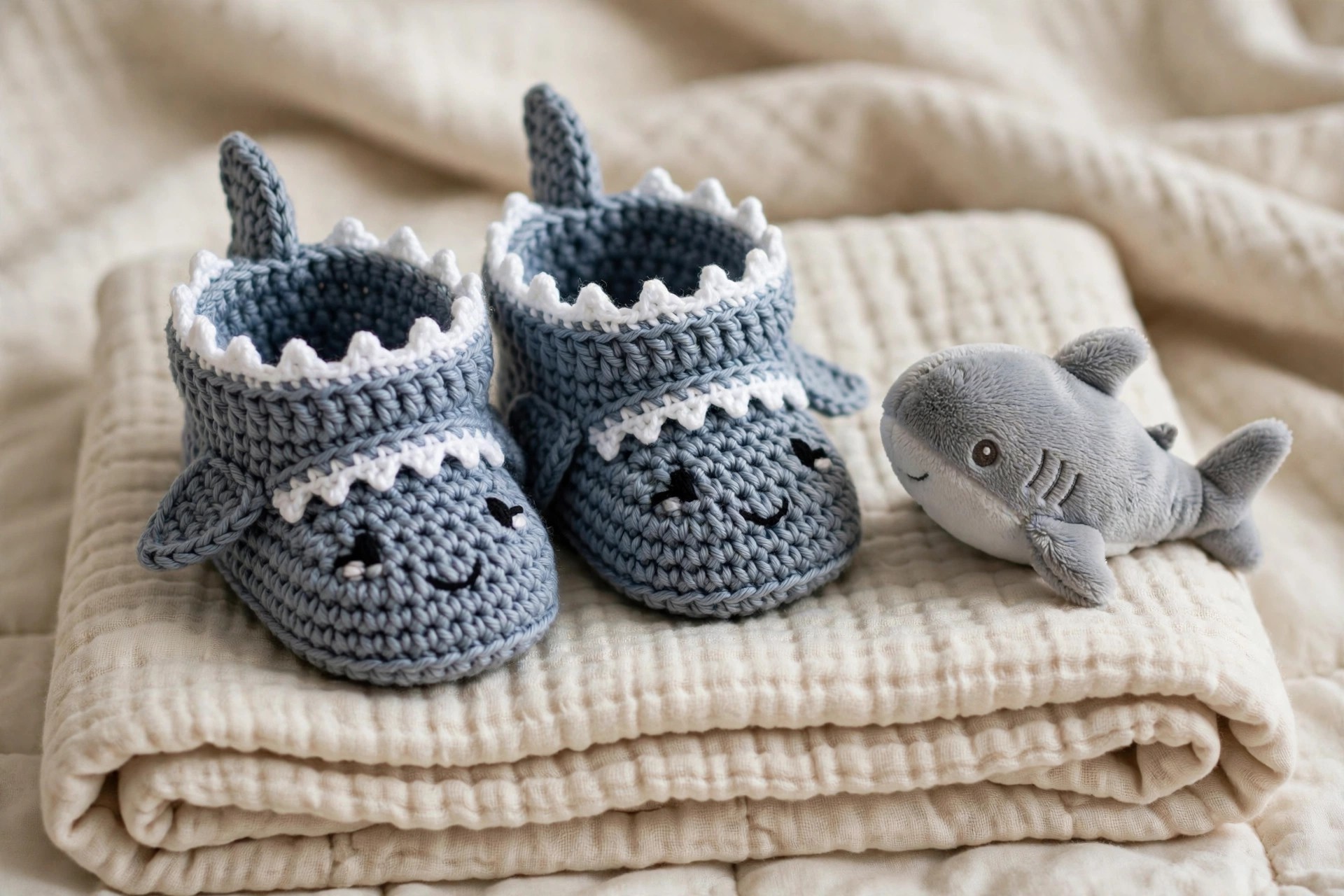
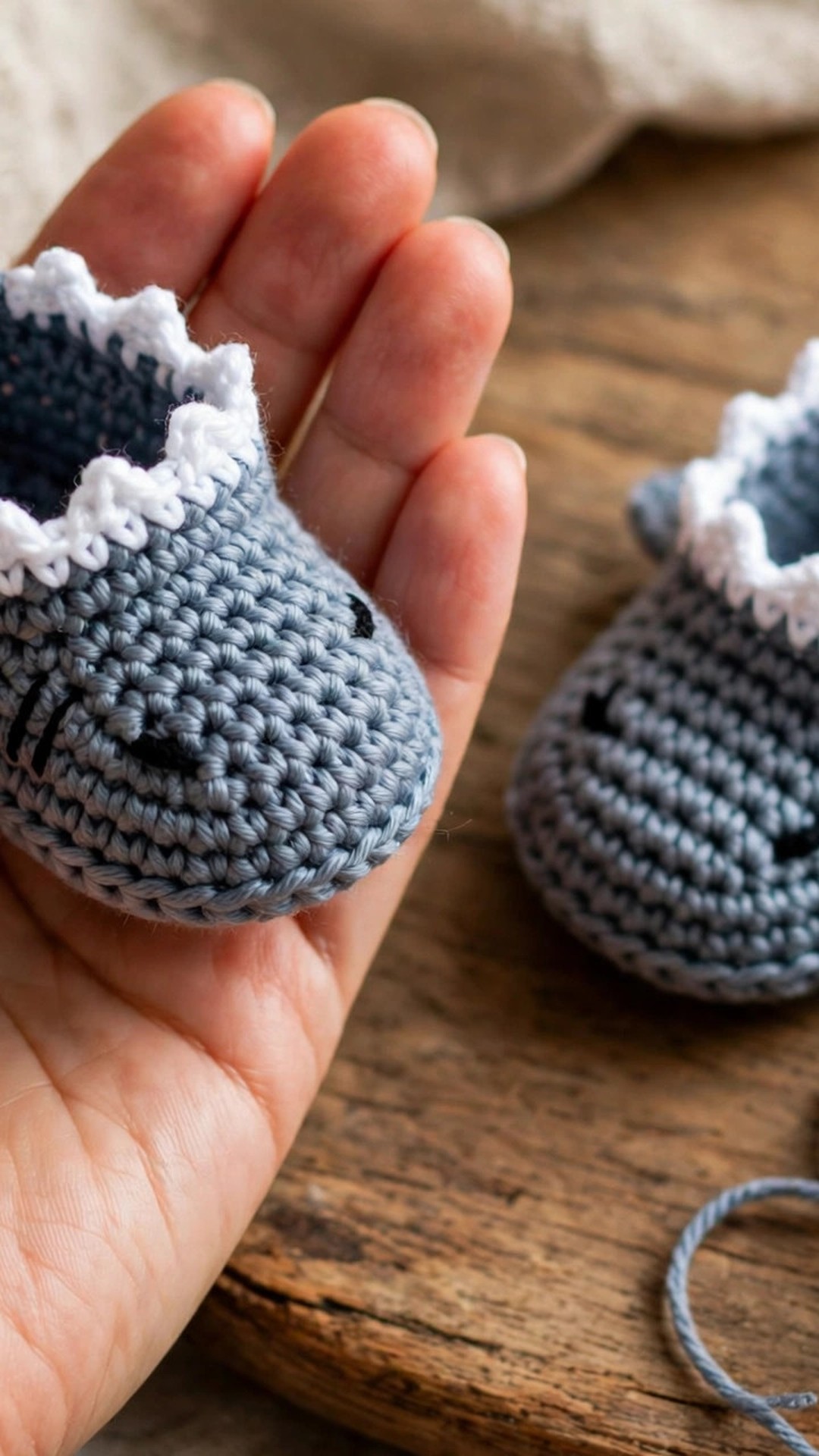
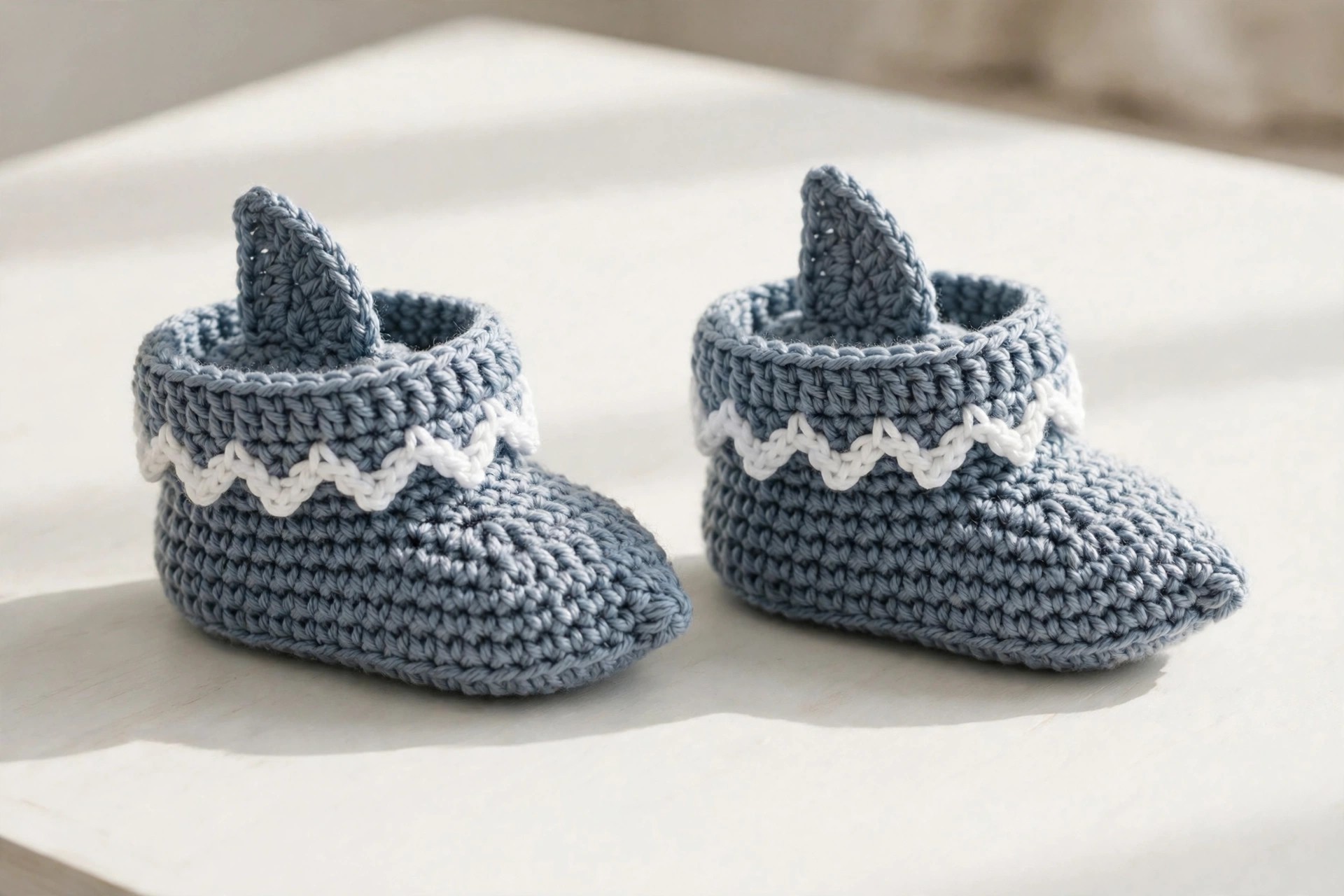
Baby shark, doo doo doo doo doo doo: now on tiny feet. These crochet shark booties are the cutest thing to happen to baby shoes in a long time: soft grey-blue booties with a white zigzag of shark teeth around the cuff, a little dorsal fin on the back, and sweet embroidered eyes on the toes.
They are worked from the sole up in one piece (plus the fins), so there is almost no sewing: sole, foot, cuff, teeth trim, done. The free pattern below covers size 0-3 months with simple adjustments for 3-6 months, and the whole pair works up in an afternoon. This is an original Little Loop Finds design in US terms.
If you have made baby booties before, you know the two rules: they must stay on, and they must be soft. These tick both boxes: a snug cuff with an optional drawstring keeps them put, and worsted yarn on a 3.5 mm hook makes a cushiony fabric with no scratchy seams inside.
Table of contents
- Why you'll love these crochet shark booties
- Materials you'll need
- Size, gauge and skill level
- Abbreviations, US terms
- The crochet shark booties pattern (US terms)
- Finishing touches and assembly
- Tips and tricks
- Variations to try next
- Troubleshooting tips
- Frequently asked questions
- More free patterns to try
Why you'll love these crochet shark booties
Novelty baby patterns walk a fine line: too simple and they look unfinished, too fiddly and they never get made. These booties land right in the sweet spot. The shark details are big, bold shapes: a toothy cuff, a triangular fin, two eyes. Each one takes minutes, and together they read instantly as a shark from across the room.
The construction is beginner-friendly. The sole is a simple oval, the foot is plain rounds with easy toe decreases, and the teeth are just picots worked into the last round: no colour changes mid-round, no intarsia, no sewing tiny pieces except the fins. If you can single crochet in the round, you are qualified.
They are also a gift-giving secret weapon. Baby showers, new-baby visits, craft fair tables: shark booties get picked up, gasped at, and photographed. Pair them with our crochet infant shoes pattern for a whole shoebox of handmade baby footwear.
Materials you'll need
| Supply | What to get |
|---|---|
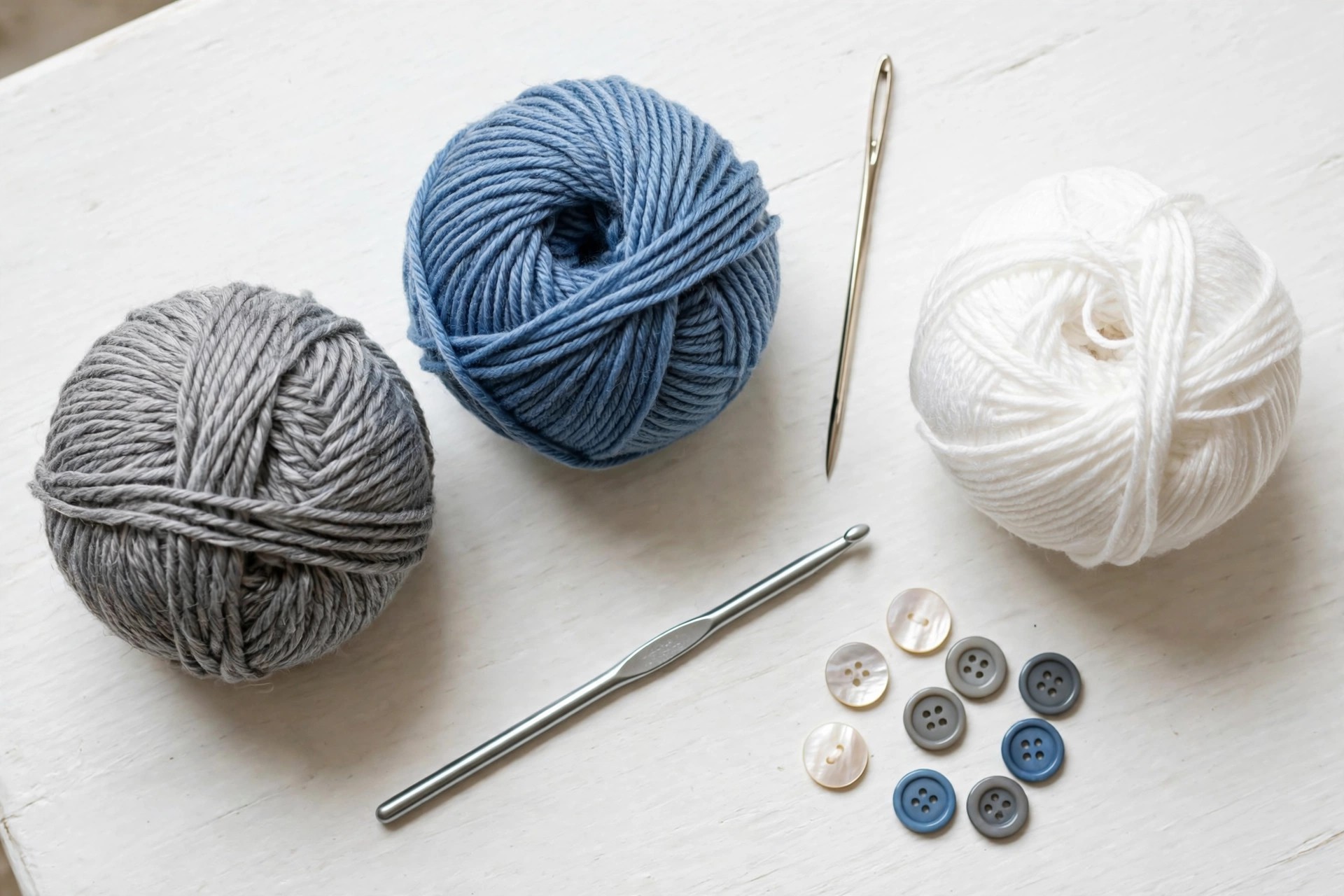
| Grey-blue yarn | Worsted-weight (#4) yarn in grey-blue, about 90 yds / 82 m |
| White yarn | Worsted-weight (#4) yarn in white, about 20 yds / 18 m |
| Black yarn | Small amount of black worsted yarn for the embroidered eyes |
| Crochet hook | 3.5 mm (E) |
| Tapestry needle | For sewing the fins and weaving in ends |
| Notions | Scissors, stitch markers |
Pick a soft, washable yarn: babies are gloriously messy, and these booties will see the washing machine. A smooth acrylic or cotton-acrylic blend works best: it keeps the shark teeth crisp and survives many washes. Avoid fuzzy novelty yarns: they swallow the tooth detail and shed around tiny mouths.
A note on sizing yarn: work both booties from the same dye lot, and finish one bootie completely before starting the second: matching pairs happen by construction, not by luck.
Size, gauge and skill level
The pattern as written fits 0-3 months (sole about 3.5 in / 9 cm). Notes for 3-6 months (sole about 4 in / 10 cm) appear after the main pattern. Booties are worked in continuous spiral rounds except where rows are specified.
| Measurement | Value |
|---|---|
| Finished sole, 0-3 mo | About 3.5 in / 9 cm |
| Finished sole, 3-6 mo | About 4 in / 10 cm |
| Approx. time | About 4 hours for the pair |
- Finished size: the 0-3 month bootie sole measures about 3.5 inches long. For reference, that fits a newborn to a 3-month-old comfortably with a little growing room. The 3-6 month version adds one sole round and a touch of width.
- Gauge: about 18 sc and 20 rounds = 4 in (10 cm). Gauge matters more here than in amigurumi: a loose bootie falls off. If your booties come out larger than the sole measurements, drop to a 3.25 mm hook.
- Skill level: easy. You should know how to work an oval sole (explained below), single crochet in the round, decrease, and work a picot. The fins are single rows: the easiest part of the whole project.
Abbreviations, US terms
| Abbreviation | Meaning |
|---|---|
| ch | chain |
| sc | single crochet |
| hdc | half double crochet |
| dc | double crochet |
| inc | increase: 2 sc in the same stitch |
| dec | invisible decrease (sc2tog also works) |
| st(s) | stitch(es) |
| R | round |
| FO | fasten off |
| BLO | back loop only |
| picot | ch 3, sl st in the first ch of the ch-3 |
| [ ] | total stitch count at the end of the round |
Reading the pattern: the sole is worked as an oval around a foundation chain: you crochet up one side of the chain, around the end, and back down the other side. The stitch counts include both sides of the oval.
The crochet shark booties pattern (US terms)
Make two identical booties. Work the sole, then the foot and cuff in continuous rounds, then the teeth trim in white. The fins are made separately and sewn on.
Sole (grey, make 2)
- ch 11.
- R1: sc in 2nd ch from hook, sc in next 8 ch, 3 sc in last ch; working down the other side of the chain, sc in next 8 ch, 2 sc in the same ch as the first sc. [22]
- R2: inc in first st, sc in next 8 sts, inc x3, sc in next 8 sts, inc x2. [28]
- R3: sc in BLO in each st around. [28]
The back-loop round creates a crisp ridge where the sole meets the upper: it also gives the bootie a flat, stable base. Check that the sole measures about 3.5 inches long before continuing.
Foot (grey, continue from the sole)
- R4-R6: sc in each st around. [28]
- R7: sc in next 8 sts, dec x6, sc in next 8 sts. [22]
- R8: sc in next 7 sts, dec x4, sc in next 7 sts. [18]
- R9: sc in each st around. [18]
The decreases shape the toe: R7 and R8 pull the front of the bootie in so it curves over the toes. Keep the decreases centred on the toe by starting each decrease section at the same point relative to your marker: count from the marker, not from where the last round ended.
Cuff (grey, continue from the foot)
- R10-R12: sc in each st around. [18]
The cuff should stand about an inch tall: it is what the teeth trim sits on. Try the bootie on a willing foot model (or a 3.5-inch oval of cardboard) to check the fit before the trim: snug but not tight.
Shark teeth trim (white)
Join white with a slip stitch in any stitch of R12.
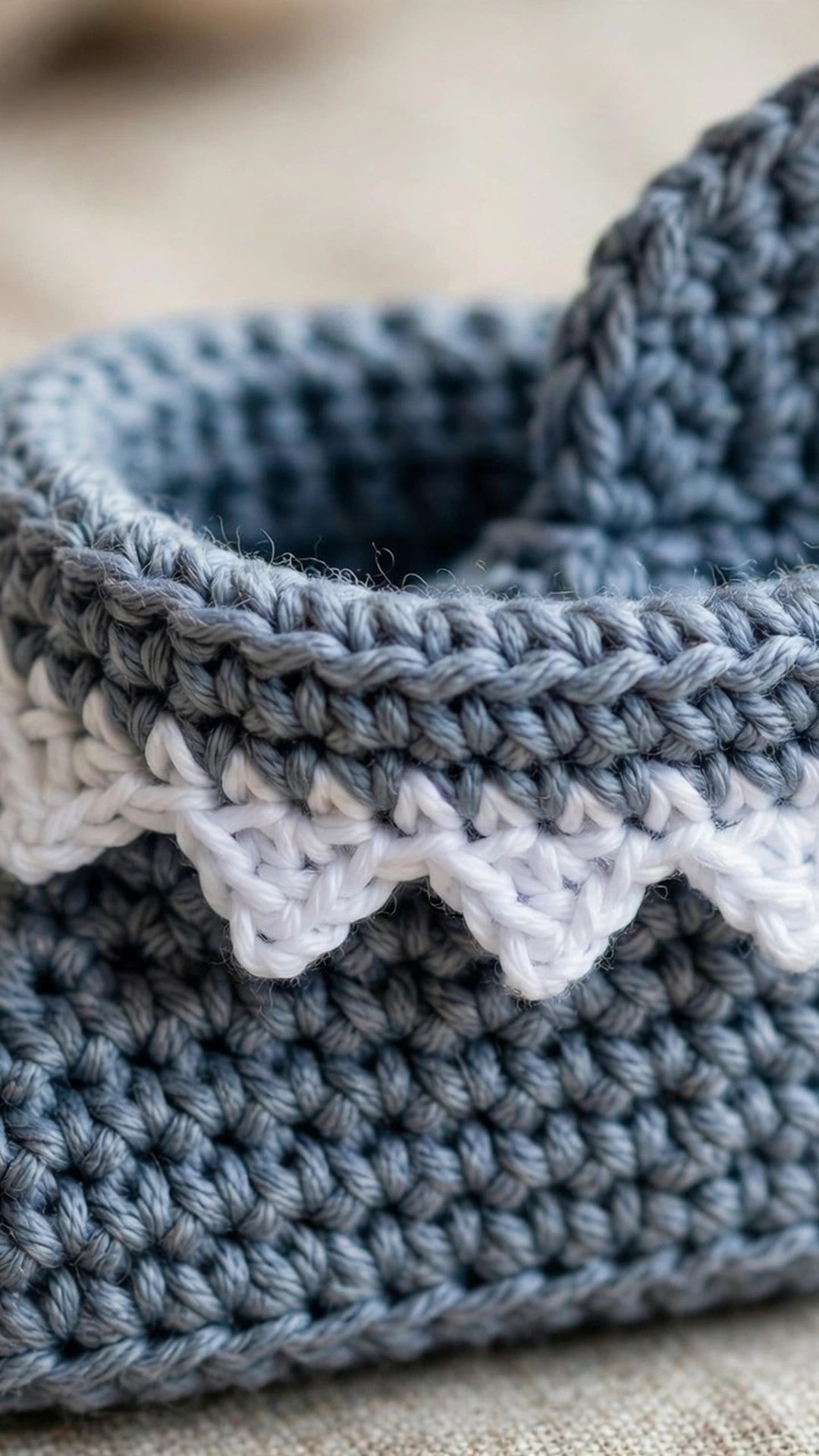
- R13: sc in next 2 sts, picot x6. [18 sc + 6 picots]
Work each picot as: ch 3, sl st in the first ch of the ch-3, then continue with the next sc. The picots flare outward into little triangles: from a distance they read as a zigzag of teeth. FO white, leaving a short tail to weave in.
Dorsal fin (grey, make 2)
Worked in rows, one fin per bootie:
- Row 1: ch 6, sc in 2nd ch from hook, hdc in next ch, dc in next ch, hdc in next ch, sc in last ch. FO, leaving a long tail for sewing.
The row naturally forms a triangle: the dc in the middle is the tallest point, the sc ends are the short corners. That tall middle point is the top of the fin.
Size 3-6 months adjustments
Work the sole as: ch 13. R1: sc in 2nd ch, sc in next 10 ch, 3 sc in last ch; down the other side, sc in next 10 ch, 2 sc in the same ch as the first sc. [26] R2: inc, sc 10, inc x3, sc 10, inc x2. [32] R3: sc in BLO around. [32] Then R4-R6: sc around [32]; R7: sc 10, dec x6, sc 10 [26]; R8: sc 9, dec x4, sc 9 [22]; R9: sc around [22]; R10-R13: cuff sc around [22]; teeth: sc 2, picot x7, sc in last st [22 sc + 7 picots]. The fin is the same.
Finishing touches and assembly
Almost no sewing: that is the beauty of this pattern. Here is the short finishing list.
Weave in the ends. The booties have only a few: the sole start, the colour join, and the fin tails. Weave each through several stitches on the inside of the bootie, changing direction once. Trim close: no loose ends where tiny toes go.
Sew on the dorsal fins. Pin one fin to the back centre of each bootie, at the height of R10-R11, with the tall point facing up and slightly back. The back is opposite the toe decreases: if you lose track, the teeth picots look the same all around, so find the toe curve first. Whipstitch the base of the fin to the cuff with the grey tail, going through the base twice for a fin that survives grabbing.
Embroider the eyes. With black yarn, work a small French knot or a 3-stitch satin dot on each side of the toe, at about R7 height and 4 stitches apart across the front. Two eyes per bootie, both facing forward: they give the shark its personality. For very young babies, embroidery is the only safe choice: no buttons, no safety eyes on footwear.
Add the drawstring (optional but recommended). Ch 60 in grey or white, FO, and weave it in and out of the stitches of R11, starting and ending at the front centre. Tie in a small bow. The drawstring is what keeps booties on kicking feet: for a shower gift, include it, since new parents will thank you.
Block lightly. The booties do not need hard blocking, but a gentle steam or a damp cloth press smooths the teeth picots so they flare evenly. Let them dry fully before gifting.
Tips and tricks
Details that make your booties look store-bought:
Make the second bootie immediately. Do not take a week off between booties: your tension will drift and the pair will not match. Finish one, cast on the second the same day. Same hook, same yarn, same hands, same day.
Count the sole twice. The oval sole is the foundation: if R2 is off by a stitch, the whole bootie leans. Count R1 (22) and R2 (28) carefully. The numbers are in the pattern: trust them over your memory of the last bootie you made.
Keep the toe decreases centred. The decreases must sit on the toe, not drift to the side. Your round marker moves as you work: recount from the marker at R7 and R8, and place the first decrease of the section at the front centre.
Weave the drawstring evenly. Skip one stitch between each in-and-out of the drawstring weave: even spacing makes the cuff gather smoothly instead of puckering in one spot.
Test the fit early. At R9, before the cuff, slip the bootie over a foot (or a cardboard oval cut to size). It should slide on easily but not swim. Easier to adjust now than after the teeth are on.
Variations to try next
One bootie base, a whole aquarium:
- Pink shark. Work everything in soft pink with white teeth: the unofficial baby-shark colourway, and a shower-gift favourite.
- Whale booties. Skip the teeth trim, work the cuff one round taller, and embroider a tiny spout of three white chain stitches on the toe. Gentle giant energy.
- Dolphin booties. Use the same sole and foot in dolphin grey, skip the teeth, and add a curved dorsal fin: our free crochet dolphin pattern has fin-shaping inspiration that scales down perfectly.
- Hammerhead booties. The statement version: work the booties in grey, skip the teeth, and crochet a wide hammerhead snout across the toe. Our crochet hammerhead shark pattern shows the head shaping to borrow from.
- Monster booties. Work the cuff in bright green, make the teeth oversized (ch-4 picots), and add googly-style embroidered eyes. Halloween baby: sorted.
Troubleshooting tips
- The booties will not stay on. The cuff is too loose or there is no drawstring. Add the drawstring through R11: it is the single most effective fix. For very active kickers, work R10 in the back loop only for a snugger ankle.
- The soles curl up at the edges. Your R3 back-loop ridge is too tight, or the sole is understuffed (it should not be stuffed at all: it is flat). Press the sole flat under a book overnight; if it persists, rework R3 at a relaxed tension.
- The teeth picots curl instead of flaring. You are working the picot slip stitch too tightly. Loosen the ch-3 and the slip stitch: the picot should stand out from the cuff, not hug it. A light steam fixes mild cases.
- One bootie is bigger than the other. Tension drift between sessions. Measure both soles: if they differ, rework the larger one the same day as the smaller. Matching pairs are made back to back.
- The toe looks lopsided. The decreases drifted off centre. Undo to R7, recount from your marker, and place the decrease section at the front centre of the toe.
- The fin flops sideways. It was sewn through only one layer. Remove it and sew through the fin base and the cuff twice, catching a second row of cuff stitches for a wider anchor.
Frequently asked questions
Is this free crochet shark booties pattern really free?
Yes, the complete pattern above is free, with no email signup and no PDF purchase required. Make as many pairs as you like.
What size do the booties fit?
The main pattern fits 0-3 months (about a 3.5-inch sole). The 3-6 month adjustments are included in the pattern: a slightly longer sole and a taller cuff, about a 4-inch sole.
Will the booties stay on a kicking baby?
With the drawstring, yes for most babies. Weave the ch-60 drawstring through R11 and tie a bow: the gathered cuff is what keeps booties on. Without a drawstring, any bootie is at the mercy of determined little legs.
What yarn is best for baby booties?
A soft, washable worsted: smooth acrylic or a cotton-acrylic blend. It keeps the teeth crisp, survives the washing machine, and has no fuzzy fibres near the baby's mouth. Avoid wool for newborn gifts: many parents prefer fully washable fibres.
Can I machine wash the booties?
Yes, if your yarn is machine washable (most acrylics are). Wash cold on gentle and lay flat to dry so the fins and teeth keep their shape.
Can I sell the finished booties?
Yes! You may sell finished booties made from this pattern in small batches (craft fairs, markets, custom orders). Please credit Little Loop Finds as the pattern designer.
Are the embroidered eyes safe for newborns?
Yes: embroidered eyes are the safest option for baby items, since there are no small parts. That is why this pattern embroiders the eyes rather than using buttons or safety eyes.
More free patterns to try
Build a whole baby gift set around the booties. Our crochet infant shoes pattern gives you classic Mary Janes and sneakers in the same size range: mix and match for a shoebox gift. For the ocean theme, the free crochet dolphin pattern makes a soft toy companion at a similar scale. And if these were your first baby booties, the easy beginner crochet patterns collection has more quick wins to build your confidence.