Temperature Snake Crochet Pattern (Free)
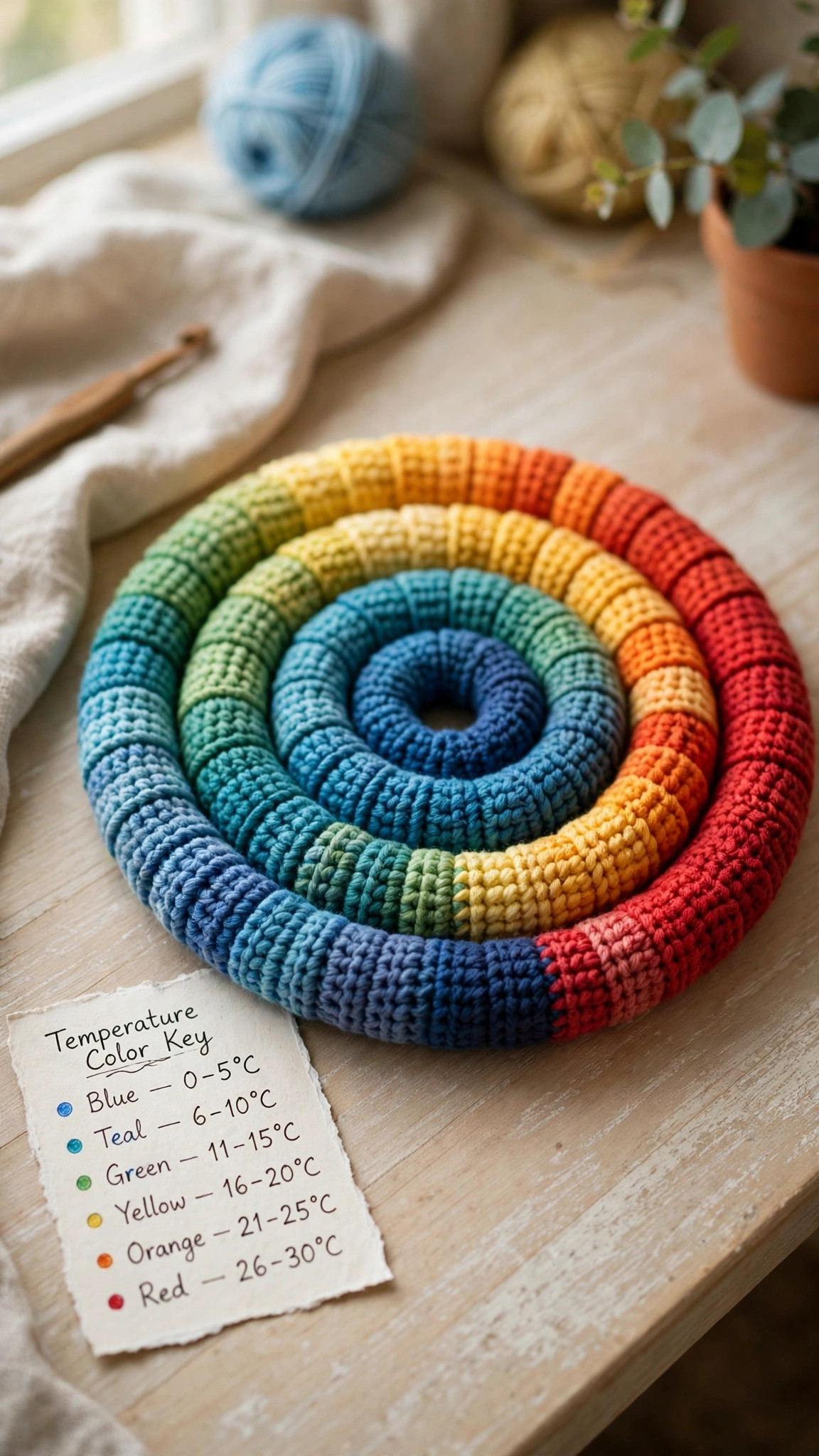
Crochet one colorful segment per day and watch the year turn into a rainbow striped keepsake snake.

Patterns · Crochet
- Finished size
- 12 to 15 ft long, 2 in wide
- Making time
- 5 minutes per daily segment
- Hook
- US G-6 (4.0 mm)
- Set
- Head, daily segments, tail
- Skill
- Easy
In this post
- Key Takeaways
- Table of Contents
- Why You Will Love a Temperature Snake
- Finished Size, Skill Level, and Time
- Materials You Need
- Abbreviations (US Terms)
- Gauge and Sizing Notes
- Your Temperature Color Key
- Part 1: The Head
- Part 2: Daily Temperature Segments
- Part 3: Tail and Finishing
- Variations: Weekly Snakes, Baby Snakes, and Gifts
- Troubleshooting Temperature Snakes
- Care Instructions
- Frequently Asked Questions
A temperature snake is the coziest way to keep a diary of the year. Each day you crochet one short segment in the color that matches that day's temperature, and by December you have a long, rainbow striped snake that tells the whole story of your year in color. This free temperature snake crochet pattern gives you the full project: a friendly head, a simple two round daily segment, a color key you can adapt to your own climate, and a tapered tail to finish it off.
This is an original Little Loop Finds design, written in US terms and completely free. The snake is worked in one continuous piece, starting at the head, so there is almost no sewing. Each daily segment takes about five minutes, which makes this the perfect low pressure year long project: a few quiet minutes with your hook each evening, and the snake grows one colorful stripe at a time.
A quick note on scope: this post is about a temperature tracker snake, a year long project where every segment records one day's temperature. If you want a plain snake toy instead, our crochet snake pattern is the classic amigurumi snake, made in one sitting with no daily tracking.
Key Takeaways
- Free original pattern: this temperature snake crochet pattern is a Little Loop Finds original design, written in US terms, and completely free.
- A year in color: one short segment per day, colored by that day's temperature, so the finished snake is a keepsake diary of your year.
- Five minutes a day: each daily segment is just two rounds of single crochet, so the project fits into the busiest evening.
- Beginner friendly: the whole snake uses single crochet, increases, and decreases, with a stitch count at the end of every round.
- Fully adaptable: the color key works in Celsius or Fahrenheit, and a weekly version makes a shorter snake if a full year feels too long.
Table of Contents
- Why You Will Love a Temperature Snake
- Finished Size, Skill Level, and Time
- Materials You Need
- Abbreviations (US Terms)
- Gauge and Sizing Notes
- Your Temperature Color Key
- Part 1: The Head
- Part 2: Daily Temperature Segments
- Part 3: Tail and Finishing
- Variations: Weekly Snakes, Baby Snakes, and Gifts
- Troubleshooting Temperature Snakes
- Care Instructions
- Frequently Asked Questions
Why You Will Love a Temperature Snake
A temperature snake turns the weather into a keepsake. A cold snap in January shows up as a band of deep blue, a heatwave in July as a stripe of bright red, and the gentle greens and yellows of spring sit in between like a gradient you made with your own hands. Nobody else's snake will ever look like yours, because nobody else lived your exact year, in your exact place, with your exact colors.
The project is also wonderfully forgiving. Miss a day or two and you simply catch up with two or three segments the next evening, because each segment is only two rounds. Go on holiday and you can look up the temperatures when you get home. There is no deadline pressure, no giant blanket to lug around, and no complicated counting: one day, one color, two rounds, done.
Temperature projects have a lovely tradition behind them. Temperature blankets are the classic version, but a blanket takes months of heavy rows and a lot of yarn. A snake gives you the same daily ritual in a small, portable, playful form, and the finished piece is a conversation starter draped over a chair or coiled in a basket.
If you like small daily makes, this snake pairs beautifully with other quick projects. Our worry worm crochet pattern is another five minute make with the same portable charm, and our jellyfish crochet pattern makes a sweet companion for a sea themed shelf.
Finished Size, Skill Level, and Time
- Finished size: about 12 to 15 feet long and about 2 inches wide, for a full year of daily segments in DK weight yarn. A weekly version, one segment per week, finishes at about 2 feet long.
- Skill level: Easy. You need a magic ring, chains, single crochet, increases, decreases, and a slip stitch join. The daily segment is the same two rounds repeated all year.
- Time: about 30 minutes for the head, about 5 minutes per daily segment, and about 20 minutes for the tail and finishing. The project spreads across the year, so it never feels like a big commitment.
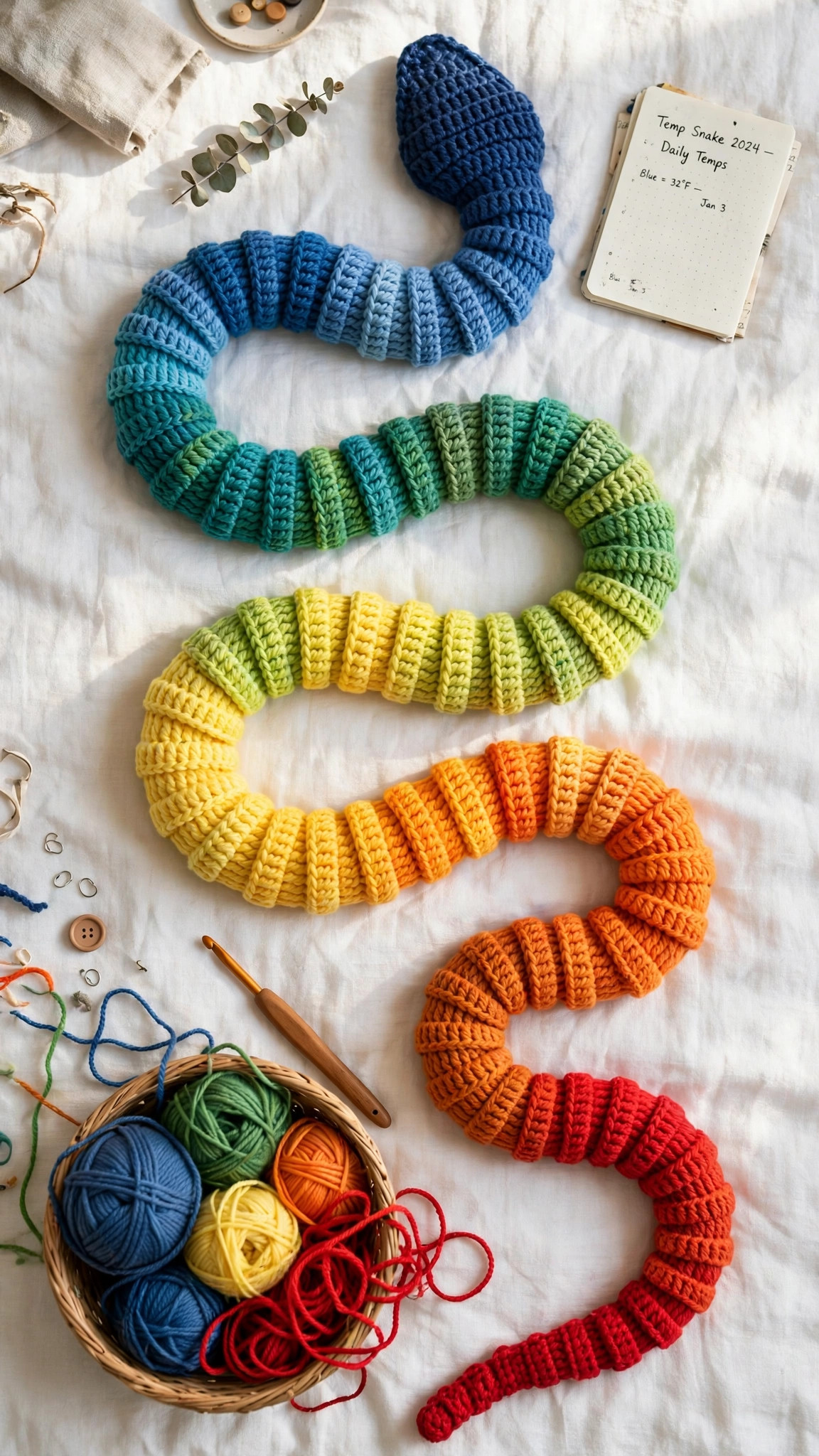
Materials You Need
| Item | What to get |
|---|---|
| Yarn, main | DK weight (size 3) yarn in 8 colors for the temperature scale, about 20 yards of each color per month |
| Yarn, head | DK weight (size 3) yarn in a color you love for the head, about 30 yards |
| Yarn, tongue | A small amount of red or pink DK yarn for the forked tongue |
| Hook | US G-6 (4.0 mm), or the size that gives you a firm, even fabric |
| Notions | Tapestry needle, scissors, stitch markers, polyester stuffing, two 10 mm safety eyes |
DK weight yarn is the best choice for a temperature snake because it makes a light, flexible snake that drapes nicely, and the segments stay neat and even. Worsted weight yarn works too, and it makes a slightly wider snake, about 2.5 inches across. Choose smooth yarns in colors that read clearly as a gradient, because the color story is the whole point of the project.
For a full year you need roughly one 100 gram ball of each temperature color, though the colors at the ends of your scale will be used less than the middle colors. Buying the full set at the start means your colors stay consistent all year. Keep a small notebook or a phone note for your daily temperatures, and a printed copy of your color key near your crochet chair.
Abbreviations (US Terms)
- ch = chain
- sl st = slip stitch
- sc = single crochet
- inc = increase, 2 sc in the same stitch
- dec = decrease, single crochet 2 stitches together
- st(s) = stitch(es)
- rnd(s) = round(s)
- rep = repeat
- MR = magic ring
Gauge and Sizing Notes
Gauge for a temperature snake is about keeping the tube even and firm, not about hitting an exact number. Work the head first and check that the tube feels firm and the stuffing does not show through the stitches. If you can see stuffing between stitches, go down a hook size. If the tube feels stiff and hard to work, go up a hook size.
Each daily segment adds about half an inch of length. A full year of 365 segments makes a snake about 15 feet long, which is gloriously long and exactly the point of the project. If that sounds like too much snake, work one segment per week instead, using the average temperature of the week, and your snake will finish at about 2 feet long. You can also start on any date: a snake begun on a birthday, a wedding day, or New Year's Day is just as meaningful as one begun on January 1.
Your Temperature Color Key
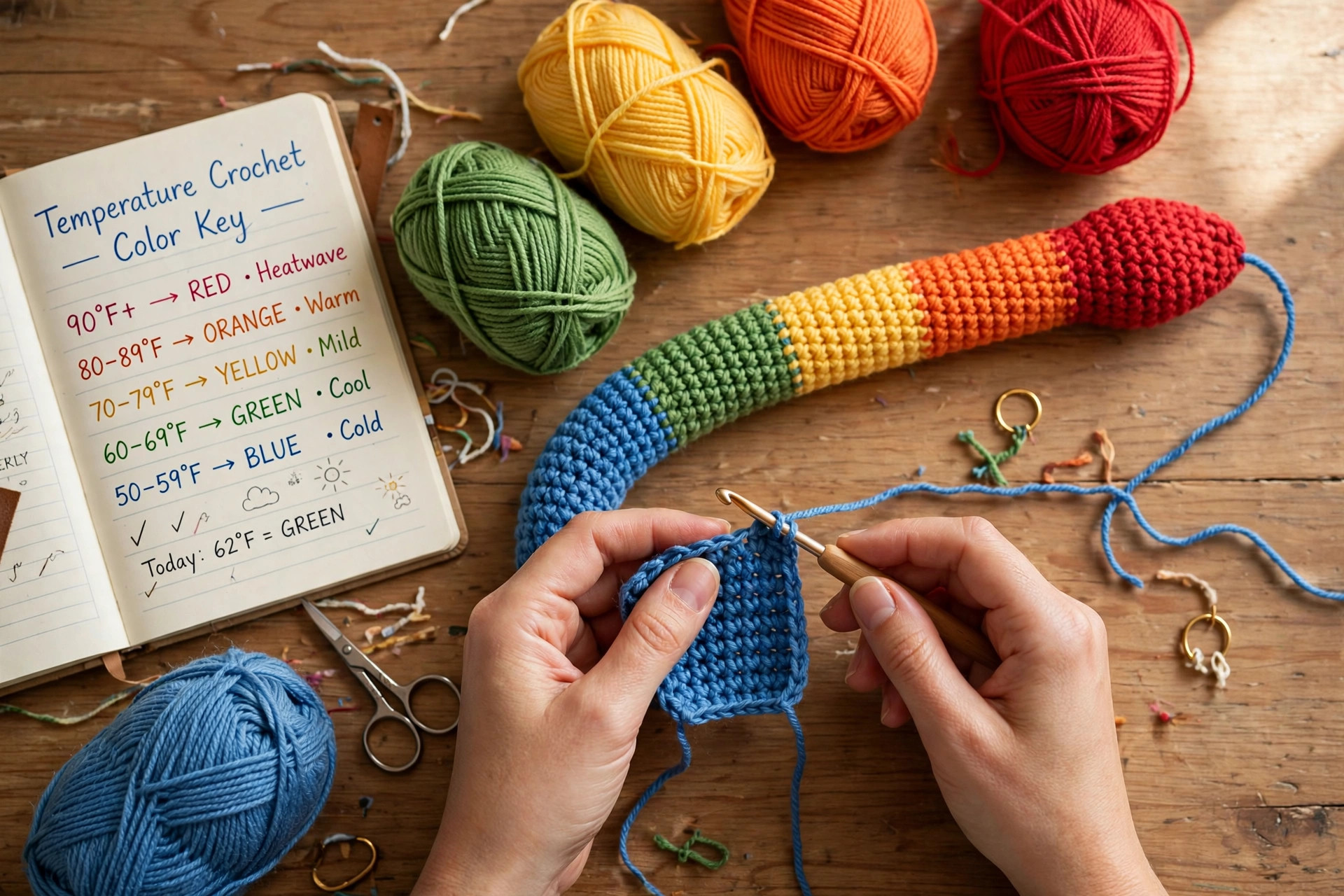
Before you crochet the first segment, choose your colors and write them down. The key below uses Celsius, with a Fahrenheit version beside it, and it suits a temperate climate with cold winters and warm summers. If you live somewhere hotter or colder, shift the bands to fit your weather, but keep eight colors in a smooth gradient from cold to hot.
| Temperature | Color | Fahrenheit |
|---|---|---|
| Below 0 C | Deep navy blue | Below 32 F |
| 0 to 5 C | Medium blue | 32 to 41 F |
| 6 to 10 C | Teal | 42 to 50 F |
| 11 to 15 C | Leaf green | 51 to 59 F |
| 16 to 20 C | Sunny yellow | 60 to 68 F |
| 21 to 25 C | Orange | 69 to 77 F |
| 26 to 30 C | Bright red | 78 to 86 F |
| Above 30 C | Deep burgundy | Above 86 F |
Record the temperature at the same time each day, or use the day's high temperature, whichever you prefer. The important thing is consistency, so the colors mean the same thing in January and in July. A weather app gives you the daily high in seconds. Mark the date on the first segment of each month with a stitch marker or a tiny tag, so you can find your place in the year later.
Part 1: The Head
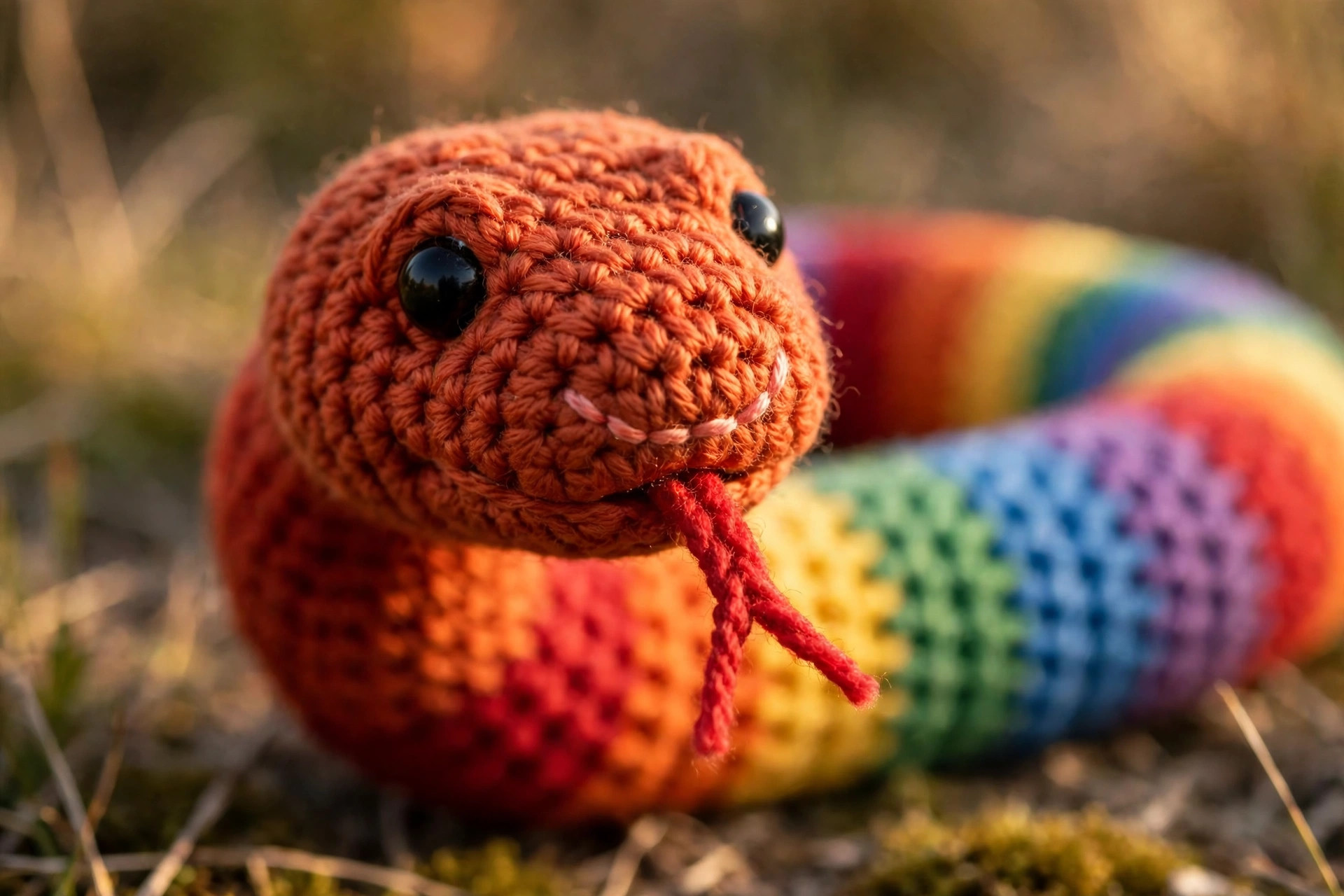
The snake starts at the head, worked in the round from the nose backward. The head is slightly wider than the body, with safety eyes and a forked tongue, and it is stuffed firmly so it holds its friendly shape. Work in continuous rounds, using a stitch marker to mark the first stitch of each round, and do not join at the end of rounds unless the pattern says so.
Head
With head color, MR, ch 1.
- Rnd 1: 6 sc in MR. (6 sc)
- Rnd 2: inc in each st around. (12 sc)
- Rnd 3: (sc, inc) rep 6 times. (18 sc)
- Rnd 4: (2 sc, inc) rep 6 times. (24 sc)
- Rnds 5 to 8: sc in each st around. (24 sc)
Place the safety eyes between Rnds 6 and 7, about 6 stitches apart, on the front of the head. If the snake is for a small child, embroider the eyes with black yarn instead of using safety eyes.
- Rnd 9: (2 sc, dec) rep 6 times. (18 sc)
- Stuff the head firmly, shaping it into a soft rounded shape.
The head should look like a gentle rounded snout, about 2 inches wide, with the eyes sitting slightly forward. If the head looks pointy, your increases were too few, so check the count at Rnd 4.
Forked Tongue
With red or pink yarn, ch 6, sl st in 2nd ch from hook, sl st in next 2 ch, ch 3, sl st in 2nd ch from hook, sl st in next ch, sl st back down the first chain to the base. Fasten off, leaving a tail for sewing. Sew the tongue to the front of the head at Rnd 2, so it pokes out of the mouth.
Part 2: Daily Temperature Segments
The body is the heart of the project: one segment per day, two rounds of single crochet in the color that matches that day's temperature. You do not join the rounds. You simply change color at the start of each new day, working the first stitch of the new color over the tail of the old one, and the segments stack into a smooth, even tube.
How to Work a Daily Segment
Check the day's temperature, find its color on your key, and join the new color with a slip stitch if the color is changing, or simply continue if the color is the same as yesterday.
- Rnd A: sc in each st around, in the day's color. (18 sc)
- Rnd B: sc in each st around, in the same color. (18 sc)
That is the whole segment. Two rounds, eighteen stitches each, about half an inch of new snake. Mark the end of the segment with your stitch marker, note the date and temperature in your notebook, and put the snake down until tomorrow. Stuff the body lightly as you go, adding a small pinch of stuffing every few segments, so the tube stays soft and even.
Keeping Track All Year
A year is a long time to remember a daily habit, so build yourself a simple routine. Keep the snake, the eight yarn colors, and your notebook in one basket by your favorite chair, so everything is in reach. Crochet the segment at the same time each day, and tick the date off in your notebook as you go.
If you miss a day, do not worry. Look up the missing temperature, work the segment the next day, and carry on.
Part 3: Tail and Finishing
When the year ends, or when you reach the date you chose as the finish, taper the body into a tail over a few rounds. Work the tail in the last day's color, or in the head color for a neat bookend, and stuff it lightly before you close it.
Tail
- Rnd 1: (sc, dec) rep 6 times. (12 sc)
- Rnd 2: sc in each st around. (12 sc)
- Rnd 3: dec in each st around. (6 sc)
- Fasten off, leaving a long tail. Thread the tail through the remaining 6 stitches, pull tight to close, and weave in the end.
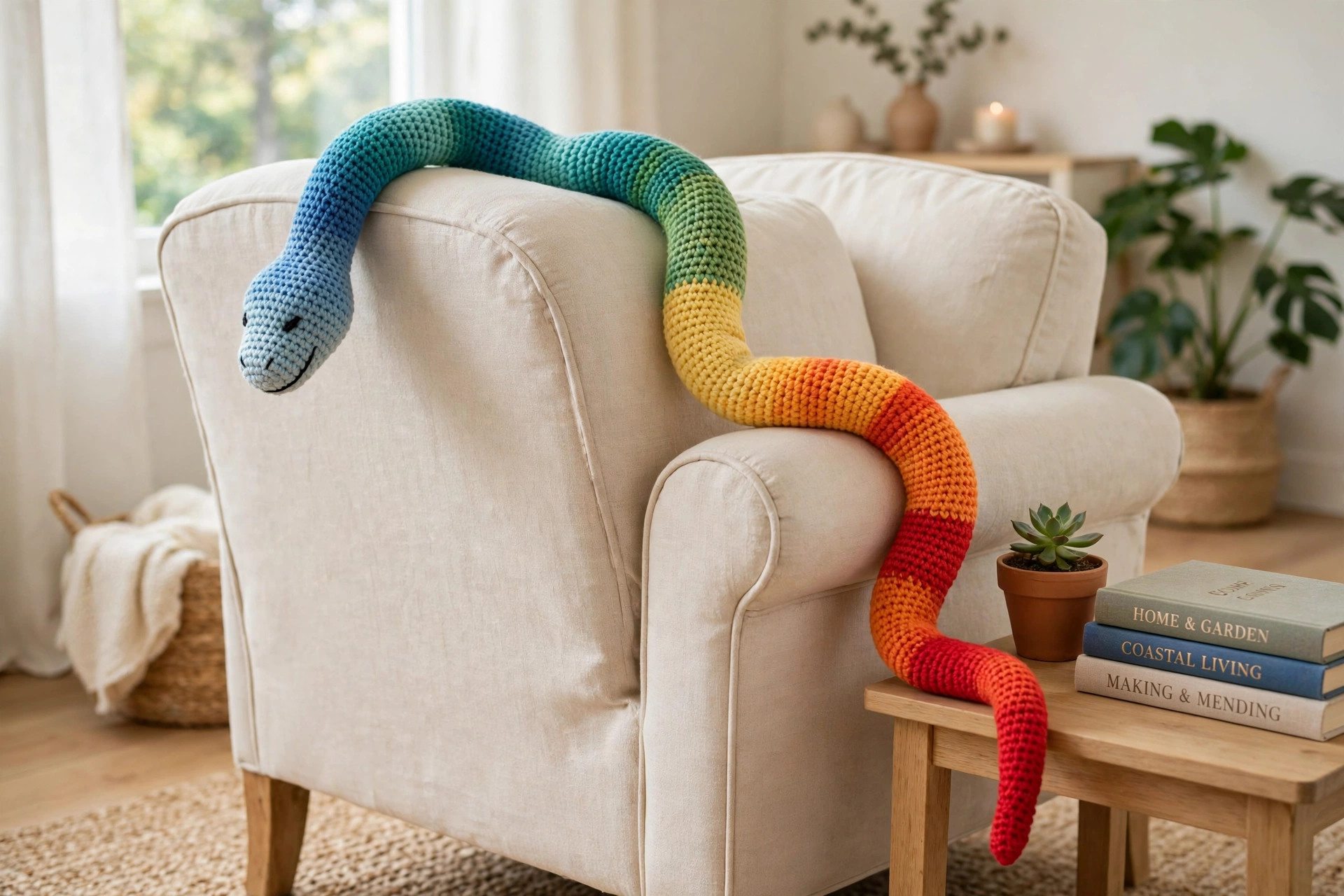
Your snake is finished. Weave in any color change tails you left along the body, working each tail back through the stitches on the inside of the tube for about an inch, then trim the excess. Give the snake a gentle stretch and a shake, so the stuffing settles evenly, and coil it into a basket or drape it over a chair for its first photograph.
Variations: Weekly Snakes, Baby Snakes, and Gifts
- Weekly snake: work one segment per week using the week's average temperature. The snake finishes at about 2 feet long, a perfect size for a child or a shelf display. Our crochet turtle patterns make a sweet companion for a shorter snake.
- Baby year snake: make a snake for a baby's first year, starting on the day they were born. Use soft pastel versions of the temperature colors, and embroider the eyes instead of using safety eyes.
- School year snake: start in September and finish in June, recording the school year instead of the calendar year. A teacher's gift with real meaning, and a lovely classroom talking point.
- Monthly snake: work twelve segments, one per month, using the month's average temperature. The snake is short and quick, and it makes a great trial run before you commit to a full year.
- Two color snake: if eight colors feel like too many, use four: cold, cool, warm, and hot. The gradient is simpler, but the story is just as clear.
If you enjoyed the slow rhythm of this project, try another long term make next year, perhaps in a different shape or a different color story.
Troubleshooting Temperature Snakes
- My snake is getting wider as it grows. You are accidentally increasing. Count your stitches at the start of each segment: there should always be 18. A stitch marker in the first stitch of each segment helps.
- My color changes look messy. Carry the new color up on the inside of the tube, and work the first stitch of the new color firmly. A tiny jog at a color change is normal in a spiral, and it disappears when the snake is coiled.
- I lost track of the date. Check your notebook for the last recorded date, and fill in the missing days from a weather app. Mark the first segment of each month so you can find your place again.
- My snake is too long to store. Coil it loosely in a basket, or drape it over a chair back. Do not fold it sharply, because a sharp fold can squash the stuffing unevenly.
- My stuffing shows through the stitches. Your hook is too big for the yarn, or your tension is too loose. Go down a hook size for the next segments.
Care Instructions
Hand wash your temperature snake gently in cool water with a tiny amount of mild soap, squeeze gently without wringing, and lay it flat to dry, coiled loosely so it keeps its shape. If the yarn label says machine washable, use a gentle cycle in a mesh laundry bag, and lay the snake flat to dry. Do not put it in the dryer on high heat, because the segments can shrink unevenly. Keep the finished snake out of direct sunlight for long stretches, so the colors stay bright, and store it coiled in a basket, not folded, so the stuffing stays even.
Frequently Asked Questions
What is a temperature snake?
A temperature snake is a year long crochet project where each day you crochet one short segment in the color that matches that day's temperature. After a year the snake is a colorful record of the weather you lived through.
How long does a temperature snake take to make?
The head takes about 30 minutes, each daily segment takes about 5 minutes, and the tail and finishing take about 20 minutes. Spread across a year, the daily time is tiny.
How long will my finished snake be?
A full year of daily segments in DK weight yarn makes a snake about 12 to 15 feet long and about 2 inches wide. A weekly version, one segment per week, finishes at about 2 feet long.
What if I miss a day?
Simply look up the missing temperature and work the segment the next day. A temperature snake is a diary, not an exam, and a caught up segment counts exactly the same as an on time one.
Can I start a temperature snake on any date?
Yes, you can start on any date you like. A snake begun on a birthday, a wedding day, or the day a baby is born is just as meaningful as one begun on January 1.
How do I choose my temperature colors?
Choose eight colors in a smooth gradient from cold to hot, such as navy, blue, teal, green, yellow, orange, red, and burgundy. Adapt the temperature bands to your climate, but keep the same key all year.
Can I sell items made from this pattern?
Yes, you may sell finished temperature snakes made from this free pattern, with credit to Little Loop Finds. Please do not sell or republish the pattern text itself.
Happy stitching, and may your snake tell the story of a wonderful year, one colorful day at a time.