Crochet Towel Holder Pattern (Free Hanging Holder)
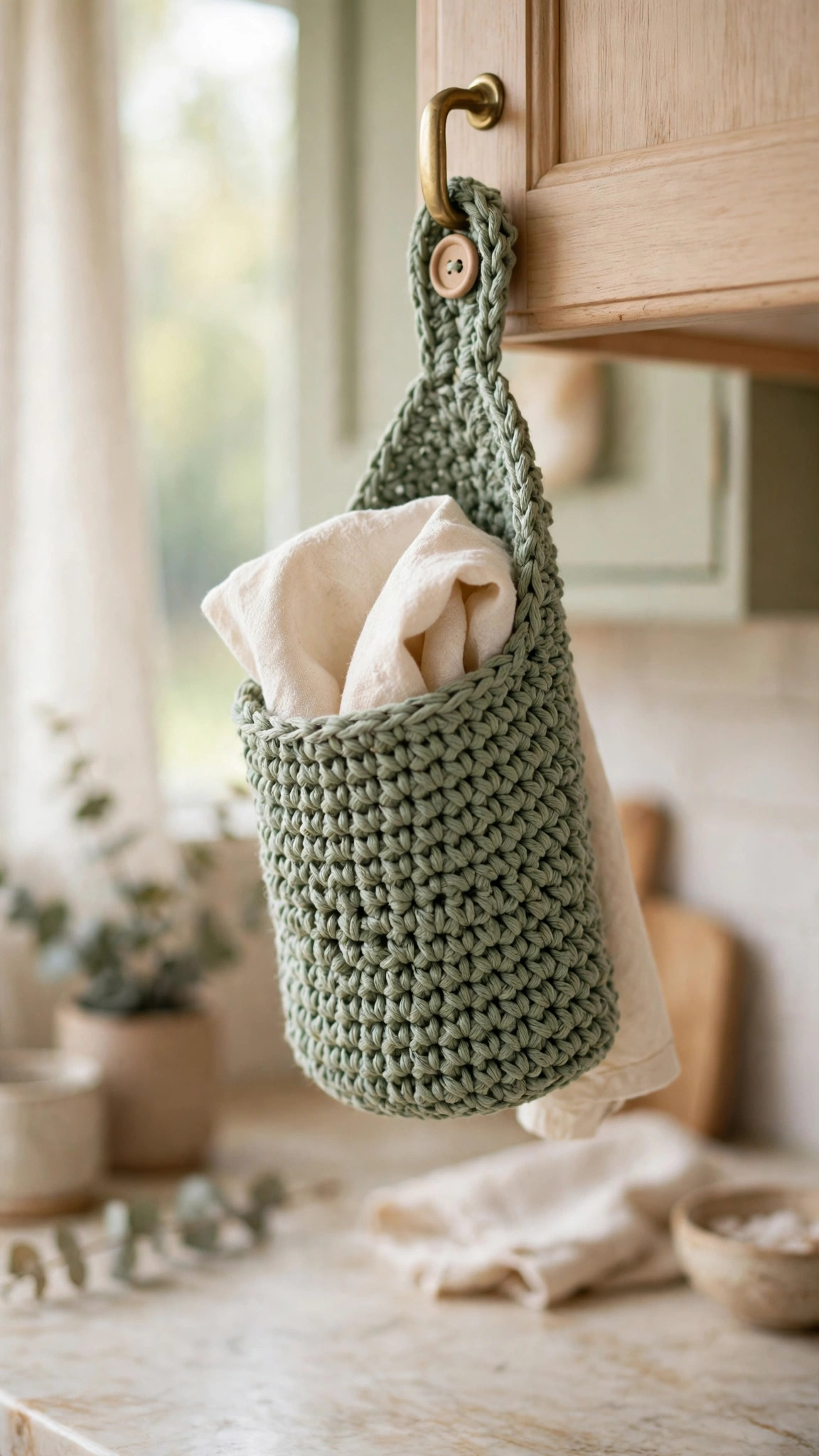
Crochet a hanging towel holder with a button loop strap in about two hours, then hang it from a cabinet handle and slide a towel into its pocket.

Patterns · Crochet
- Finished size
- 8 in wide, 11 in long
- Making time
- 2 hours per holder
- Hook
- US H-8 (5.0 mm)
- Set
- Holder, button loop
- Skill
- Easy
In this post
- Key Takeaways
- Table of Contents
- Why You Will Love This Crochet Towel Holder
- Finished Size, Skill Level, and Time
- Materials You Need
- Abbreviations (US Terms)
- Gauge and Sizing Notes
- Part 1: The Holder Panel
- Part 2: The Pocket and Side Seams
- Part 3: The Hanging Strap and Button
- Variations: Colors, Sizes, and Uses
- Troubleshooting a Holder That Will Not Hang Right
- Care Instructions
- Frequently Asked Questions
A crochet towel holder keeps your kitchen towel right where you need it, hanging from a cabinet handle instead of sliding off the oven bar onto the floor. This free crochet towel holder pattern makes a sturdy hanging holder with a button loop strap: a folded pocket that grips a kitchen towel, and a strap that loops over a handle and buttons shut. It works up in about two hours and uses less than one ball of cotton yarn.
This is an original Little Loop Finds design, written in US terms and completely free. The holder is worked flat in rows, then the bottom folds up into a pocket and the strap is worked straight off the top edge, so there is almost no sewing. If you can crochet a chain and a single crochet, you can crochet this towel holder.
A quick note on scope: this post is about one specific crochet towel holder, a hanging holder with a button loop strap that holds a folded kitchen towel in its pocket. It is not a crocheted towel itself. If you want the towel to go inside it, our crochet kitchen towel pattern makes a matching cotton towel in the same yarn.
Key Takeaways
- Free original pattern: this crochet towel holder pattern is a Little Loop Finds original design, written in US terms, and completely free.
- A hanging holder, not a towel: a folded pocket grips your kitchen towel, and a button loop strap hangs it from a handle.
- Beginner friendly and quick: simple rows of single crochet, with the shaping limited to a folded pocket and one buttonhole.
- A two hour project: one holder takes about 2 hours, so you can make a matching set for the kitchen in a weekend.
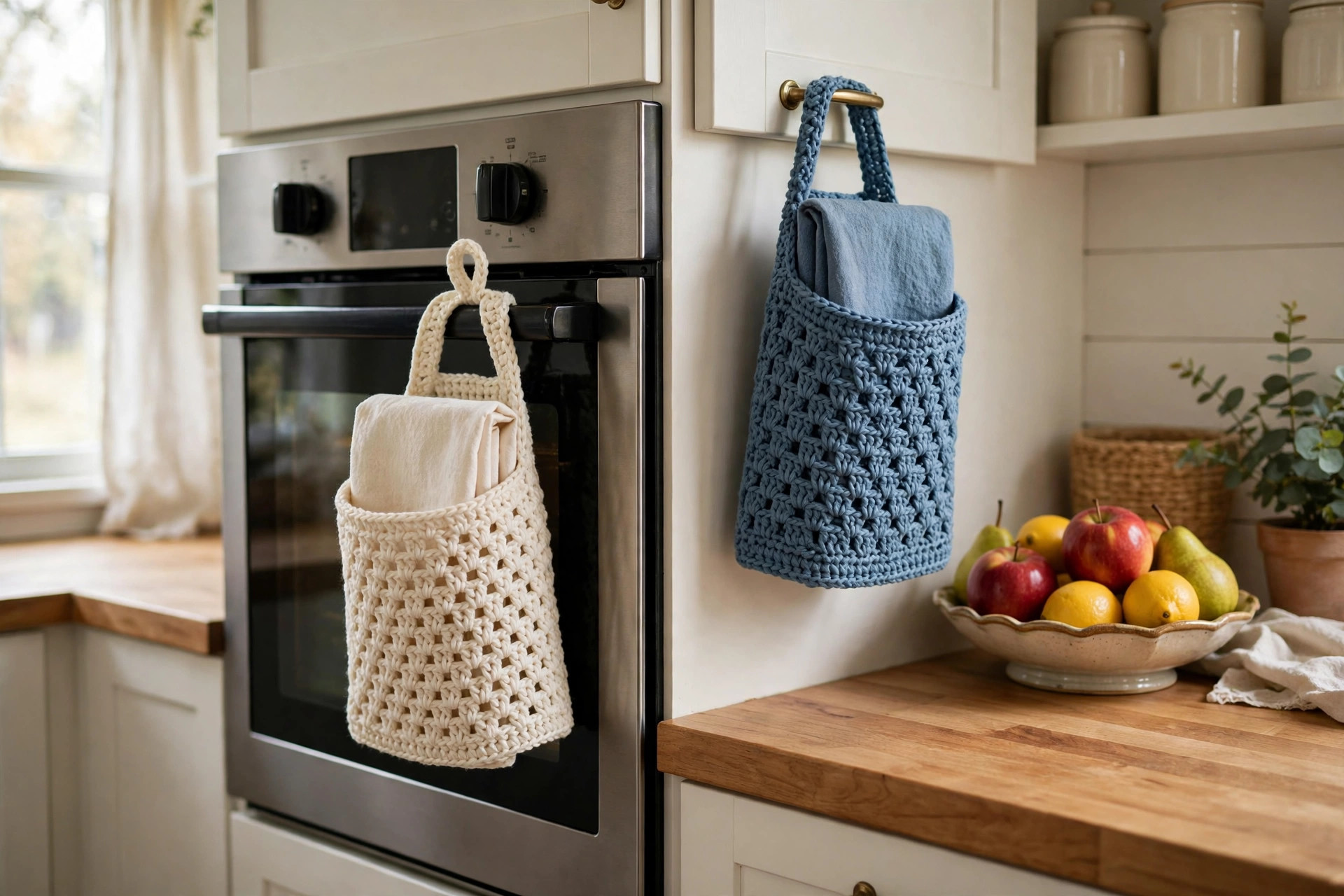
- Three places to hang it: a cabinet handle, an oven bar, or a towel rail by the sink.
Table of Contents
- Why You Will Love This Crochet Towel Holder
- Finished Size, Skill Level, and Time
- Materials You Need
- Abbreviations (US Terms)
- Gauge and Sizing Notes
- Part 1: The Holder Panel
- Part 2: The Pocket and Side Seams
- Part 3: The Hanging Strap and Button
- Variations: Colors, Sizes, and Uses
- Troubleshooting a Holder That Will Not Hang Right
- Care Instructions
- Frequently Asked Questions
Why You Will Love This Crochet Towel Holder
Every kitchen needs a towel within reach, and a towel draped over an oven bar always ends up on the floor. A hanging towel holder fixes that with a simple idea: the towel sits inside a crocheted pocket, and the pocket hangs from a handle on a buttoned strap, so the towel stays put through cooking, washing up, and drying hands.
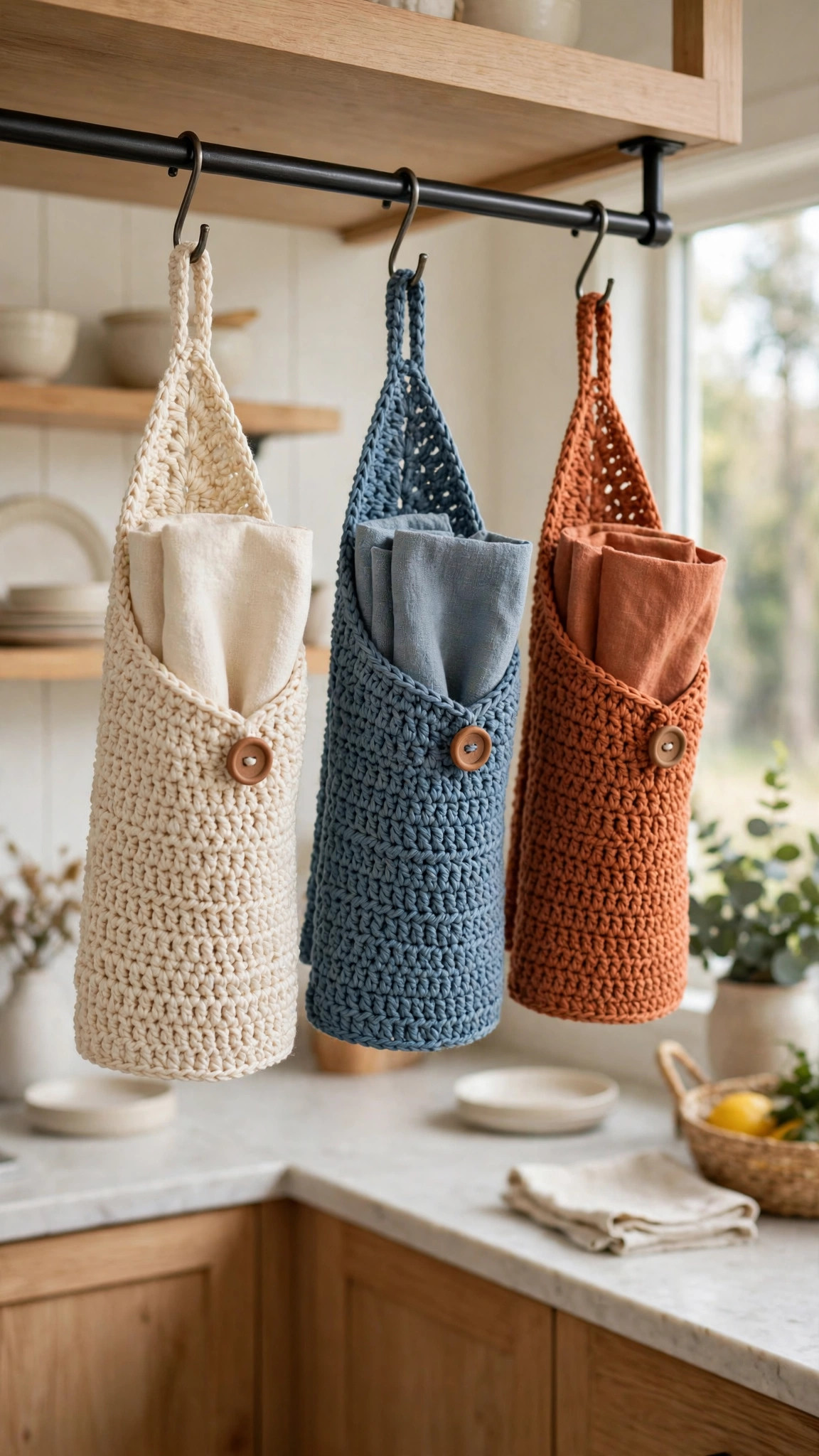
A crochet towel holder is also one of the most useful gifts you can make. It is quick, it uses very little yarn, and it looks handmade in the best way, textured cotton in a color that matches the kitchen. Make one in sage green for a calm farmhouse kitchen, one in dusty blue for a bright modern kitchen, and one in terracotta for a warm country kitchen. Our crochet dishcloths free patterns use the same sturdy cotton if you want a matching set for the sink.
Finished Size, Skill Level, and Time
- Finished size: the holder is 8 inches wide and 11 inches long before folding, with a pocket about 5 inches deep and a hanging strap about 3 inches long. It fits a standard folded kitchen towel.
- Skill level: Easy. You need chains, single crochet, and a little whipstitch seaming.
- Time: about 2 hours per holder: 1 hour and 15 minutes for the panel, 20 minutes for the pocket and seams, and 25 minutes for the strap, button, and finishing.
Size Table
| Size | Towel it fits | Starting chain | Stitches in Row 1 |
|---|---|---|---|
| Small | Hand towel | ch 25 | 24 sc |
| Standard | Kitchen towel | ch 29 | 28 sc |
| Large | Large tea towel | ch 33 | 32 sc |
Measure your towel before you start, folded in thirds the way it will sit in the pocket. If you are between sizes, make the larger size, because a pocket that is too tight will not take the towel, but a pocket that is a little loose still holds it well. Our crochet potholders free patterns pair beautifully with a matching holder as a kitchen gift set.
Materials You Need
| Item | What to get |
|---|---|
| Yarn | Worsted weight (size 4) cotton yarn, 120 yards for the standard size |
| Hook | US H-8 (5.0 mm), or the size that gives you the gauge below |
| Button | One flat wooden button, 1 inch across |
| Towel | One standard kitchen towel to fit inside the pocket |
| Notions | Tapestry needle, scissors, stitch markers, sewing needle and thread for the button |
Cotton yarn is the best choice for a crochet towel holder because it is firm, absorbent, and holds its shape under the weight of a damp towel. A smooth worsted weight cotton shows clean stitch definition and washes well, which matters for something that lives in the kitchen and gets washed often. Choose sage green for a calm farmhouse look, dusty blue for a bright kitchen, or cream for a holder that goes with every towel you own. Avoid fuzzy or novelty yarns, because they hide the stitch texture and shed fluff onto the towel. If you want a dressier holder, a dark stained wooden button looks lovely against cream yarn, and a natural wooden button looks lovely against sage green yarn.
Abbreviations (US Terms)
- ch = chain
- sl st = slip stitch
- sc = single crochet
- st(s) = stitch(es)
- rep = repeat
- RS = right side
- WS = wrong side
Gauge and Sizing Notes
Gauge for a towel holder matters because the width of the panel decides whether the pocket fits your towel, and the length decides how deep the pocket is. Work a swatch of 14 sc stitches and 16 rows, and measure it. It should be about 4 inches wide and 4 inches tall. If your swatch is wider than 4 inches, go down a hook size. If it is narrower, go up a hook size.
Measure the towel before you start, folded in thirds the way it will sit in the pocket, and check the width against the size table. The standard size fits a folded towel about 7 inches wide. Count your stitches at the end of row 1, because the whole holder depends on that count, and a missed stitch will make the pocket narrower than the size you planned.
Part 1: The Holder Panel
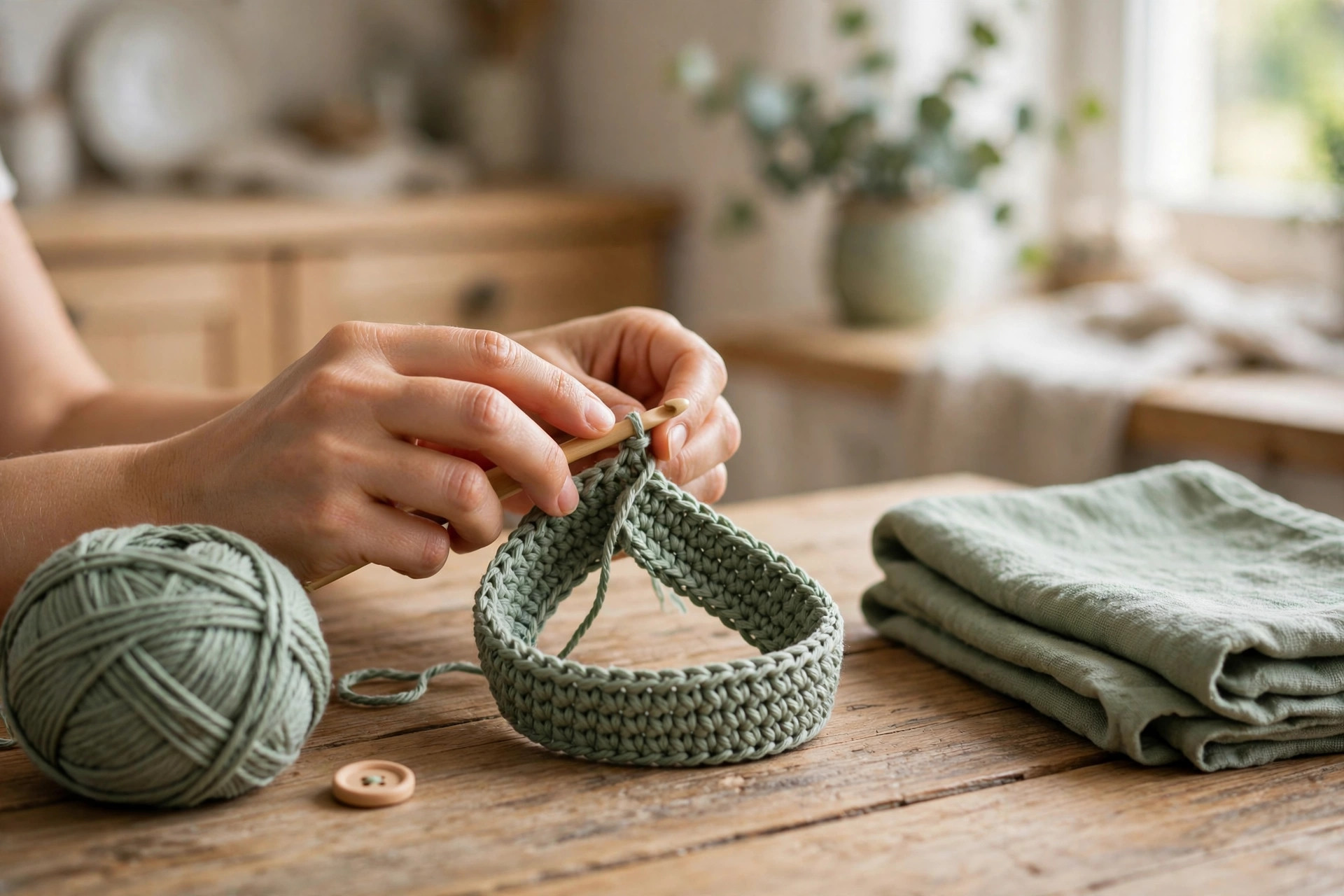
The panel is a simple rectangle worked flat in rows of single crochet. It forms the whole holder: the back of the holder, the front of the pocket, and the base the strap grows from, so there is no seam to sew along the length of the holder.
The Panel
With your yarn, chain the number from the size table for your size. The example counts below use the standard size, with 28 stitches in row 1. Adjust the counts in brackets to your own size.
- Row 1 (RS): sc in the 2nd ch from the hook and in each ch across. (28 sc for the standard size)
- Row 2 (WS): ch 1, turn, sc in each st across. (28 sc)
- Rows 3 to 44: ch 1, turn, sc in each st across. (28 sc in every row)
The panel is now about 8 inches wide and 11 inches long. Lay it flat and measure it. If your panel is more than half an inch off in width, check your gauge, because a panel that is too narrow will make a pocket that will not take the towel. The length is less critical, because a slightly longer panel simply makes a slightly deeper pocket.
Part 2: The Pocket and Side Seams
The pocket is formed by folding the bottom of the panel up against the front of the panel, then stitching the two side edges closed. The towel slides into the pocket from the top, and the folded edge at the bottom holds its weight.
Folding the Pocket
Lay the panel flat with the right side facing up. Fold the bottom edge up by 5 inches, so the wrong side of the folded part sits against the right side of the panel, and the folded edge forms the bottom of the holder. The top edge of the folded part is the opening of the pocket, and it should sit about 6 inches below the top edge of the panel. Place a stitch marker at each side where the fold meets the panel, so the fold does not shift while you sew.
Sewing the Side Seams
With your tapestry needle and a length of the same yarn, whipstitch the folded edge to the panel along the left side, working one whipstitch into every row end from the bottom fold up to the pocket opening, for about 20 stitches in total. Repeat along the right side, working the same number of whipstitches. Knot the yarn on the inside of the pocket and weave in the ends. Turn the holder right side out and check that the pocket opening is even and the sides sit flat. Our crochet grocery bag holder pattern uses the same folded pocket idea if you want more practice with this construction.
Part 3: The Hanging Strap and Button
The strap is worked straight off the top edge of the panel, in the center 6 stitches. It loops over a cabinet handle or an oven bar, then buttons to the back of the holder, so the holder hangs securely and lifts off easily for washing.
Working the Strap
With your yarn still attached at the top edge of the panel, find the center 6 stitches of the top edge and join the yarn with a slip stitch at the first of those 6 stitches.
- Row 1: ch 1, sc in the next 6 sts. (6 sc)
- Rows 2 to 12: ch 1, turn, sc in each st across. (6 sc in every row)
The strap is now about 1.75 inches wide and 3 inches long. It should sit centered on the top edge of the panel, with the same number of stitches on each side of it. If the strap sits off center, the holder will hang crooked, so count the stitches on each side and move the strap if the counts do not match.
The Buttonhole
- Row 13: ch 1, turn, sc in the first 2 sts, ch 2, skip the next 2 sts, sc in the last 2 sts. (4 sc plus a ch-2 space)
- Row 14: ch 1, turn, sc in each st across, working 2 sc into the ch-2 space. (6 sc)
Fasten off, leaving a tail to weave in. The buttonhole sits near the end of the strap and should be just wide enough for your 1 inch button to pass through with a gentle push. If the buttonhole is too tight, work row 14 with 3 sc in the ch-2 space instead of 2, which opens the hole a little wider.
Sewing the Button
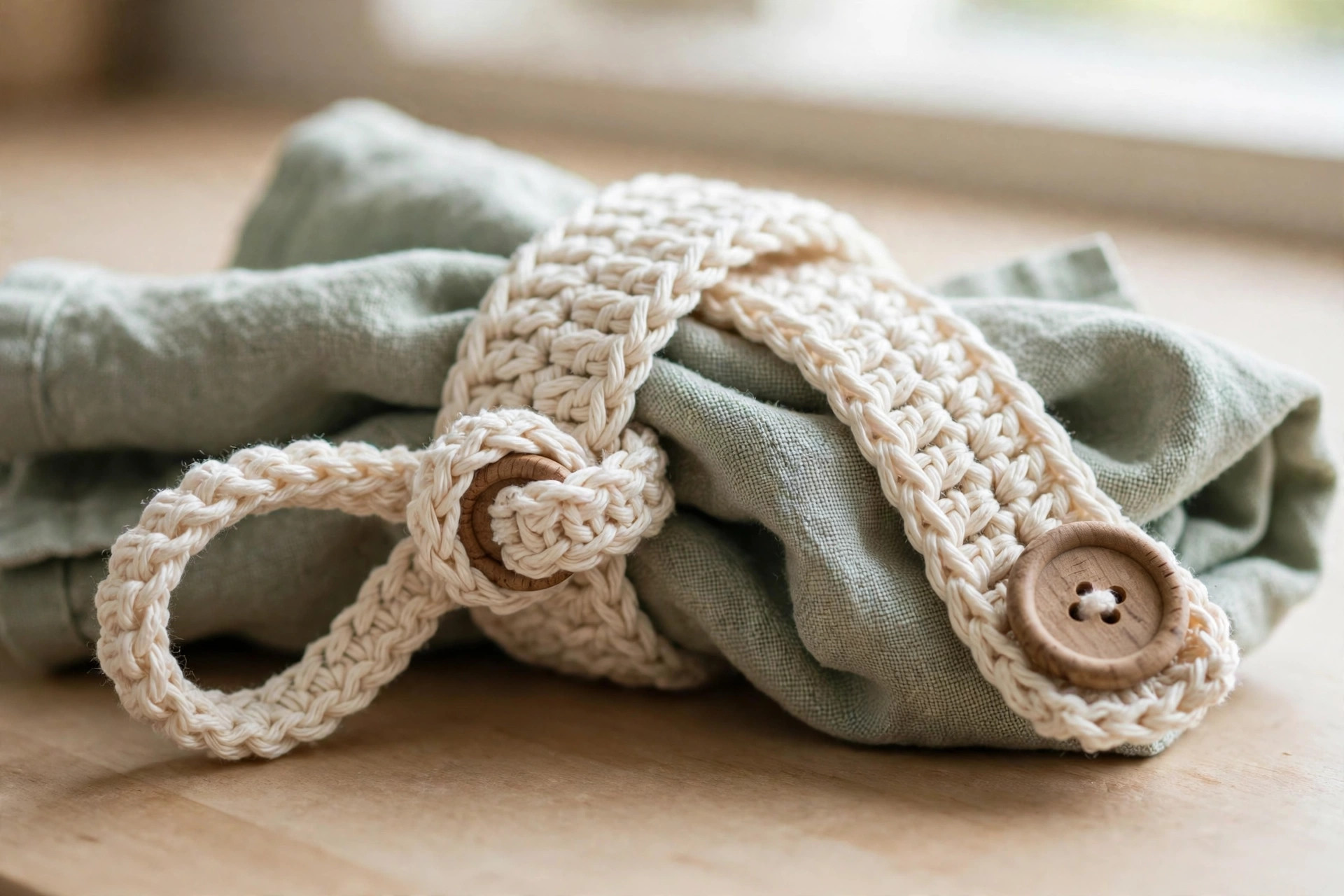
Sew the button onto the back of the panel, at the top edge, centered under the strap, about 1 inch below the top edge. Use a sewing needle and strong thread, sew through the button at least four times, and knot the thread firmly on the inside of the holder. To hang the holder, loop the strap over a cabinet handle or an oven bar, fold it down the back of the holder, and push the button through the buttonhole. Fold your kitchen towel in thirds, slide it into the pocket, and it is ready to use.
Variations: Colors, Sizes, and Uses
- Classic sage green holder: work the holder in sage green with a natural wooden button, the colorway in the photos. Our crochet coaster pattern makes a sweet matching set for the kitchen table.
- Dusty blue holder for a bright kitchen: make the holder in dusty blue with a cream button for a fresh, cheerful look that pairs well with white cabinets.
- Cream holder for any kitchen: make the holder in cream with a dark stained wooden button, and use it with any towel color you already own.
- Terracotta holder for a country kitchen: make the holder in terracotta with a natural wooden button for a warm, rustic finish that matches wooden countertops.
- A bathroom holder: make the small size in a soft color and hang it from a bathroom towel rail to hold a hand towel, keeping it off the floor and within reach.
Troubleshooting a Holder That Will Not Hang Right
- My towel slides out of the pocket. The pocket is too shallow, or the towel is folded too thin. Fold the towel in thirds instead of in half so it fills the pocket, or make the pocket deeper by folding up 6 inches instead of 5 on your next holder.
- My holder hangs crooked. The strap is off center, or one side seam is longer than the other. Count the stitches on each side of the strap, and check that both side seams have the same number of whipstitches.
- My buttonhole is too tight. The chain space was worked too small, or the button is too big for the hole. Work 3 sc into the ch-2 space in row 14, or choose a button a little smaller than 1 inch across.
- My strap is too short for the handle. The handle is thicker than a standard cabinet handle, or the strap rows were worked too tightly. Add 4 more rows to the strap on your next holder, which adds about 1 inch of length.
- My pocket sides gape open. The side seams were worked too loosely, or the towel is too wide for the pocket. Take the seams out and re-sew them with tighter whipstitches, working one stitch into every row end.
Care Instructions
Hand wash a crochet towel holder in cool water with a mild detergent, and press the water out gently without wringing. Reshape the holder while it is damp, laying it flat with the pocket open, and let it dry flat on a clean towel. Do not put it in the dryer on high heat, and keep the wooden button out of long soaks so it does not swell or crack. Machine wash the kitchen towel separately as usual. Check the button stitching before every wash and re-sew any thread that feels loose.
Frequently Asked Questions
Is this crochet towel holder pattern good for beginners?
Yes, it is a great first home project. You need chains, single crochet, and a little whipstitch seaming, and every row ends with a stitch count. One holder takes about 2 hours, so it is a satisfying weekend make.
What yarn is best for a crochet towel holder?
Worsted weight cotton yarn is the best choice, because it is firm, absorbent, and holds its shape under the weight of a damp towel. Sage green gives the calm farmhouse look in the photos, but dusty blue, cream, and terracotta all work well for different kitchens.
Is this the same as a crochet kitchen towel pattern?
No, this is a holder, not a towel. The holder is a crocheted pocket with a button loop strap that hangs from a handle and grips a folded towel. Our crochet kitchen towel pattern makes the towel itself, so the two patterns work as a matching pair, and this holder fits the towel that pattern makes.
What size towel fits in the holder?
The standard size fits a folded kitchen towel about 7 inches wide, folded in thirds. The small size fits a hand towel, and the large size fits a large tea towel. Measure your towel folded in thirds before you start, and pick the size from the table that matches.
How does the button loop strap work?
Loop the strap over a cabinet handle, an oven bar, or a towel rail, fold it down the back of the holder, and push the button through the buttonhole. The button holds the strap closed around the handle, so the holder stays put, and it lifts off easily when you want to wash it.
Can I make the holder in a different size?
Yes, you can change the size by changing the starting chain. Each 4 stitches adds about 1 inch of width, so chain 25 for a small holder and chain 33 for a large one, following the size table. Keep the pocket fold at 5 inches deep for the standard size, and adjust it to suit a thicker or thinner towel.
Can I sell towel holders made from this pattern?
Yes, you may sell finished towel holders made from this free pattern, with credit to Little Loop Finds. Please do not sell or republish the pattern text itself. A set of three holders in sage green, dusty blue, and cream makes a lovely kitchen gift bundle, and pairs nicely with matching dishcloths like our crochet dishcloths free patterns or a set of coasters like our crochet coaster pattern.
Happy stitching, and may your new towel holder keep your kitchen towel right where you need it.