Crochet Kitchen Towel Pattern: Waffle Weave Towel
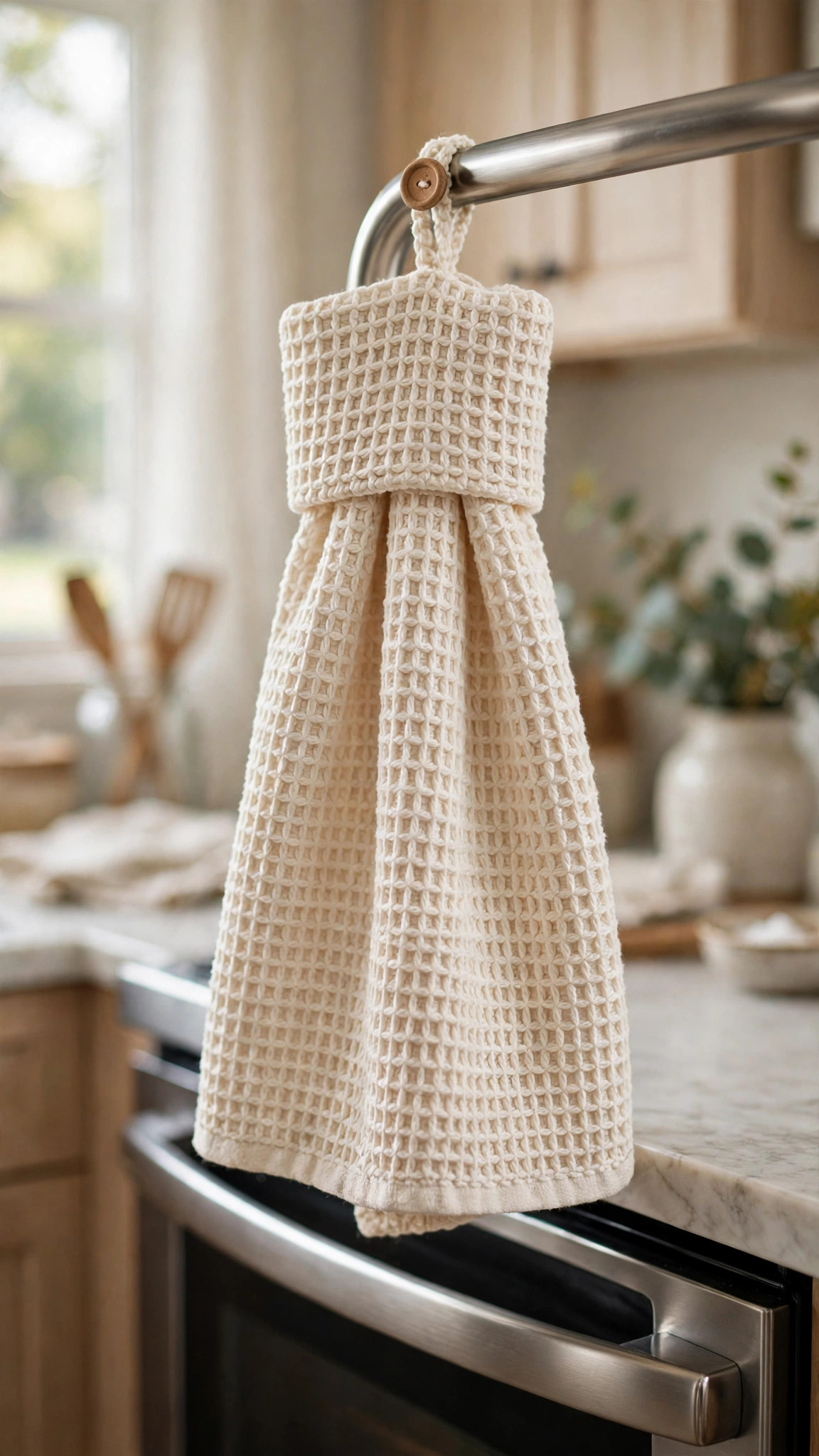
A thick, absorbent waffle stitch kitchen towel in 100% cotton, with a button loop that hangs on any oven handle: one evening to make.

Kitchen · Crochet
- Finished size
- 13.5 x 19 in (standard)
- Making time
- About 4 hours
- Hook
- 4.5 mm, cotton yarn
- Sizes
- 3 sizes, US terms
- Skill
- Advanced Beginner
In this post
A good kitchen towel works harder than almost anything else in your home, so it deserves to be made well. This crochet kitchen towel pattern gives you a thick, thirsty towel in classic waffle stitch, finished with a sturdy button loop so it hangs right on your oven handle instead of sliding onto the floor for the tenth time today. The waffle texture is not just pretty: those little raised squares soak up spills fast and give you a gentle scrubbing surface for wiping counters and drying dishes.
This is an original Little Loop Finds design, written in US terms, and it works up in one relaxed evening. You only need to know double crochet and front post double crochet, and the hanging tab is plain single crochet with one simple buttonhole. Make one for your own kitchen, then make three more, because handmade towels are the gift people actually use every single day.
- Why you'll love this crochet kitchen towel pattern
- Materials you'll need
- Size, gauge and skill level
- Abbreviations, US terms
- The pattern (US terms)
- Finishing touches
- Care and washing notes
- Three color variations to try next
- Troubleshooting tips
- Frequently asked questions
- More free patterns to try
Why you'll love this crochet kitchen towel pattern
Most crocheted towels fail in the same way: they look lovely and absorb nothing, because they are made in acrylic with an open lacy stitch. This pattern fixes both problems at the root. It calls for 100 percent cotton, the only fiber that actually drinks up water, and the waffle stitch packs the fabric dense while leaving little pockets that trap moisture. The result is a towel that dries a stack of dishes without wringing out, and the texture gives you just enough grip to wipe a sticky counter clean.
The hanging design is the other half of the magic. A sewn-on tab with a buttonhole fastens to a wooden button on the towel front, so once it is on the handle, it stays there. It works on oven handles, towel bars, drawer pulls, and even a sturdy cabinet knob.
It is also a wonderfully practical gift: a set of two or three in coordinating colors, tied with a ribbon, costs little in yarn and gets used every single day. If you enjoy useful kitchen makes, our free crochet dishcloth patterns pair perfectly with this towel, and the free crochet potholder patterns complete a matching kitchen set.
Materials you'll need
| Supply | What to get |
|---|---|
| Yarn | 100% cotton, worsted weight (#4). Small: about 120 yds / 110 m. Standard: about 200 yds / 183 m. Large: about 290 yds / 265 m |
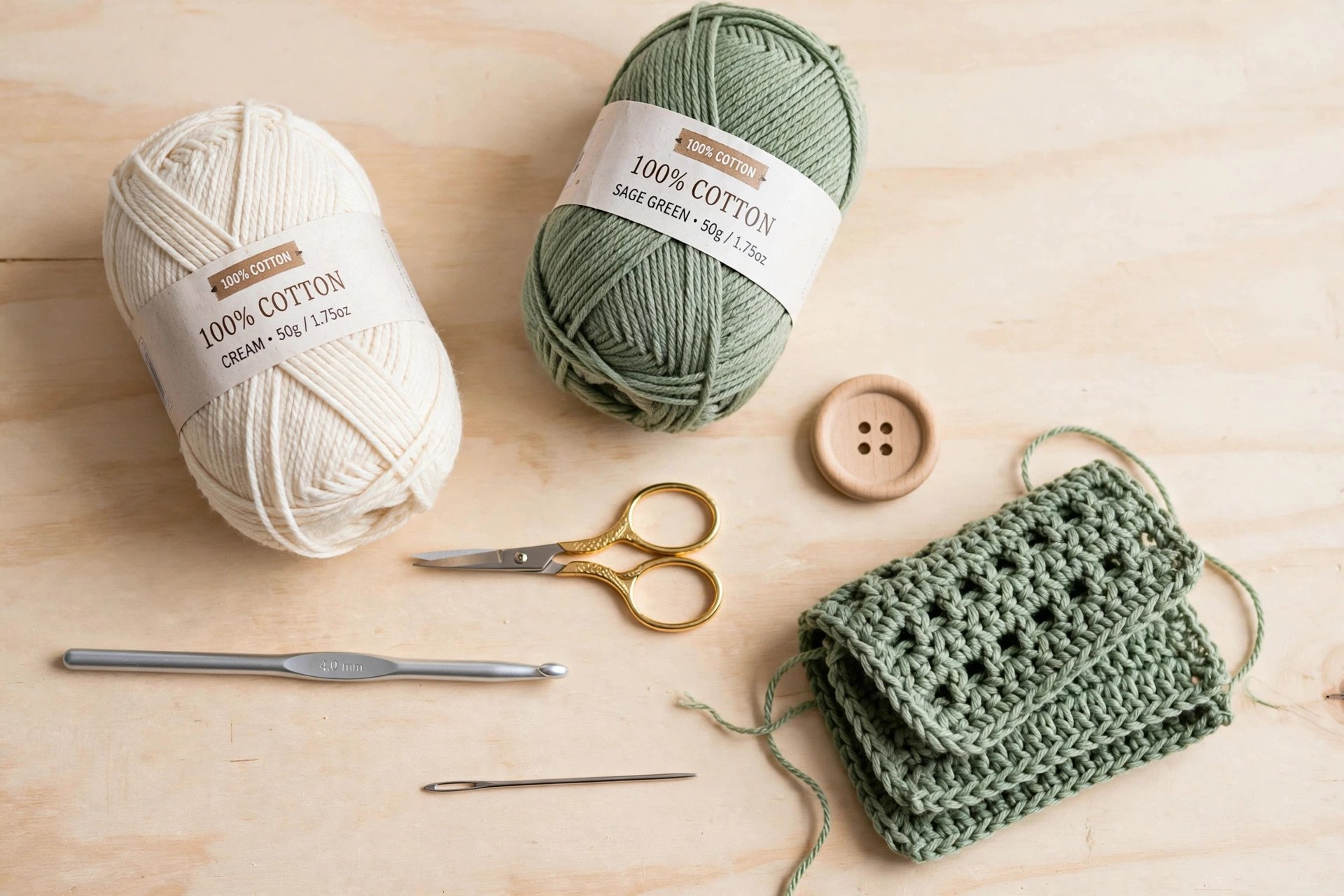
| Crochet hook | 4.5 mm (US 7) |
| Button | One 1 in (25 mm) wooden button, with 4 holes |
| Tapestry needle | For weaving in ends and sewing the tab and button |
| Notions | Scissors, stitch markers, a tape measure |
| Optional | A spare 4.0 mm hook if your waffle stitch runs loose |
Buy yarn labeled 100 percent cotton, worsted weight, the type sold for dishcloths: it is absorbent, survives hot water and the dryer, and gets softer with every wash. Do not substitute acrylic or a wool blend: acrylic barely absorbs water and can melt on a hot pan or oven rack, and wool felts in a hot wash. Mercerized cotton works beautifully too, with a slightly smoother finish.
A note on color: medium tones like sage green, warm grey, terracotta, and denim blue hide everyday stains far better than white, and the waffle texture shows beautifully in them.
Size, gauge and skill level
Three sizes are included, and the standard is the everyday workhorse. Instructions below are written for the standard size, with small and large in brackets: small (standard, large).
| Size | Finished body | Foundation | Yarn |
|---|---|---|---|
| Small | 10 in x 14 in / 25 x 36 cm | Ch 39 | About 120 yds |
| Standard | 13.5 in x 19 in / 34 x 48 cm | Ch 51 | About 200 yds |
| Large | 17 in x 24 in / 43 x 61 cm | Ch 63 | About 290 yds |
- Finished size (standard): about 13.5 in (34 cm) wide and 19 in (48 cm) tall, not counting the hanging tab. The tab adds about 5 in (13 cm) when folded over a handle.
- Gauge: 14 sts and 10 rows = 4 in (10 cm) in waffle stitch pattern (Rows 2 and 3 repeated) with a 4.5 mm hook, measured after a light steam block. Gauge matters for absorbency here: if your stitches are loose and airy, the towel will feel flimsy. Go down to a 4.0 mm hook if your fabric looks open.
- Skill level: confident beginner. You should know how to chain, single crochet, and double crochet. The only new skill is the front post double crochet, and it is just a double crochet worked around the post of a stitch instead of into the top. Two rows of practice and your hands will know it.
First waffle project? Chain 21, work 10 rows of the pattern as a swatch, and check your gauge. You will learn the rhythm and end up with a bonus coaster.
Abbreviations, US terms
| Abbreviation | Meaning |
|---|---|
| ch | chain |
| sc | single crochet |
| dc | double crochet |
| fpdc | front post double crochet: yarn over, insert hook from front to back to front around the post of the indicated stitch, complete as a dc |
| sl st | slip stitch |
| st(s) | stitch(es) |
| RS | right side |
| WS | wrong side |
| FO | fasten off |
| [ ] | total stitch count at the end of the row |
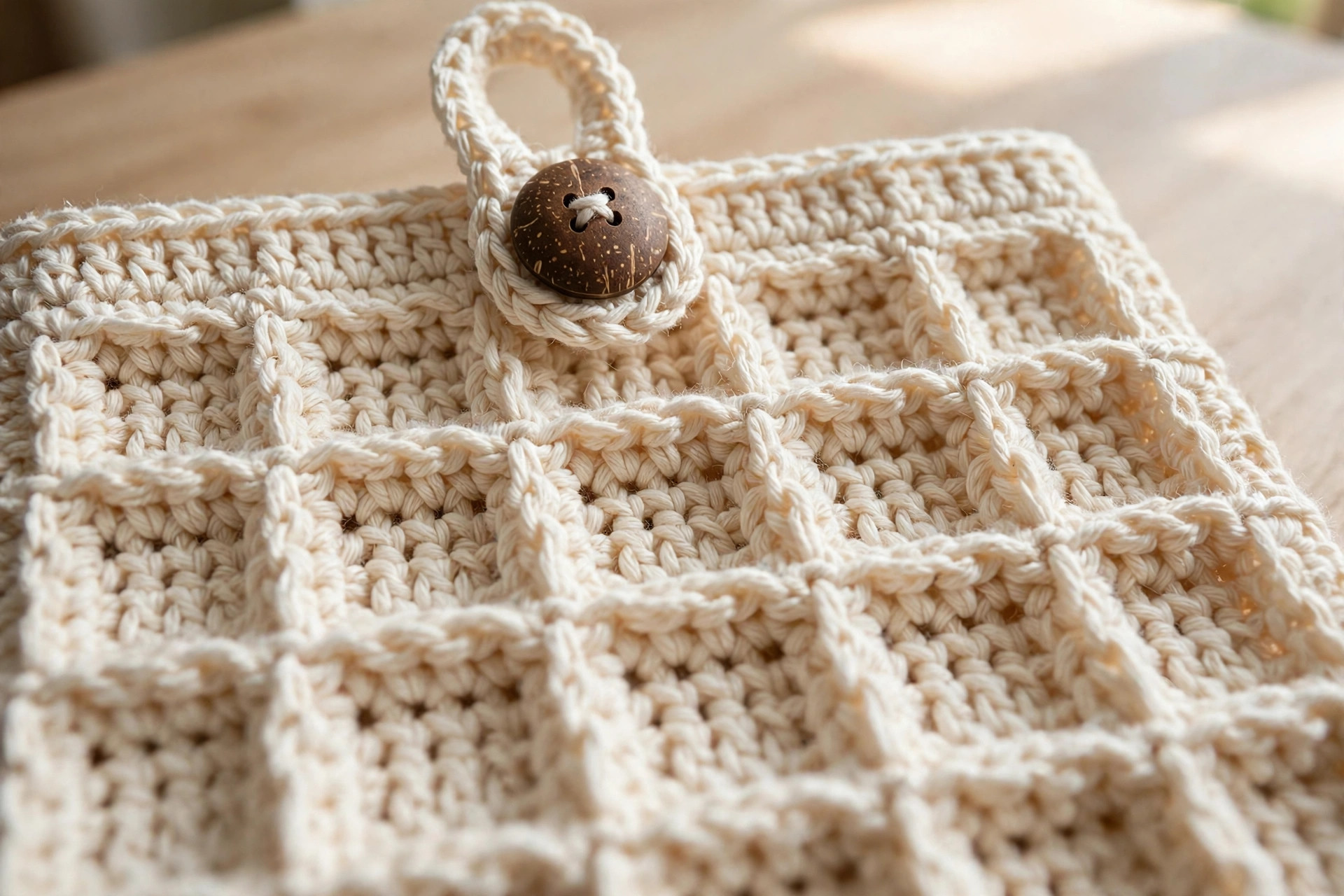
A note on the fpdc: the front post double crochet is what builds the raised waffle grid. Work it loosely, one hook size of slack in your tension, so the post stitches sit proud of the fabric instead of pulling it tight. If your waffle squares look flat, you are working the fpdc too tightly: consciously relax your yarn hand on those stitches.
The pattern (US terms)
The towel is worked bottom up in rows, starting at the bottom edge with the scalloped trim worked last. The hanging tab is made separately in single crochet, then sewn on. Keep your edges straight by counting the first and last stitch of every row: the chain-2 at the start of each waffle row counts as your first double crochet.
The towel body
With your 4.5 mm hook and cotton yarn, chain 39 (51, 63).
Row 1 (RS): dc in 4th ch from hook and in each ch across. [36 (48, 60) dc]
Row 2: ch 2 (counts as dc), fpdc around next 2 sts, *dc in next st, fpdc around next 2 sts; rep from * across to last st, dc in last st. [36 (48, 60)]
Row 3: ch 2 (counts as dc), dc in next 2 sts, *fpdc around next st, dc in next 2 sts; rep from * across. [36 (48, 60)]
Repeat Rows 2 and 3 alternately until the piece measures 13 (19, 23) in / 33 (48, 58) cm from the starting edge, ending with a Row 3. Do not fasten off yet: you will work the top edge next.
Top edge: ch 1, turn. Work 2 rows of sc across the top edge, one sc in each st. [36 (48, 60) sc per row] This gives you a firm, flat band to sew the tab onto. Fasten off, leaving a 6 in tail, and weave it in.
Bottom scalloped edging (optional but pretty): with RS facing, join yarn with a sl st in the first foundation stitch at the bottom right corner. Ch 1, sc in same st, *skip next 2 sts, 5 dc in next st, skip next 2 sts, sc in next st; rep from * across the bottom edge, ending with a sc in the last st. Fasten off and weave in the end. The scallops use up the slight flare of the foundation edge and give the towel a finished hem look.
The hanging tab
The tab is a narrow strap, worked in single crochet, with one buttonhole near the top. Work it in the same cotton yarn.
Ch 14.
Row 1: sc in 2nd ch from hook and in each ch across. [13 sc]
Rows 2-20: ch 1, turn, sc in each st across. [13 sc]
Row 21 (buttonhole row): ch 1, turn, sc in first 5 sts, ch 2, skip next 2 sts, sc in last 6 sts. [13]
Rows 22-24: ch 1, turn, sc in each st across, working 2 sc into the ch-2 space on Row 22. [13 sc]
Fasten off, leaving a 12 in tail for sewing.
Assembly
Lay the towel flat with the wrong side up. Center the tab on the top edge, with the buttonhole end pointing away from the towel. Using the 12 in tail, whipstitch Rows 1 through 4 of the tab to the back of the towel, working through the two rows of single crochet at the top edge. Sew firmly: this seam carries the whole towel every time you pull it off the handle.
Turn the towel right side up. Sew the wooden button to the front of the towel, centered, about 1.5 in (4 cm) below the top edge. Sew it on with doubled thread or yarn, going through all four holes several times, and knot it securely on the wrong side. A hanging towel takes daily tugging, so make this button bombproof.
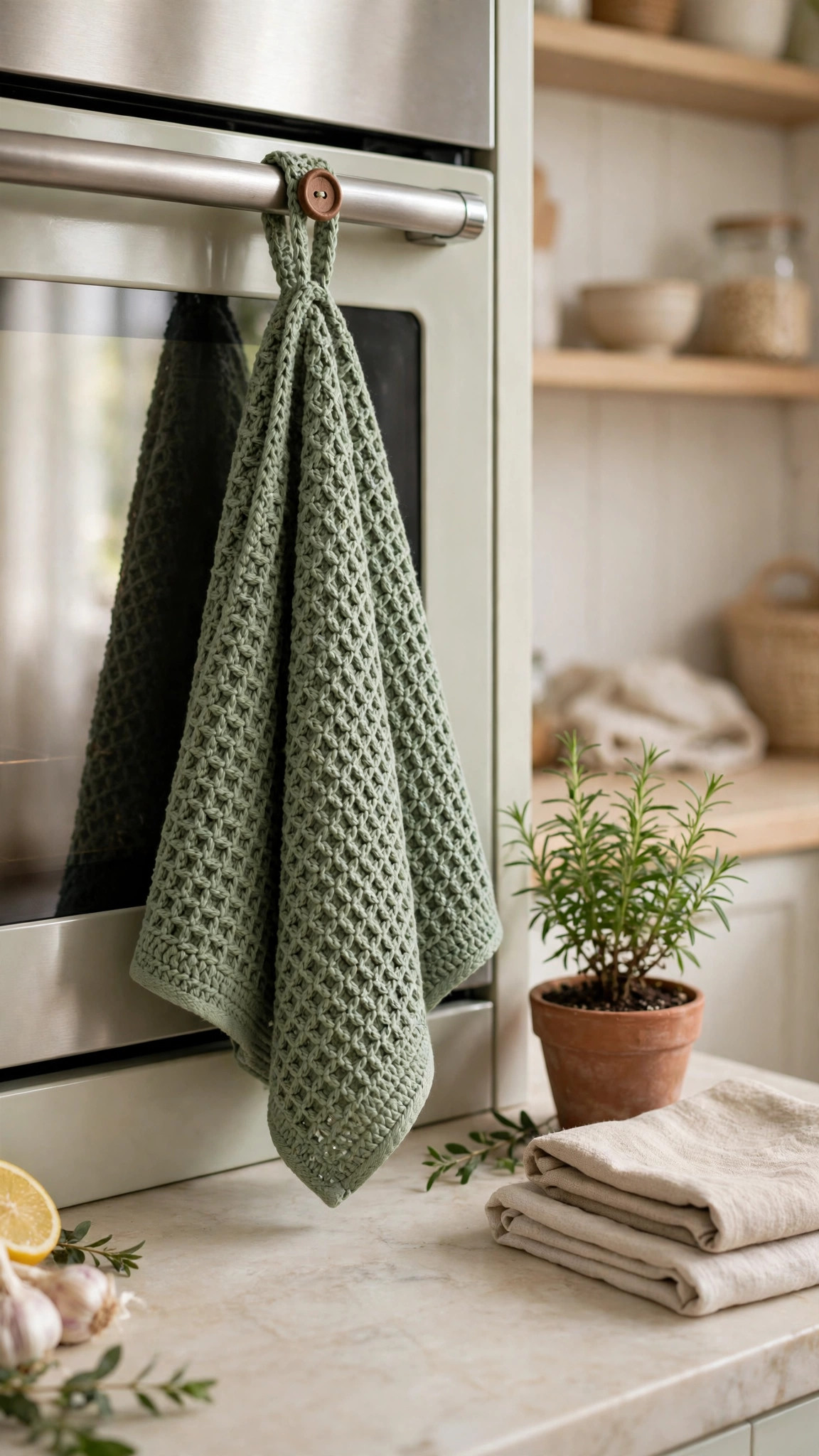
To hang: pass the tab up behind the oven handle bar, fold it over the front, and slip the button through the buttonhole. The towel hangs flat, the tab lies smooth, and it will not budge until you unbutton it. Our crochet grocery bag holder pattern uses a similar button-tab idea if you want to practice the technique on a smaller make first.
Finishing touches
Take ten unhurried minutes here: it is the difference between homemade and handmade.
Block the towel. Soak it in lukewarm water for 15 minutes, squeeze gently (never wring), roll it in a clean bath towel to press out moisture, then lay it flat in a neat rectangle. The waffle stitch relaxes with blocking, and cotton gets more absorbent after its first wash, so this step improves how the towel works, not just how it looks.
Check the tab seam. Give the tab a firm tug, the way a hurried cook yanks a towel off the handle. If the whipstitching gaps, add a second row of stitching now.
Bury every end. Weave each tail through the backs of stitches for at least 2 in, changing direction once so it cannot work loose. Cotton ends are slippery when wet, so be generous here.
Wash before first use. One warm wash removes yarn sizing and opens up the cotton fibers. The towel comes out noticeably softer and thirstier than it went in.
Care and washing notes
Cotton kitchen towels are easy keepers, but a few habits will keep yours absorbent and handsome for years.
- Machine wash warm with like colors and regular detergent. Warm is enough for daily washing and gentler on the wooden button.
- Skip the fabric softener. Softener coats cotton fibers with a waxy film that kills absorbency. A half cup of white vinegar in the rinse cycle softens naturally instead.
- Tumble dry low or line dry. Waffle stitch dries fast because air moves through the texture. Snap the towel once before line drying to fluff the waffles up.
- Expect slight shrinkage. Cotton shrinks about 5 percent in the first few washes, mostly in length. The pattern has enough ease that this will not matter, and the texture gets denser as it tightens.
- Treat stains promptly. Rinse tomato, turmeric, and berry stains in cold water right away, then wash warm.
With normal kitchen use and weekly washing, expect a cotton waffle towel to last several years. When it finally wears thin, it makes an excellent cleaning rag for its second career.
Three color variations to try next
Once you have the construction down, the same pattern makes a whole wardrobe of towels. Same stitches, three personalities:
- Classic stripe. Work the body in cream, changing to a contrast color every 6 rows of the waffle repeat. The texture breaks the stripes into a woven-look plaid. If you like coordinating kitchen sets, the free crochet trivet patterns are the matching heat-proof piece.
- Two-tone tab. Make the body in one solid color and the tab plus scalloped edging in a bold contrast. A great way to use up a partial ball of cotton, and the contrast tab is easy to spot on a busy oven handle.
- Holiday gift set. Work three standard towels in deep red, forest green, and cream, and tie them with a ribbon around a wooden spoon. For a fuller handmade gift, add washcloths from our free crochet scrubby patterns, which work up in minutes from the same cotton.
And if this towel got you hooked on kitchen crochet, the free crochet dishcloth patterns are the natural next project: same cotton, same one-evening speed, endlessly giftable.
Troubleshooting tips
- The edges curl inward. A little curl at the side edges is normal before blocking: a proper soak and flat dry fixes it. If it persists, work the first and last stitch of every row a touch looser.
- The waffle squares look flat. Your front post stitches are too tight. Relax your tension on every fpdc and let the hook do the work around the post.
- The towel feels stiff. Cotton softens dramatically in the first wash, so do not judge it off the hook. If it is still board-like after washing, go up half a hook size on your next one.
- The buttonhole is too tight. Work ch 3 instead of ch 2 in the buttonhole row, or choose a slightly smaller button. Test the button through the hole before sewing: it should pass with a gentle push.
- The towel stretches when wet. Cotton relaxes under water, especially in length. Hang it folded over the handle rather than bunched at one corner, and it springs back as it dries.
- The tab seam gaps when tugged. Add a second row of whipstitching, or sew the tab on with yarn doubled. Kitchen towels take daily abuse, so over-engineer this seam.

Frequently asked questions
Is waffle stitch really good for kitchen towels?
Yes, it is one of the best stitches for the job. The raised front post squares create little pockets that trap and hold water, so the towel absorbs more per wipe than flat single crochet. The texture also gives you a gentle scrubbing surface.
Why does the pattern call for 100 percent cotton instead of acrylic?
Absorbency. Cotton fibers drink water; acrylic fibers just push it around. Acrylic can also melt or scorch on a hot oven rack or pan. Cotton handles heat, hot water, and the dryer without complaint, and gets softer with every wash.
I am a beginner. Can I really make this?
If you can chain, single crochet, and double crochet, yes. The only new stitch is the front post double crochet, which is simply a double crochet worked around the post of a stitch instead of into its top. Work the swatch from the gauge section first, and the main towel will feel easy.
How do I hang the towel if I do not have an oven handle?
The button loop works on anything the tab can fold over: a towel bar, a drawer pull, a sturdy cabinet knob, or a wall hook. For a round knob, fold the tab in half and button it into a loop, then slip the loop over the knob.
Will the towel shrink in the wash?
Expect about 5 percent shrinkage in the first few washes, mostly in length. This is normal for cotton and the pattern has enough ease that it does not matter. The texture gets denser and thirstier as it tightens, which is exactly what you want.
Can I sell the finished towels I make?
Yes! You may sell finished towels made from this pattern in small batches (craft fairs, markets, gifts). Please credit Little Loop Finds as the pattern designer with a link back to this page.
More free patterns to try
If this towel was fun, keep the hook moving through the kitchen. The free crochet dishcloth patterns are the quick daily make, the free crochet potholder patterns add heat protection in matching colors, the free crochet scrubby patterns use up every last scrap of cotton, and the free crochet trivet patterns round out a complete handmade kitchen set.