Crochet Tote Bag Pattern (Sturdy Cotton, Free)
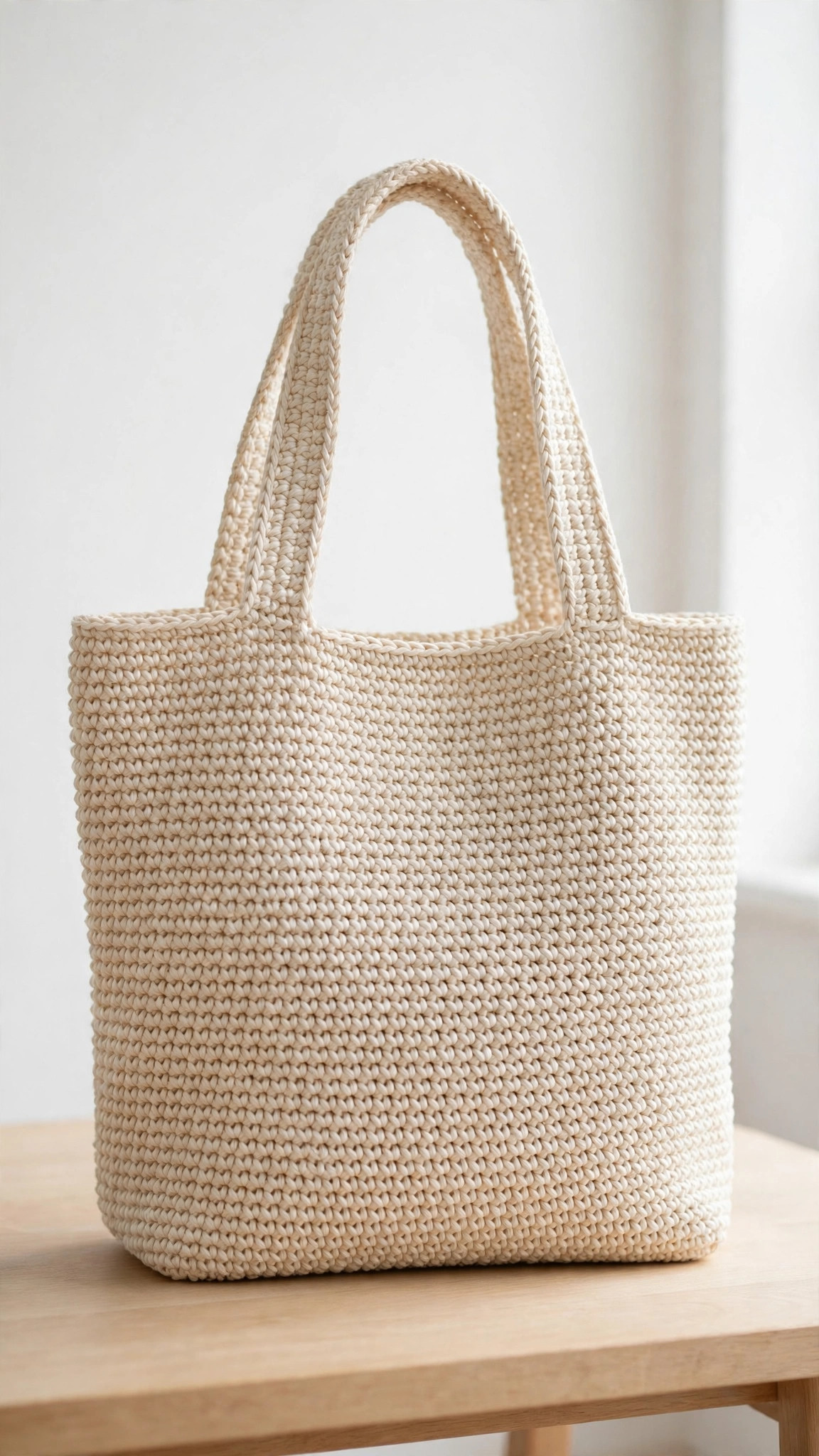
Stitch a sturdy everyday crochet tote bag in cotton with a flat base, strong handles, and a roomy body.

Patterns · Crochet
- Finished size
- 14 in wide x 15 in tall
- Making time
- 6 to 8 hours
- Hook
- US I-9 (5.5 mm)
- Set
- Flat base, sides, handles
- Skill
- Easy
In this post
- Key Takeaways
- Table of Contents
- Why You Will Love This Tote Bag
- Finished Size, Skill Level, and Time
- Materials You Need
- Abbreviations (US Terms)
- Gauge and Sizing Notes
- Part 1: The Flat Base
- Part 2: The Sides
- Part 3: Handles, Top Edge, and Finishing
- Variations: Colors, Sizes, and Uses
- Troubleshooting Totes That Stretch or Slump
- Care Instructions
- Frequently Asked Questions
A good crochet tote bag is the kind of project that earns its keep every single day. It carries your library books, your farmers market vegetables, your knitting project, and your lunch, all without complaining. This free crochet tote bag pattern makes a sturdy everyday cotton tote with a flat base, a roomy body, and strong handles that will not stretch out of shape. It is an original Little Loop Finds design, written in US terms, and it works up quickly in worsted weight cotton yarn.
The base is worked flat first, so the bag stands up on its own. The sides use dense stitches, so groceries and books do not poke through. The handles are crocheted into the top edge and reinforced, so they can carry real weight.
A quick note on scope: this post is a pattern for one specific structured everyday tote bag, with a flat base and fixed handles. It is not a roundup of bag styles. If you want to browse lots of different bag ideas first, our free crochet bag patterns collection has slouchy bags, granny square bags, and market bags to compare.
Key Takeaways
- Free original pattern: this crochet tote bag pattern is a Little Loop Finds original design, written in US terms, and completely free.
- Sturdy structured build: a flat worked base, dense stitches, and reinforced handles mean the bag stands up and carries real weight.
- Beginner friendly: only chains, single crochet, half double crochet, and double crochet, with a stitch count at the end of every round.
- Practical everyday size: about 14 inches wide and 15 inches tall, big enough for books, groceries, and a yarn project.
- Quick and giftable: about 6 to 8 hours from first stitch to finished bag, and a wonderful handmade gift for anyone who shops, reads, or crafts.
Table of Contents
- Why You Will Love This Tote Bag
- Finished Size, Skill Level, and Time
- Materials You Need
- Abbreviations (US Terms)
- Gauge and Sizing Notes
- Part 1: The Flat Base
- Part 2: The Sides
- Part 3: Handles, Top Edge, and Finishing
- Variations: Colors, Sizes, and Uses
- Troubleshooting Totes That Stretch or Slump
- Care Instructions
- Frequently Asked Questions
Why You Will Love This Tote Bag
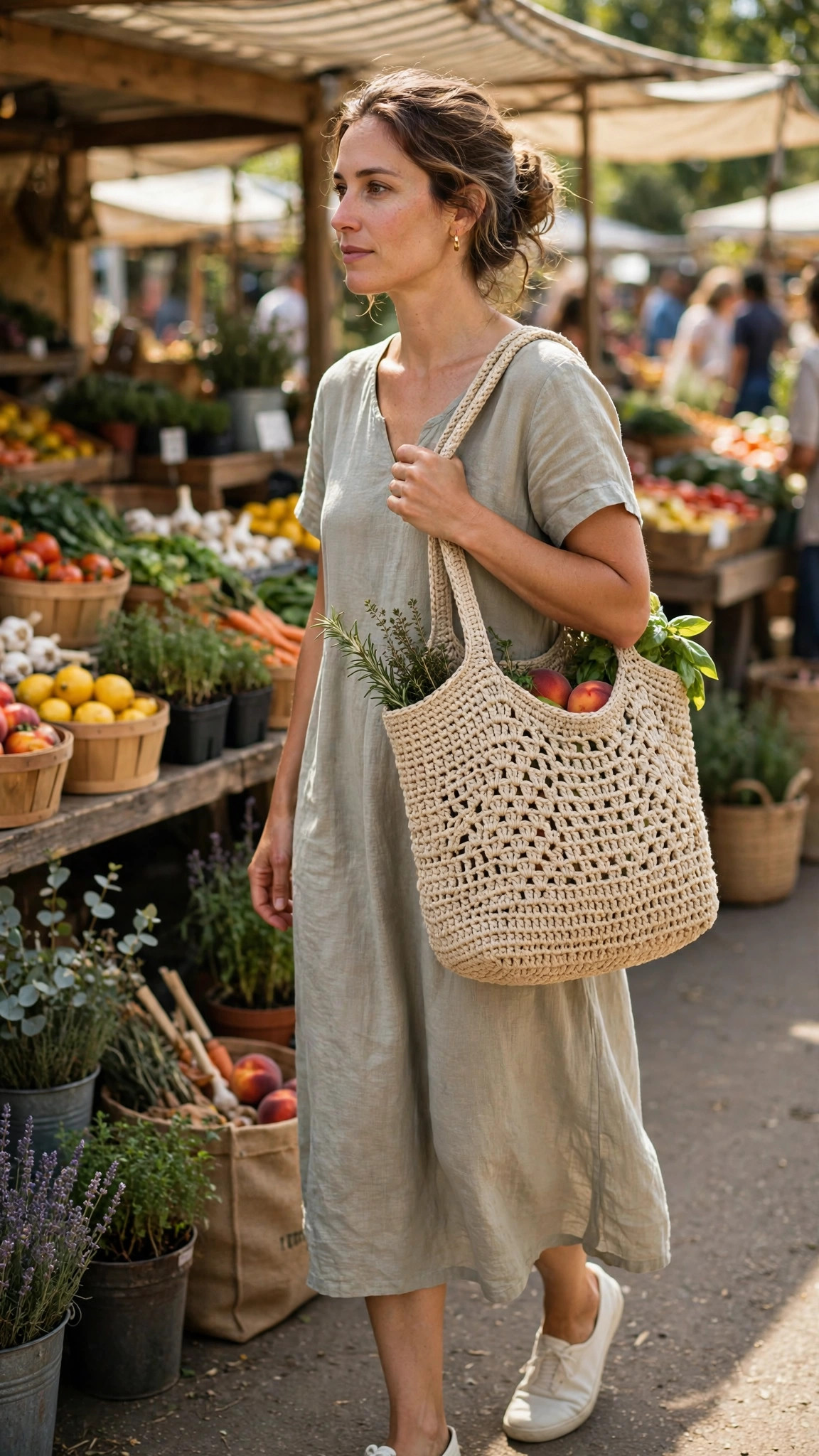
There is something deeply satisfying about a bag you made yourself carrying your whole day. A crochet tote is useful in a way that a decorative project never is. You take it to the market on Saturday, to the library on Monday, and to the park on Sunday, and every time someone asks where you got it, you get to say you made it. Cotton yarn gives the bag a clean, sturdy feel, and the tight stitches mean small things like pens and lip balm stay inside where they belong.
This tote is also a great stash buster with a plan. The main color needs about four balls of worsted weight cotton, and the stripe and handle accent use only small amounts, so you can use up leftover balls from other projects. The pattern is rhythmic and relaxing once the base is done, and the finished bag looks far more polished than the simple stitches suggest.
Finished Size, Skill Level, and Time
- Finished size: about 14 inches wide, 15 inches tall (not counting handles), and 4 inches deep at the base, after blocking. The handles add about 9 inches of drop, so the bag hangs comfortably from your shoulder.
- Skill level: Easy. You need to know how to chain, single crochet, half double crochet, double crochet, and slip stitch, plus how to work in the round. The handles use a simple chain loop that the pattern explains step by step.
- Time: about 6 to 8 hours total: roughly 1 hour for the flat base, 3 to 4 hours for the sides, and 1 to 2 hours for the handles, top edge, and finishing.
Materials You Need
| Item | What to get |
|---|---|
| Yarn, main color | Worsted weight (size 4) 100 percent cotton, about 650 yards in your main color |
| Yarn, accent color | Worsted weight cotton, about 100 yards for the stripe and handle reinforcement |
| Hook | US I-9 (5.5 mm), or the size that gives you a dense, sturdy fabric |
| Notions | Tapestry needle, scissors, stitch markers, measuring tape |
| Optional lining | Half a yard of cotton fabric and a sewing needle, if you want a lined bag |
Cotton yarn is the best choice for a tote bag because it is strong, it does not stretch the way acrylic does, and it holds its shape when the bag is full. Mercerized cotton gives a smooth finish with lovely stitch definition, while unmercerized cotton feels softer and more rustic. Avoid fuzzy or novelty yarns, because they hide the stitches and make a weaker fabric.
Abbreviations (US Terms)
- ch = chain
- sl st = slip stitch
- sc = single crochet
- hdc = half double crochet
- dc = double crochet
- inc = increase (2 stitches in the same stitch)
- st(s) = stitch(es)
- rnd(s) = round(s)
- rep = repeat
- sk = skip
- sp = space
- RS = right side
- BLO = back loop only
Gauge and Sizing Notes
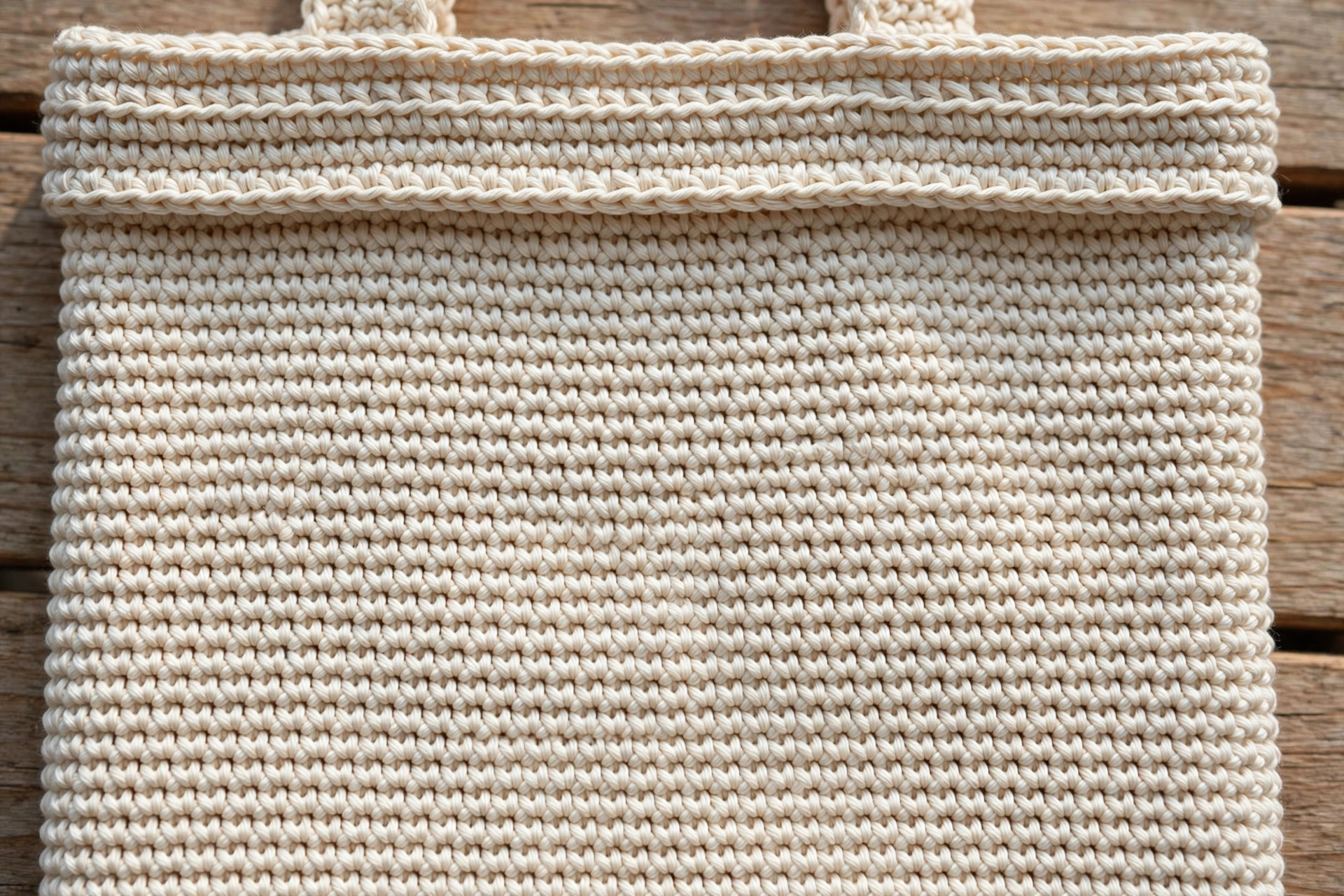
Gauge matters for a tote bag more than for a scarf, because a loose gauge makes a bag that stretches and sags. Work a swatch: chain 20, work 16 rows of single crochet, and measure. You want 14 single crochet stitches and 16 rows to equal 4 inches. If your swatch is wider than 4 inches, go down a hook size. If it is narrower, go up a hook size. The fabric should feel dense and firm, almost like a woven basket, with no gaps you can see through when you hold it up to the light.
To make a smaller tote, start with a chain of 31 instead of 41 and work the base for 10 rows instead of 12, which gives a bag about 11 inches wide. To make a larger tote, start with a chain of 51 and work the base for 14 rows, which gives a bag about 17 inches wide. Whatever size you choose, keep the gauge tight, because a tote lives or dies by its density.
Part 1: The Flat Base
The base is worked back and forth in rows of single crochet, which makes a dense rectangle that the whole bag stands on. Work loosely enough that the fabric lies flat, and count your stitches at the end of each row so the rectangle stays even. Mark the corners with stitch markers when you finish, because you will need to find them when you start the sides.
The Base Rectangle
With main color, ch 41.
- Row 1: sc in 2nd ch from hook and in each ch across. (40 sc)
- Rows 2 to 12: ch 1, turn, sc in each st across. (40 sc)
- Do not fasten off. Place a stitch marker in each corner of the rectangle.
Your base should measure about 11.5 inches wide and 3 inches deep, and it should lie perfectly flat. If the edges curl, smooth the piece with your hands and press it gently with a warm iron through a damp cloth. The base is the foundation of the whole bag, so take a moment to get it right before you move on to the sides.
Part 2: The Sides
The sides are worked in the round, starting with a round of single crochet worked evenly around all four edges of the base rectangle. The pattern gives you the stitch count for each round, so you can check your work as you go.
Building the Body
- Rnd 1: ch 1, work 40 sc across the long top edge, 3 sc in the corner, 12 sc evenly along the short side edge (one sc in the end of each row), 3 sc in the corner, 40 sc across the long bottom edge, 3 sc in the corner, 12 sc evenly along the other short side edge, 3 sc in the corner. Join with a sl st to the first sc. (116 sts)
- Rnd 2: ch 1, sc in BLO of each st around. Join. (116 sts)
- Rnds 3 to 8: ch 2 (does not count as a st), hdc in each st around. Join with a sl st to the first hdc. (116 sts)
- Change to accent color.
- Rnd 9: ch 1, sc in each st around. Join. (116 sts)
- Rnd 10: ch 1, sc in each st around. Join. (116 sts)
- Change to main color.
- Rnds 11 to 24: ch 3 (counts as dc), dc in each st around. Join with a sl st to the top of the ch 3. (116 sts)
The bag should now be about 12 inches tall from the base, and the stripe should sit neatly across the middle like a belt. If the sides lean or wobble, check that your stitch count is still 116 at the end of each round, because a missed or extra stitch is the usual cause. The double crochet rounds grow quickly, so this is the most satisfying part of the project: you can see the bag getting taller with every round.
Part 3: Handles, Top Edge, and Finishing
The top edge and handles are what turn a crochet tube into a bag you can actually carry. Two rounds of single crochet firm up the top edge, then the handles are formed with chain loops that are worked over in the following rounds.
Top Edge
- Rnds 25 to 26: ch 1, sc in each st around. Join with a sl st to the first sc. (116 sts)
Handles
Place stitch markers to mark the handle positions before you start. The join sits at the start of the front long edge. Count 8 stitches in from each end of the front edge and each end of the back edge, and mark those four points. The front handle spans the middle 24 stitches of the front edge, and the back handle spans the middle 24 stitches of the back edge.
- Rnd 27: ch 1, sc in the first 8 sts, ch 40, sk 24 sts, sc in the next 8 sts, sc in the next 18 sts (corner, side, and corner), sc in the next 8 sts, ch 40, sk 24 sts, sc in the next 8 sts, sc in the next 18 sts. Join with a sl st to the first sc. (148 sts, counting each chain as a stitch)
- Rnds 28 to 30: ch 1, sc in each st around, working into each chain of the handle loops. Join. (148 sts)
- Rnd 31: ch 1, sc in each st around. Join. Fasten off.
The handles should each measure about 9 inches from the top edge to the top of the loop, which is a comfortable shoulder drop for most people. If you prefer a shorter hand-held tote, chain 28 instead of 40 for each handle and skip 24 stitches as written, which gives a drop of about 6 inches. If the handle loops twist while you work the rounds over them, untwist them before each round so the handles lie flat.
Finishing
Weave in all ends with a tapestry needle, working the tails through the backs of several stitches so they disappear. Turn the bag inside out and check the base corners, because the corners take the most stress when the bag is full. If you see any gaps at the corners, close them with a few whip stitches using the main color yarn. Turn the bag right side out, fill it with a few books, and let it sit overnight so the stitches settle. Your tote is ready to carry.
If you want a lining, cut a piece of cotton fabric to the size of the finished bag plus a seam allowance, sew it into a simple pouch with a top hem, and hand stitch the hem to the inside of the top edge of the bag.
Variations: Colors, Sizes, and Uses
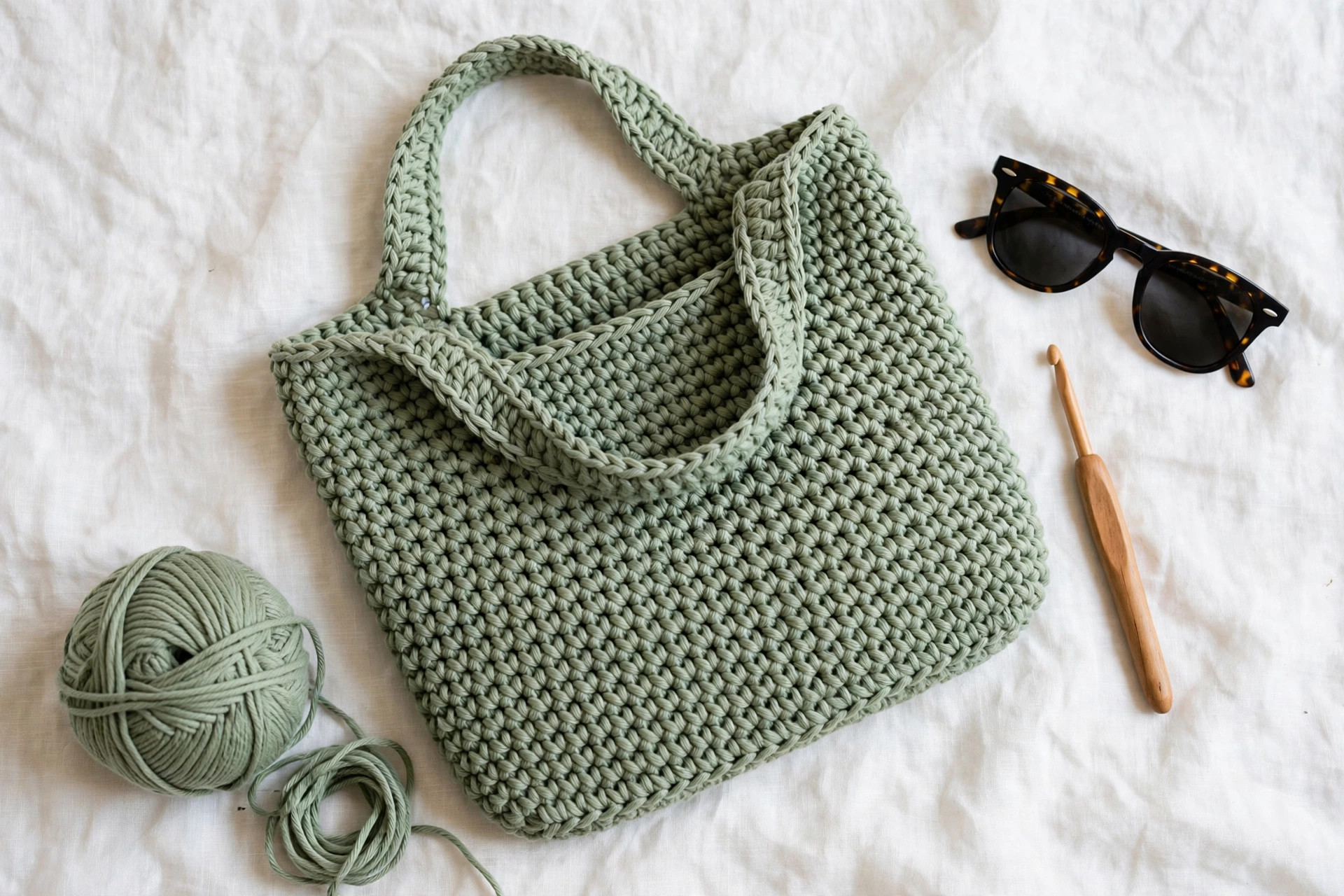
- Market tote: work the bag in a bright stripe pattern, changing color every two rounds in the double crochet section, for a cheerful farmers market bag. Our crochet grocery bag holder pattern is a handy companion for storing all those market bags at home.
- Granny square tote: work the sides in granny square clusters instead of plain double crochet for a lacy, vintage look. Our crochet granny square bag pattern shows the same idea in a smaller bag.
- Beach tote: use a larger hook and work the sides in open mesh (double crochet, chain 1, skip 1) so sand falls through and wet swimsuits can breathe. Our crochet hobo bag pattern free makes a soft slouchy alternative for the same trips.
- Tiny project bag: start with a chain of 31 and work the base for 10 rows for a small bag that holds one yarn project and a hook roll. Our crochet basket pattern free is a matching storage basket for your yarn shelf.
- Two-tone handles: work the handle rounds in the accent color for a smart contrast detail that makes the bag look store bought.
- Lined library tote: add the cotton lining described above and an inside pocket made from a small rectangle of fabric, for a bag that carries books, a phone, and a pen without anything rattling around.
If you love bags with structure, a crochet pencil case pattern is a small next project that uses the same dense single crochet fabric in miniature.
Troubleshooting Totes That Stretch or Slump
- My tote stretches when it is full. The gauge is too loose, or the yarn is acrylic. Cotton with a tight gauge is the fix: rework the bag with a hook one size smaller, and use 100 percent cotton yarn.
- My tote slumps and will not stand up. The base is too small for the height, or the sides are too loose. Make the base one size larger, work the first three side rounds in single crochet instead of half double crochet, and block the bag over a box so the base stays flat.
- My handles stretch out of shape. The handle chains were worked too loosely, or the handle rounds are too few. Work the handle loops with a hook one size smaller, add one more round of single crochet over the handles, and carry lighter loads until the cotton settles.
- My base corners have gaps. The corner increases were missed in the first side round. Close small gaps with whip stitches, and on your next bag, place stitch markers in the corners and work three stitches into each corner as written.
- My sides lean to one side. The join drifts when you work in the round. Slip stitch to join at the end of every round, so the seam stays straight up the back of the bag.
- My stripe looks wavy. The color change was made mid-round or the tension changed with the new ball. Change colors at the join and carry the tension evenly.
Care Instructions
Empty the bag and shake out crumbs and lint. Hand wash it in cool water with a mild soap, gently squeezing the suds through the fabric without wringing or twisting. Rinse in cool water until the water runs clear, then roll the bag in a clean towel and press to remove water. Reshape the bag over a box or a stack of books so the base stays flat and the sides stand straight, and leave it to dry flat, away from direct heat. Do not machine wash or tumble dry a cotton tote, because the heat shrinks the bag. If the handles stretch with use, wash and reshape the bag, and the cotton will spring back.
Frequently Asked Questions
Is this crochet tote bag pattern good for beginners?
Yes, it is a great first bag project. You need to know chains, single crochet, half double crochet, and double crochet, and the pattern explains the handle chain loops step by step. Every round ends with a stitch count, so you can check your work as you go.
What yarn is best for a crochet tote bag?
Worsted weight 100 percent cotton is the best choice, because it is strong, holds its shape, and does not stretch the way acrylic does. Mercerized cotton gives a smooth finish, while unmercerized cotton feels softer. Avoid fuzzy or novelty yarns, because they make a weaker fabric.
How big is the finished tote bag?
About 14 inches wide, 15 inches tall, and 4 inches deep at the base, after blocking. The handles add about 9 inches of drop. The pattern also gives notes for a smaller 11 inch tote and a larger 17 inch tote.
Will the tote stretch when I carry groceries?
A cotton tote worked at the gauge in this pattern stretches very little, because the stitches are dense and the handles are reinforced with three extra rounds. Carry the bag by both handles to spread the weight, and do not overload it with more than about 10 pounds.
Can I line the tote bag?
Yes, and the pattern explains how in the finishing section. Cut cotton fabric to the size of the finished bag, sew a simple pouch, and hand stitch the hem to the inside of the top edge. A lining is optional but lovely for small items.
Can I sell tote bags made from this pattern?
Yes, you may sell finished tote bags made from this free pattern, with credit to Little Loop Finds. Please do not sell or republish the pattern text itself.
How do I keep the tote standing up?
The flat base is the key, so block the bag over a box and let it dry in shape. Store the bag stuffed with a rolled towel or a small box when you are not using it, so the base stays flat and the sides stay straight.
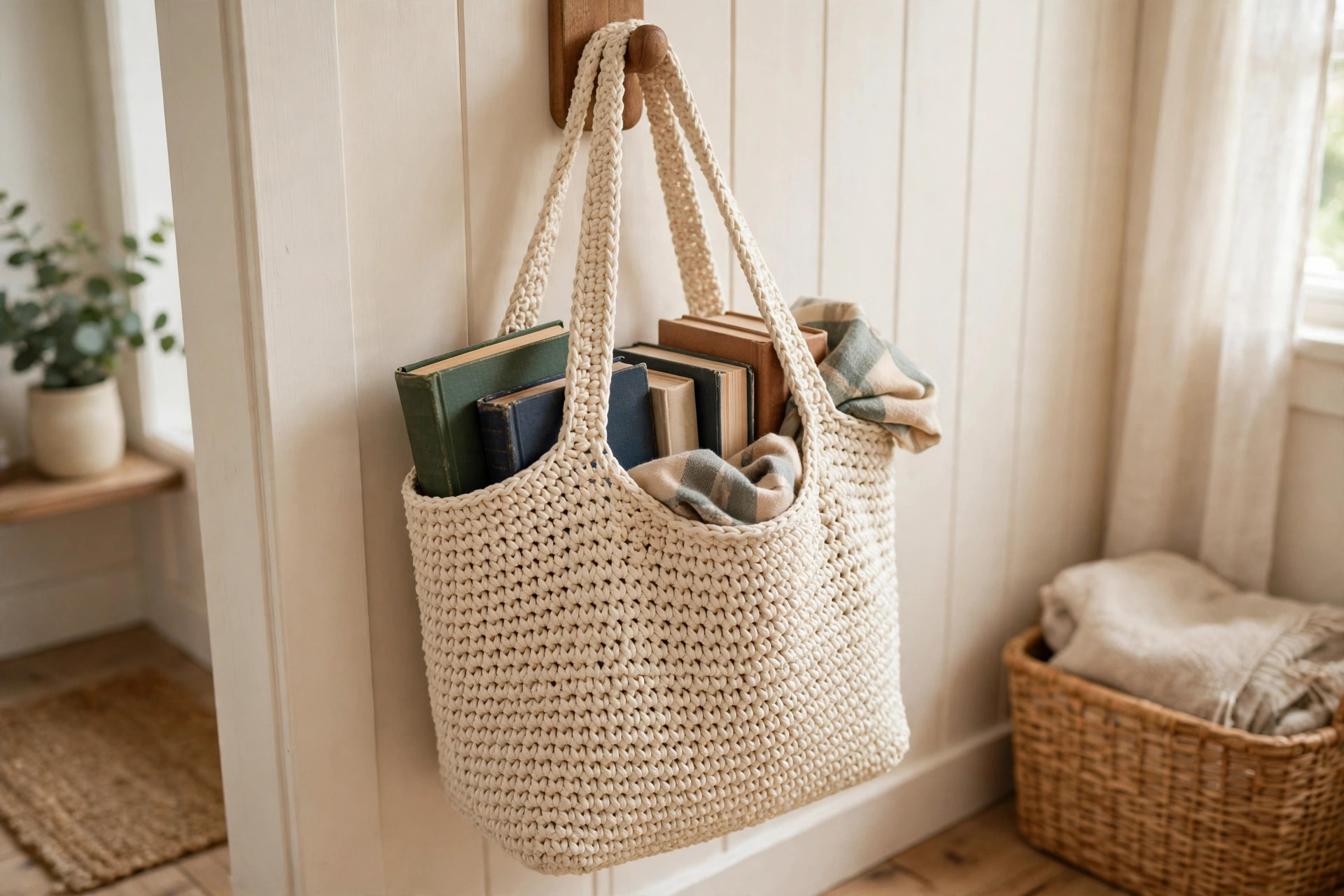
Happy stitching, and may your new tote carry many happy trips to the market, the library, and everywhere in between.