Crochet Christmas Coasters Free Patterns: 3 Festive Sets
Three original Christmas coasters — a lacy snowflake, a bauble-dotted tree, and a berry wreath with a bow — each worked in worsted cotton in under an hour with full round-by-round US-terms instructions.

Home décor · Crochet
- Finished size
- About 4½ in / 11.5 cm across
- Making time
- 30–45 minutes each
- Hook
- 4.0 mm, worsted-weight cotton
- Pieces
- Set of 3 designs
- Skill
- Easy
In this post
There is a particular kind of December panic that has nothing to do with shopping. It is the moment a guest sets a steaming mug down on your good wooden table, smiles, and says, "You don't have a coaster, do you?" These crochet Christmas coasters free patterns are the answer — a festive set of three original designs you can hook up from leftover cotton before the guests have taken their coats off.
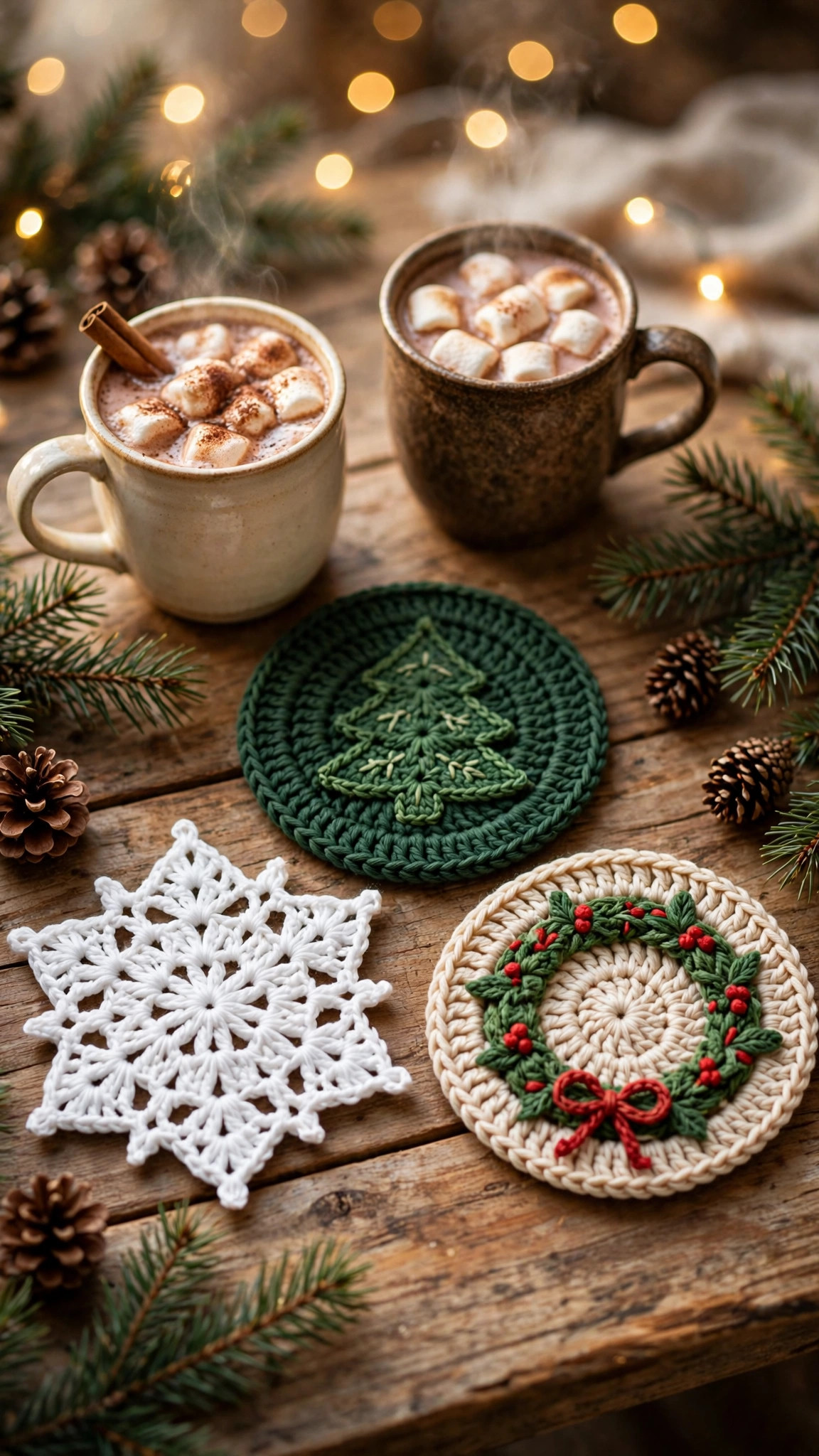
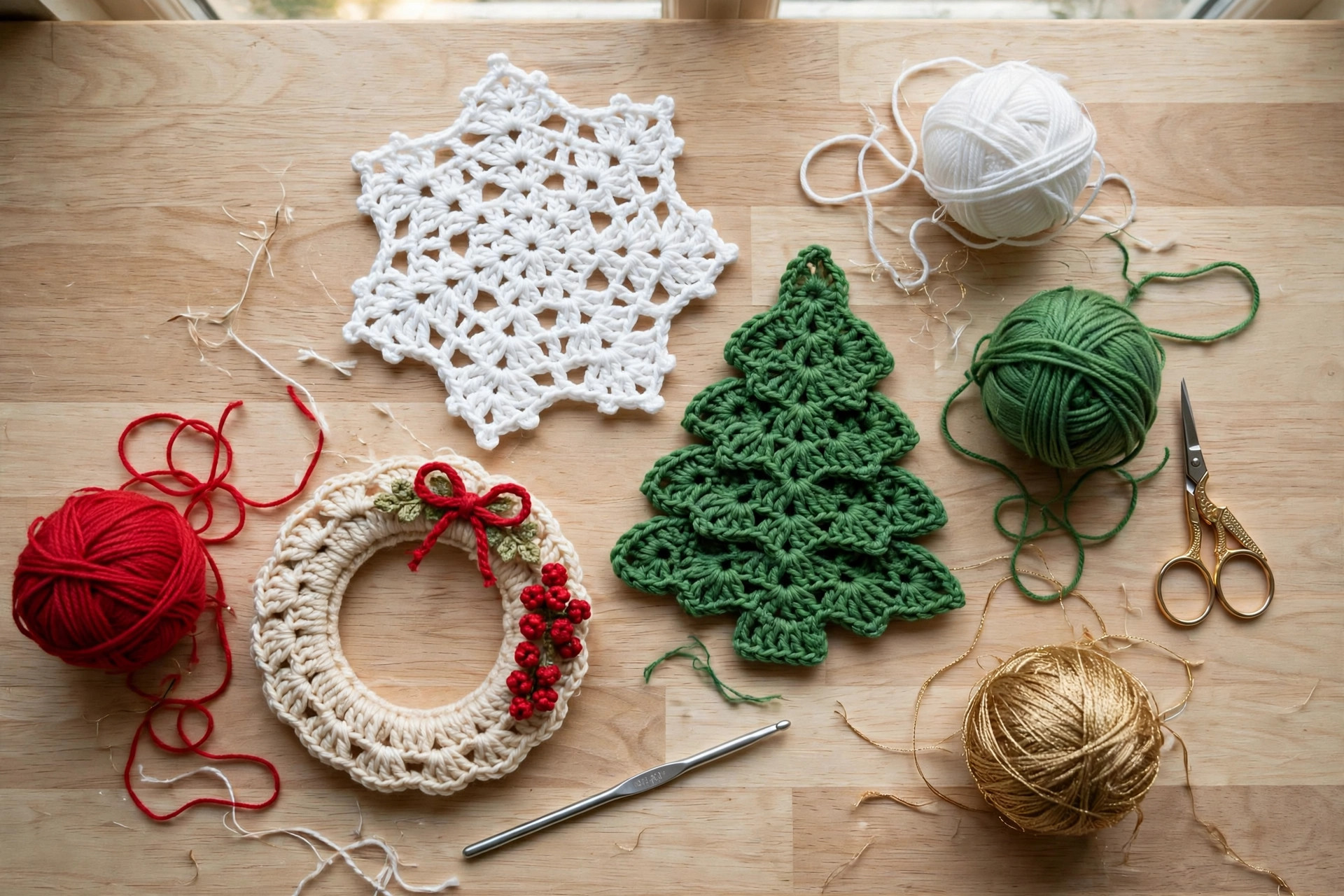
In this post you get three complete, round-by-round patterns: a lacy white snowflake with picot points, a deep green Christmas tree coaster with a gold star and red baubles, and a wreath coaster with berries and a bow on a cream base. Each takes half an hour or so, uses a few grams of worsted cotton, and lies flat straight off the hook. Make one design in multiples, make the full mixed set, or gift them in tied stacks of four — a mug rug under every mug and not a ring mark in sight.
Contents
- Why you'll love these Christmas coasters
- Materials you'll need
- Size, gauge and skill level
- Abbreviations — US terms
- The patterns (US terms)
- Finishing your coasters
- Tips for perfect Christmas coasters
- FAQ
- What to crochet next
Why you'll love these Christmas coasters
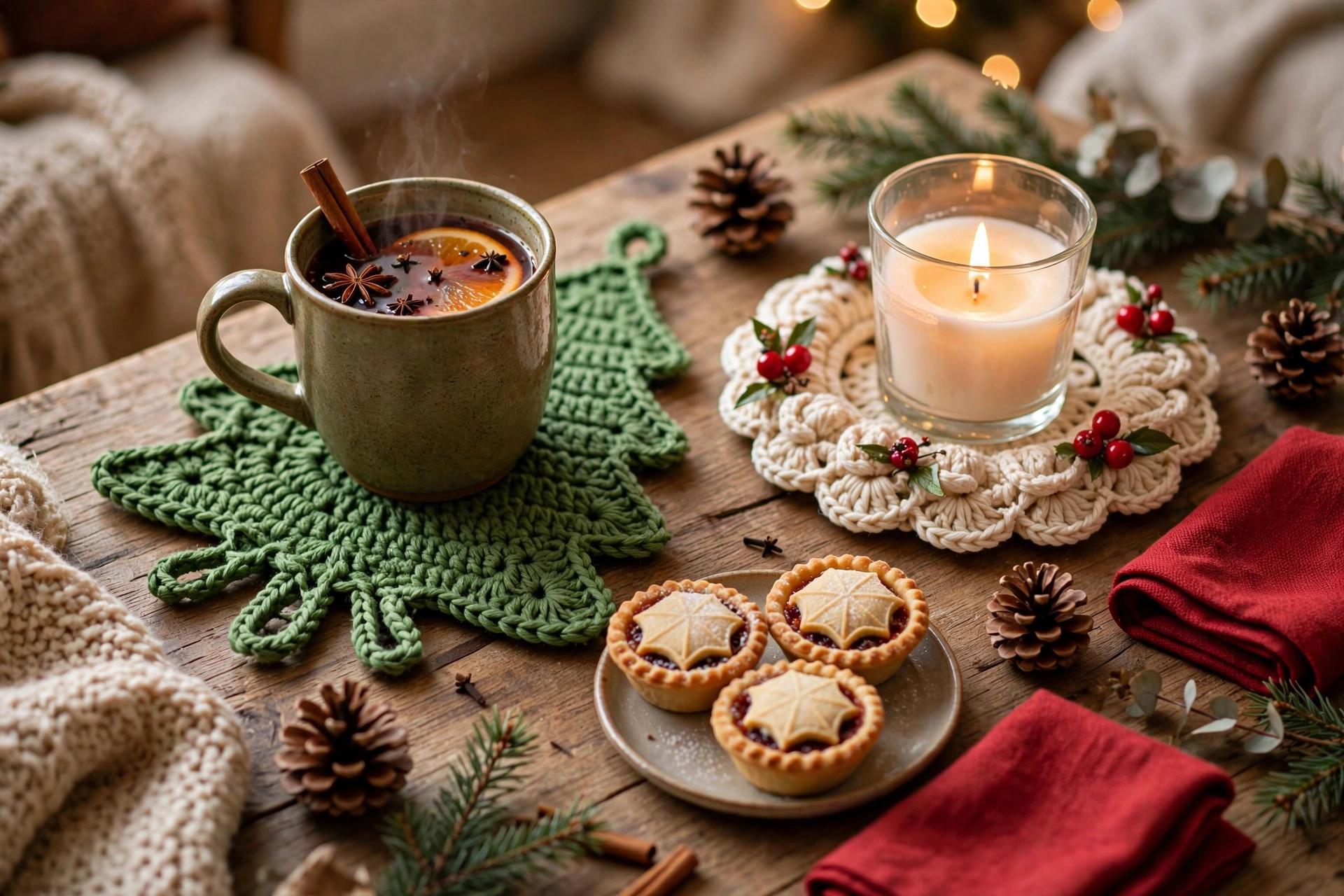
Coasters are the fastest win in Christmas crochet. No sizing, no long rows, and the finish line is always under an hour away — yet the result looks planned weeks ago. A snowflake under a white mug, a tree under the mulled wine, a wreath under the candle glass: suddenly the whole table reads as decorated.
The set is designed to work as a set. All three coasters share the same yarn, hook, and finished size, and the colour story — white, deep green, cream, with pops of red and gold — repeats across the designs, so they look intentional together or split into pairs for gifting. If you enjoyed our springtime flower coaster crochet pattern, think of this as its winter wardrobe: same satisfying one-sitting make, dressed for December.
They also use up the awkward ends of cotton balls in every stash — the greediest design eats only about 20 g. And because cotton coasters go in the wash, guests can actually use them, through every hot chocolate between now and New Year.
Materials you'll need
| Supply | What to get |
|---|---|
| White cotton yarn | Worsted (#4) cotton, bright white, about 15 g per snowflake |
| Green cotton yarn | Worsted (#4) cotton, deep forest green, about 20 g per tree, 12 g per wreath |
| Light green cotton yarn | About 8 g, for the tree appliqué |
| Cream cotton yarn | Worsted (#4) cotton, cream or natural, about 15 g per wreath base |
| Red cotton yarn | Small amount for berries, bow, baubles and edging |
| Gold cotton yarn | Small amount for the tree-top star |
| Brown cotton yarn | Tiny amount for the tree trunk |
| Crochet hook | 4.0 mm (G-6) |
| Notions | Yarn needle with a large eye, scissors, stitch marker, measuring tape |
| Optional | Pins and a towel or blocking mat for a quick steam finish |
A note on yarn: choose cotton, not acrylic, for coasters meeting hot mugs. Cotton absorbs condensation, sits flat, tolerates heat without softening, and survives endless washing. One 100 g ball each of green and white, plus scraps of cream, red, and gold, makes a mixed set of six.
Size, gauge and skill level
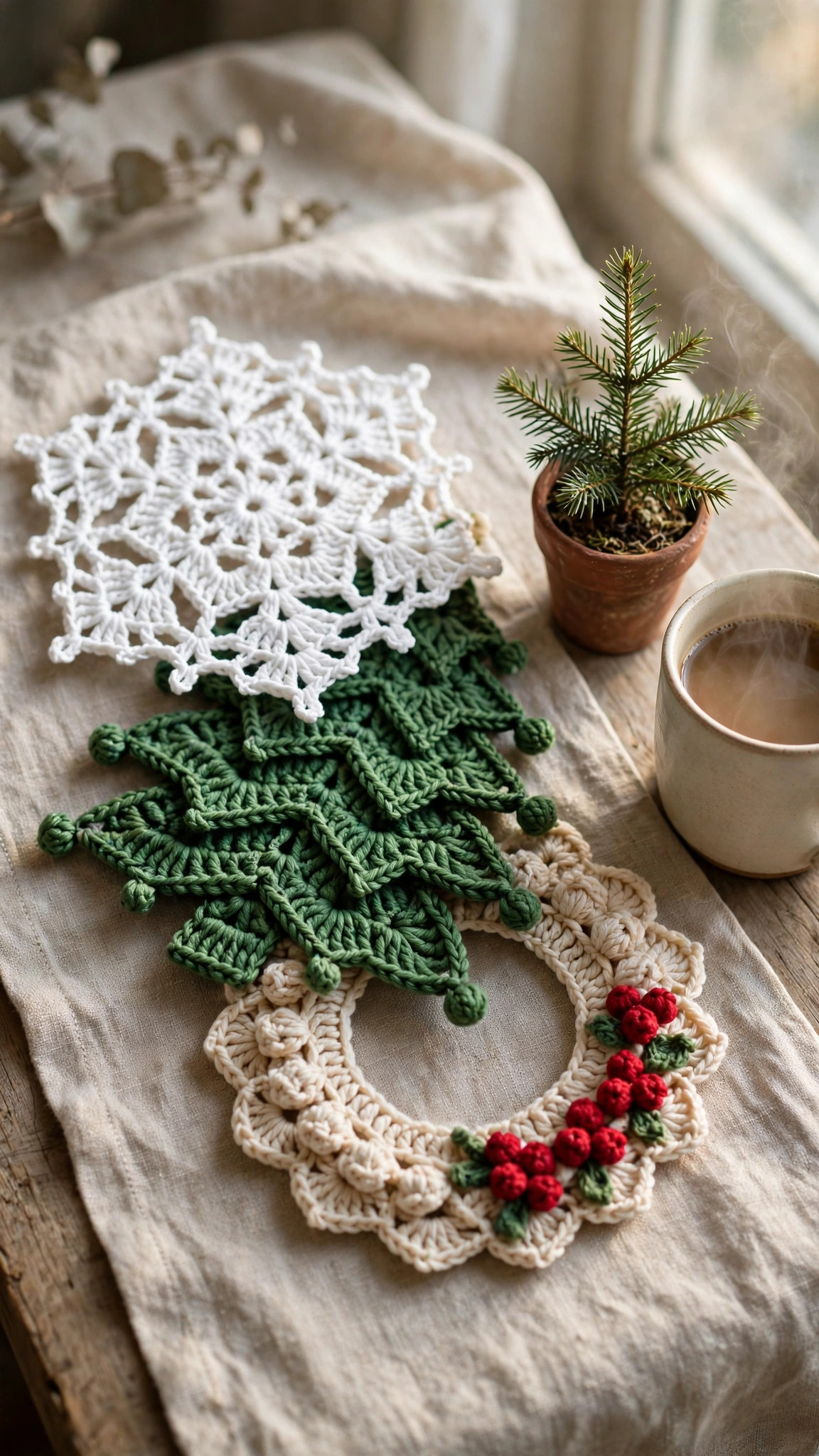
- Finished size: snowflake about 4½ in (11.5 cm) point to point; tree and wreath about 4¼ in (11 cm) across — roomy for a standard mug, small enough to batch-make.
- Gauge: 15 sc × 17 rounds = 4 in (10 cm) with a 4.0 mm hook. Coaster gauge is forgiving — ¼ in bigger or smaller still saves your table — but if your circles ruffle or cup, gauge and the increase rhythm are the first things to check.
- Skill level: easy. Be comfortable with the magic ring, single crochet, double crochet, and slip stitch. The picot is explained where it appears, and the tree and wreath are flat circles with appliqué pieces sewn on.
Before you start: all three patterns use joined rounds unless stated otherwise. Keep a marker in the first stitch while you learn the rhythm — losing your place in a sea of green is a rite of passage nobody needs twice.
Abbreviations — US terms
| Abbreviation | Meaning |
|---|---|
| MR | magic ring |
| ch | chain |
| sl st | slip stitch |
| sc | single crochet |
| hdc | half double crochet |
| dc | double crochet |
| inc | increase (2 sc in the same stitch) |
| sk | skip |
| st(s) | stitch(es) |
| R | round / row |
| FO | fasten off |
Picot: chain 3, slip stitch into the first of those chains. That tiny loop points each snowflake tip. Practise two on a scrap first.
The patterns (US terms)
Start with the tree if this is your first set: its solid circle teaches the increase rhythm the other two designs borrow. For a bigger table project in the same cotton, our crochet table runners free patterns use the same flat-circle logic at a grander scale.
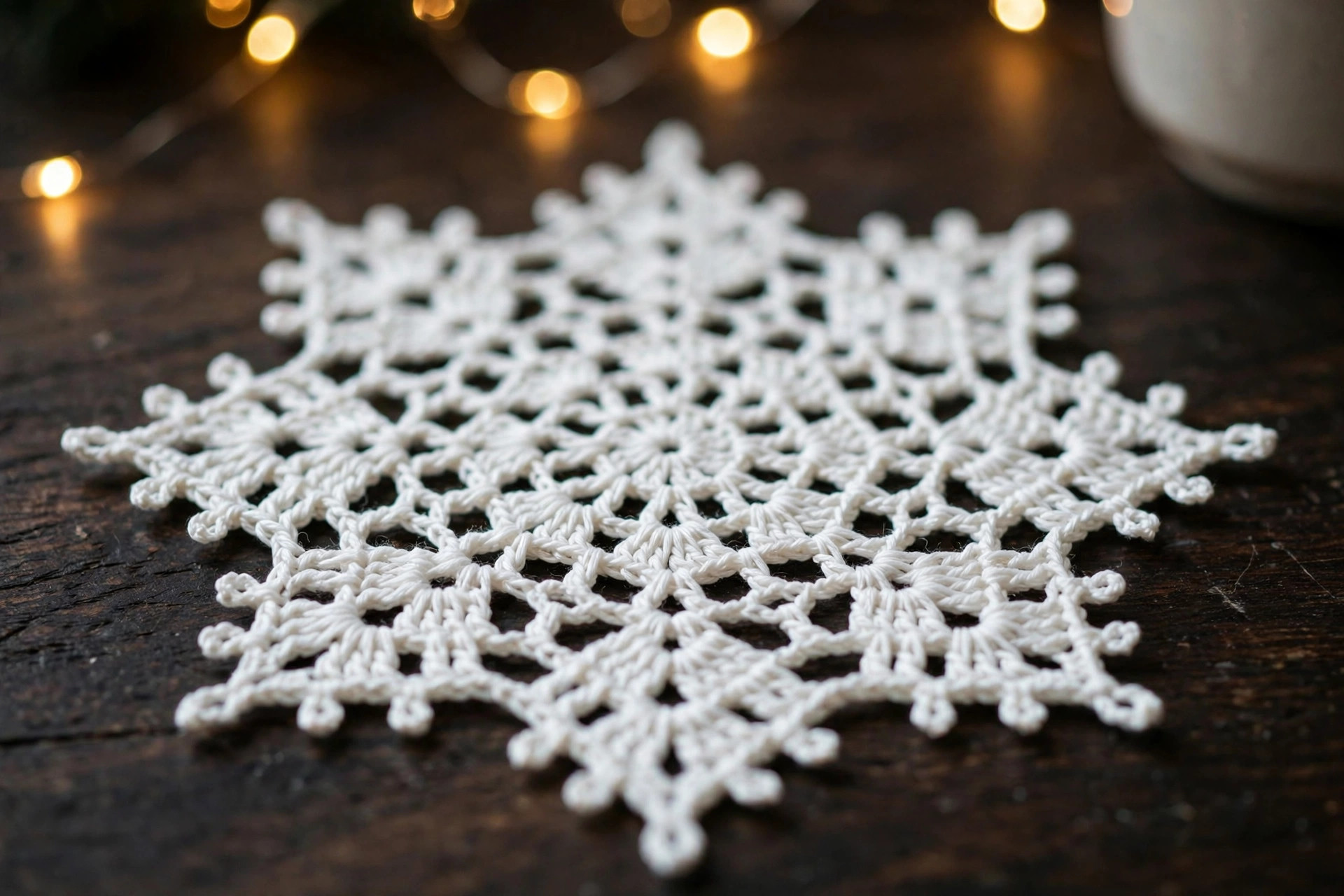
Design 1: Snowflake coaster
White, lacy, and unmistakably wintry, this is the showpiece of the set. A solid seven-round centre keeps your mug stable, then six shell points open out into a snowflake silhouette with picot tips — all the drama in the last two rounds.
- R1: MR, 6 sc, join with sl st to first sc (6)
- R2: ch 1, inc in each st around, join (12)
- R3: ch 1, [sc, inc] × 6, join (18)
- R4: ch 1, [2 sc, inc] × 6, join (24)
- R5: ch 1, [3 sc, inc] × 6, join (30)
- R6: ch 1, [4 sc, inc] × 6, join (36)
- R7: ch 1, [5 sc, inc] × 6, join (42)
- R8 — the points: ch 1, sk 3 sts, (2 dc, ch 2, 2 dc) in next st, sk 2 sts, sl st in next st — repeat from * to * 6 times in total (6 shell points made). Join with sl st to the first ch-1 space.
- R9 — picot edge: sl st in next 2 dc, in the ch-2 space work (sc, ch-3 picot, sc), sl st in next 2 dc, sl st in the sl st — repeat from * to * 6 times. FO and weave in the ends.
Your snowflake should lie almost flat, with six even points. If one point looks shorter, you probably skipped 2 stitches instead of 3 before its shell — a two-minute fix now. Give the flake a firm tug point-to-point in three directions to settle the lace. In cream it reads as a vintage doily-style coaster; in pale blue it is pure Frozen-party territory.
Design 2: Christmas tree coaster
A rich forest-green circle forms the base — thick, flat, and properly mug-sized — with a lighter green tree appliqué sewn in the middle. A gold star, a brown trunk, and red baubles finish the scene. This is the most giftable design of the three: a stack of four tied with red ribbon is the present every host opens with a grin.
Base — forest green:
- R1: MR, 6 sc, join (6)
- R2: ch 1, inc in each st around, join (12)
- R3: ch 1, [sc, inc] × 6, join (18)
- R4: ch 1, [2 sc, inc] × 6, join (24)
- R5: ch 1, [3 sc, inc] × 6, join (30)
- R6: ch 1, [4 sc, inc] × 6, join (36)
- R7: ch 1, [5 sc, inc] × 6, join (42)
- R8: ch 1, [6 sc, inc] × 6, join (48)
- R9 — edge: change to red, ch 1, sc in each st around, join (48). FO and weave in the ends.
The single red round tidies the edge, stops any curling, and frames the tree like a bauble on a card. Prefer subtler? Work R9 in gold, or keep the base all green.
Tree appliqué — light green, worked flat:
- Row 1: ch 2, sc in the 2nd ch from the hook (1)
- Row 2: ch 1, turn, 3 sc in the sc (3)
- Row 3: ch 1, turn, inc, sc, inc (5)
- Row 4: ch 1, turn, inc, 3 sc, inc (7)
- Row 5: ch 1, turn, inc, 5 sc, inc (9)
- Row 6: ch 1, turn, inc, 7 sc, inc (11)
- Row 7: ch 1, turn, inc, 9 sc, inc (13)
- FO, leaving a long tail of about 12 in (30 cm) for sewing.
Trunk — brown: ch 4, sc in the 2nd ch from the hook and in the next 2 ch (3). Row 2: ch 1, turn, sc in each st (3). FO, leaving a tail for sewing.
Star — gold: MR, ch 2, sc in the 2nd ch from the hook, sl st into the ring — repeat from * to * 5 times to make 5 points. Pull the ring snug, FO, leaving a tail for sewing.
Assembly: lay the trunk on the base first, centred at the bottom, so its top edge hides under the tree. Pin the tree over it, tip up, and whipstitch around the tree with its long tail, catching edge stitches only; then sew the trunk's sides and bottom. Sew the star to the tip with two or three firm stitches. Finally, embroider five or six red French knots (wrap the yarn twice around the needle before pulling through) across the branches as baubles. Stand back: that is a Christmas tree, in forty minutes.
Design 3: Wreath coaster
The friendliest of the three: a calm cream circle, a plump green wreath ring sewn on top, six red berries, and a little bow at the bottom. The ring is worked around a chain loop, giving the wreath real dimension — it sits up from the base like the real thing on a door, and mugs rest neatly inside its circle.
Base — cream:
- R1: MR, 6 sc, join (6)
- R2: ch 1, inc in each st around, join (12)
- R3: ch 1, [sc, inc] × 6, join (18)
- R4: ch 1, [2 sc, inc] × 6, join (24)
- R5: ch 1, [3 sc, inc] × 6, join (30)
- R6: ch 1, [4 sc, inc] × 6, join (36)
- R7: ch 1, [5 sc, inc] × 6, join (42)
- R8: ch 1, sc in each st around, join (42). FO and weave in the ends.
Wreath ring — forest green:
- Foundation: ch 20, join with sl st to the first ch to form a ring, taking care not to twist the chain.
- R1: ch 1, work 30 sc into the ring itself (not into individual chains), spreading them evenly so the chain disappears inside the stitches, join (30)
- R2: ch 1, [4 sc, inc] × 6, join (36)
- R3 — leaf edge: sl st in next st, (sc, ch 2, sc) in next st — repeat from * to * 18 times around, join (18 little leaves). FO, leaving a long tail of about 16 in (40 cm) for sewing.
Berries — red, make 6: MR, 4 sc, join. FO, leaving a short tail; pull the ring fully closed so the four stitches bead up into a tiny ball.
Bow — red: ch 6, sl st into the first ch (loop made); ch 6, sl st into the same ch (second loop); ch 4, sl st into the same point (first tail); ch 4, sl st into the same point (second tail). FO, wrap the tail around the centre five times, and knot firmly at the back.
Assembly: centre the ring on the cream base and pin at four points. Sew it down with its long tail, stitching through the ring's R2 stitches into the base — the leaf edge should stay free and flippy, never stitched flat. Sew the berries in three pairs, at about 10, 2, and 5 o'clock on the ring, and the bow at 6 o'clock, sewn through its wrapped centre. Every wreath sits slightly differently, and that handmade wobble is the charm of it.
Finishing your coasters
Five unhurried minutes turn "I made a circle" into "I made a coaster." Weave in every end, changing direction twice — a twice-turned tail stays buried in the wash. Knot sewing tails on the base's underside.
Then block, simply. Lay each coaster on a folded towel, shape it with your fingers — tease the snowflake points out, round the tree base, arrange the wreath ring — and give it a few bursts of steam from a kettle or iron held just above. Press gently while it cools. The cotton relaxes, all three designs dry dead flat, and the snowflake's points turn properly crisp.
For gifting, stack four coasters, cross red ribbon over the top, and add a tag: "cotton, machine wash warm, dry flat." A set pairs naturally with our crochet Christmas stocking pattern in a handmade hamper.
Tips for perfect Christmas coasters
- Your circle is ruffling like a lettuce leaf. Too many stitches for your tension — or increases landing on top of each other round after round. Stagger them: start alternate rounds with half the stitches before the first increase (begin R5 with 1 sc, inc, then continue [3 sc, inc]).
- Your circle is cupping into a bowl. Too few stitches, or tension tighter than gauge. Check you have not skipped an increase round — count at the end of every round — or try a 4.5 mm hook to compare.
- Sew appliqués on before you block. Sewing settles the tree and wreath into position; blocking afterwards relaxes everything together.
- Keep berries and bows out of the mug zone. A berry parked dead centre makes mugs rock, which is why the pattern places berries on the ring itself. Same for the tree: French knots belong on the branches.
- Make the set production-line style. All snowflake centres first, then all points; all bases, then all trees. Your speed doubles, and a set of six takes one film's worth of evening. Our crochet doily patterns free collection uses the same batching trick at a fancier scale.
- Wash before gifting if you can. One warm wash softens cotton's stiffness and settles the stitches into their flattest selves — and proves the coaster survives the laundry.
FAQ
Are these Christmas coaster patterns really free?
Yes — all three complete patterns are here in full, with every round, stitch count, and assembly step. Nothing is held back and there is no signup. To say thank you, save the pin or share this post with a crochet friend.
What is the best yarn for crochet coasters?
Worsted-weight cotton, every time. It absorbs condensation instead of letting it pool, protects wood from hot mug bases, lies flat, and machine-washes without complaint. Acrylic looks similar but slides around, absorbs nothing, and can soften under a very hot mug.
Why is my coaster curling at the edges?
Curling almost always means the stitch count drifted — a missed increase round, or tension that tightened as you relaxed. Count at the end of every round against the printed counts, and finish with the steam-and-press step above, which persuades all but the most determined curl to lie down.
How long does each coaster take to make?
About 30–45 minutes once you have the rhythm. The tree is fastest (a plain circle plus a small appliqué), the wreath takes a little longer for its sewn-on pieces, and the snowflake sits in between. A mixed set of six is a realistic one-evening project.
Can I make the coasters bigger for mugs and glasses?
Yes. For any flat-circle base, work one extra increase round — [7 sc, inc] × 6 for 54 stitches — before the edge round, adding roughly half an inch across. For the snowflake, add the round before the points round; the repeat still divides evenly by six, so nothing else changes.
Can I sell coasters made from these patterns?
Yes — you may sell finished coasters from these patterns at craft fairs and online, in small batches. Please credit Little Loop Finds as the designer with a link back here. The pattern text and photos may not be copied, republished, or sold.
How do I wash crochet Christmas coasters?
Machine wash warm with similar colours, reshape, and dry flat. Cotton improves with washing — the fibres bloom and absorbency goes up. Iron warm if you want the snowflake points extra crisp.
What to crochet next
However many you make — one snowflake for your desk or six mixed sets for the whole street — these little circles earn their place on the table every day of December. Happy crocheting, and merry Christmas from Little Loop Finds.
The box below contains an Etsy link. If you buy through it, we may earn a small commission at no extra cost to you. Learn more.
No time to make one?
Short on time? Find handmade crochet Christmas coasters on Etsy.
Browse on Etsy (opens Etsy in a new tab)