Daisy Crochet Pattern (Free Flower Motif)
Crochet a flat daisy flower motif with twelve petals and a sunny center, then join it into blankets, hats, and bags.

Patterns · Crochet
- Finished size
- 4 in across, petal to petal
- Making time
- 1 hour per motif
- Hook
- US H-8 (5.0 mm)
- Set
- Center, petals, join
- Skill
- Easy
In this post
- Key Takeaways
- Table of Contents
- Why You Will Love This Daisy Crochet Pattern
- Finished Size, Skill Level, and Time
- Materials You Need
- Abbreviations (US Terms)
- Gauge and Sizing Notes
- Part 1: The Daisy Center
- Part 2: The Twelve Petals
- Part 3: Joining Motifs and Finishing
- Variations: Colors, Sizes, and Uses
- Troubleshooting Daisies That Curl or Pucker
- Care Instructions
- Frequently Asked Questions
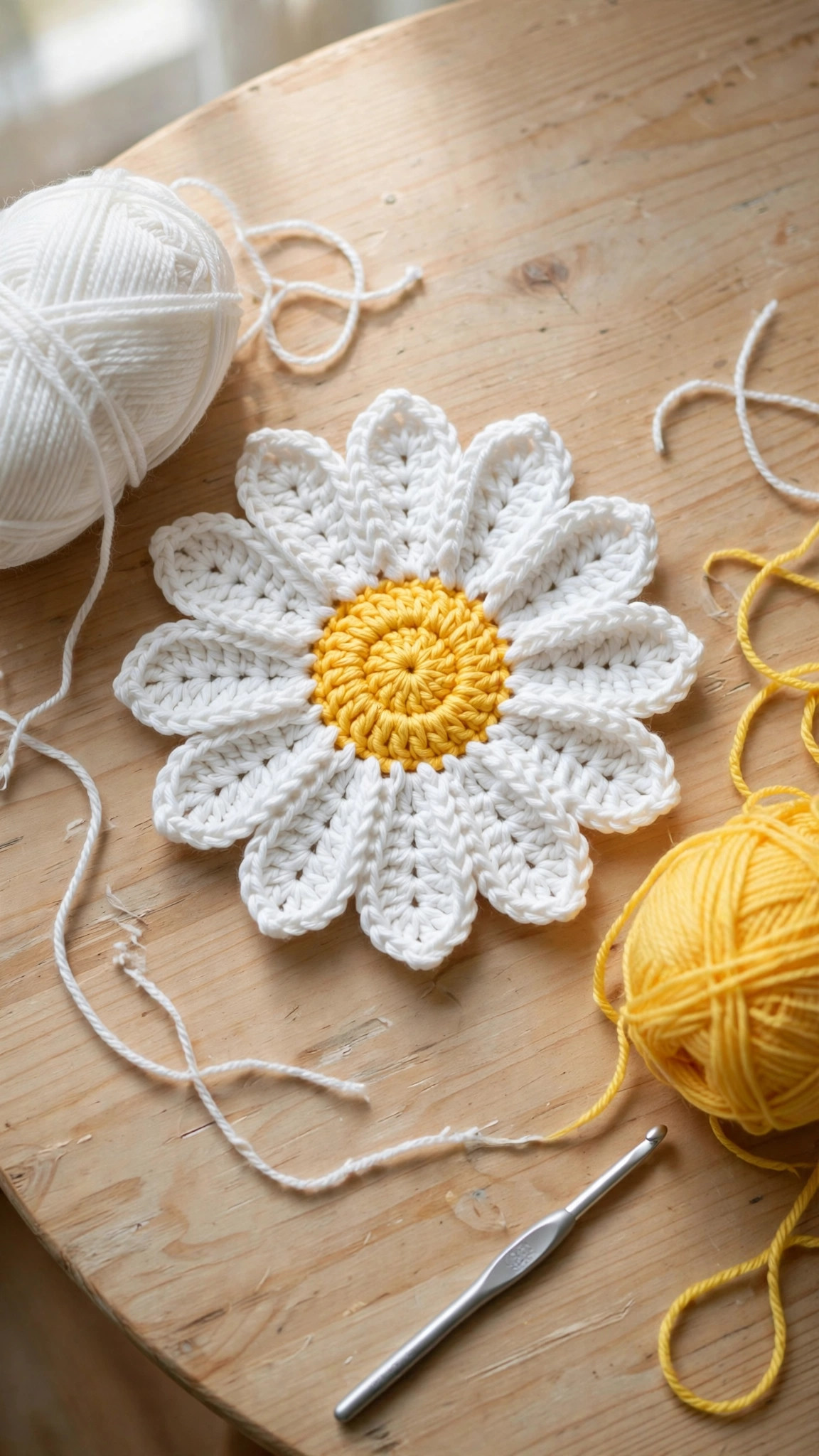
A crochet daisy is one of the happiest little motifs you can make. White petals around a sunny yellow center, worked flat in just a few rounds, and ready to join into blankets, hats, bags, and garlands. This free daisy crochet pattern walks you through every step, from the yellow center circle to the twelve petals and the joining methods that turn single flowers into a finished project.
This is an original Little Loop Finds design, written in US terms and completely free. The daisy is a flat flower motif, not a three dimensional amigurumi flower, which means it sits neatly on fabric and joins edge to edge without bulk. Each motif takes about an hour, uses only a small amount of yarn, and works up the same way every time, so a blanket made from forty motifs looks neat and even. If you can crochet a magic ring, a single crochet increase, and a chain, you can crochet this daisy.
A quick note on scope: this post is about one specific flat daisy flower motif, a joinable applique with twelve petals and a yellow center. It is not a daisy granny square, which is a full square with a flower in the middle. If you want that square version, our daisy granny square crochet pattern is a separate pattern. This motif is the flat flower itself, made to sew onto things or join into larger pieces.
Key Takeaways
- Free original pattern: this daisy crochet pattern is a Little Loop Finds original flat flower motif, written in US terms, and completely free.
- A joinable flower motif: a yellow center circle with twelve white petals, worked flat so it sews onto fabric or joins edge to edge.
- Beginner friendly motif: simple chains, single crochet, half double crochet, and double crochet, with a stitch count at the end of every round.
- Quick one hour flower: one motif takes about an hour and uses about 15 yards of yarn, so a blanket is a stash friendly project.
- Many ways to use it: sew daisies onto hats and bags, join them into blankets and scarves, or string them into a spring garland.
Table of Contents
- Why You Will Love This Daisy Crochet Pattern
- Finished Size, Skill Level, and Time
- Materials You Need
- Abbreviations (US Terms)
- Gauge and Sizing Notes
- Part 1: The Daisy Center
- Part 2: The Twelve Petals
- Part 3: Joining Motifs and Finishing
- Variations: Colors, Sizes, and Uses
- Troubleshooting Daisies That Curl or Pucker
- Care Instructions
- Frequently Asked Questions
Why You Will Love This Daisy Crochet Pattern
There is something about a daisy that feels like the start of spring. White petals, a yellow center, and a shape that everyone recognizes at a glance. A crochet daisy sewn onto a hat, scattered across a baby blanket, or strung into a garland brings that same bright feeling into a handmade project, and it does it with only a few yards of yarn.
A daisy motif is also one of the best first motif projects. The center teaches you how to work a flat circle that stays flat, the petals teach you how to shape with chains and taller stitches, and the joining teaches you how separate pieces become a blanket.
Finished Size, Skill Level, and Time
- Finished size: about 4 inches across from petal tip to petal tip, and about 2.5 inches across the yellow center, in worsted weight yarn. The pattern also gives notes for a small 3 inch applique version and a large 5 inch version.
- Skill level: Easy. You need a magic ring, chains, slip stitches, single crochet, half double crochet, and double crochet, plus a little sewing to join the motifs.
- Time: about 1 hour per motif: roughly 15 minutes for the center, 30 minutes for the twelve petals, and 15 minutes for weaving in ends and blocking.
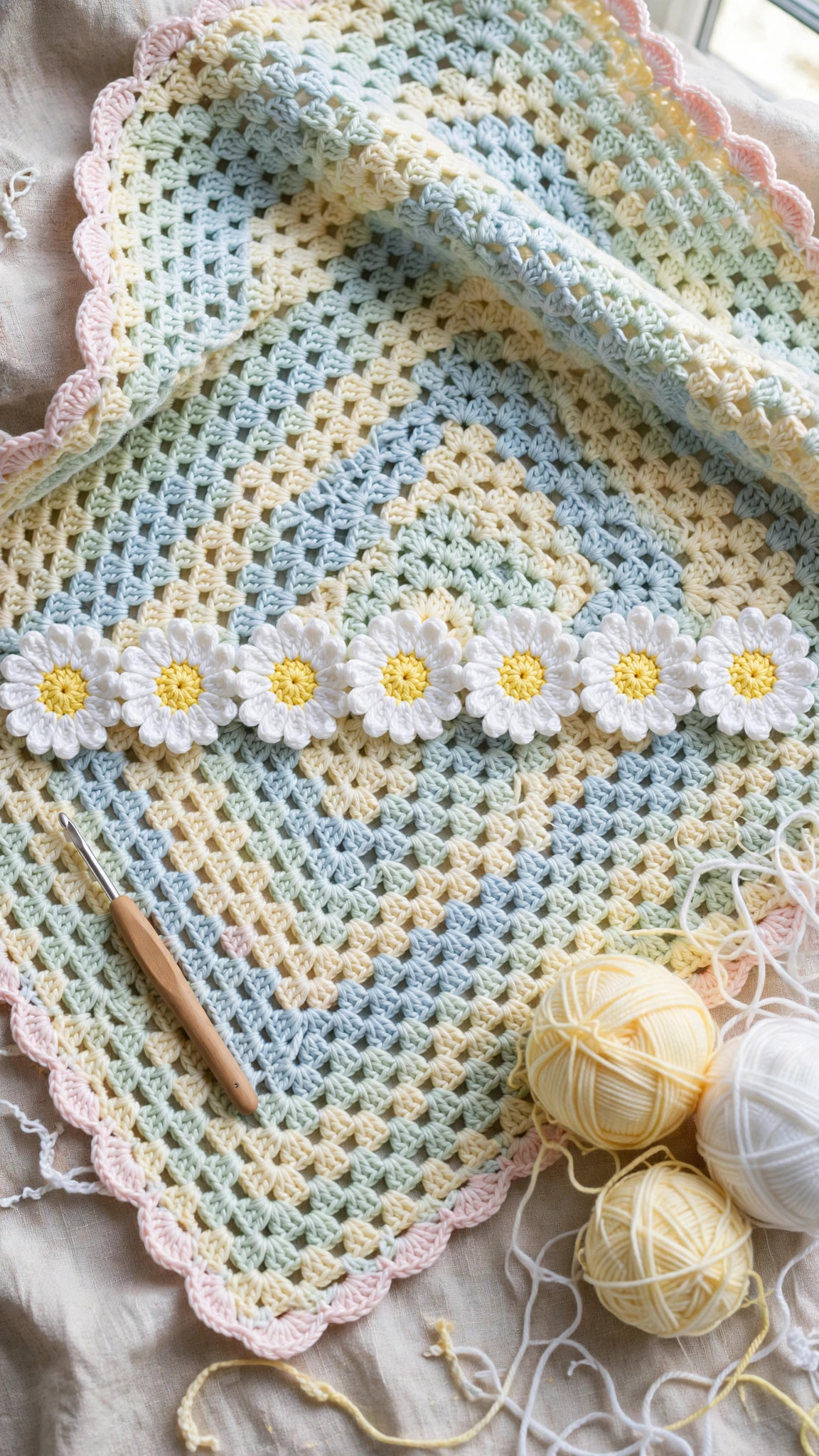
Materials You Need
| Item | What to get |
|---|---|
| Yarn, petals | Worsted weight (size 4) yarn in white, about 10 yards per motif |
| Yarn, center | Worsted weight (size 4) yarn in sunny yellow, about 5 yards per motif |
| Hook | US H-8 (5.0 mm), or the size that gives you a flat motif with no curling |
| Notions | Tapestry needle, scissors, stitch markers, pins, blocking mat (optional) |
Worsted weight yarn is the best choice for a daisy motif because it works up quickly, the petals hold their shape, and the finished flower is sturdy enough to sew onto a bag or a hat. A smooth acrylic or cotton yarn works well, because it shows clean stitch definition and it washes easily. Avoid fuzzy or eyelash yarns, because they hide the petal shaping and make the center circle hard to count. Choose a bright white for classic daisies, or try cream for a softer vintage look. For the center, a warm sunny yellow reads as a daisy at a glance, and a golden yellow gives a richer flower.
Abbreviations (US Terms)
- ch = chain
- sl st = slip stitch
- sc = single crochet
- hdc = half double crochet
- dc = double crochet
- inc = increase, 2 sc in the same stitch
- st(s) = stitch(es)
- rnd(s) = round(s)
- rep = repeat
- MR = magic ring
- BLO = back loop only
- FLO = front loop only
Gauge and Sizing Notes
Gauge for a flat daisy motif is about keeping the flower flat, not about hitting an exact number. Work the center circle first and lay it on a table. It should sit flat with no ruffle at the edge and no cup in the middle. If the edge ruffles, your stitches are too loose or you have too many increases, so go down a hook size. If the center cups like a bowl, your stitches are too tight or you have too few increases, so go up a hook size.
To make a smaller daisy, use DK weight yarn with a 4.0 mm hook for a flower about 3 inches across, which is a good size for a hat applique or a hair clip. To make a larger daisy, use bulky weight yarn with a 6.5 mm hook for a flower about 5 inches across. The stitch counts stay the same in every size. For a blanket, make all of your motifs with the same yarn and the same hook, so every flower measures the same and the joins line up.
Part 1: The Daisy Center
The center is a flat yellow circle worked in the round from a magic ring, with one increase round after another so the circle grows evenly and stays flat. Work in a continuous spiral for rounds 1 and 2, then join with a slip stitch at the end of round 3 so the circle has a neat edge for the petals. Use a stitch marker to mark the first stitch of every round.
Center
With the yellow yarn, MR, ch 1.
- Rnd 1: 8 sc in MR. (8 sc)
- Rnd 2: inc in each st around. (16 sc)
- Rnd 3: (sc in next st, inc in next st) rep 8 times, sl st in first sc to join. (24 sc)
- Fasten off, leaving a tail about 6 inches long for weaving in.
Your finished center should be about 2.5 inches across and lie perfectly flat on the table. If it ruffles, pull out round 3 and work it again with a slightly smaller hook. If it cups, work it again with a slightly larger hook. A flat center is the foundation of the whole flower, because the petals attach to its edge, and a wavy center makes wavy petals.
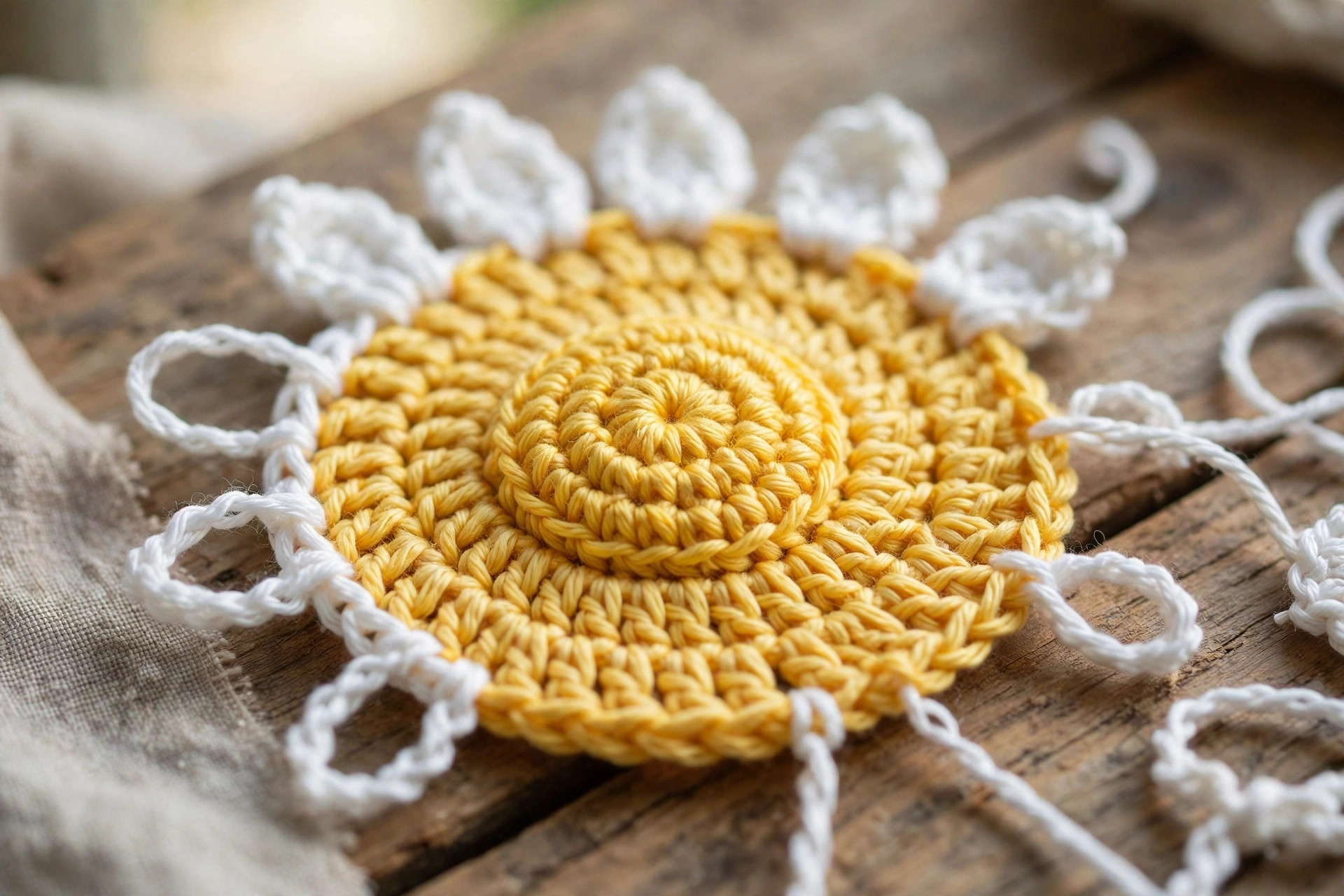
Part 2: The Twelve Petals
The petals are worked in white yarn, one at a time, around the edge of the yellow center. Each petal is a small chain that you work back down with a mix of single, half double, and double crochet stitches, which gives the petal a gentle point at the tip and a wider middle. There are twelve petals in total, and each one uses two stitches of the center edge, which is why the center ends at 24 stitches.
Petals
Join the white yarn with a slip stitch in any stitch of the center edge.
- Petal 1: sl st in the next st, ch 6, sc in the 2nd ch from the hook, hdc in the next ch, dc in the next 2 ch, hdc in the last ch, sl st in the next st of the center edge. (1 petal made)
- Petal 2-12: repeat the same petal in the next 2 stitches of the center edge, working a slip stitch, a chain of 6, and the same stitches back down the chain, then a slip stitch into the next center stitch. (12 petals)
Fasten off, leaving a tail about 6 inches long for weaving in. Each petal should be about 1 inch long and half an inch wide, pointed at the tip and slightly wider in the middle. The petals should fan out evenly around the center with no gaps and no overlap. If two petals crowd together, you may have worked two petals into the same pair of center stitches, so count the center stitches and check that each petal starts two stitches after the last one.
The back of the flower should look almost as neat as the front. The slip stitches that anchor each petal form a tidy ring around the center, and the tails should be woven in under that ring where they will not show. Turn the daisy over and check that no white tails poke through to the front between the petals.
Part 3: Joining Motifs and Finishing
Finishing a daisy means weaving in the ends, blocking the flower flat, and then joining it to other motifs or sewing it onto a project. Block each motif before you join it, because a blocked daisy joins neatly and an unblocked one pulls the blanket out of shape.
Weave in the yellow tail first, running it under the back of the center stitches in a small circle so it disappears. Then weave in the white tail the same way, running it under the slip stitch ring on the back of the flower. Trim both tails close to the fabric. To block a daisy, pin it face down on a blocking mat or a towel, gently pulling each petal out to the same length and spacing, and mist it lightly with water. Leave it to dry completely before you unpin it. A blocked daisy lies flat and every petal points outward in a neat circle.
To join daisies into a blanket, lay the motifs out in rows on a bed or a table and pin the edges together where the petal tips meet. The simplest join is a whip stitch: with a tapestry needle and matching yarn, sew through the petal tips of two neighboring motifs, taking one stitch through each pair of tips, and working your way along the shared edge. This join is nearly invisible from the front and lets the blanket drape softly.
For a stronger join that shows as a neat ridge, use a slip stitch join instead. Hold two motifs with their wrong sides together, join yarn at one corner, and slip stitch through both layers along the edge, one stitch per petal tip. This join is firmer and works well for bags and placemats, where the piece needs to hold its shape. A baby blanket made from daisy motifs measures about 24 by 32 inches with 6 motifs across and 8 motifs down, which uses 48 motifs in total. A lap blanket of 8 by 10 motifs uses 80 motifs, and a scarf of 2 by 12 motifs uses 24.
To sew a single daisy onto a hat or a bag, position it where you want it and pin it in place, then sew through the back of the center and the base of a few petals with small hidden stitches. Do not sew through the petal tips, because that flattens the flower and hides its shape. Our crochet coaster pattern makes a matching table set for the same yarn, and it uses the same flat circle start as the daisy center.
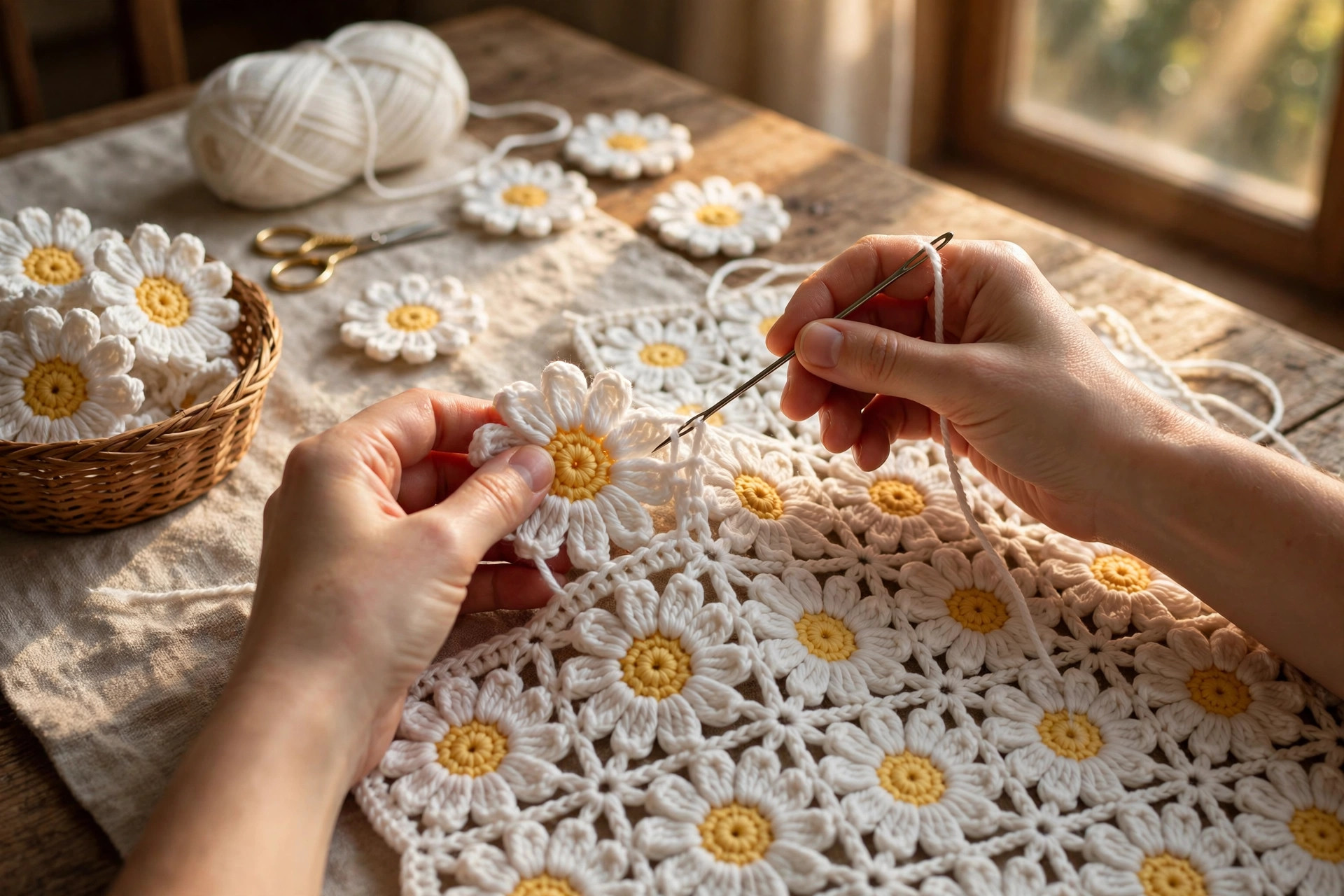
Variations: Colors, Sizes, and Uses
- Classic white daisy: work the petals in bright white with a sunny yellow center, the colorway in the photos, for a daisy that everyone recognizes at a glance. Our puff flower crochet pattern makes a matching textured flower in the same size.
- Pink daisy: make the petals in soft pink with a golden yellow center for a sweet spring flower that suits a baby blanket or a nursery garland. Our crochet rose pattern makes a matching pink flower for the same blanket.
- Two layer daisy: work a second round of petals behind the first, using the back loops of the center edge, for a fuller flower with 24 petals. Work the back petals one round taller, with a chain of 7 instead of 6, so they peek out behind the front petals.
- Daisy garland: make ten daisies in mixed colors and string them on a chain of 60, spacing the flowers evenly, for a spring garland that hangs across a mantel or a nursery wall. Our crochet leaf pattern makes matching green leaves to space between the flowers.
- Daisy applique: make the small 3 inch version with DK weight yarn and sew it onto a hat, a tote bag, or a baby cardigan. Sew only the center and the petal bases, so the petals lift up and catch the light. Our crochet bookmark pattern is another small applique style project in the same yarn weight.
Troubleshooting Daisies That Curl or Pucker
- My center circle ruffles like a lettuce leaf. You have too many stitches for the round, or your tension is too loose. Go down a hook size, and check that round 3 really is one single crochet and one increase repeated 8 times, for 24 stitches in total.
- My center cups like a bowl. You have too few stitches, or your tension is too tight. Go up a hook size, and check that round 2 really is an increase in every stitch, for 16 stitches.
- My petals curl inward. The chain is too tight, or the stitches worked back down the chain are too short. Work the chain loosely, and pull each stitch up to full height before you work the next one.
- My petals are uneven lengths. Some chains were worked tighter than others. Count the chain of every petal before you work back down it, and block each finished daisy so the petals even out.
- My joined blanket pulls and puckers. The motifs were joined before blocking, or the join stitches are too tight. Block every motif first, pin the blanket flat while you join, and keep the whip stitches loose enough that the join can flex.
Care Instructions
Hand wash daisy motifs and finished daisy projects gently in cool water with a tiny amount of mild soap, squeeze gently without wringing, and lay flat to dry so the petals keep their shape. If the yarn label says machine washable, use a gentle cycle in a mesh laundry bag, and lay the piece flat to dry. Do not put a daisy blanket in the dryer on high heat, because the petals can curl and the motifs can shrink unevenly. Reshape the petals by hand while the piece is still damp, and keep finished daisies out of direct sunlight, so the white stays bright and the yellow stays sunny.
Frequently Asked Questions
Is this daisy crochet pattern good for beginners?
Yes, it is a great first motif project. You need chains, single crochet, half double crochet, and double crochet, and every round ends with a stitch count. One motif takes about an hour, and the petals are the same stitch sequence twelve times, so the pattern is easy to memorize.
How big is the finished daisy?
About 4 inches across from petal tip to petal tip, in worsted weight yarn with a 5.0 mm hook. Use DK weight yarn for a small 3 inch applique version, or bulky weight yarn for a large 5 inch version. The stitch counts stay the same in every size.
How many daisies do I need for a baby blanket?
A baby blanket of 24 by 32 inches needs 6 motifs across and 8 motifs down, which is 48 daisies in total. At about 15 yards of yarn per motif, that is roughly 720 yards of yarn, plus a little extra for joining. Make all the motifs first, block them, and then join them in rows.
How do I join daisy motifs together?
Lay the motifs out in rows and whip stitch through the petal tips of neighboring motifs, or use a slip stitch join through both layers for a firmer ridge. Block every motif before you join it, pin the blanket flat while you work, and keep the join stitches loose enough that the blanket drapes.
Can I sew a crochet daisy onto a hat or a bag?
Yes, daisies make lovely appliques. Position the flower, pin it in place, and sew through the back of the center and the base of a few petals with small hidden stitches. Do not sew through the petal tips, because that flattens the flower. The small 3 inch version works best for hats.
Can I sell daisies made from this pattern?
Yes, you may sell finished daisies and finished projects made from this free pattern, with credit to Little Loop Finds. Please do not sell or republish the pattern text itself. Single daisy appliques sell well at craft markets, and a set of daisy motifs makes a sweet gift bundle.
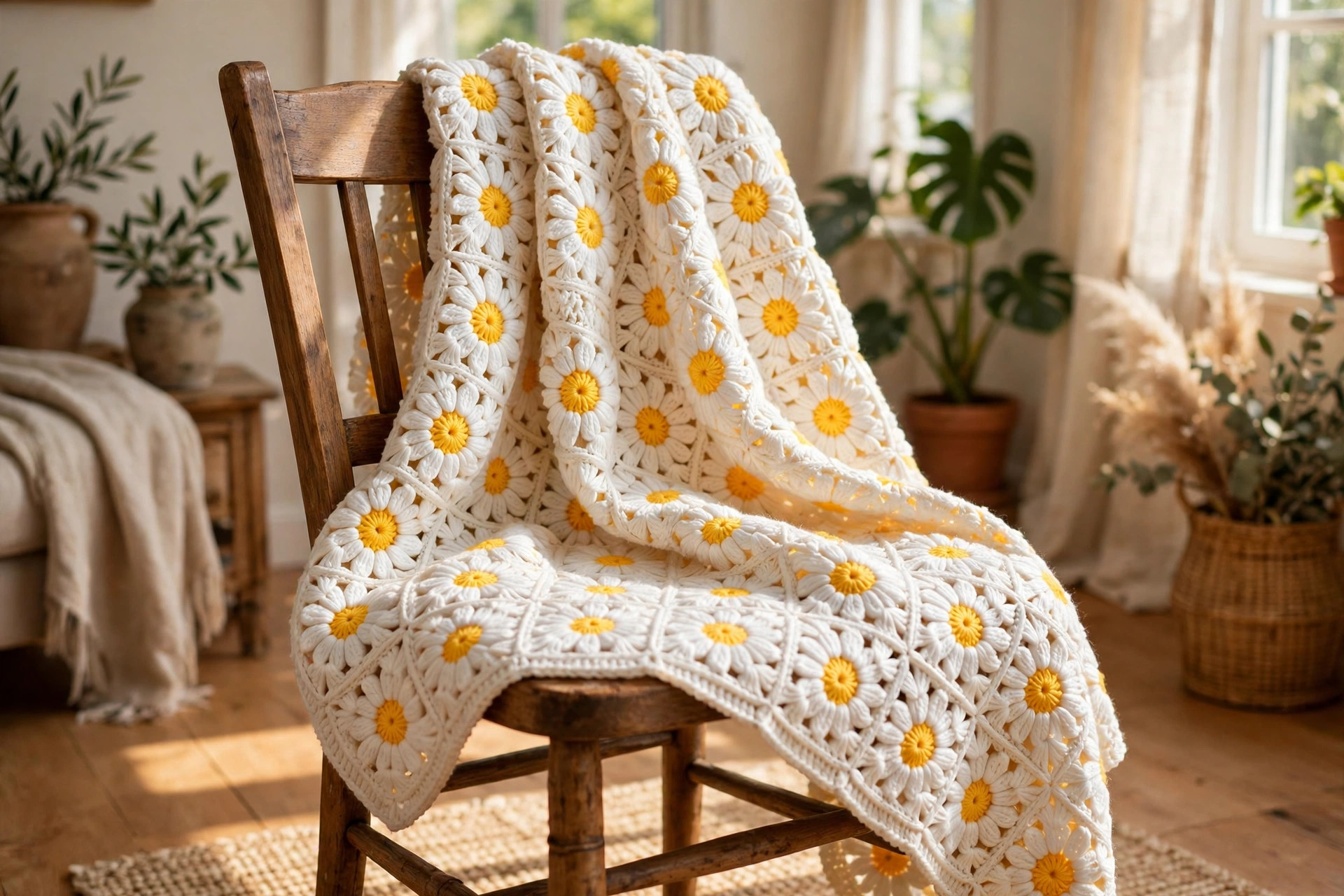
Happy stitching, and may your little daisy bring a bright spot of spring to whatever you make with it.