Crochet Curtains Pattern (Easy Window Panels)
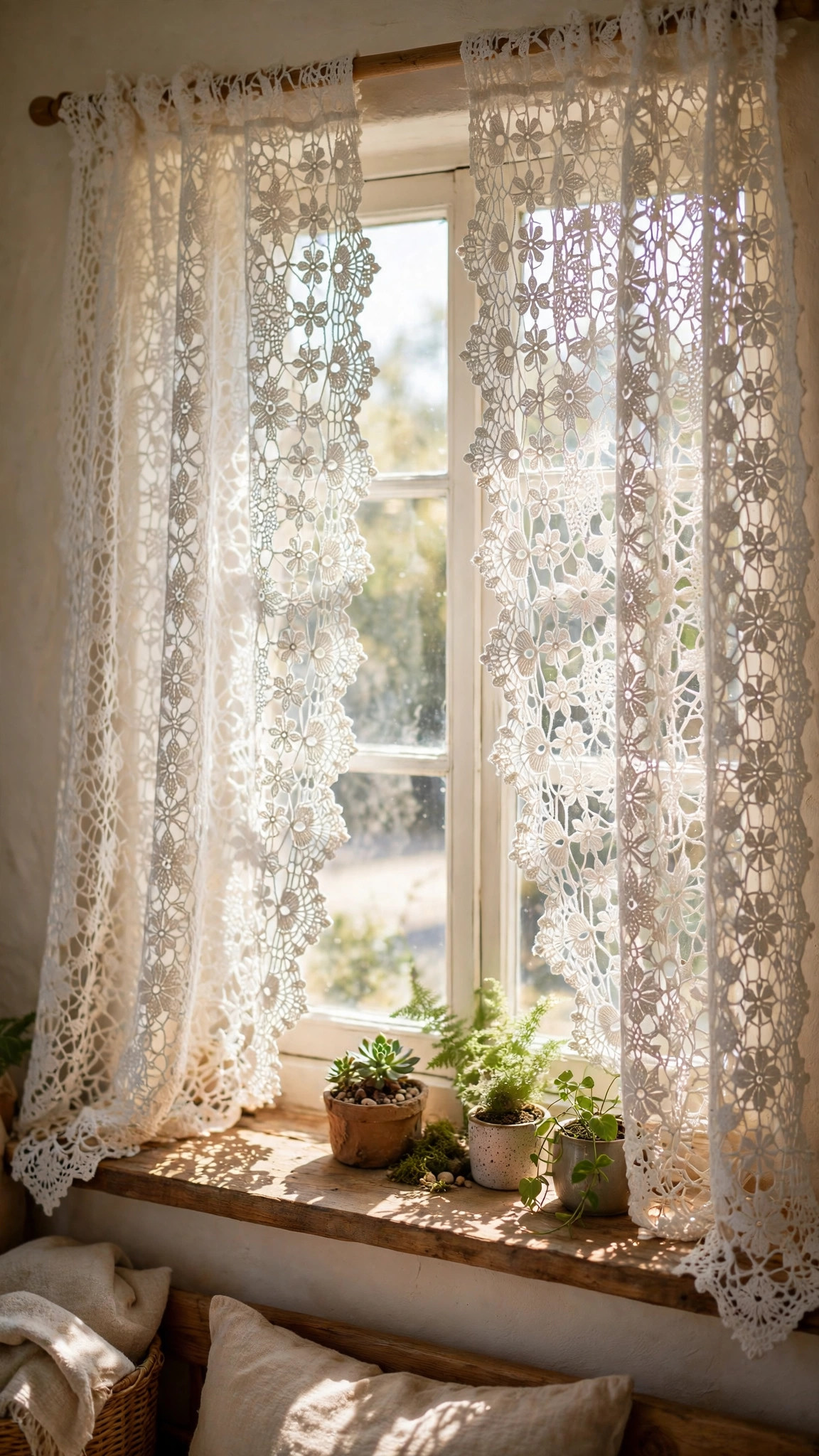
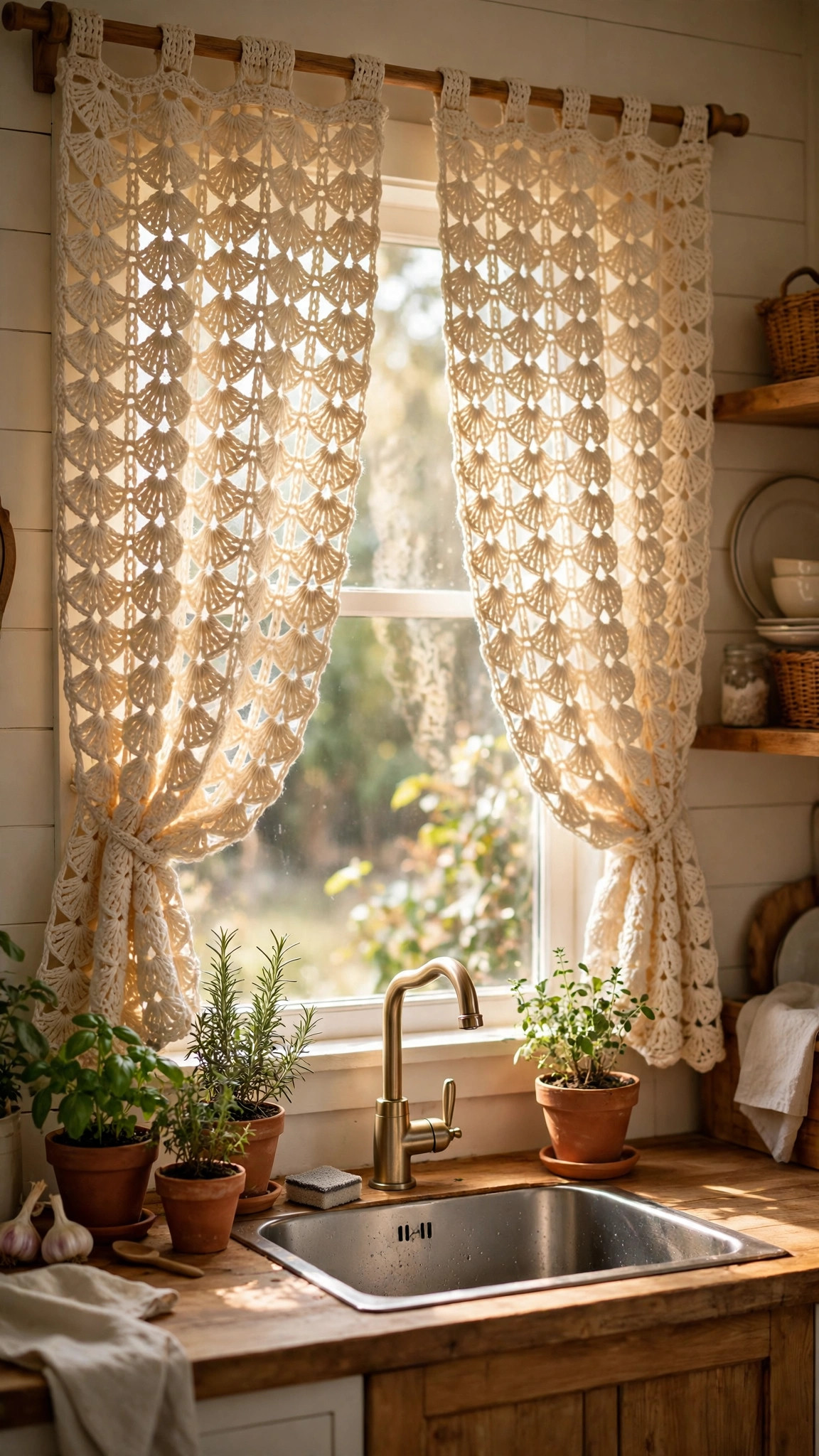
Crochet light lace window panels in shell stitch with a scalloped edge and a rod pocket, then hang them and watch the sunlight glow through.

Patterns · Crochet
- Finished size
- 24 x 36 in
- Making time
- 8 hours/panel
- Hook
- US H-8 (5.0 mm)
- Set
- 2 panels
- Skill
- Beginner
In this post
- Key Takeaways
- Table of Contents
- Why You Will Love These Curtains
- Finished Size, Skill Level, and Time
- Materials You Need
- Abbreviations (US Terms)
- Gauge and Sizing Notes
- Part 1: The Main Panel
- Part 2: The Lace Border and Rod Pocket
- Part 3: Hanging and Finishing
- Variations: Colors, Sizes, and Uses
- Troubleshooting Curtains That Do Not Look Right
- Care Instructions
- Frequently Asked Questions
- More Free Patterns to Try
A pair of crochet curtains can turn a plain window into the prettiest spot in the room, and this free crochet curtains pattern makes two soft lace panels that let the sunlight through in the loveliest way. Each panel is about 24 inches wide and 36 inches long, takes about 8 hours, uses about 400 yards of cotton yarn, and makes a wonderful home decor project for a beginner.
This is an original Little Loop Finds design, written in US terms and completely free. The curtains are made from a simple shell stitch worked in rows, with a scalloped lace border along the bottom and a rod pocket at the top, so they slide straight onto a curtain rod with no sewing skills needed.
A quick note on scope: this post is about one specific crochet curtain, a window panel with an open shell stitch, a scalloped bottom edge, and a rod pocket. That makes it different from a valance, which is a short curtain that covers only the top of a window, and different from a heavy blackout curtain. These panels are light, airy, and made to filter sunlight, not block it.
Key Takeaways
- Free original pattern: a Little Loop Finds original design, written in US terms, and completely free.
- Light lace window panels: an open shell stitch that filters sunlight, with a scalloped bottom edge and a rod pocket.
- Simple stitches: worked in rows with chains, single crochet, and double crochet only.
- An 8 hour panel: one panel takes about 8 hours, worked one row at a time.
- Great for home decor: a soft, handmade touch for a kitchen, bedroom, or living room window.
Table of Contents
- Why You Will Love These Curtains
- Finished Size, Skill Level, and Time
- Materials You Need
- Abbreviations (US Terms)
- Gauge and Sizing Notes
- Part 1: The Main Panel
- Part 2: The Lace Border and Rod Pocket
- Part 3: Hanging and Finishing
- Variations: Colors, Sizes, and Uses
- Troubleshooting Curtains That Do Not Look Right
- Care Instructions
- Frequently Asked Questions
- More Free Patterns to Try
Why You Will Love These Curtains
Crochet curtains are a slow, relaxing project with a beautiful payoff. The shell stitch repeats the same two rows all the way down the panel, so once you learn the repeat you can crochet while you watch television or listen to a podcast, and the panel grows a little longer every evening.
These curtains also make a wonderful gift for a new home. A pair of handmade lace panels says welcome home in a way a store bought gift never does, and they fit any style, from a farmhouse kitchen to a bright modern bedroom.
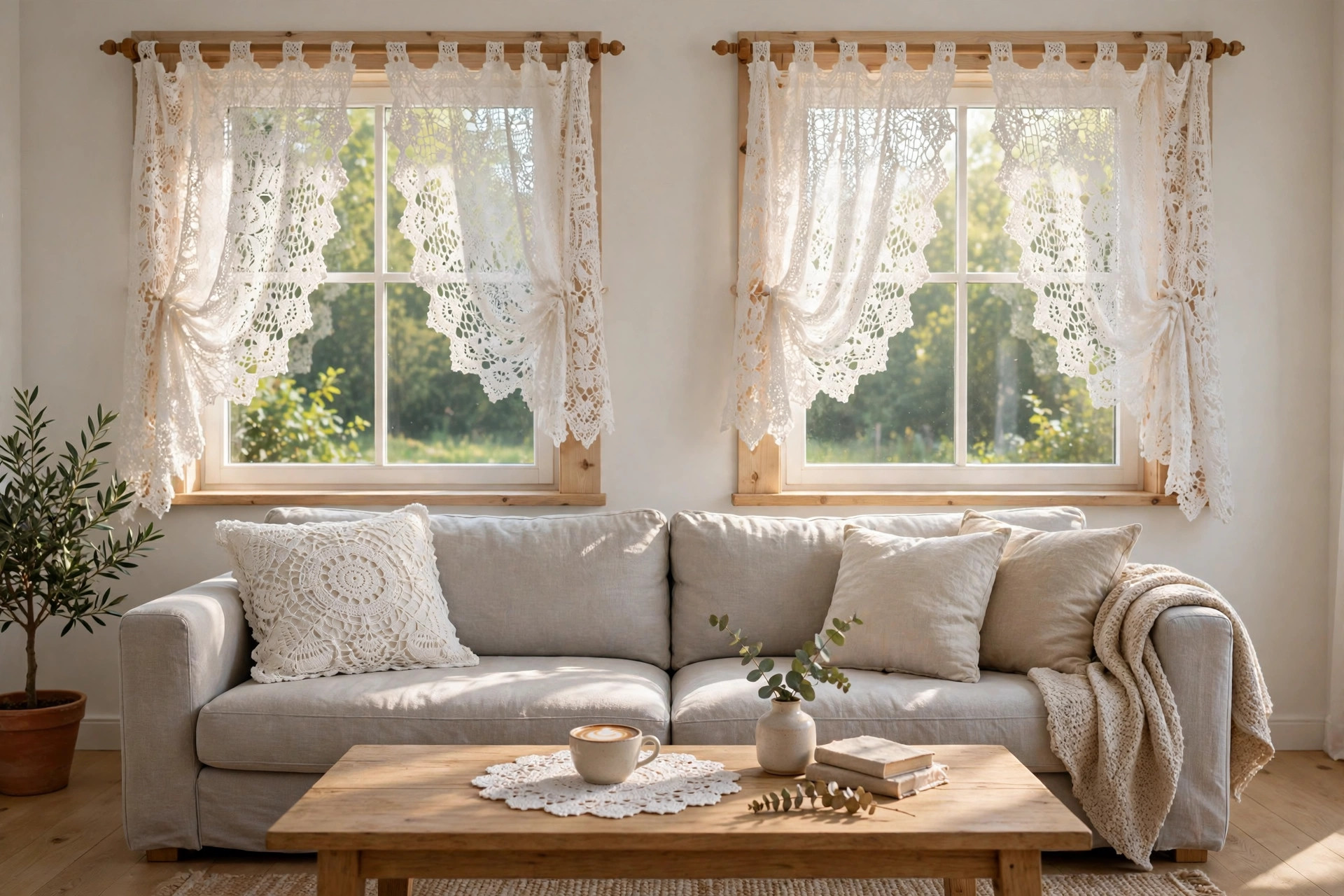
The best part is how the light comes through. The open shell stitch turns harsh sunlight into a soft glow, and the scalloped edge casts a pretty shadow on the windowsill in the morning. It is the kind of handmade detail that makes a whole room feel softer.
These curtains are also easy to care for. Cotton washes well, and a quick soak and a flat dry brings the lace right back to shape. Unlike heavy store bought curtains that need dry cleaning, you can wash these at home in a mesh bag and hang them back up the same day.
Finished Size, Skill Level, and Time
- Finished size: one panel. Each panel is about 24 inches wide and 36 inches long, not counting the rod pocket. A pair covers a standard window about 36 inches wide.
- Skill level: Beginner. You need a chain, single crochet, and double crochet, plus a simple shell stitch.
- Time: about 8 hours per panel: 30 minutes to chain and start, 6 hours for the main panel rows, 45 minutes for the lace border, and 45 minutes for the rod pocket and finishing. A pair takes about 16 hours.
Materials You Need
| Item | What to get |
|---|---|
| Yarn | Worsted weight cotton yarn in white or cream, about 400 yards per panel |
| Hook | US H-8 (5.0 mm), or the size that gives you the gauge below |
| Notions | Tapestry needle, scissors, stitch markers, measuring tape, curtain rod |
Cotton yarn is the best choice for crochet curtains because it holds its shape, hangs nicely, and washes well. A smooth worsted weight cotton works best for this pattern, because it shows the shell stitch clearly and it is strong enough to hang without stretching out of shape.
A measuring tape is the most important notion for this project, because curtains need to fit your window. Measure your window before you start, and check the panel width against the rod as you work the first few rows.
Abbreviations (US Terms)
- ch = chain
- sl st = slip stitch
- sc = single crochet
- dc = double crochet
- st(s) = stitch(es)
- rep = repeat
- RS = right side
- WS = wrong side
- FO = fasten off
Gauge and Sizing Notes
Gauge matters on curtains because the panel needs to fit your window. Work a swatch of 2 shell repeats and 4 rows in the cotton yarn. It should be about 3 inches wide and 2.5 inches tall.
The pattern is written for one panel 24 inches wide and 36 inches long. To make a wider panel, add chains in multiples of 6, which adds one shell repeat, about 1.5 inches, each time. To make a longer panel, work more rows, which adds about 0.6 inches per row. Measure your window first, and write down your target width and length before you chain.
Part 1: The Main Panel
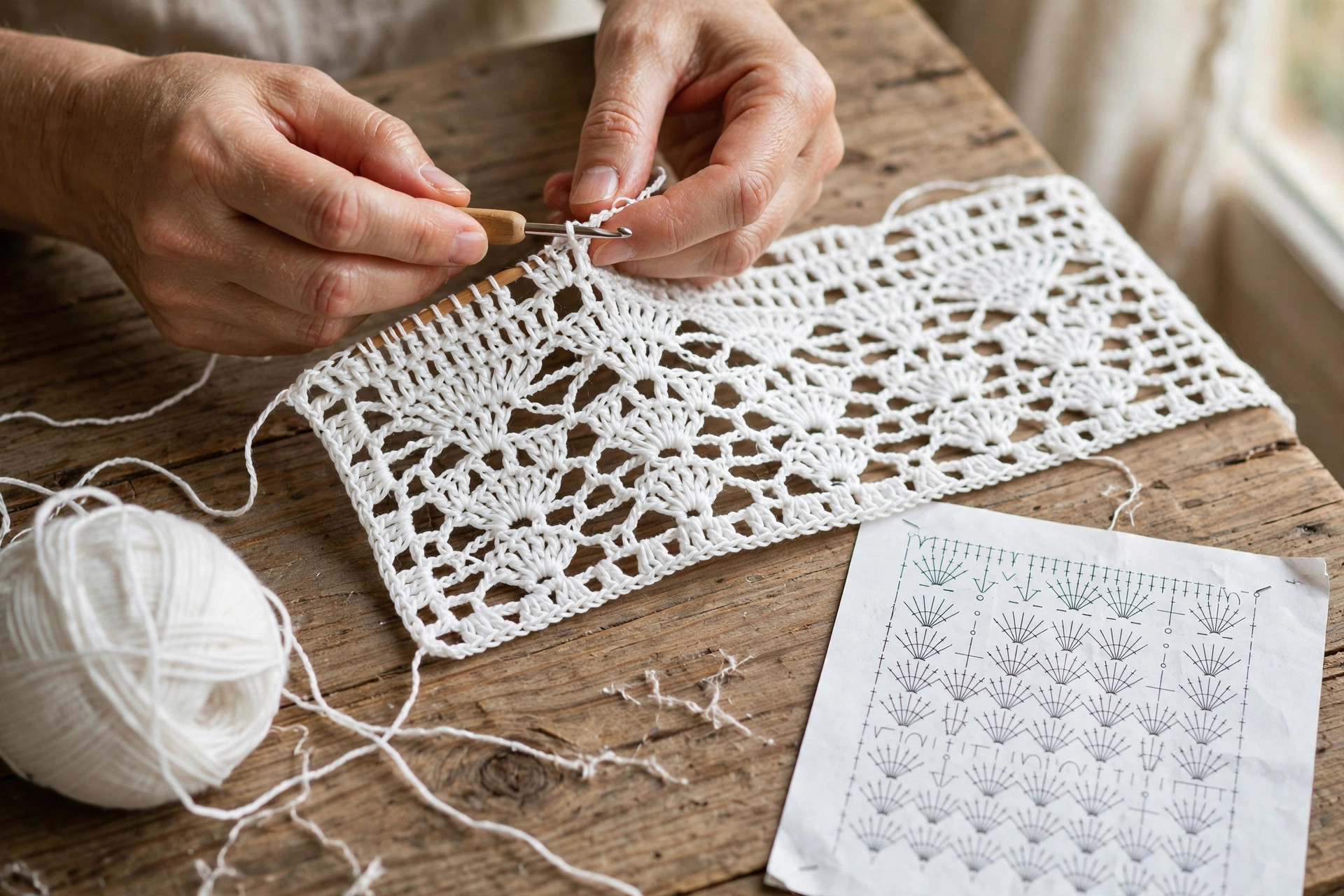
The curtain starts with a foundation chain, then rows of shell stitch worked back and forth. Each shell is 5 double crochet stitches worked into one stitch, with a single crochet between shells. Work in rows, turning at the end of each row, with a stitch marker in the first stitch of each row until the repeat feels easy.
With the cotton yarn, ch 97.
- Row 1 (RS): sc in the 2nd ch from the hook, (skip 2 ch, 5 dc in the next ch, skip 2 ch, sc in the next ch) rep across, ending with sc in the last ch. You should have 16 shells. Turn.
- Row 2 (WS): ch 3 (counts as the first dc), 2 dc in the first sc, (skip 2 dc, sc in the next dc, skip 2 dc, 5 dc in the next sc) rep across, ending with 3 dc in the last sc. Turn.
- Row 3: ch 1, sc in the first st, (skip 2 dc, 5 dc in the next sc, skip 2 dc, sc in the next dc) rep across, ending with sc in the top of the turning ch. Turn.
- Rows 4-59: rep rows 2 and 3, alternating, until the panel measures about 33 inches from the starting chain.
Count your shells at the end of every row, because a missed shell will make the panel narrower on one side. The panel should be about 24 inches wide and 33 inches long when you reach row 59. Do not fasten off, because the lace border starts right away in the next row.
If your panel is wider than 24 inches, your gauge is loose, so switch to a smaller hook for the next panel. If it is narrower, your gauge is tight, so switch to a larger hook. The width matters more than the length, because you can always add or remove rows to fix the length.
Keeping the Edges Straight
Curtains show every wavy edge, so straight sides matter more here than on a scarf or a blanket. Always work the last stitch of each row into the top of the turning chain, and always chain 3 at the start of a double crochet row. If the edge starts to slant, count your stitches and check that you have 16 shells on every row. A stitch marker in the first and last stitch of a row makes it easy to spot a missed edge stitch before it becomes a slant.
Part 2: The Lace Border and Rod Pocket
The lace border is a scalloped edge worked along the bottom of the panel, and the rod pocket is a folded sleeve at the top that slides onto a curtain rod. Work the border first, while the yarn is still attached, then turn the panel over for the rod pocket.
With the yarn still attached after row 59, turn the panel so the bottom edge faces you.
- Border row 1: ch 1, sc in the first st, (skip 1 st, 5 dc in the next st, skip 1 st, sc in the next st) rep across the bottom edge, ending with sc in the last st. Turn.
- Border row 2: ch 1, sc in each st across, working 1 sc in each dc and 1 sc in each sc, to smooth the scallops. Fasten off and weave in the end.
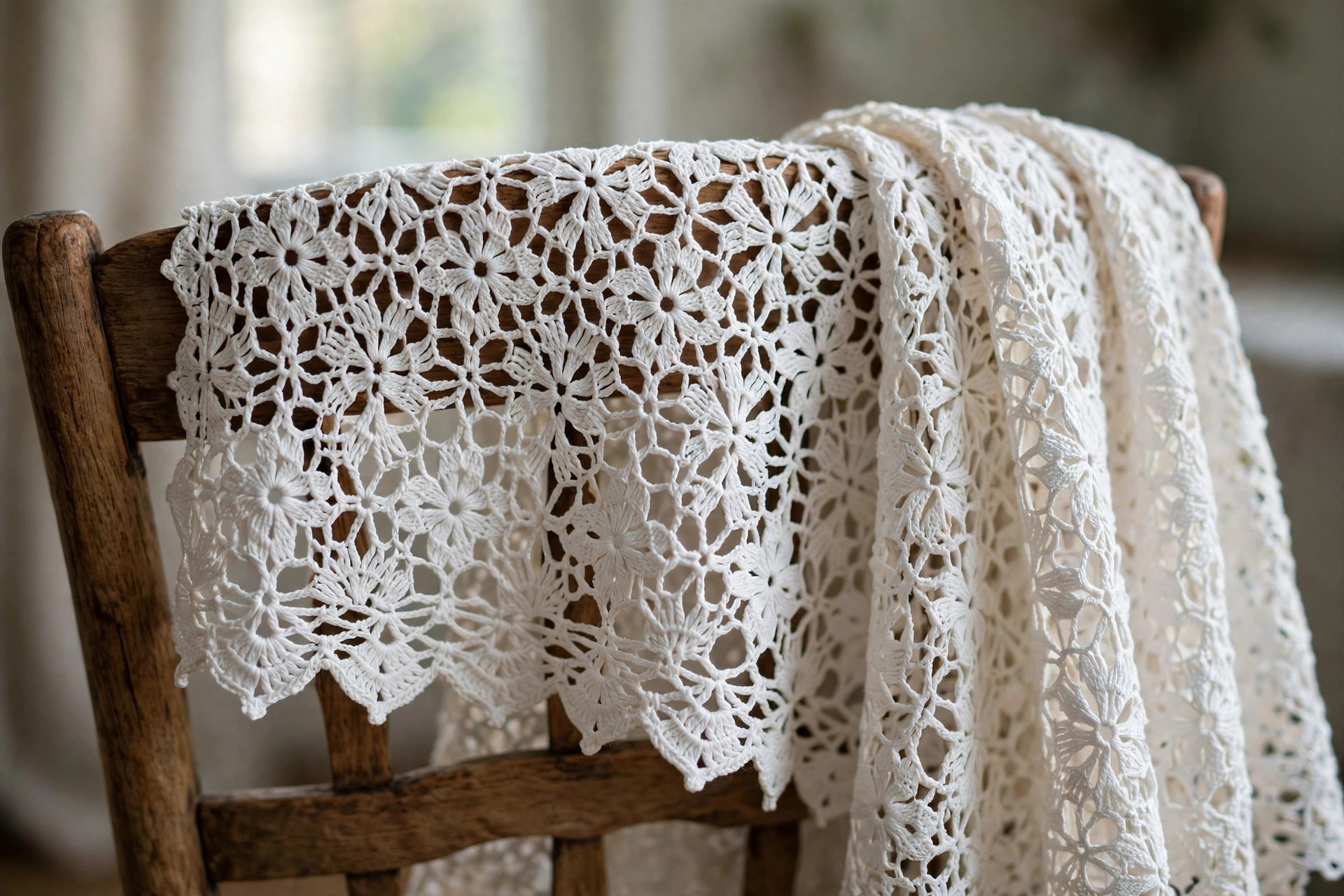
The border should be about 1.5 inches deep, with 16 soft scallops across the bottom. The scallops are what make the curtain look like lace, so keep them even and do not pull the yarn tight across the skipped stitches.
For the side edges, work a simple border up each side: join the yarn at the bottom corner with a sl st, ch 1, and work 1 sc in the end of each row up the side, then 1 sc in each stitch across the top, then 1 sc in the end of each row down the other side. Fasten off and weave in the ends. This side border keeps the panel from curling and gives it a finished look.
The rod pocket is a fold at the top of the panel. Fold the top 3 inches of the panel to the back, and pin it in place with stitch markers every 4 inches. Thread a tapestry needle with a long piece of yarn, and sew the folded edge to the back of the panel with a whip stitch, working through the fold and the panel one stitch at a time. Leave the ends open so the rod can slide through. Our crochet table runners free patterns use the same fold and whip stitch edge on another flat home piece.
Part 3: Hanging and Finishing
This is the part where a flat panel becomes a curtain. Block the panel first, then slide it onto the rod, hang it, and even out the folds.
Blocking the Panel
Blocking makes the shell stitch open up and the panel hang straight. Soak the panel in cool water with a little mild detergent for 15 minutes, then press the water out gently without wringing. Lay the panel flat on a clean towel, and pin the edges straight, with the bottom scallops spread evenly. Let it dry fully, which takes about a day. The panel will grow a little longer as it dries, which is normal for cotton.
Hanging the Curtains
Slide the rod through the rod pocket of each panel, and hang the rod on the window. Push the panels to the sides so they frame the window, and pull the folds apart so they hang evenly. Step back and check that both panels are the same length. If one panel is longer, re-block it and pin it a little shorter, or trim the rod pocket fold by half an inch. Check the panels again after a day, because cotton can relax and drop a little as it hangs, and you may need to even out the folds once more.
Steam the panels lightly with a steamer or an iron on low, holding it a few inches away, to relax any fold lines from storage. Do not press the iron directly on the lace, because the heat can flatten the shells.
Variations: Colors, Sizes, and Uses
- Classic white curtains: work the panels in white cotton for the brightest, airiest look.
- Cream curtains: work the panels in cream cotton for a warm, farmhouse kitchen window.
- Valance curtains: stop the main panel after row 24 for a short valance about 15 inches long.
- Long curtains: work the main panel to row 84 for floor length panels about 54 inches long.
- Kitchen cafe curtains: work one panel to row 30 and hang it on the lower half of the window only.
- Matching home set: pair the curtains with a matching crochet cushion cover pattern and a crochet pillow pattern free for a living room set that looks planned, and add our crochet doily patterns free for the coffee table.
Troubleshooting Curtains That Do Not Look Right
- My panel is wider at the bottom than the top. You added stitches by working into the turning chain twice. Count your shells on every row, and work the last stitch into the top of the turning chain only once.
- My edges curl inward. The side border was skipped, or the gauge is too tight. Work the side border up both sides, and block the panel flat to relax the curl.
- My shells look uneven. Some shells have 4 double crochet and some have 6. Count the stitches in each shell as you work it, and keep your tension even.
- My panel is too short for the window. Add more rows to the main panel before the border, about 0.6 inches per row, and re-block to stretch it a little.
- My rod pocket is too tight for the rod. The fold was sewn too close to the edge. Unpick the seam and refold it a little deeper, at least 3 inches, so the rod slides through easily.
Care Instructions
Machine wash crochet curtains in cool water on a gentle cycle, inside a mesh laundry bag, with a mild detergent. Do not use bleach, because it weakens cotton yarn. Hang the panels to dry, or lay them flat, and reshape the scalloped edge while they are damp. Iron on low if needed, holding the iron a few inches away from the lace.
Frequently Asked Questions
Are crochet curtains good for beginners?
Yes, this pattern is best for a beginner who knows chains, single crochet, and double crochet. The shell stitch repeats the same two rows all the way down, and the pattern explains each row step by step.
What yarn is best for crochet curtains?
A smooth worsted weight cotton yarn is the best choice, because it holds its shape, hangs nicely, and washes well. Avoid fluffy or fuzzy yarn, because it hides the shell stitch and sheds in the sunlight. A white or cream cotton gives the brightest, airiest look, and a light pastel cotton works well in a bedroom or a nursery.
How many panels do I need for one window?
Two panels cover a standard window about 36 inches wide, with one panel on each side. For a wider window, make 3 or 4 panels, or make each panel wider by adding chains in multiples of 6.
How do I make the curtains fit my window?
Measure your window first, then adjust the pattern. Add chains in multiples of 6 to make a wider panel, about 1.5 inches per shell repeat, and add or remove rows to make a longer or shorter panel, about 0.6 inches per row.
Can I hang crochet curtains without a rod pocket?
Yes, you can use clip rings instead. Clip the rings evenly across the top edge of the panel, about 4 inches apart, and hang the rings on the rod. This also makes the curtains easier to take down for washing.
Can I sell curtains made from this pattern?
Yes, you may sell finished curtains made from this free pattern, with credit to Little Loop Finds. Do not sell or republish the pattern text itself.
More Free Patterns to Try
If you loved making these curtains, keep going with more home decor from our free pattern library. Try our crochet wall hanging pattern for another window or wall piece, or our crochet placemats free pattern for the table.
Happy stitching, and may your new curtains fill every sunny morning with soft, lacy light.