Dragon Scale Crochet Pattern (Free Shawl)
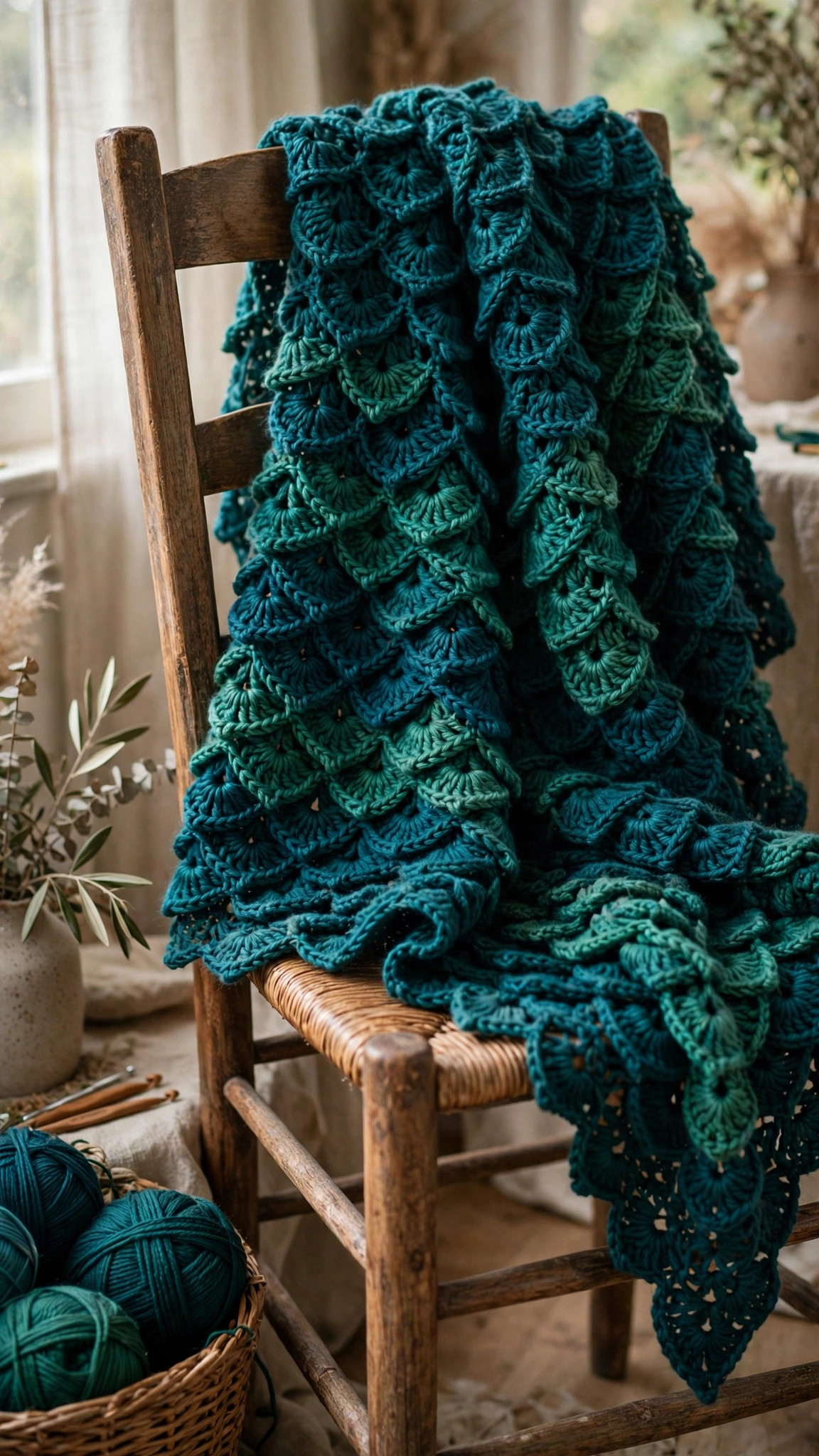
Stitch a soft triangle shawl in the layered dragon scale stitch, with scales that overlap like roof tiles.

Patterns · Crochet
- Finished size
- 60 in wide, 28 in deep
- Making time
- 8 to 10 hours
- Hook
- US I-9 (5.5 mm)
- Set
- Swatch, triangle body and fringe
- Skill
- Intermediate
In this post
- Key Takeaways
- Table of Contents
- Why You Will Love the Dragon Scale Stitch
- Finished Size, Skill Level, and Time
- Materials You Need
- Abbreviations (US Terms)
- Gauge and Sizing Notes
- Part 1: Learning the Dragon Scale Stitch
- Part 2: The Triangle Shawl
- Part 3: Edging, Fringe, and Finishing
- Variations: Colors, Projects, and Scale Sizes
- Troubleshooting Scales That Curl or Gape
- Care Instructions
- Frequently Asked Questions
The dragon scale stitch, also called the crocodile stitch, is one of the most magical textures in crochet. Layer upon layer of little scales overlap like roof tiles, catching the light and begging to be touched. This free dragon scale crochet pattern turns that famous texture into a soft, wearable shawl, and it teaches you the stitch from the very first scale, so you can use it for blankets, gloves, hats, and anything else that deserves a little drama.
This is an original Little Loop Finds design, written in US terms and completely free. The shawl is a simple triangle worked from the top edge down, with the scale stitch forming the body and a plain double crochet mesh holding everything together. Once you understand the two row repeat, the pattern becomes a relaxing rhythm: one row of mesh, one row of scales, and the shawl grows. If you can chain, double crochet, and work a front post double crochet, you can make this shawl.
A quick note on scope: this post is about the dragon scale stitch technique and a shawl made with it, not an amigurumi dragon toy. If you want a dragon to sit on your shelf, we have that too, and you will find a link to it below.
Key Takeaways
- Free original pattern: this dragon scale crochet pattern is a Little Loop Finds original design, written in US terms, and completely free.
- Famous scale texture: layered crocodile stitch scales that overlap like roof tiles and catch the light.
- Simple triangle shawl: one two row repeat, worked top down, with no shaping to memorize.
- Weekend plus project: about 8 to 10 hours from first chain to finished fringe, including learning the stitch.
- Wonderfully giftable: perfect for birthdays, winter gifts, fantasy fans, and anyone who loves texture.
Table of Contents
- Why You Will Love the Dragon Scale Stitch
- Finished Size, Skill Level, and Time
- Materials You Need
- Abbreviations (US Terms)
- Gauge and Sizing Notes
- Part 1: Learning the Dragon Scale Stitch
- Part 2: The Triangle Shawl
- Part 3: Edging, Fringe, and Finishing
- Variations: Colors, Projects, and Scale Sizes
- Troubleshooting Scales That Curl or Gape
- Care Instructions
- Frequently Asked Questions
Why You Will Love the Dragon Scale Stitch
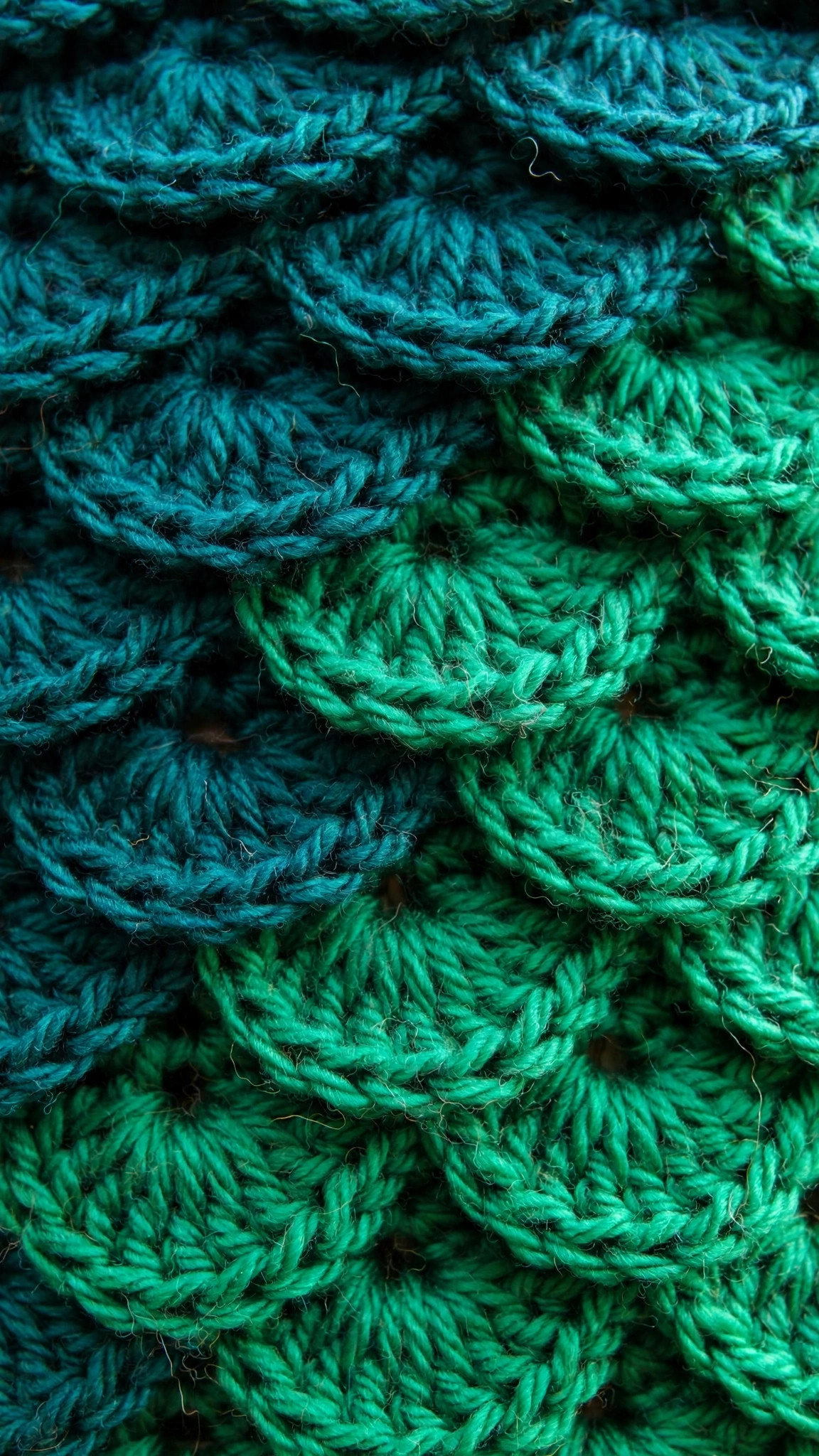
The first time you finish a row of dragon scales, you will want to show someone. Each scale is a little shell of five double crochet stitches worked around a post, and when the next scale overlaps it, the fabric suddenly looks three dimensional. It is the rare stitch that looks far harder than it is: the whole technique is just double crochet, worked around a post instead of into the top of a stitch.
The shawl is also wonderfully wearable. The finished triangle is about 60 inches wide and 28 inches deep, big enough to wrap around your shoulders on a cool evening and light enough to drape over a chair as a throw. The scales add warmth without weight, because the mesh rows between them keep the fabric airy.
It is a great stash project in a different way from most. The scale stitch eats yarn, about 900 yards for this shawl, so it is the perfect excuse to use up that big skein you have been saving. Because the stitch looks best in a solid or gently variegated yarn, it is also a good way to show off a beautiful hand dyed skein that would get lost in a busier pattern.
Finished Size, Skill Level, and Time
- Finished size: about 60 inches wide across the top edge and 28 inches deep at the center point, after blocking.
- Skill level: Easy to Intermediate. You need chains, single crochet, double crochet, and front post double crochet, plus the patience to learn one new stitch.
- Time: about 8 to 10 hours total: roughly 1 hour to learn the stitch on a swatch, 6 to 7 hours for the shawl body, and 1 hour for the edging and fringe.
Materials You Need
| Item | What to get |
|---|---|
| Yarn, main color | Worsted weight (medium 4) acrylic or wool blend in deep teal, about 900 yards |
| Yarn, accent color | Small amount of emerald, about 80 yards, for the edging and fringe |
| Hook | US I-9 (5.5 mm), or the size that gives you a soft drape with your yarn |
| Notions | Tapestry needle, scissors, stitch markers, pins for blocking |
A soft acrylic or wool blend is the best choice here because the scales need drape. A stiff cotton will make the scales stand up like armor, which looks fun but does not wrap well around shoulders. A gently variegated yarn shows off the scale texture beautifully, but avoid a busy multicolor yarn, because strong color changes hide the shape of each scale.
Abbreviations (US Terms)
- ch = chain
- sl st = slip stitch
- sc = single crochet
- dc = double crochet
- fpdc = front post double crochet
- V-st = V stitch (dc, ch 1, dc in the same stitch)
- sp = space
- st(s) = stitch(es)
- rnd(s) = round(s)
- rep = repeat
Gauge and Sizing Notes
Gauge for this shawl is more about drape than exact numbers. Work a swatch of 4 V-stitches and 2 scale rows: it should measure about 4 inches wide and feel soft when you hold it up, with the scales lying flat instead of cupping. If your swatch feels stiff like cardboard, go up a hook size. If the scales flop and the mesh gaps look loose, go down a hook size.
To make a smaller shawl, stop after fewer repeats for a shawl about 48 inches wide, which is a lovely size for a child or a shoulder wrap. For a larger shawl or a small lap blanket, keep repeating until the top edge measures about 72 inches, and add a second skein of yarn.
Part 1: Learning the Dragon Scale Stitch
Before you start the shawl, make a practice swatch. The dragon scale stitch is built on a mesh of V-stitches, and each scale is worked around the two posts of one V-stitch. The first scale row always feels awkward, and the second feels natural, so give yourself a swatch to learn on.
The Practice Swatch
With your main color, ch 31.
- Row 1 (mesh): dc in 4th ch from hook, ch 1, dc in same ch (first V-st made), skip 2 ch, V-st in next ch, rep across, ending with a dc in the last ch. Turn. (10 V-sts)
- Row 2 (scales): ch 3 (counts as dc), work 4 dc around the post of the first dc of the first V-st, ch 1, work 5 dc around the post of the second dc of the same V-st, skip the next V-st, work 5 dc around the first post of the next V-st, ch 1, work 5 dc around the second post of the same V-st, rep across, ending with 5 dc around the last post and a dc in the turning chain. Turn.
- Row 3 (mesh): ch 3, V-st in the center of the first scale, V-st in the center of each scale across, dc in the last st. Turn.
- Row 4 (scales): rep Row 2, working the scales into the V-sts of Row 3. Notice that the scales now sit between the scales of the row below, which makes the overlapping tiled look.
Work 6 more rows, alternating mesh and scale rows, and study your swatch. Each scale should be a neat little shell of 5 stitches, with a chain 1 gap between its two halves. If a scale looks lopsided, you probably worked 4 stitches on one side and 6 on the other, so count the stitches on each post. Once your swatch looks even, you are ready for the shawl.
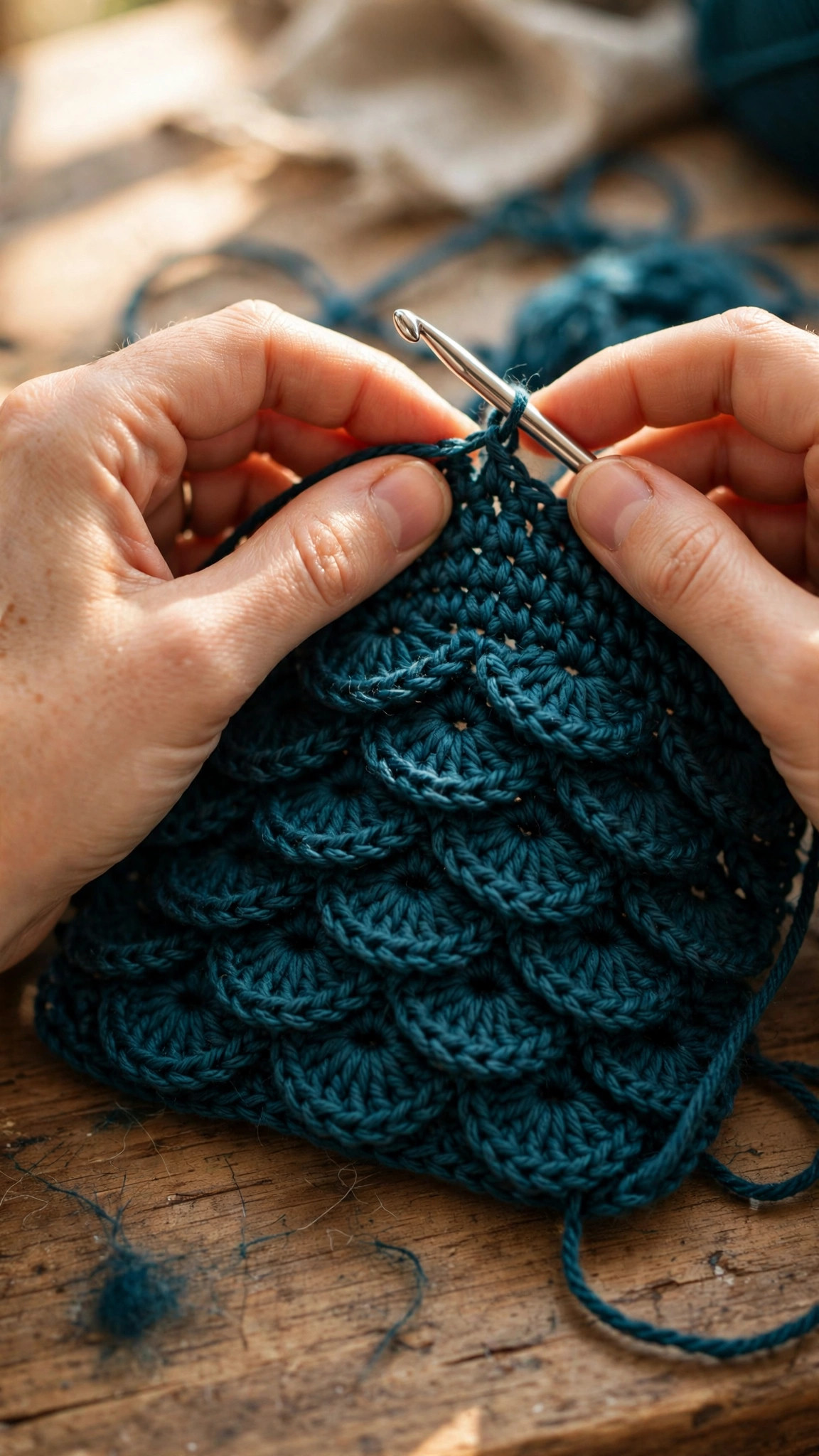
The trickiest part is the first double crochet around a post. Push your hook from front to back around the post, yarn over, and pull the loop through, just like a normal double crochet but worked sideways around the post instead of down into the top of the stitch.
Part 2: The Triangle Shawl
The shawl starts with a small triangle at the top center and grows outward with increases at the center and at both edges. The increase points are marked with stitch markers, and every mesh row adds one V-stitch at each increase point, so the shawl grows evenly. Work in rows, turning at the end of each row, and move your stitch markers up as you go.
Setup
With your main color, ch 4, join with a sl st to form a ring.
- Row 1: ch 3 (counts as dc), (dc, ch 1, dc, ch 1, dc) in ring, turn. (This is the tiny center triangle: 3 dc with 2 chain spaces)
- Row 2: ch 3, dc in first st, V-st in the first ch 1 space, dc in the next dc, V-st in the next ch 1 space, 2 dc in the last st, turn.
- Row 3: ch 3, dc in first st, work a scale around the first V-st, work a scale around the next V-st, 2 dc in the last st, turn.
Body Repeat
From here, the shawl follows a two row repeat. Mesh rows add V-stitches at the center and the edges, and scale rows work one scale into every V-stitch of the row below.
- Mesh row: ch 3, dc in first st, V-st in the center of the first scale, V-st in the center of each scale across, V-st in the center of the last scale, dc in the next st, V-st in the last space, 2 dc in the last st, turn. (You should have 2 more V-sts than the mesh row before)
- Scale row: ch 3, work 5 dc around the first post of the first V-st, ch 1, work 5 dc around the second post of the same V-st, skip the next V-st, work a scale around the following V-st, rep across, ending with a scale around the last V-st and a dc in the turning chain, turn.
Repeat these two rows until the top edge measures about 60 inches, or until you have used about 800 yards of your main color. Keep a little yarn in reserve for the edging: about 80 yards of your accent color, or 80 yards of your main color if you prefer a single color shawl. Count your V-stitches on every mesh row for the first few repeats, because a missed increase makes the triangle lean to one side.
When the shawl is the size you want, end after a scale row, so the bottom point finishes with a neat row of scales instead of open mesh. Lay the shawl flat and admire it before you add the edging: this is the moment the dragon scale magic really shows.
Part 3: Edging, Fringe, and Finishing
The edging frames the scales and stops the top edge from rolling, so it is worth doing carefully. With your accent color, join with a slip stitch at the top right corner of the shawl, with the right side facing you.
- Edging row 1: ch 1, sc in each stitch and each chain space along the top edge, working 3 sc into the center point at the bottom of the triangle, and 2 sc into each corner where the top edge meets the side. Join with a sl st to the first sc.
- Edging row 2: ch 1, (sc, ch 2, skip 1 st) rep around the whole shawl, working (sc, ch 2, sc) into the center point, join with a sl st to the first sc. Fasten off and weave in the end.
For the fringe, cut strands of accent yarn about 12 inches long. Fold each strand in half, pull the loop through a stitch on the bottom edges of the shawl with your hook, then pull the two ends through the loop and tug gently to knot it. Space the fringe about 1 inch apart along both slanted bottom edges, leaving the top edge plain. Trim the fringe evenly with sharp scissors, holding the shawl up so the strands hang straight while you cut.
Block the shawl to finish it. Pin it to a towel, stretching the top edge straight and the center point sharp, mist it lightly with water, and let it dry completely. Blocking opens the mesh and lets the scales lie flat, so do not skip it.
Variations: Colors, Projects, and Scale Sizes
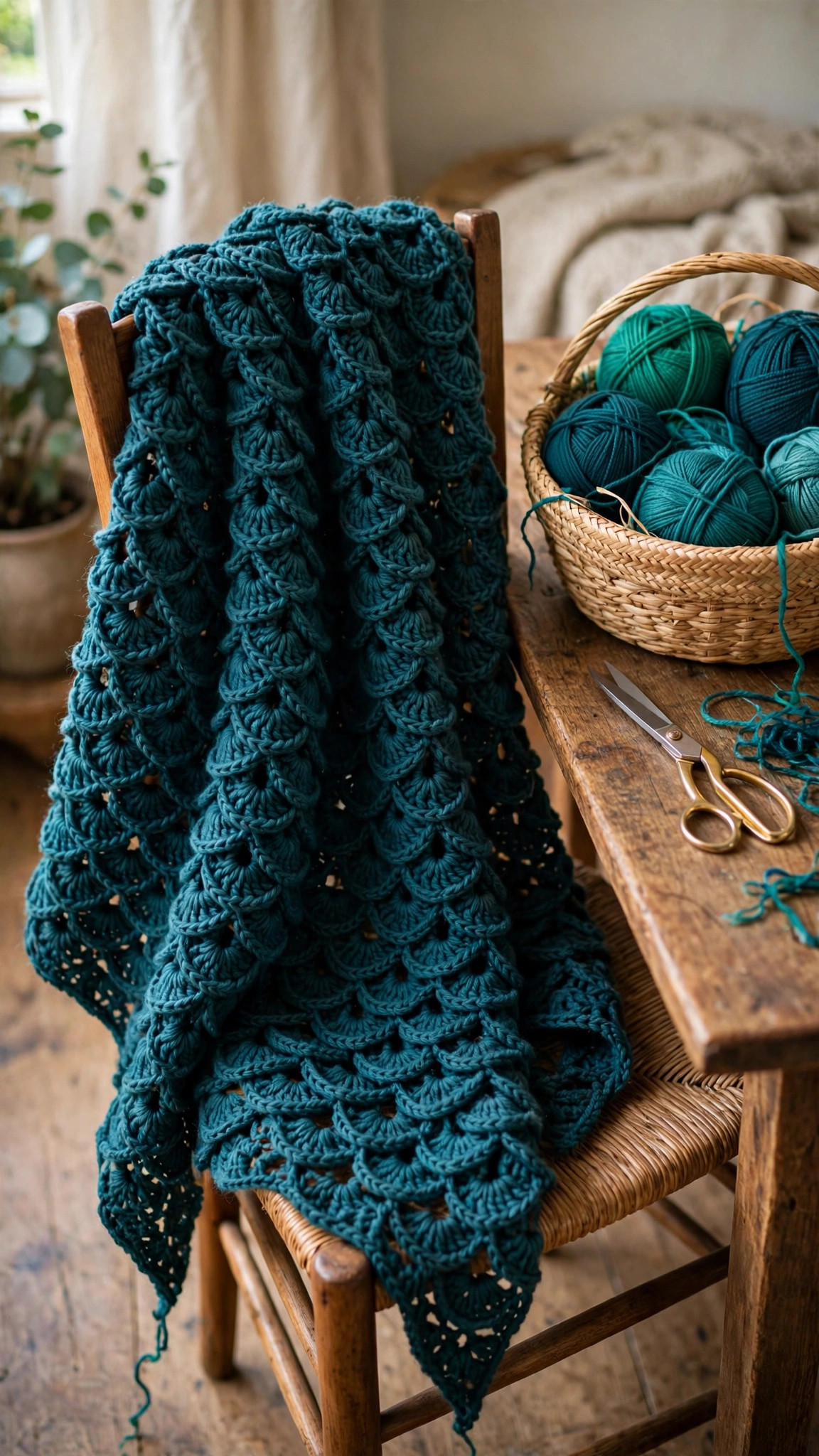
- Mermaid shawl: work the body in deep teal and the edging in emerald, for scales that shimmer like a mermaid tail.
- Baby dragon blanket: follow the same two row repeat on a rectangular foundation chain instead of a triangle, for a cuddly blanket about 30 inches wide. Smaller scales, made with 4 double crochet per half instead of 5, suit baby projects.
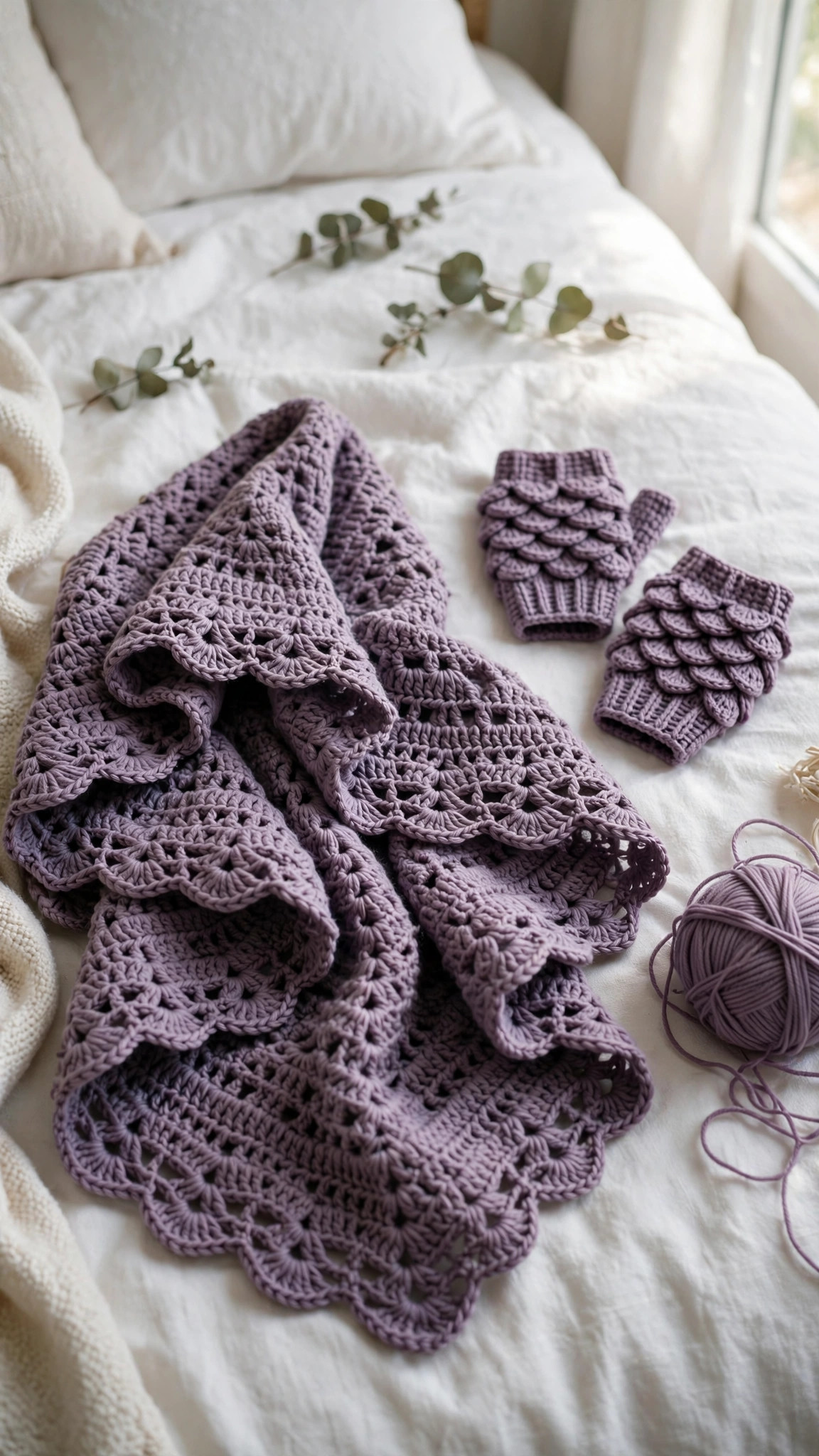
- Dragon scale gloves: work the stitch in the round on a small foundation, for fingerless gloves with a row of scales across the back of the hand. Our chevron crochet pattern uses a similar rhythmic repeat if you want another textured project.
- Autumn dragon shawl: work the body in rust and gold, for a shawl that looks like a dragon curled up in autumn leaves. The crochet mushroom pattern makes a sweet woodland friend to match.
- Two tone scales: change color on every scale row, so the scales alternate between two colors and the tiled effect stands out even more. Keep the mesh rows in your main color so the scales stay the star.
If you want a dragon to sit on your shelf next to your shawl, the crochet dragon pattern free makes a sweet amigurumi dragon in the same size range. For a leafy dragon with a different texture, the celestial leaf dragon crochet pattern is a lovely companion piece. And if you want to try another stitch that builds texture from simple repeats, the mosaic crochet pattern is a wonderful next project.
Troubleshooting Scales That Curl or Gape
- My scales curl up at the edges. Your scale rows are tighter than your mesh rows. Go up a hook size for the scale rows only, or work the scales a touch looser, and block the finished shawl firmly.
- The mesh gaps look too big. Go down a hook size, or work your V-stitches with a chain 1 space instead of a wider gap. The mesh should read as a light net, not a fishing net.
- One side of my triangle is longer than the other. Count your V-stitches on the last mesh row. You probably missed an increase at one edge or at the center, so unpick back to the last even row and recount.
- The scales look flat, not raised. You may be working into the tops of the stitches instead of around the posts. Push your hook around the post from front to back, so the scale wraps around the post and stands out from the fabric.
- My shawl leans to one side. Check your center stitch marker: the most common cause is forgetting the center increase on a mesh row, which makes one half narrower.
Care Instructions
Shake the shawl out after wearing it to remove dust and lint. If it gets grubby, hand wash it gently in cool water with a tiny amount of mild soap, squeeze it gently without wringing, and lay it flat to dry, reshaping the triangle and pinning the center point while it is damp. Do not machine wash or tumble dry a wool blend shawl, because the agitation can felt the scales and shrink the shawl. Store it folded, not hung, so the weight of the scales does not stretch the top edge.
Frequently Asked Questions
Is the dragon scale stitch the same as the crocodile stitch?
Yes, they are the same stitch with two names. Dragon scale and crocodile stitch both describe the layered scale texture made by working double crochet stitches around the posts of V-stitches. This pattern uses the name dragon scale because it fits the fantasy feel of the shawl.
Is the dragon scale stitch hard to learn?
It looks harder than it is. The stitch is just double crochet worked around a post instead of into the top of a stitch. The first scale row feels awkward, and the second feels natural. Make a practice swatch first, and you will be ready for the shawl after about 30 minutes of practice.
How much yarn does a dragon scale shawl need?
About 900 yards of worsted weight yarn for a shawl 60 inches wide: about 800 yards of the main color for the body and about 80 yards of an accent color for the edging and fringe. The scale stitch eats yarn, so buy one extra skein if your skeins are small.
What yarn is best for the dragon scale stitch?
A soft acrylic or wool blend with good drape is best. Avoid stiff cotton, because it makes the scales stand up like armor instead of lying flat and wrapping well. A solid or gently variegated yarn shows the scale shape best, while a busy multicolor yarn hides it.
Can I use the dragon scale stitch for other projects?
Yes, the stitch works for blankets, fingerless gloves, hats, scarves, and even bag panels. Work it on a rectangular foundation chain for a blanket, or in the round for gloves and hats. The two row repeat is the same whatever shape you make.
How do I keep the scales from curling?
Work the scale rows a little looser than the mesh rows, and block the finished piece firmly. Pin the shawl to size, mist it with water, and let it dry completely. Blocking opens the mesh, lets the scales lie flat, and sets the shape.
Can I sell shawls made from this pattern?
Yes, you may sell finished shawls made from this free pattern, with credit to Little Loop Finds. Please do not sell or republish the pattern text itself.
Happy stitching, and may your shawl be as magical as the dragon it is named for.