Crochet Tablecloth Pattern (Round, Lacy)
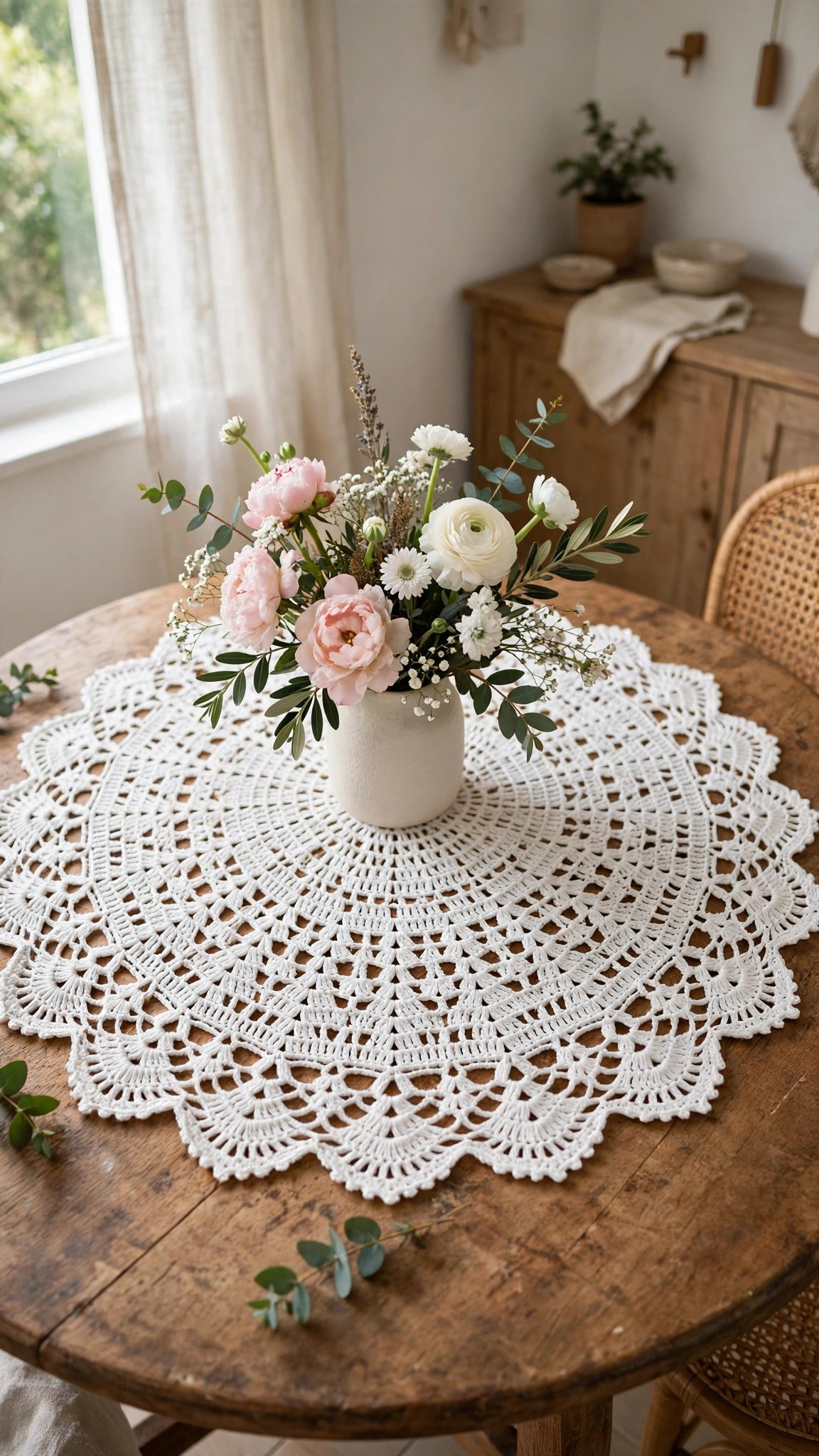
Crochet a round 48 inch lace tablecloth with an open mesh pattern and a scalloped edge in about twelve hours, then dress up every meal you share at your table.

Patterns · Crochet
- Finished size
- 48 in across
- Making time
- 12 hours
- Hook
- US G-6 (4.0 mm)
- Set
- Tablecloth, border
- Skill
- Easy
In this post
- Key Takeaways
- Table of Contents
- Why You Will Love This Tablecloth
- Finished Size, Skill Level, and Time
- Materials You Need
- Abbreviations (US Terms)
- Gauge and Sizing Notes
- Part 1: The Center Motif
- Part 2: Growing the Rounds
- Part 3: The Scalloped Border
- Variations: Colors, Sizes, and Uses
- Troubleshooting a Tablecloth That Does Not Lie Flat
- Care Instructions
- Frequently Asked Questions
A crochet tablecloth turns an ordinary table into the prettiest spot in the room, and this free crochet tablecloth pattern makes a round, lacy tablecloth with an open mesh pattern and a scalloped edge. It is about 48 inches across, worked in joined rounds with simple double crochet and chain spaces, and it makes a lovely cover for a round dining table, a side table, or a handmade housewarming gift.
This is an original Little Loop Finds design, written in US terms and completely free. The tablecloth is worked in the round from the center out, in a simple three round repeat that you will memorize after the first few rounds. There is no seaming and no joining of motifs, because the whole cloth is one piece, and the scalloped border finishes the edge neatly.
A quick note on scope: this post is about one specific crochet tablecloth, a round lace cloth worked in the round. That makes it different from a coaster or a placemat, which are small flat pieces worked on their own. If you want a small matching piece first, our crochet coaster pattern is the matching project.
Key Takeaways
- Free original pattern: a Little Loop Finds original design, written in US terms, and completely free.
- A round lace tablecloth: a 48 inch cloth with an open mesh pattern and a scalloped edge.
- One skill level: written for an easy crocheter who knows double crochet and chain spaces.
- Simple stitches: worked in joined rounds with double crochet, chain spaces, and a picot edge.
- A weekend project: one tablecloth takes about 12 hours, worked a few rounds at a time.
Table of Contents
- Why You Will Love This Tablecloth
- Finished Size, Skill Level, and Time
- Materials You Need
- Abbreviations (US Terms)
- Gauge and Sizing Notes
- Part 1: The Center Motif
- Part 2: Growing the Rounds
- Part 3: The Scalloped Border
- Variations: Colors, Sizes, and Uses
- Troubleshooting a Tablecloth That Does Not Lie Flat
- Care Instructions
- Frequently Asked Questions
Why You Will Love This Tablecloth
A crochet tablecloth turns a few balls of cotton yarn into a piece of handmade lace that you will use every day. The open mesh pattern lets the wood of the table show through, the scalloped edge hangs in soft waves, and the whole cloth has a light, airy look that suits a dining room, a kitchen, or a garden table. It is the kind of project that looks far harder than it is, because the pattern is one short repeat worked over and over.
The tablecloth is worked in the round from the center out, which means there is no seaming and no joining of motifs. Each round starts with a chain and ends with a slip stitch, so you always know where you are. The three round repeat is a mesh round, a fill round, and an increase round, and you will memorize it after the first few repeats. The border is the best part, because a simple scallop and picot edge makes the cloth look finished and professional, even if your rounds are not perfect.
Finished Size, Skill Level, and Time
- Finished size: about 48 inches across after blocking, to fit a round table up to 42 inches wide with a 3 inch drop on each side. The center motif is about 8 inches across, and the border is about 2 inches deep.
- Skill level: Easy. You need a chain, double crochet, slip stitch, and working in joined rounds. No color changes are needed, and the border is a simple scallop worked in the last three rounds.
- Time: about 12 hours per tablecloth: 1 hour for the center motif, 9 hours for the growing rounds, and 2 hours for the border and blocking.
Materials You Need
| Item | What to get |
|---|---|
| Yarn, main color | DK weight cotton yarn in white or cream, about 1,200 yards |
| Hook | US G-6 (4.0 mm), or the size that gives you the gauge below |
| Notions | Tapestry needle, scissors, stitch markers, blocking pins, a large flat surface or blocking mats |
DK weight cotton yarn is the best choice for a crochet tablecloth because it is strong, holds its shape, and shows the open lace pattern clearly. A mercerized cotton yarn works best, because it has a slight shine and it blocks beautifully. A soft acrylic yarn also works, and it is the best choice if you want a cloth that can go in the washing machine often, but it will not block as crisply as cotton.
A stitch marker is the most important notion for this project, because the rounds are long and it is easy to lose count of your stitches. Mark the first stitch of every round, and count your stitches at the end of every increase round. Blocking pins are the second most important notion, because the tablecloth will not lie flat or show its lace pattern properly until it is blocked.
Abbreviations (US Terms)
- ch = chain
- sl st = slip stitch
- sc = single crochet
- dc = double crochet
- picot = ch 3, sl st in the first ch
- sp(s) = space(s)
- st(s) = stitch(es)
- rep = repeat
- RS = right side
- FO = fasten off
Gauge and Sizing Notes
Gauge matters on a tablecloth because the finished size depends on it, and a wrong gauge makes a cloth that is too small for the table. Work a swatch of 12 dc and 6 rows in the main color. It should be about 4 inches wide and 3 inches tall. If it is wider, go down a hook size. If it is narrower, go up a hook size.
The pattern is written for one size, a 48 inch round cloth. To make a smaller cloth, stop after any increase round and work the border, which gives a cloth of about 30, 36, or 42 inches. To make a larger cloth, keep working the three round repeat until the cloth is the size you want, then work the border. Measure the cloth across the middle as you work, and compare it to the size you need before you start the border. Our crochet mandala pattern uses the same center out start if you want to practice the rounds on a smaller piece first.
Part 1: The Center Motif
The tablecloth starts with a small solid center, worked in joined rounds from a magic ring. The center is solid double crochet, which gives the cloth a firm middle that sits flat on the table. Work in joined rounds, and join each round with a slip stitch to the top of the starting chain.
Rounds 1 to 6
With the main color, make a magic ring.
- Round 1: ch 3 (counts as the first dc), 11 dc in the ring, join with a sl st to the top of the ch 3. (12 dc)
- Rounds 2 to 5: ch 3, then increase evenly each round, working 2 dc in every stitch, then (dc, 2 dc in the next st), then (2 dc, 2 dc in the next st), then (3 dc, 2 dc in the next st). Join each round with a sl st. (24, 36, 48, 60 dc)
- Round 6: ch 3, dc in each st around, join with a sl st. (60 dc)
The center motif should be about 8 inches across when you reach round 6, and it should lie flat. If the center cups upward, you have too few increases, so take out round 5 and work it with more increases. If the center ripples, you have too many increases, so take out round 5 and work it with fewer increases. Count your stitches at the end of every increase round, because a missed increase will make the cloth grow unevenly.
Part 2: Growing the Rounds
The main part of the tablecloth is a three round repeat: a mesh round, a fill round, and an increase round. The mesh round makes the open lace, the fill round fills the chain spaces with double crochet, and the increase round grows the cloth wider. Work the repeat five times, from round 7 to round 21, and the cloth will grow from 8 inches to about 44 inches across.
The Three Round Repeat
Work rounds 7 to 9 as follows, and then repeat the same three round pattern four more times, with the stitch counts given below.
- Mesh round: ch 4 (counts as dc, ch 1), skip 1 st, (dc in the next st, ch 1, skip 1 st) rep around, join with a sl st to the 3rd ch of the starting ch 4. This round has half as many dc as the round below it, with a ch 1 space between each dc.
- Fill round: ch 3, then work 2 dc in each ch 1 space around, join with a sl st. This round doubles the stitch count back up.
- Increase round: ch 3, then increase evenly, working (4 dc, 2 dc in the next st) on the first repeat, then (5 dc, 2 dc in the next st), then (6 dc, 2 dc in the next st), then (7 dc, 2 dc in the next st) on the last repeat. Join with a sl st.
The stitch counts for each repeat are as follows. After the first mesh round you have 30 dc, after the fill round 60 dc, and after the first increase round 72 dc. After the second repeat you have 84 dc, after the third repeat 96 dc, after the fourth repeat 108 dc, and after the fifth repeat 120 dc. Work one solid round of dc in each stitch between repeats 3 and 4, and again between repeats 4 and 5, to keep the cloth from growing too fast. These solid rounds are rounds 13 and 17, and they give the lace a calm band between the open sections.
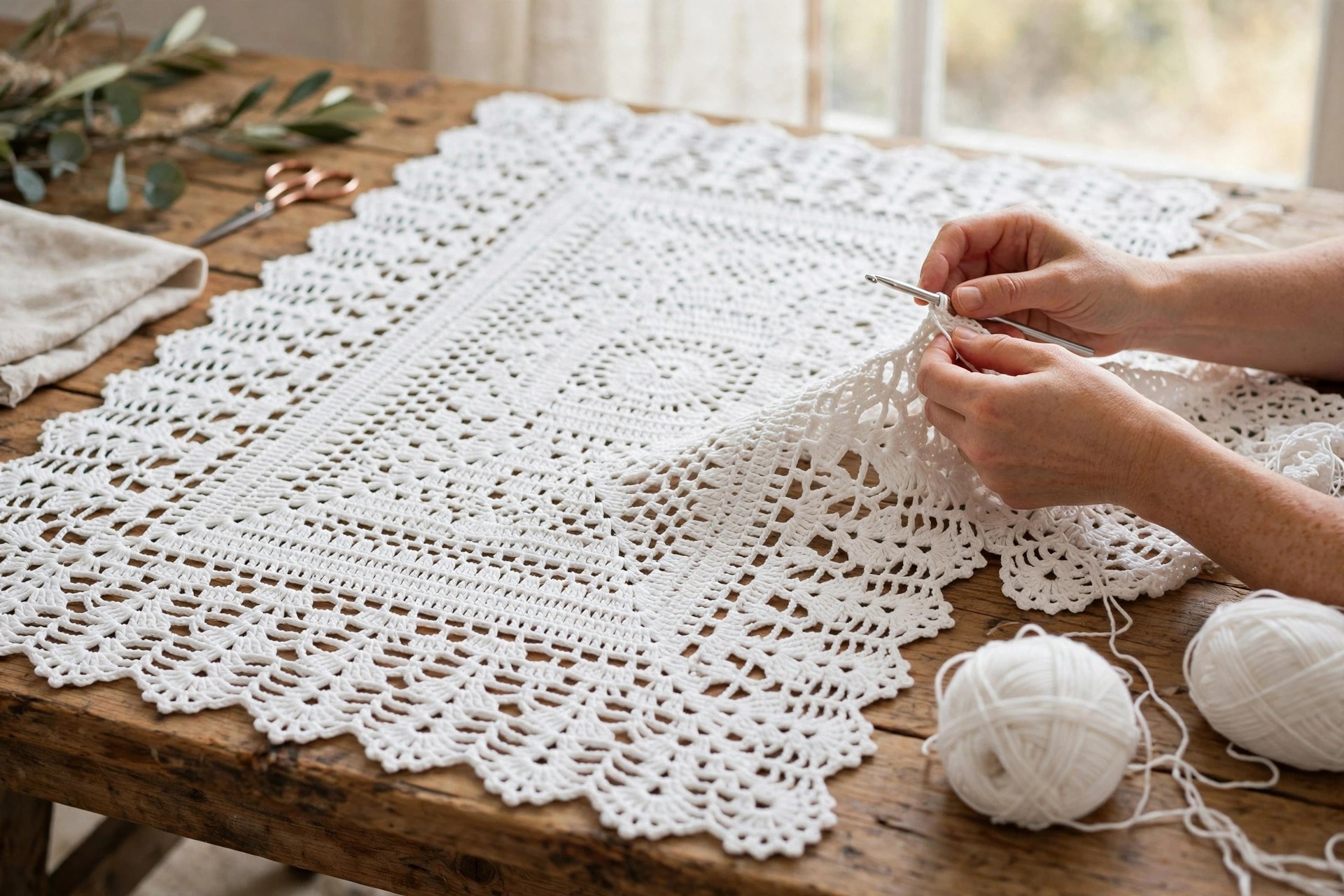
Keep the cloth flat as you work, and spread it out on a table every few rounds to check it. If the edge starts to ripple, skip an increase round and work a solid round instead. If the edge starts to cup, work an extra increase round. The cloth should lie flat on its own before blocking, with only a gentle wave at the edge.
Checking Your Size
After round 21, measure the cloth across the middle. It should be about 44 inches across. If it is smaller, work one more three round repeat before the border. If it is larger, go straight to the border. The border adds about 2 inches on each side, so a 44 inch cloth becomes a 48 inch cloth after the border.
Mark the start of the border round with a stitch marker, and count your stitches one more time before you begin. The border needs a stitch count that divides evenly by 6, and 120 divides by 6 exactly. If your count is off by a few stitches, work a few decreases in the first border round to bring it to a multiple of 6.
Part 3: The Scalloped Border
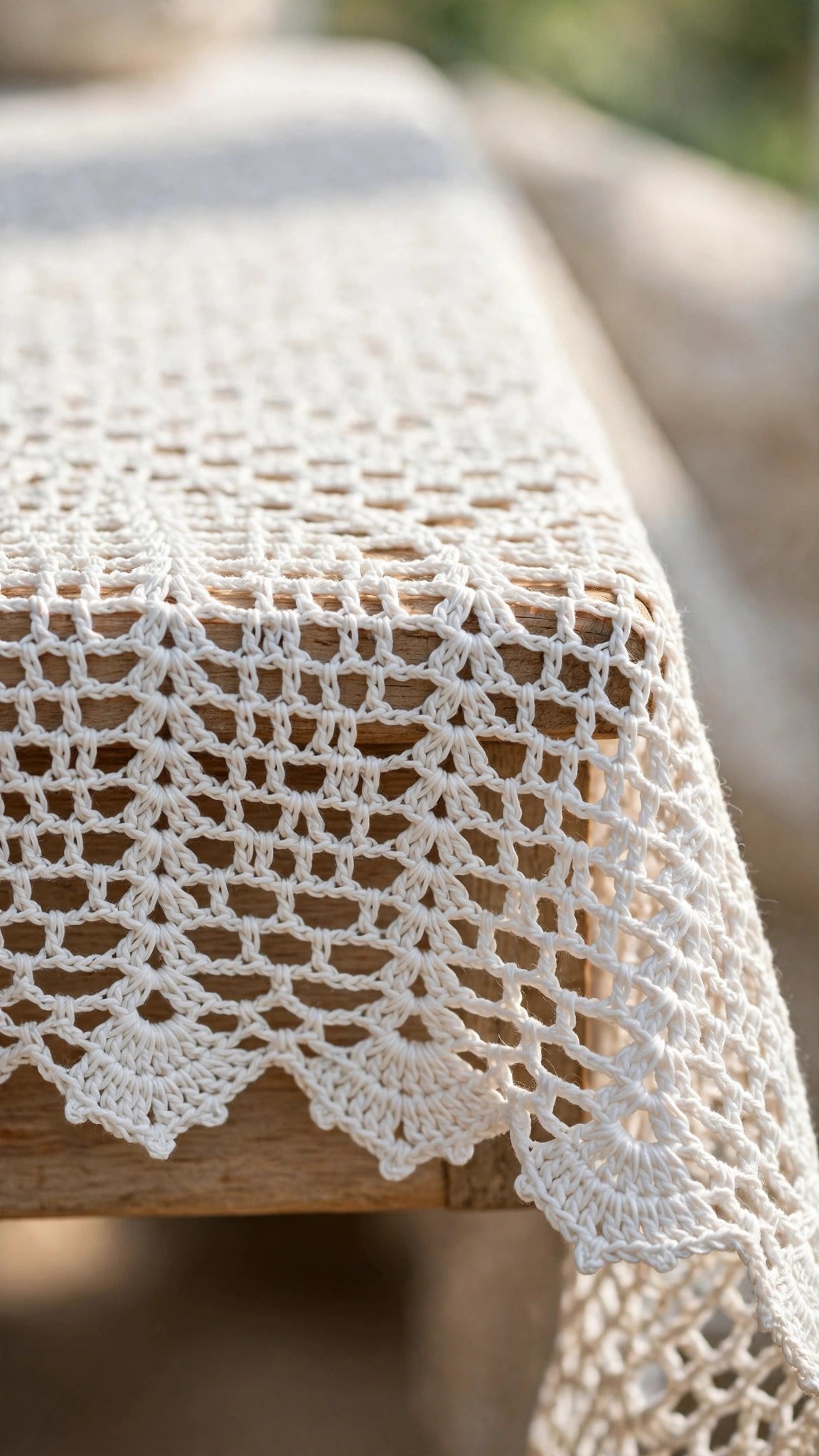
The border is the part that makes the tablecloth look finished. It is three rounds: a plain round that sets up the scallops, a scallop round that makes the waves, and a picot round that adds a tiny point to each scallop. Work all three rounds in the main color.
Rounds 22 to 24
- Round 22: ch 1, sc in each st around, join with a sl st. (120 sc) This round firms up the edge and gives the scallops a base to sit on.
- Round 23: ch 1, (sc in the next st, skip 2 sts, 5 dc in the next st, skip 2 sts) rep around, join with a sl st. This round makes 20 scallops around the edge.
- Round 24: ch 1, (sc in the next sc, ch 1, picot in the top of the middle dc of the next scallop, ch 1, sc in the next sc) rep around, join with a sl st, then fasten off and weave in the ends.
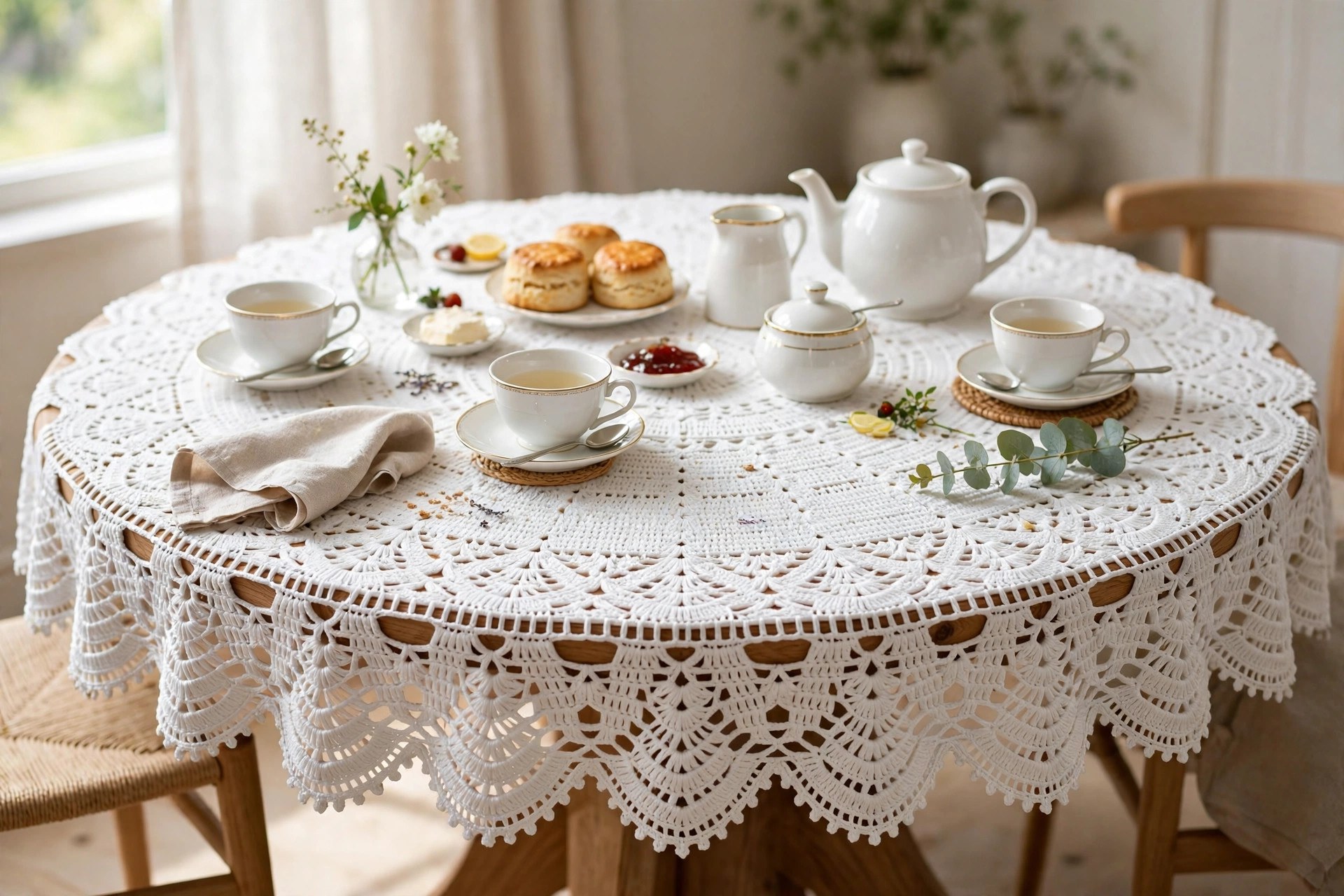
The border should hang in soft waves, about 2 inches deep. If the scallops pull tight, work 6 dc in each scallop instead of 5 on round 23. If the scallops flop open too far, work 4 dc in each scallop instead of 5. Try the cloth on the table before you block it, and check that the border hangs evenly all the way around.
Blocking the Tablecloth
Blocking is what turns a wavy pile of crochet into a flat lace tablecloth, so do not skip it. Soak the cloth in cool water with a little mild detergent for 20 minutes, then press the water out gently without wringing. Lay the cloth flat on blocking mats or a clean sheet, and pin the edge out to its full 48 inches, pinning each scallop point in place. Leave it to dry fully, which takes about a day. Our 21 free crochet home patterns collection has more home pieces that use the same blocking method if you want to practice on a smaller cloth first.
Variations: Colors, Sizes, and Uses
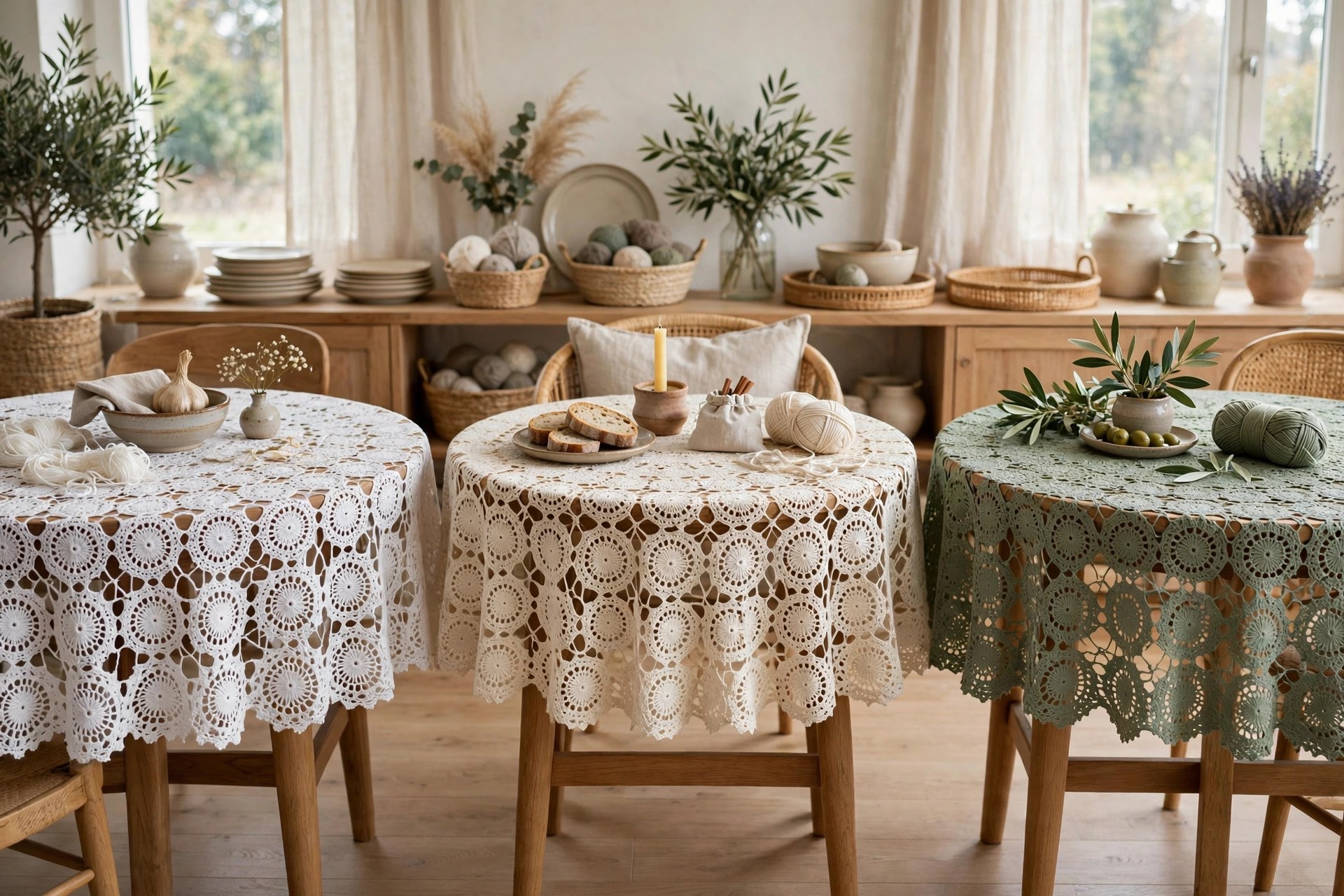
- Classic white tablecloth: work the cloth in white, just as written, for a cover that suits any table.
- Cream tablecloth: work the cloth in cream for a warmer look that suits a wooden table.
- Sage tablecloth: work the cloth in soft sage green for a calm, garden look.
- Small side table cloth: stop after the third repeat and work the border, for a cloth about 30 inches across.
- Large dining cloth: work one more repeat before the border, for a cloth about 54 inches across.
- Gift set: pair a tablecloth with matching flower coaster crochet pattern pieces in the same yarn for a handmade gift set that looks planned.
Troubleshooting a Tablecloth That Does Not Lie Flat
- My tablecloth ripples at the edge. There are too many stitches in the outer rounds. Skip an increase round and work a solid round instead, or take out the last repeat and work it with fewer increases.
- My tablecloth cups upward. There are too few stitches in the outer rounds. Work an extra increase round, or take out the last repeat and work it with more increases.
- My center will not lie flat. The increase rounds in the center have too few or too many stitches. Take out round 5 and rework it, adding or removing increases until the center lies flat.
- My scallops are uneven. The stitch count before the border was not a multiple of 6. Count your stitches before round 22, and work a few decreases to reach a multiple of 6.
- My tablecloth looks wavy after blocking. The pins were not placed evenly, or the cloth was moved before it dried. Rewet the cloth, pin it out again, and leave it until it is fully dry.
Care Instructions
Hand wash a crochet tablecloth in cool water with a mild detergent, and press the water out gently without wringing. Reshape the cloth and lay it flat to dry, pinning the scallops out if they need it. A cotton tablecloth can go in the washing machine on a gentle cycle, but hand washing keeps the lace crisp and the scallops neat. Iron the cloth on a low setting while it is still slightly damp, and store it folded in a drawer, away from direct sunlight.
Frequently Asked Questions
Is this crochet tablecloth pattern good for beginners?
Yes, it is best for an easy crocheter who knows double crochet and chain spaces. You need joined rounds and a slip stitch join, but the pattern is one three round repeat worked five times. There are no color changes and no seaming, so it is a great first lace project.
What yarn is best for a crochet tablecloth?
DK weight cotton yarn is the best choice, because it is strong, holds its shape, and shows the open lace pattern clearly. A mercerized cotton yarn works best, because it has a slight shine and it blocks beautifully. A soft acrylic yarn also works, and it is the best choice if you want a cloth that can go in the washing machine often.
How big is the finished tablecloth?
The finished tablecloth is about 48 inches across after blocking, to fit a round table up to 42 inches wide with a 3 inch drop on each side. To make a smaller cloth, stop after any increase round and work the border, which gives a cloth of about 30, 36, or 42 inches. To make a larger cloth, keep working the three round repeat until the cloth is the size you want.
Do I have to block the tablecloth?
Yes, blocking is needed for this pattern. The lace will not lie flat or show its pattern properly until it is blocked. Soak the cloth, press the water out, pin it out to its full size, and leave it until it is fully dry. A blocked tablecloth lies flat, shows the mesh clearly, and hangs in even scallops.
Can I make this tablecloth in a different shape?
This pattern makes a round tablecloth only, because it is worked in the round from the center out. A square or rectangular tablecloth needs a different construction, worked in rows or joined motifs. This post is only about the round cloth. If you want a small flat piece instead, see our crochet coaster pattern.
Can I sell tablecloths made from this pattern?
Yes, you may sell finished tablecloths made from this free pattern, with credit to Little Loop Finds. Do not sell or republish the pattern text itself. A tablecloth in white cotton makes a lovely item for a market stall or a housewarming gift.
Happy stitching, and may your little tablecloth dress up every meal you share at your table.